Hello. I’m Dr. Jo Wonjin, and I’ve been seeing patients for 10 years.

They say filler for nasolabial folds looks unnatural.
What other procedures are good?
Filler is probably the most commonly known treatment for nasolabial folds.
Because it immediately restores volume, satisfaction tends to be high in the beginning as well.
But in fact, the causes of nasolabial folds are quite varied.
In some cases, there is a hollow groove, but in others, they deepen because the cheeks sag or because skin elasticity decreases.
So today, under the topic of recommended treatments for nasolabial folds (Ulthera/Thermage/EMFACE/Juvelook Volume/Thread Lifting),
I’ll organize what each of these five treatments is based on and what condition it is suited for.
If you read for just 3 minutes, the direction that suits you will become much clearer.
Table of Contents
- Two reasons nasolabial folds form
Even for the same nasolabial fold, if the cause is different, the approach is completely different.
- Sagging
When the cheek fat has descended, as we age, the fat pad above the cheek slips downward, as shown in the photo below.
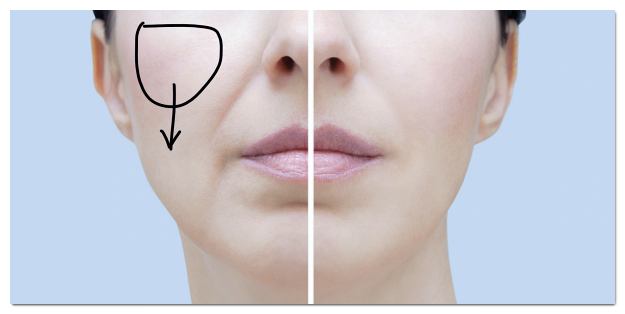
The tissue that used to be above piles up over the nasolabial line, making the groove look deeper.
In such cases, the key is a “lifting” treatment that raises or tightens the sagging tissue.
Ulthera, SERF, thread lifting, and EMFACE fall into this category.
- Hollowing
When volume itself has been lost, collagen and fat decrease.
This becomes a type where the area below the nasolabial line sinks in, as shown in the photo below.
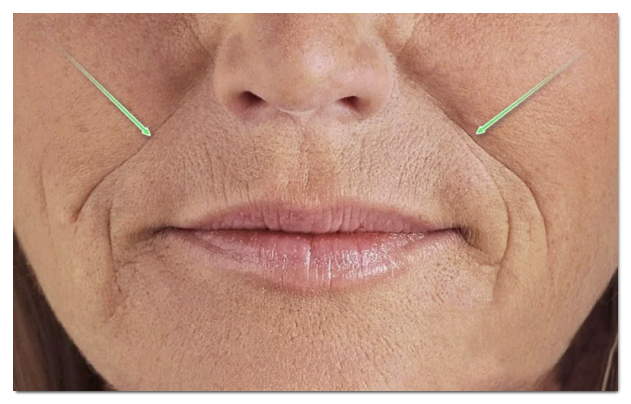
Because the groove itself has deepened, there are limits to how much it can be improved by pulling upward.
In this case, a treatment that naturally fills the hollow area is needed.
A collagen booster such as Juvelook Volume is a representative option.
In fact, most cases are mixed cases with both sagging and hollowing.
So in actual practice, lifting and volume restoration are often combined.
Recommended treatments for nasolabial folds
- Ulthera
If nasolabial folds come from sagging cheeks, the first thing to consider is ultrasound lifting.
Ulthera delivers ultrasound deep into the fascial layer of the skin, contracting the fascia and inducing collagen regeneration.
Shrinking is in the same category, but compared with Ulthera, its energy is lower, so it is less painful and the cost burden is also lower.
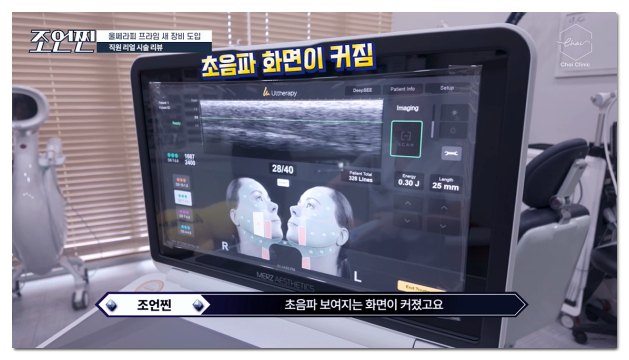 The Ulthera in the photo above can be performed while watching through an ultrasound screen to see whether the energy is entering the deeper skin layer well.
However, Shrinking may have a shorter duration of effect.
It is a good option when sagging is not severe and as a first lifting attempt.
One thing to be careful about: if a person has little facial fat, Ulthera can actually make the cheeks look sunken.
Please be sure to read the article below.
Recommended treatments for nasolabial folds
- Thermage
Some people have thin, weak skin that folds and creases like paper.
For these people, radiofrequency treatment that restores the dense elasticity of the dermis tends to be a better fit than ultrasound lifting.
Thermage and SERF deliver thermal energy to the dermis to induce new collagen production.
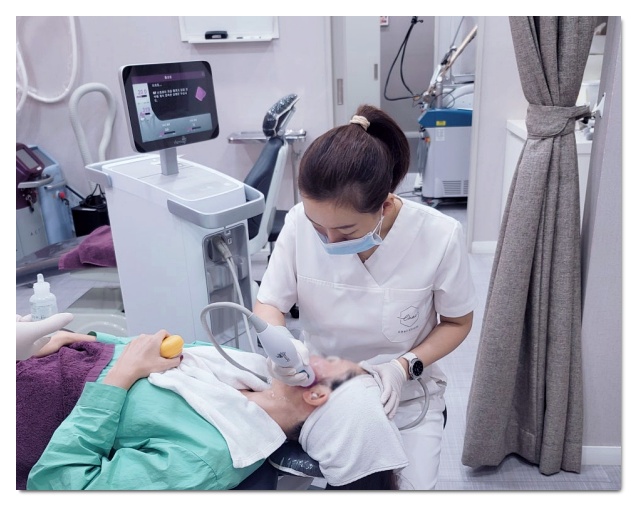 The photo above shows Thermage being performed.
As collagen regenerates, fine lines and the nasolabial fold line naturally become less noticeable.
Corege does not deliver heat; instead, it uses waves to stimulate the cells and encourage regeneration.
Because there is no treatment pain, many people receive it comfortably, almost like a care session.
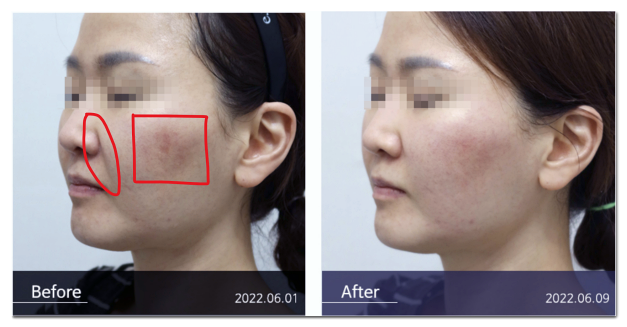 The photo above shows before and after Corege treatment. If you look at the left side, you can see that the deep nasolabial fold has become less prominent, right?
Recommended treatments for nasolabial folds
- EMFACE
If the previous treatments act on the skin or fat layer, EMFACE takes a somewhat different approach.
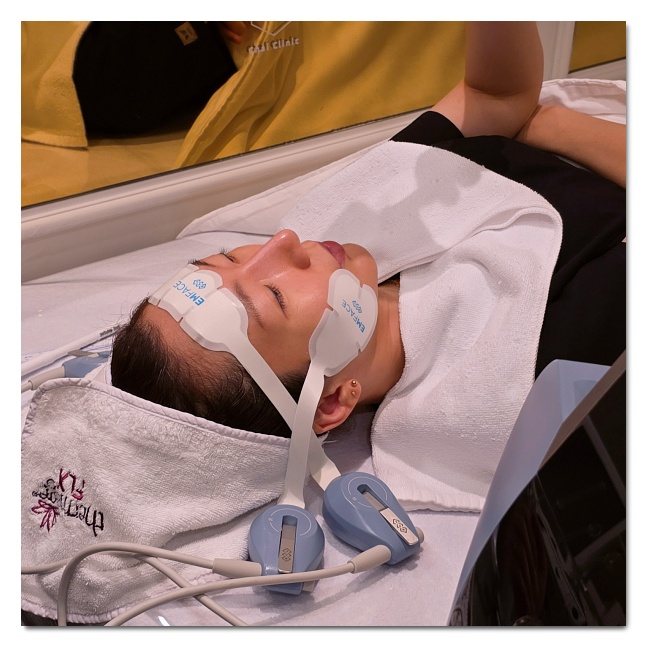
It strengthens the muscles around the cheekbone area with electrical stimulation.
As we age, these muscles lose strength, and the cheek tissue sags downward, making the nasolabial folds deeper.
When EMFACE tightens these muscles again,
it creates the effect of lifting the cheek tissue attached above them upward.
The white pad in the photo below delivers the electrical stimulation.
Recommended treatments for nasolabial folds
- Juvelook Volume
If sagging tissue is not the cause,
but the bone or fat beside the nose has sunk in deeply and volume restoration is absolutely necessary,
and you absolutely dislike the foreign-body sensation typical of fillers, Juvelook Volume is a good option.

Instead of directly filling the area with an artificial substance like a filler,
Juvelook is injected into the skin to encourage your body to produce collagen on its own.
As time passes, your own tissue gradually fills in,
so it feels much more natural when making expressions and has the big advantage of not feeling foreign.
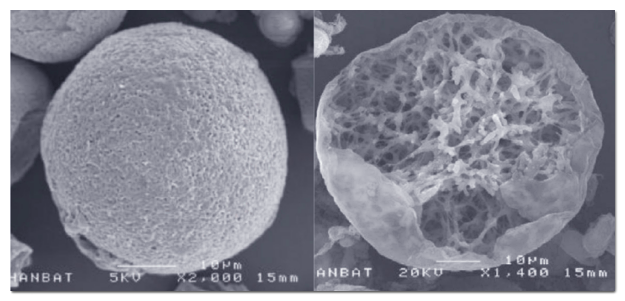 The photo above shows Juvelook particles. Since it is a powder type that is hydrated with water before use, the hydration technique and timing are important.
However, precise hydration and layer-by-layer injection techniques are very important to prevent clumping (nodules).
That is why Juvelook Volume should not be done immediately after a same-day consultation.
I explained this in more detail in the article below.
- Thread lifting
When the sagging of the skin and fat is severe enough that laser devices alone are not satisfying,
more direct methods are needed.
Medical dissolvable threads are inserted into the skin,
and the sagging front cheekbone area and cheek tissue are physically pulled upward and firmly fixed in place.
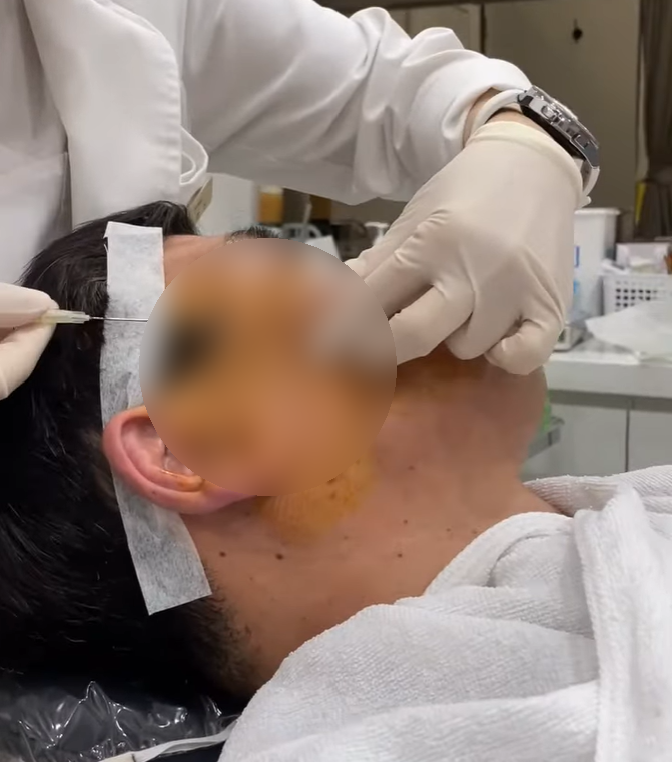
Immediately after the procedure, the sagging tissue lifts in a more dramatic way,
and as the threads dissolve, an added effect of improving the surrounding elasticity also appears.
- Summary of successful treatment
Let me briefly summarize what I mentioned today.
When the tissue is sagging
When volume is hollowed out

As I mentioned today, treatment options for nasolabial folds are quite broad beyond filler.
The important thing is to first figure out whether your nasolabial fold comes from “hollowing” or “sagging.”
If you have been worrying about nasolabial folds, I hope this post helps you set your direction, even if only a little.
Thank you. This was Jo Wonjin.
[What are the characteristics of a hospital that gives a proper diagnosis?]