Hello. I’m Dr. Jo Won-jin, and I’ve been treating skin conditions for 10 years.

I’ve had more than five laser treatments, but the scars are still the same.
JuveLook doesn’t seem to work very well either. Why is that?
To get straight to the point, it’s not that the laser or JuveLook is wrong.
It’s more likely because the prior step called subcision wasn’t done properly.
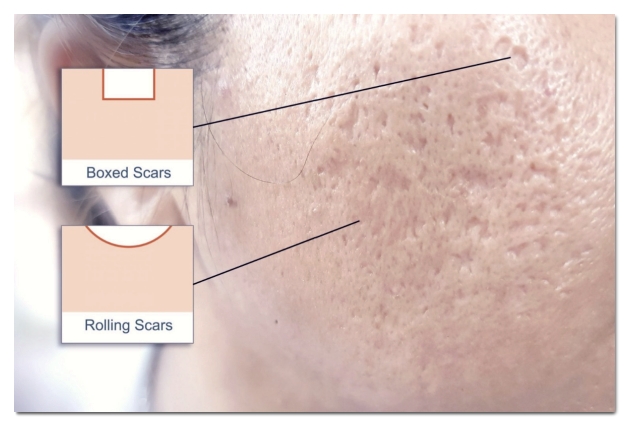
The photo above shows a skin surface that has sunken in due to acne. The shapes are different too.
Pitted scars are a state where the inner structure of the skin has become adhered.
If this structure is not loosened first, no matter how much laser is applied from above, the change will be limited.
Today, under the topic of why laser treatment alone doesn’t work for pitted acne scars and how to fix it, I’ll cover the following.
-
Why scars are not sufficiently improved by laser alone
-
What subcision is
-
How to get subcision properly
-
Frequently asked questions (Q&A)
- Why can’t pitted acne scars be treated with laser alone?
If you look under the skin at the pitted scar area, as shown in the photo below,
strong tissue called fibrous septa is pulling the skin downward tightly.
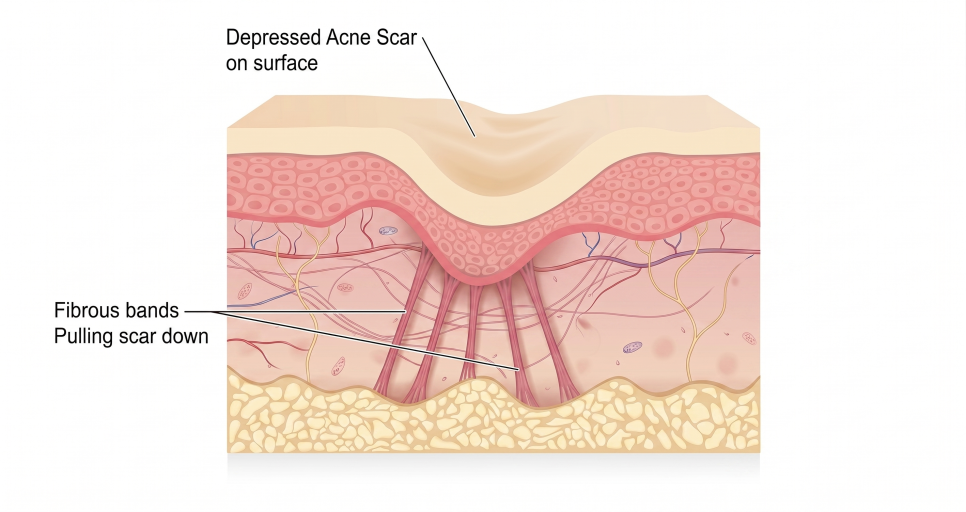
The tissue pulling on the skin surface in the photo above is fibrous septa. It forms in acne scar areas and pulls the skin inward, creating a depression.
So no matter how much you try to smooth the surface from above, it keeps getting pulled from below, and the surface remains sunken.
The same applies to laser treatment.
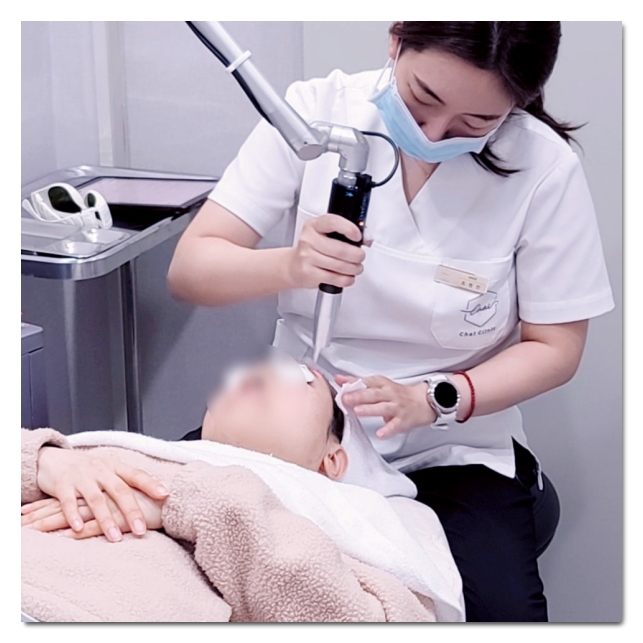
It is true that heat is applied to the skin surface to stimulate collagen regeneration,
but if the fibrous septa are still holding things down inside, there is no space for the skin to rise.
That’s why even after several laser sessions,
people often end up with an ambiguous result of
"It seems a little better, or maybe not."
- What happens when subcision is left out of pitted acne scar treatment
The key point in treatment is whether the process called subcision is properly included.
Subcision is a procedure that cuts the fibrous septa beneath the skin.
It is like cutting the cords that are pulling the depressed area downward.
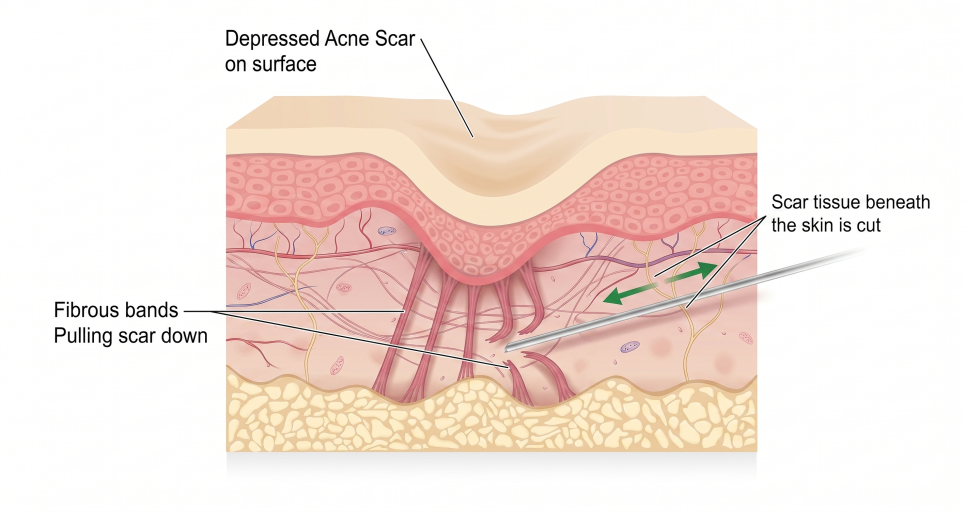
As shown in the photo above, the tissue pulling on the skin is physically cut. This is usually done one by one by hand.
What happens if you receive laser treatment first without this process?
Because the fibrous septa continue to pull from below, the newly formed collagen is eventually pressed down as well.
This is why it may look slightly fuller right after the procedure, but then return to the original state over time.
You may think, "Then shouldn’t we just use a stronger laser?"
But increasing the intensity can raise the risk of burns and may also cause pigmentation.
- The solution for pitted acne scars: how should subcision be done?
You may understand that subcision is important, but there are actually points to watch out for with this procedure as well.
In general, subcision is performed by a doctor using a needle or cannula to directly cut the adhesions beneath the skin.
However, if it is done too broadly beyond what is necessary, even normal skin tissue can be damaged.
Also, because it is a procedure performed by hand,
there is a limitation in that the result can vary slightly depending on the provider’s condition and sensation.
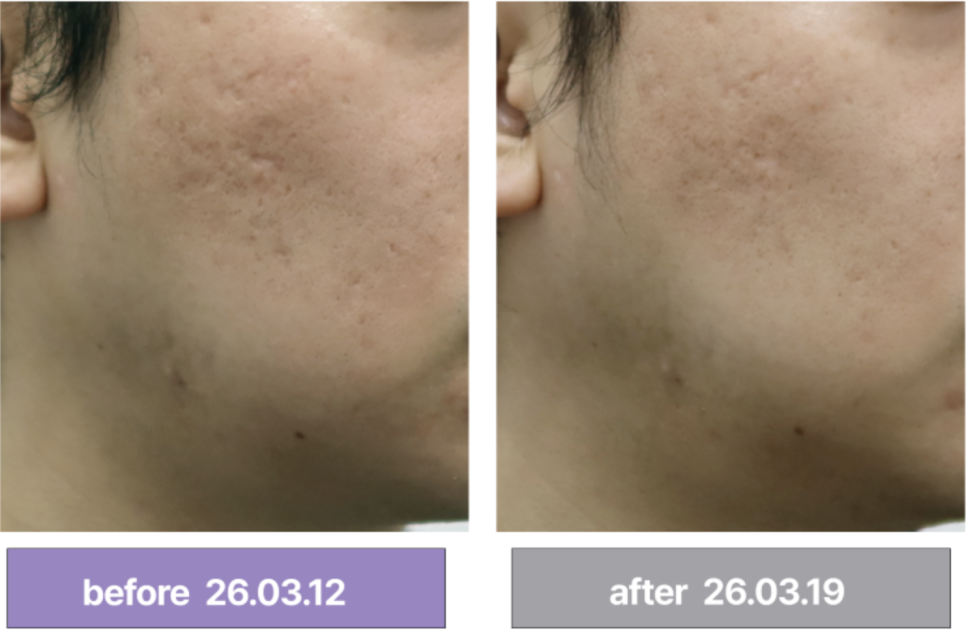
The photo above shows the result of one acne scar treatment session with (Tripil Pro), and you can see that the pitted scars have risen a lot.
So, to address this, we introduced a device called Tripil Pro.
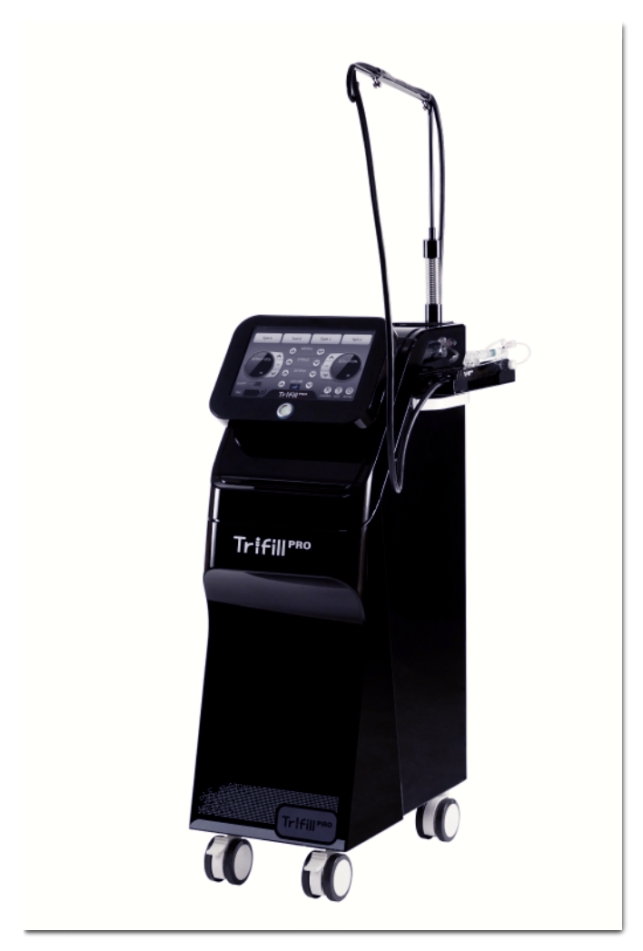
The device in the photo above is Tripil Pro.
Tripil Pro uses air instead of a needle to release the fibrous adhesions in the affected area,
and at the same time injects skin boosters such as JuveLook.
Because it reduces unnecessary damage while delivering the medication precisely where it is needed,
the synergy improves when combined with regenerative medications like JuveLook.
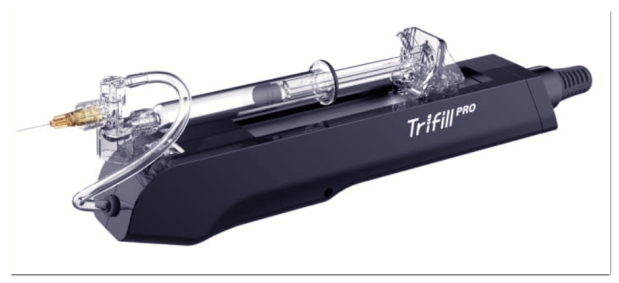
Tripil Pro is designed so that medication can be injected together like this.
So when receiving treatment,
rather than simply comparing laser types, it is better to check whether subcision is included,
and how precisely that subcision can be performed in that environment.
Scar treatment is an area where hospitals can differ quite a lot in their approach.
It may also help to refer to the article below when choosing a clinic.
- Frequently Asked Questions (Q&A)
Q. Is subcision very painful?
A. It does involve pain because it cuts through the adhered tissue inside the skin,
but if Tripil Pro is used to prevent unnecessary damage or dissection in surrounding areas, the pain can be reduced.
There are individual differences, so if you tell them about your pain sensitivity during the pre-procedure consultation, the anesthesia method can also be adjusted.
Q. How many sessions are needed?
A. It depends on the depth and extent of the scars, but usually treatment is done with 2 to 3 subcision sessions plus laser.
Rather than doing too much at once, it tends to produce better results when enough time is given for recovery.
Q. Does it still work for old scars?
A. The older the scar, the more likely the fibrous septa have hardened.
That makes the role of subcision even more important. Age does not mean there is no possibility,
so the first step is to get an accurate diagnosis of your current condition.
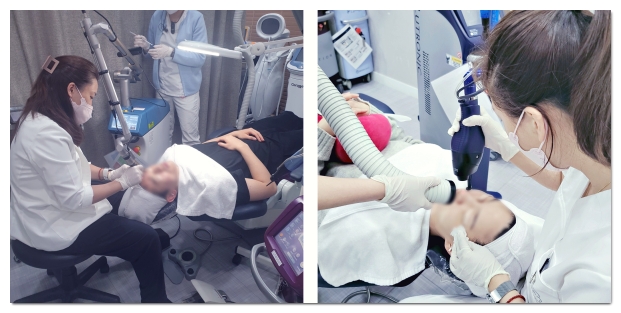
Summary of key points in treating pitted acne scars
-
Pitted scars are a structural problem where fibrous septa pull the skin downward
-
Repeating laser alone without subcision has limited effect
-
The precision of subcision determines the outcome, so check how it is performed

If you have gone from one procedure to another and been emotionally worn out by it,
there may have been a missing step, rather than a problem with the procedure itself.
The order of first releasing the structure and then promoting regeneration on top of it,
is something that can make future choices much easier if you remember just this.
Thank you. This was Jo Won-jin.