Hello. I’m Dr. Jo Wonjin, and I’ve been practicing dermatology in Hongdae for 10 years.

My skin has sagged like a bulldog ㅜㅜ
I got a lifting procedure, so why isn’t it working?
When consulting about buccal fat lifting, many people have already had one or two procedures,
but they say, “I wasn’t told exactly how it was done or what type I am.”
If you read this post all the way through today,
at the very least,
you should get a sense of “what type my buccal fat is and which procedure I should choose.”
Table of Contents
- The real reason buccal fat develops
- 3-step self-check to identify my buccal fat type
- Principles and roles of each buccal fat lifting procedure (how to choose)
- Which procedure to use and when
- What you must know if you are worried about hollow cheeks
- Frequently Asked Questions (FAQ)
- The Real Reason Buccal Fat Develops
Buccal fat is not simply a problem of “sagging skin.”
The face has deep-layer fat that supports the inner cheeks,
and above that, facial ligaments and supporting structures inside the skin hold everything in place together.
As we age, these three things collapse at the same time.
First, the volume under the cheekbones becomes thinner,
second, the flesh near the corners of the mouth slides downward,
and third, the ligaments that should hold everything up become loose.
As a result, fat gathers beside the corners of the mouth and creates jowls.
In other words, buccal fat is not the result of just “fat” or just “sagging,” but of combined aging.
That is why it can be difficult to solve with just one procedure.
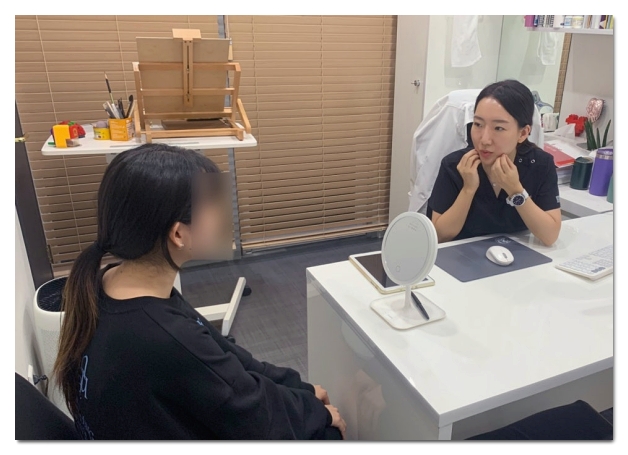
- My Buccal Fat Type: 3-Step Self-Check
Before a consultation, I recommend checking the following three things in front of a mirror.
Check 1. When you sweep your cheek upward with your hand
If the jowls almost disappear and the line around the mouth becomes smooth, it is closer to the “sagging type.”
This means the main cause is that the support structure has dropped.
But if the front cheek volume is reduced and the skin is thin, filling in volume may be needed instead.
If the tissue is firm but sagging, tightening the internal fascia may be necessary.
Check 2. When you open your mouth and say “ah”
If the jowls still stand out and look even more bunched up, there is a high chance it is the “fat type.”
This means there is a lot of fat inside the cheek, and it has come down with a heavy feeling.
In this case, reducing the fat helps ease the descended buccal fat.
Check 3. The line below the corners of the mouth when you smile
If the marionette line becomes deeper, it is often the “combined type,” where ligament and skin adhesion are also involved.
In such cases, one type of procedure may not be enough.
The priority changes depending on which factor is stronger, and even the same jowls require different approaches in your 30s and 50s.
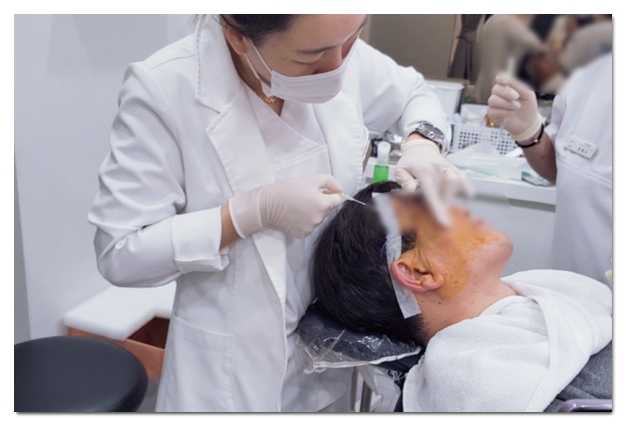
- Principles and Roles of Each Buccal Fat Lifting Procedure (How to Choose)
Here I will summarize the working layers and targets of four representative procedures.
- Contouring injection
This is an injection procedure that directly injects medication into the fat layer inside the cheek to break down and eliminate fat cells.
If you only lift sagging without reducing fat, it may rise a little at first, but because it is heavy, it quickly comes back down.
It is strong at reducing the volume of “fat-type buccal fat,” where the fat amount is large.
But even with this, whether it only temporarily reduces volume for a short time,
or reduces the actual number of fat cells,
depends on the procedure.
You can check the details below.
- Ultherapy
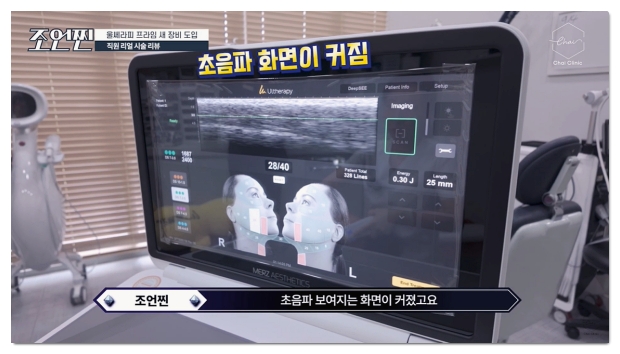
It applies point-by-point heat to the SMAS layer, the fascia layer covering the facial muscles, so that the fascia contracts.
It is useful for the “sagging type,” where there is volume but the problem is sagging.
Even with Ultherapy, simply focusing the treatment on the sagging area does not necessarily improve sagging.
If you read the article below, you can see why.
- Shurink
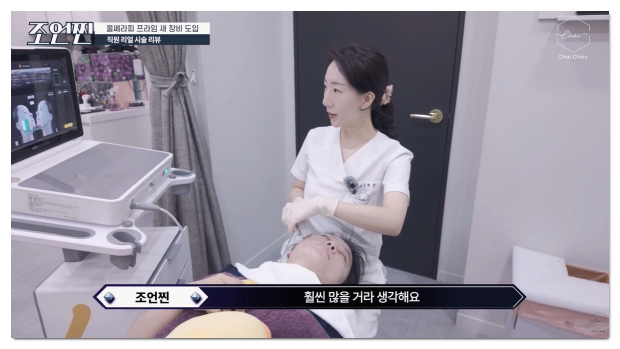
This is an ultrasound-based treatment like Ultherapy, but the energy output is somewhat weaker than Ultherapy.
It also targets the deep fascia layer inside the skin.
It is often used for early sagging in the 20s and 30s or for maintenance.
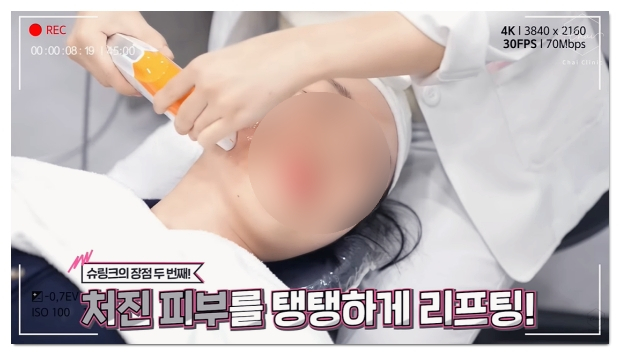 The photo above shows Shurink lifting in progress.
- Thread lifting
It physically creates support lines inside the skin with dissolvable threads and lifts the tissue.
It is effective for deep sagging that needs immediate repositioning, or when the jawline has significantly collapsed.
But if thread lifting is not done conservatively,
side effects such as threads protruding toward the skin surface or visible dimples can occur.
The method to prevent these side effects is written in the article below.
- Which Procedure to Use and When
In consultations, I judge in this order.
(1) Look at the amount of fat first
If you lift only the sagging without reducing fat,
it may rise a little at first, but because it is heavy, it quickly comes back down.
So I consider contouring injections that reduce the weight of the fat itself.
(2) Look at fascia sagging
If the entire SMAS layer has dropped and the nasolabial folds and jawline have also collapsed, I combine Ultherapy.
(3) Is it already deeply sagging?
If the depth is too much to be handled by fat reduction and fascia tightening alone, thread lifting is used to provide physical support.
(4) Is the skin condition itself weak?
For people with thin skin and reduced elasticity, lifting alone may have limited effect,
so it is better to combine collagen-regeneration procedures.
Even for the same buccal fat issue, in some people in their 30s, contouring injection alone may be enough,
while in many people in their 50s, a step-by-step combination of contouring injection + Ultherapy + threads is needed for a natural result.
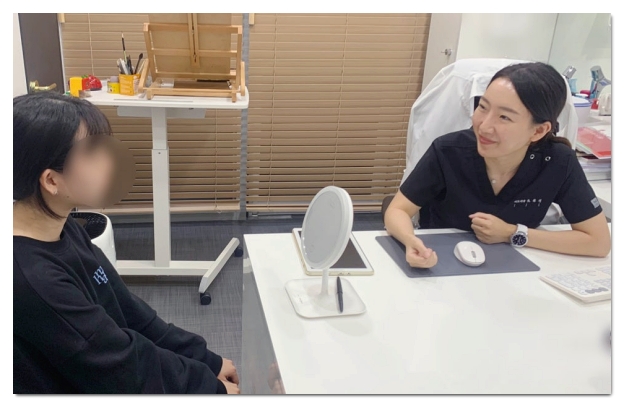
- What You Must Know If You Are Worried About Hollow Cheeks
You may ask, “Buccal fat treatment reduces fat, so why do we need to worry about hollowness?”
In the end, buccal fat procedures work by “reducing fat or pulling tissue.”
If this is excessive, the fat in the front of the cheek can also be reduced, making the face look older instead.
If you already have a thin face with sunken cheeks and only the buccal area is prominent,
buccal fat lifting is not recommended, or the plan should be set differently.
Support structure reinforcement should come first rather than lifting,
and for laser devices, radiofrequency types such as Thermage or Serf may be more suitable than ultrasound, which delivers heat deeper.
- Frequently Asked Questions (FAQ)
Q1. How long does each procedure last?
- Ultherapy: Retreatment is usually recommended every 6–12 months
- Thread lifting: Depending on the threads used (PDO, PLLA, etc.), results last 6 months to 2 years
- Contouring injection: Lasts if body weight is maintained. However, the effect decreases if weight increases
Q2. When is the best time for a retouch (reinforcement)?
The time when collagen regeneration effects are strongest is 2–3 months after the procedure.
At that time, checking the progress and planning any necessary reinforcement procedures is the most reasonable approach.
Q3. Are there bad habits that shorten the maintenance period?
No matter how good the procedure is, if the following three factors overlap, the effect fades quickly.
- Sudden weight fluctuations
- Excessive sun exposure
- The habit of clenching your teeth tightly
In closing
Buccal fat is not a problem that can be solved by simply “pulling it up,” but a form of combined aging in which fat, support structures, and skin all collapse together.
That is why the starting point should not be choosing one device,
but first determining which type your face is closest to.

For buccal fat lifting, if it is the fat type, start with fat reduction; if it is the sagging type, start with the fascia;
and if it is a combined type, designing the order can help reduce regrets such as hollow cheeks.
Please receive treatment safely at a place that carefully diagnoses your face and creates a plan for you.
Thank you. This has been Jo Wonjin.