Hello, I’m Lee Seong-joon, Chief Director of the Seoul branch of Liting Plastic Surgery.
“Director, I want to get a thread lift, but I’m scared because I’ve heard there can be side effects.”
This is a concern that patients who visit our clinic have been expressing frequently lately.
It is true that even with procedures known for high safety, we cannot overlook the possibility of unforeseen side effects.
Even so, thread lifting is known as a procedure recommended for people who are sensitive to bruising or swelling.
Today, I’ll explain what the representative side effect, thread lift dimpling, is and whether there are any ways to prevent it.

Difference Between a Traditional Lift Surgery and Thread Lift
First, I think it’s necessary to explain the concepts and differences between traditional lift surgery and thread lifting.
The lifting surgery that many people are familiar with is a surgical method that involves making an incision in the skin, pulling it tight, and fixing it in place.
In contrast, thread lifting is a simple non-incisional procedure that can provide an immediate lifting effect.
It is easy to understand as a concept in which medical threads that dissolve inside the body are inserted into the skin to pull up sagging areas.
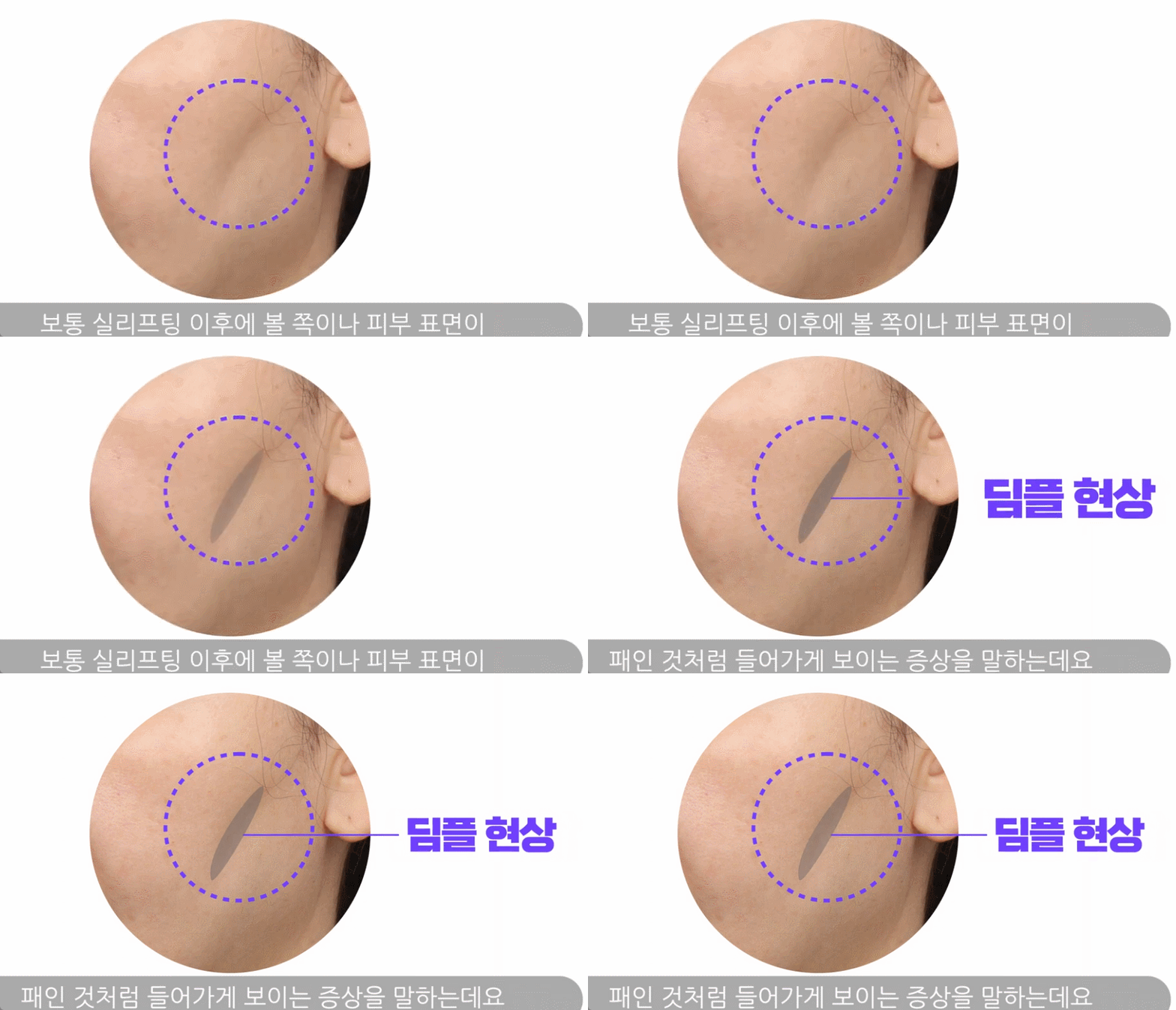
Representative Side Effect: Dimpling
Compared with traditional lifting surgery, thread lifting takes less time and allows a quicker return to daily life.
However, many people worry about the side effect of thread lift dimpling.
“Dimpling” refers to skin indentations or an uneven, puckered appearance.
This may improve over time, but in some cases it can become a source of stress.
Causes of Dimpling
The main reason this symptom appears is when an excessively strong lifting effect is pursued or when the thread is inserted too close to the skin’s surface.
It is especially more likely to occur in people with thin skin.
To prevent this side effect, proper consultation and thread selection are important.
Through consultation, the key is to accurately assess skin thickness and the degree of sagging and to use the appropriate number and type of threads.
This can help minimize thread lift dimpling.
To reduce thread lift dimpling, a loop-shaped technique that securely fixes the thread to the fascial layer of the scalp is effective.
The common method for thread lifting is to make a small opening near the temple and insert the thread.
However, our clinic uses a dual method in which threads are inserted into both the dermal layer and the fascial layer, then tied and fixed at the midpoint, resulting in much stronger fixation and lifting the loosened retaining ligaments as well, allowing for a more powerful lifting effect.
Thread lifting is one of the simple yet effective procedures, but it requires extensive experience and skilled technique from the medical staff.
For a safe and effective thread lift, accurate diagnosis and a treatment plan are more important than anything else.
Based on our long experience with thread lifting, our clinic provides safe and effective procedures.
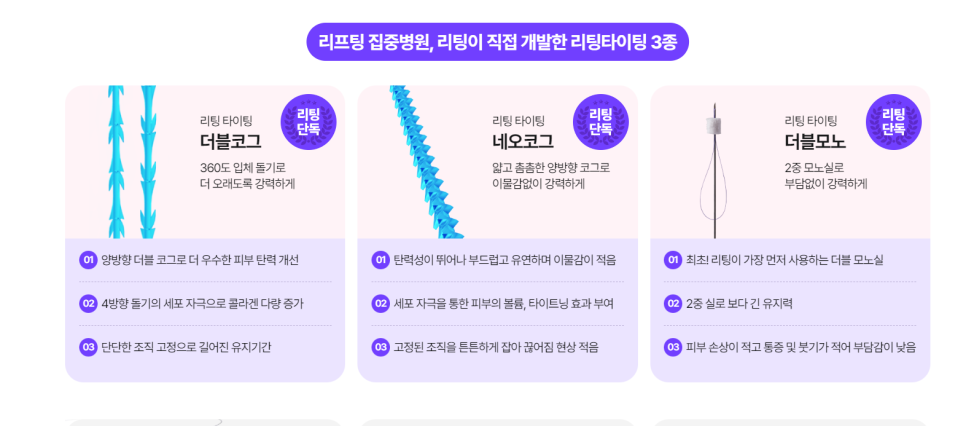
In particular, for thread lifting, we use our own developed threads and carefully analyze each person’s facial structure and skin condition to finely adjust the treatment points and the amount of thread inserted so that the most natural results can be achieved.
For those who are concerned about sagging facial skin, drooping cheeks, and wrinkles as they age, our thread lifting may be the most effective and satisfying solution.
If you want to regain a natural youthful face and a clear, firm facial line, please experience the beauty that best suits your face with Liting Plastic Surgery.