Hello, I’m Lee Seong-jun, the chief director of the Seoul branch of Reting Plastic Surgery.
Time passes equally for everyone.
And no one can stop it.
And time, which keeps flowing without stopping, leaves traces on the skin as well.
As the years go by, fine wrinkles appear across previously firm skin, and thicker, deeper-set wrinkles can also develop.
As the forehead, eyelids, and cheeks sag, the overall impression can change as well.
Although these changes are a natural process everyone experiences, the sense of loss they bring can be significant.
Fortunately, today there are a variety of medical procedures and surgeries that can help address these concerns.
When people think of lifting, they often first think of injections or laser procedures, but if sagging has already become severe, it may be difficult to achieve major changes with procedures alone.
Among those who visit our Seocho Plastic Surgery clinic, if this applies to them, we recommend a facelift.
Today, we would like to look at the key factors that determine the results of a facelift.

What Is a Facelift?
A facelift refers to physically lifting sagging facial skin.
When the skin has already become significantly loose, an incision is made along the line from the temple to in front of the ear, the earlobe, and behind the ear, and the skin is pulled upward in all directions.
At this point, some of the excess sagging skin is removed and sutured, so it is a surgery that can deliver a clearly visible lifting effect immediately after the procedure.
However, because it involves incising and suturing the skin, it may also cause physical and psychological 부담.
If you choose the Seocho Plastic Surgery medical team, which has extensive clinical data, delicate surgical skill, and aesthetic sense, you can reduce that burden and worry and expect stable results.

The Key to Facelifts: Retaining Ligaments and the SMAS Layer
I said that a facelift is a lifting surgery that pulls up and fixes sagging skin, but it does not simply pull the surface of the skin.
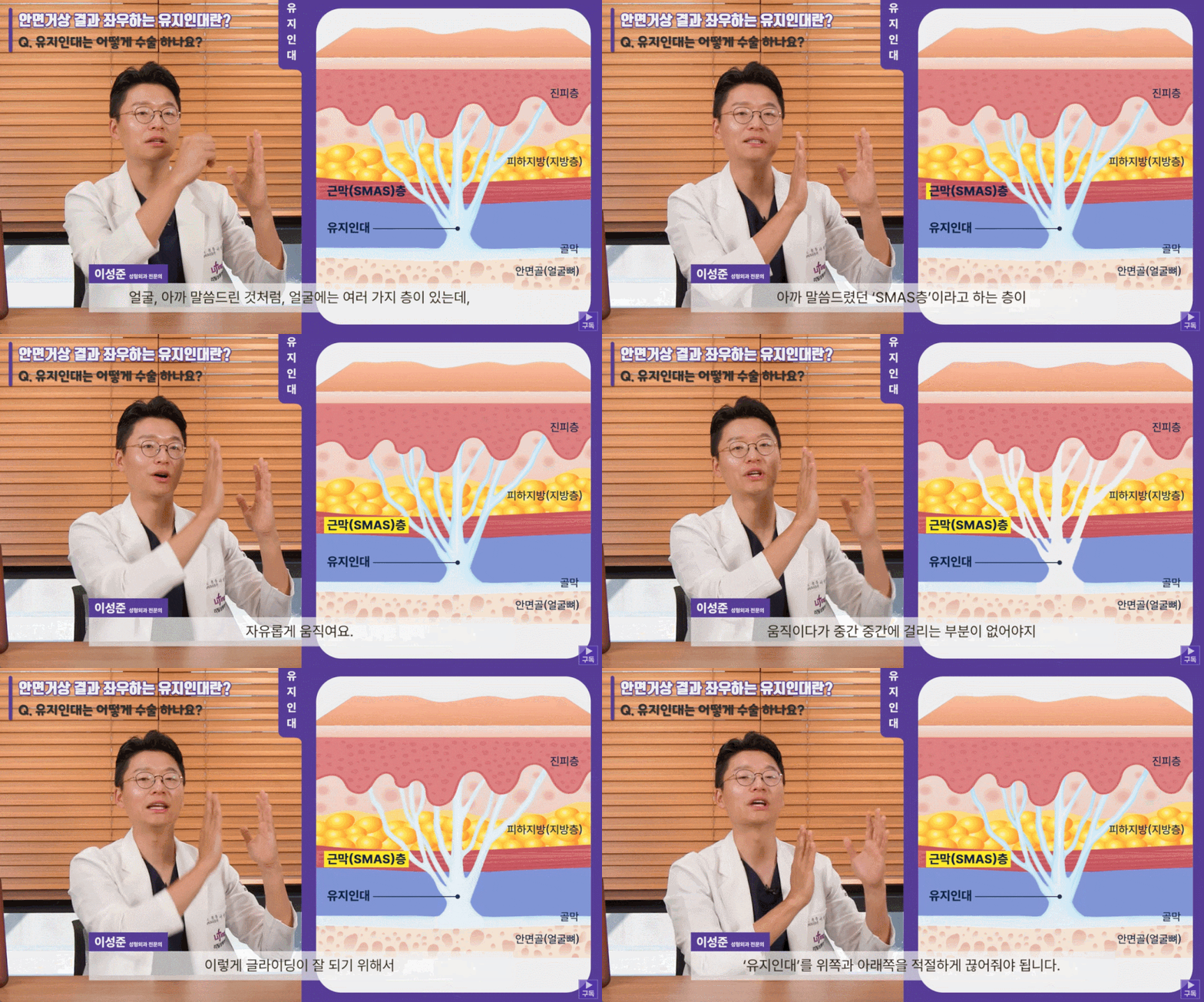
Our skin is made up not only of the dermis and epidermis, but also of the fascial layer called the SMAS layer, the subcutaneous fat layer, and the muscle layer.
Skin sagging also appears throughout these skin layers.
In other words, for stable results, it is important to firmly lift from the deeper layers.
And here, the retaining ligaments and the SMAS layer are the parts that must be considered important.
This is because the results of a facelift depend on how high the medical team at Seocho Plastic Surgery is in their anatomical understanding of these structures and how precisely they can handle them.
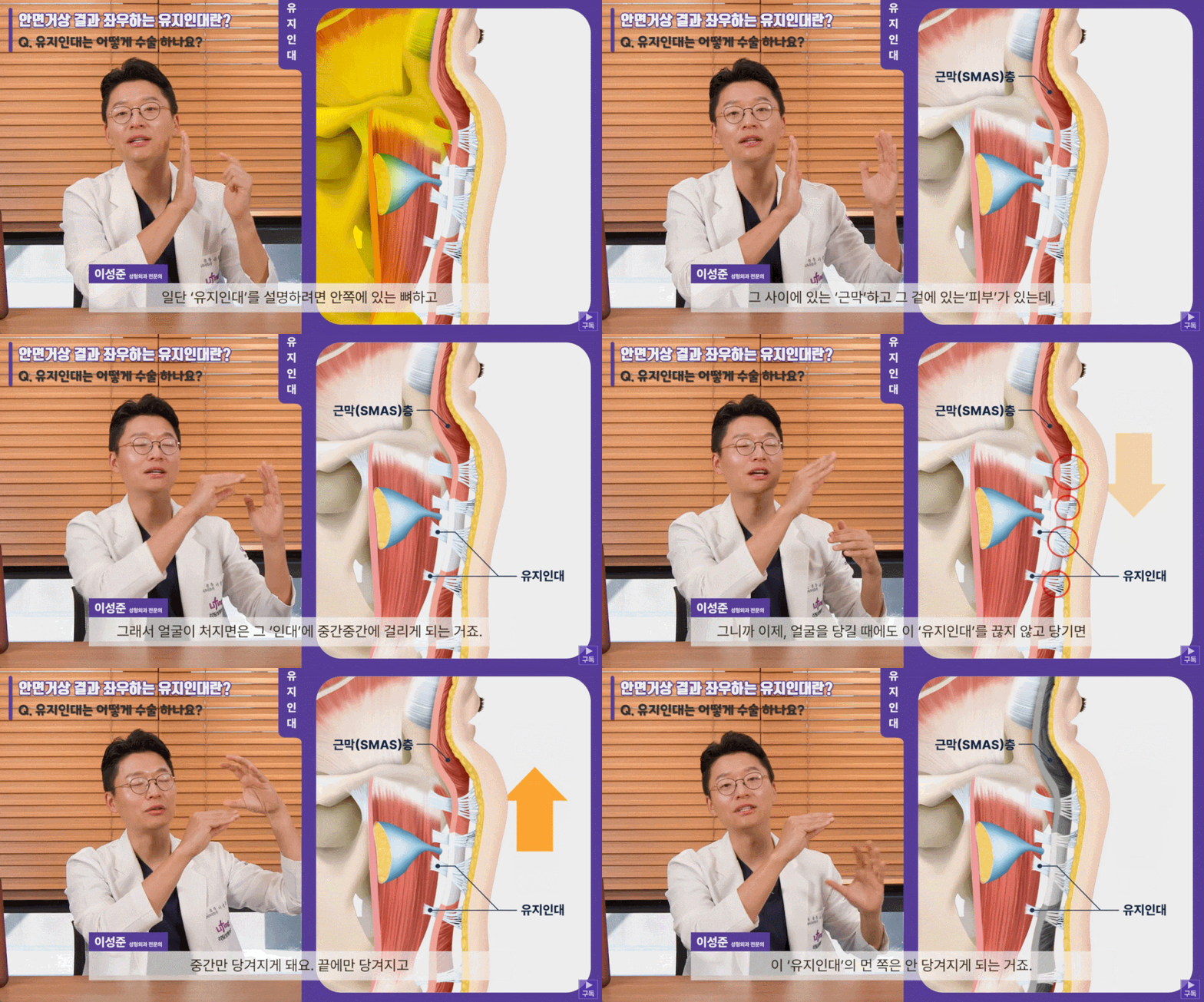
The Role and Function of Retaining Ligaments
First, let’s look at what retaining ligaments are.
Retaining ligaments are tissue that runs through the entire skin.
They are structures that begin at the periosteum and connect to the fascial layer, subcutaneous fat layer, and dermis, serving to firmly support the skin.
Because of these retaining ligaments, our skin does not suddenly become loose or sag overnight, but changes gradually.
Of course, as time passes, the skin will sag in various areas even with retaining ligaments, but in areas where retaining ligaments exist, there is a feeling of resistance even when sagging occurs.
In this way, retaining ligaments are an important factor that slows skin aging, but when considering a facelift, they can actually become an obstacle.
The skin needs to be efficiently pulled upward, but the retaining ligaments hold it in place, making it difficult to lift the deeper layers of the skin.
Why Precise Planning Matters
To improve the longevity of a facelift and create a natural result, it is important to dissect and lift all the way to the SMAS layer.
However, even if the SMAS layer is dissected so it can move, free movement is difficult if the retaining ligaments in various areas are still holding the fascial layer in place.
That is why it is important to appropriately release the retaining ligaments according to the area being lifted.
Of course, not all retaining ligaments need to be released during a facelift.
In fact, if all retaining ligaments are released, there may no longer be any tissue to support the skin, and the skin can end up looking as though it is fluttering in the wind.
Therefore, it is important to find a clinic with advanced anatomical understanding of the retaining ligaments and fascial layer, and with the surgical skill to precisely release and dissect only the necessary areas.
A Clinic That Focuses Only on Lifting
Our Seocho Plastic Surgery clinic focuses exclusively on lifting procedures and has particularly strong expertise in facelifts.
There are many medical institutions that perform facelifts, but even the same facelift can produce very different results depending on the direction and strength of the pull, the amount of skin removed, and the degree to which the retaining ligaments are released.
At our clinic, we carefully consider each person’s skin thickness, the degree of sagging and the pattern of wrinkles, as well as the shape and proportions of their facial features, and provide comprehensive guidance on facelifts along with various lifting procedures that can create synergy.
Rather than being merely technicians who perform cosmetic procedures, we approach each person as medical professionals and, based on a proper understanding of beauty and medical knowledge, seek the lifting plan that is truly necessary for each patient.

A Place That Can Turn Back Time for the Skin
At Seocho Plastic Surgery, honest and straightforward treatment is our top priority.
We use medical devices, equipment, and materials whose safety has been verified, and we continue to study anti-aging in order to create even better results.
Furthermore, from a long-term perspective, we provide detailed consultations and customized lifting plans so that you can maintain lively, firm skin elasticity for a long time. If you have any questions, please feel free to contact us at any time.
Become younger tomorrow than you were yesterday!
👇 If you read this post, a successful facelift is possible 👇