
Hello.
I am Lee Seong-joon, the chief director of Reiting Plastic Surgery, Seoul Branch.
Many people ask during consultations,
“After a facelift, how long does it last?”
In today’s post, I will explain facelift longevity
in more detail.
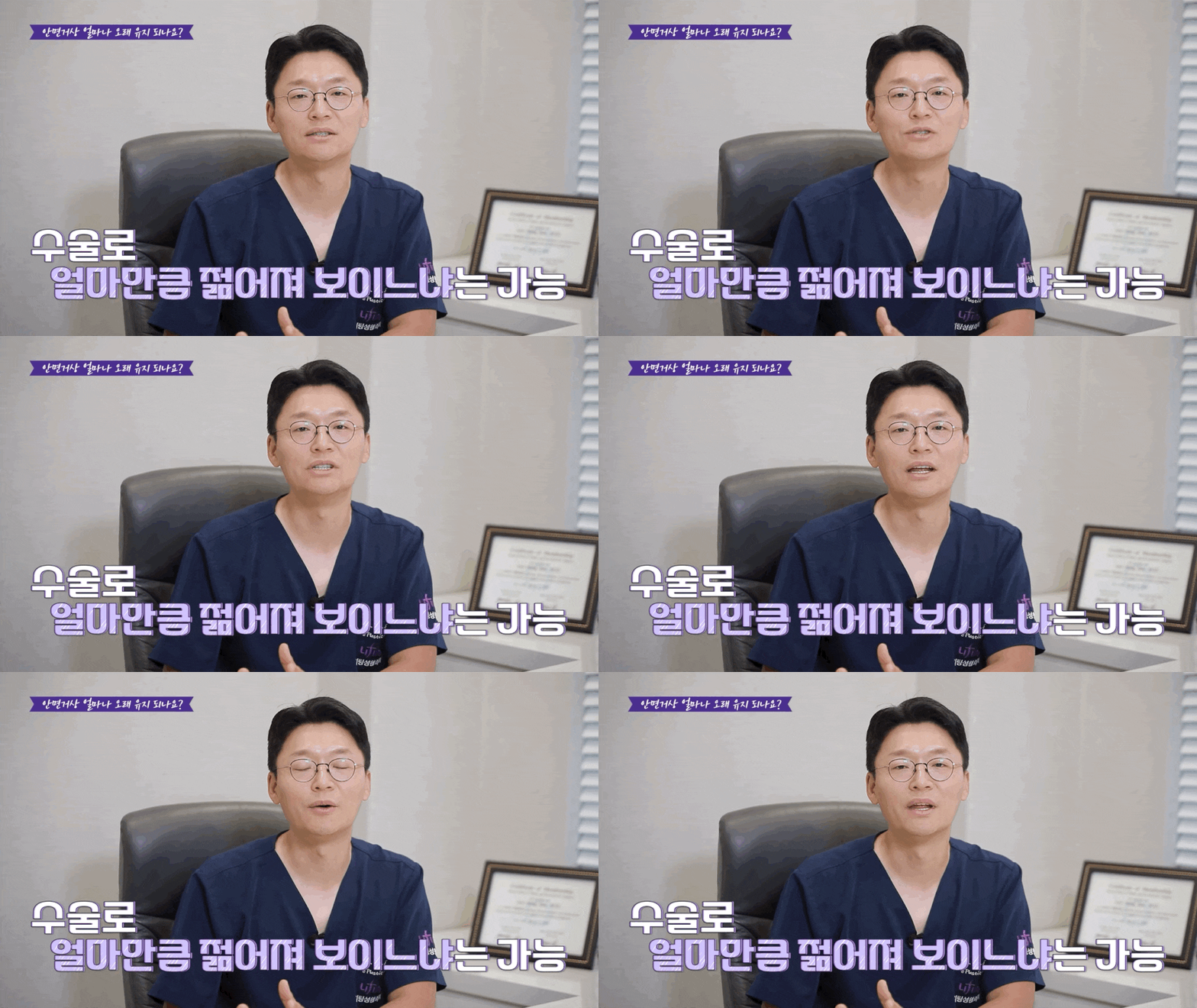
A facelift cannot stop aging.
A facelift helps improve skin elasticity
and reduce wrinkles,
so it is a procedure that focuses on
how much younger the face looks.

For example, let’s say that among two twins,
only one of them had a facelift.
Ten years later, the person who had surgery says
that their face has remained similar to
what it looked like before surgery.
At that point,
if you compare them with the other twin who did not have surgery,
there will be a clear difference in how much time has passed.
In this way, a facelift does not slow aging through surgery,
but it helps create a firmer and more refreshed impression.
From a financial perspective,
it may be more efficient to operate on a sufficiently wide area at once.
In general, satisfaction is often high when a broad area is treated in one procedure.
However, because each area of the face has a different structure and function,
even if one area improves,
it may be difficult for that effect to extend to other areas.
Therefore, additional management is important to maintain the desired result.

After a facelift, ongoing care is also important.
Management to prevent sagging skin after surgery
is extremely important as well.
After a facelift, there may be other things
that you did not notice before surgery
that start to stand out.
Sagging skin can be improved by tightening it through surgery,
but to slow the progression of aging,
periodic care such as Botox, laser treatments, and injections
may be helpful.
Please keep this in mind.
Concerned about the lower face or neck wrinkles?
V Neck Lifting
If you especially feel sagging in the lower face,
V Neck Lifting may be more helpful than a facelift.
It can improve a bothersome double chin,
excess fat around the jawline,
and even neck wrinkles,
helping to enhance the overall facial line and neck area.
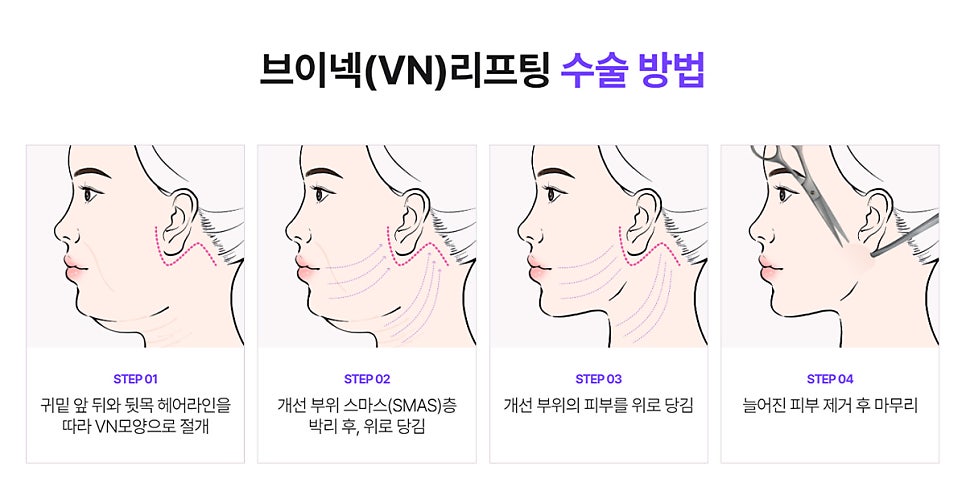
V Neck Lifting
involves making a VN-shaped incision
along the front and back of the area below the ears and the back hairline of the neck,
dissection of the fascial layer (SMAS layer) in the treatment area,
and then pulling the treated area together with the skin,
removing the excess sagging skin, and finishing the procedure.
It may be helpful for people who have more chin fat relative to their body weight,
those concerned about neck wrinkles,
and those who want to improve the lower face and neck wrinkles at the same time.
Please refer to the information about facelift longevity
introduced today,
and make your decision carefully
based on more accurate information.
That concludes today’s post 😊
If you would like to know more about this topic in detail,
please refer to the YouTube video below.