Hello.
I am Director Lee Seong-jun of Leting Plastic Surgery Seoul Branch.
What do you think is
the main cause of looking older?
Many of you have probably heard the term
“youthful proportions,”
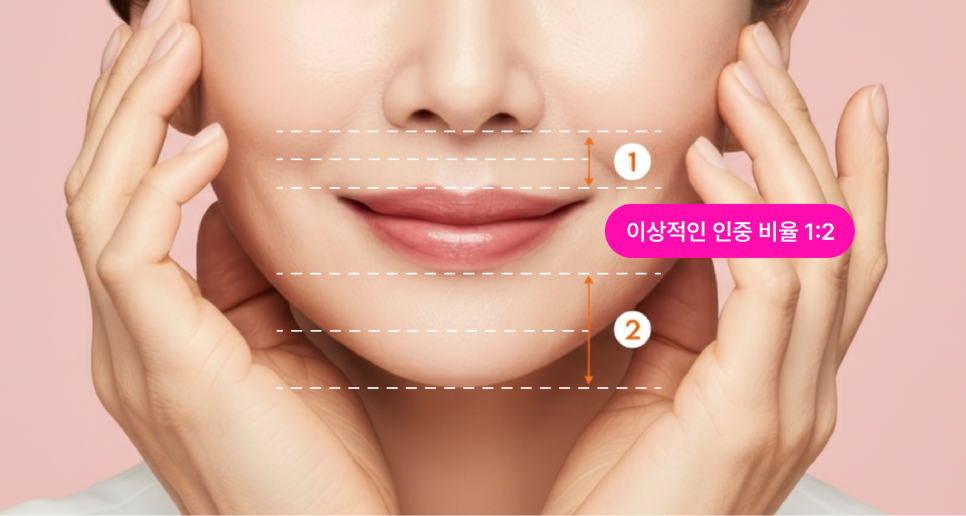
and the ideal proportion that makes someone look youthful is said to be
1 from under the nose to the lips,
and 2 from the lips to the tip of the chin.
That means the longer the distance from under the nose to the lips,
that is, the philtrum,
the older a person may look.
Today, I’d like to explain the philtrum,
a major cause of looking older,
and philtrum reduction surgery.

Because it is located at the center of the face,
even small changes can often
alter the impression.
Today, we will look at philtrum reduction surgery reviews,
step by step,
covering the approach and considerations.
| 📍 Table of Contents--------------------------1. The philtrum, an important area that forms the center of the face2. Can proportions be designed with philtrum reduction surgery?3. The surgical principles and approach of philtrum reduction surgery4. Things to know when considering philtrum reduction surgery5. Insights from philtrum reduction surgery reviews6. An era that considers harmony over change |
- The philtrum, an important area that forms the center of the face
The short distance between the base of the nose and the upper lip,
that is, the philtrum, corresponds to the central axis of the face.
The length and position of the philtrum can
affect the overall facial proportions
and the impression of the expression.
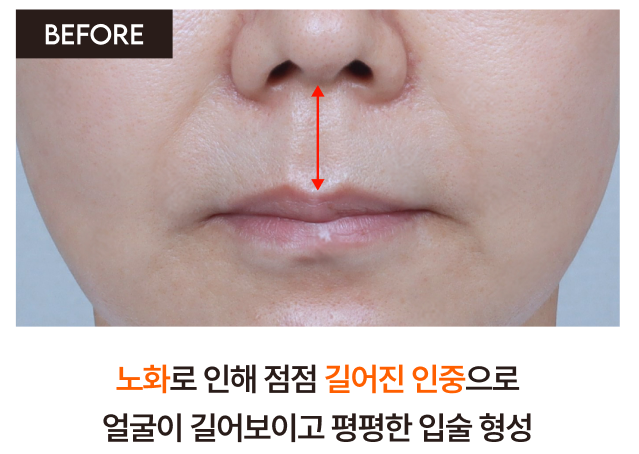
In general, as people age, changes in skin elasticity and weakening of the muscles around the mouth
can cause the philtrum to appear longer.
At times, people feel that their impression looks different.
This is not simply due to sagging skin,
but because the proportions of the central face have changed.
What matters is finding the most natural and harmonious
proportions for my facial structure.
So, what does it specifically mean to
redesign the philtrum length in a harmonious way?
Let’s take a look.
- Can proportions be designed with philtrum reduction surgery?

Philtrum reduction surgery is a surgical approach that helps restore dimension by adjusting
the length and proportions of the central face.
This process is not simply about
making the philtrum shorter,
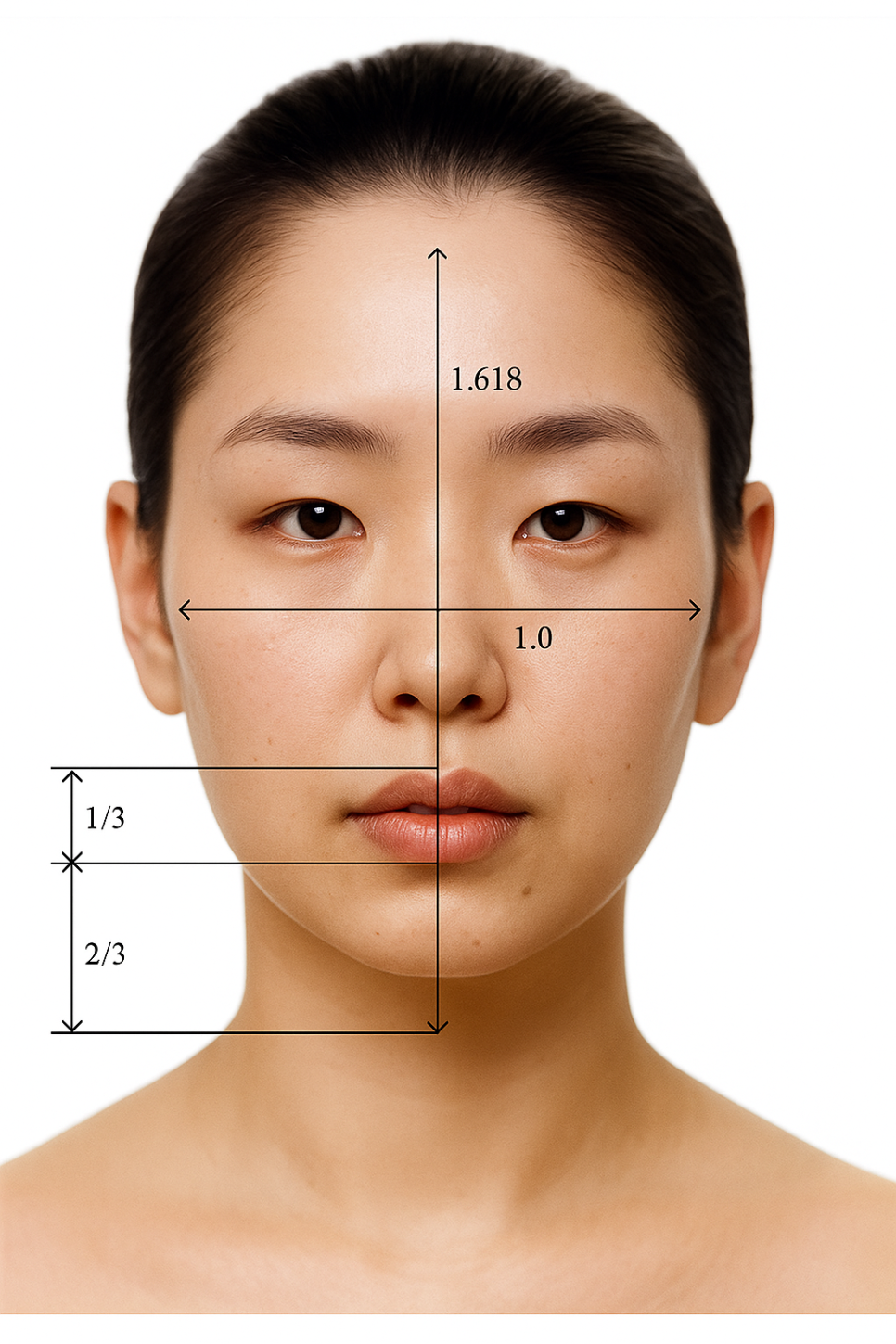
but rather about carefully adjusting the proportions of the facial center
by balancing the area under the nose and the lips.
For this reason,
philtrum reduction surgery should be approached with consideration for the overall proportions
and the expression line.
Looking at philtrum reduction surgery reviews,
rather than saying “my face changed,”
some people share the experience that “my expression became more natural.”
This harmony of proportions is determined not only by
the philtrum length itself,
but also by
the internal structure and the surgical approach.
So let’s look at
how philtrum reduction surgery is performed,
step by step.
- The surgical principles and approach of philtrum reduction surgery
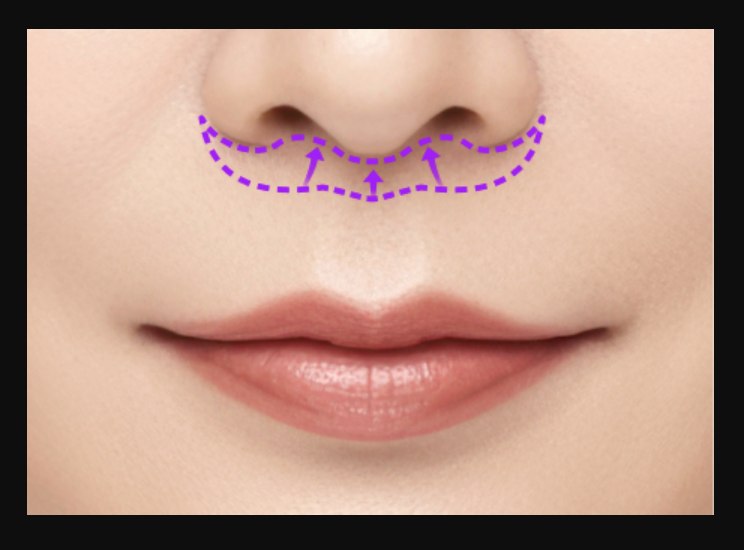
Philtrum reduction surgery is a surgical method that refines the proportions of the central face
by adjusting the skin between the base of the nose and the upper lip.
Unlike the surgery commonly known as a “subnasal excision,”
the incision line is determined according to the length of the lips,
wrinkles, and the degree of sagging,
and a customized design is planned with facial proportions in mind.
| ✔️ Considerations for incision placement and scars |
During surgery, the incision line is designed in a curved shape
along the shadow line at the lower end of the columella.
Because this area is shaded,
the scar is considered to be placed within a natural shadow,
helping reduce the burden of visibility.
| ✔️ Step-by-step approach to philtrum reduction surgery |
Philtrum reduction surgery may be performed in one or two stages depending on the condition of the midface
and the shape of the nose.
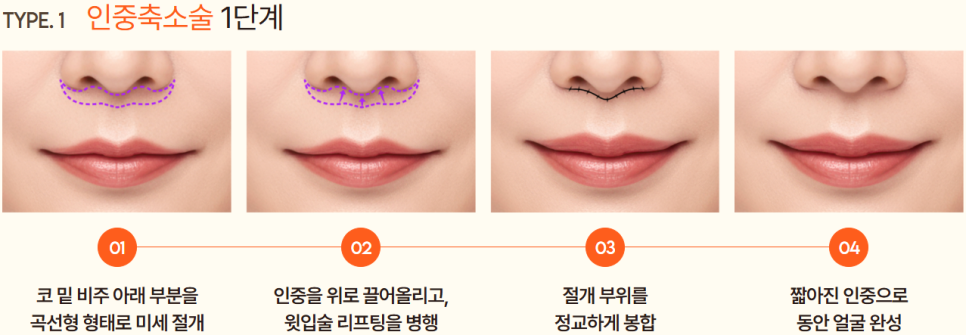
Stage 1: This is a method of making a subtle curved incision at the lower part of the columella beneath the nose.
It lifts the philtrum upward
and combines it with upper-lip lifting,
aiming to refine the upper-lip line and create a more dimensional midface impression.
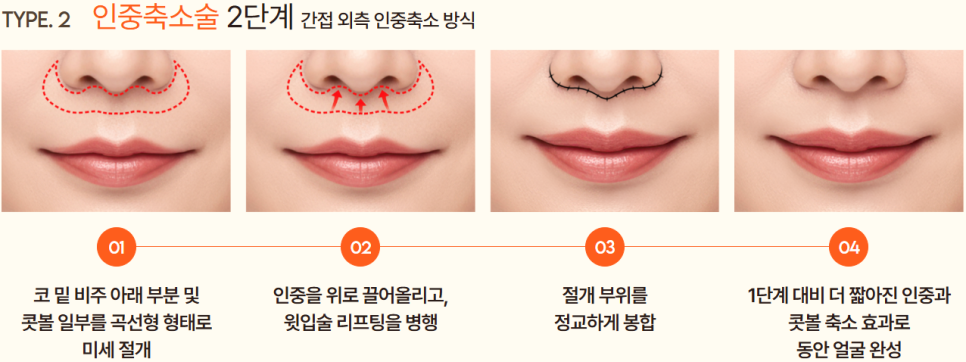
Stage 2: This method expands the incision range to include part of the nostrils.
Like Stage 1, it lifts the philtrum
and combines it with upper-lip lifting,
and it may also help reduce nostril flaring.
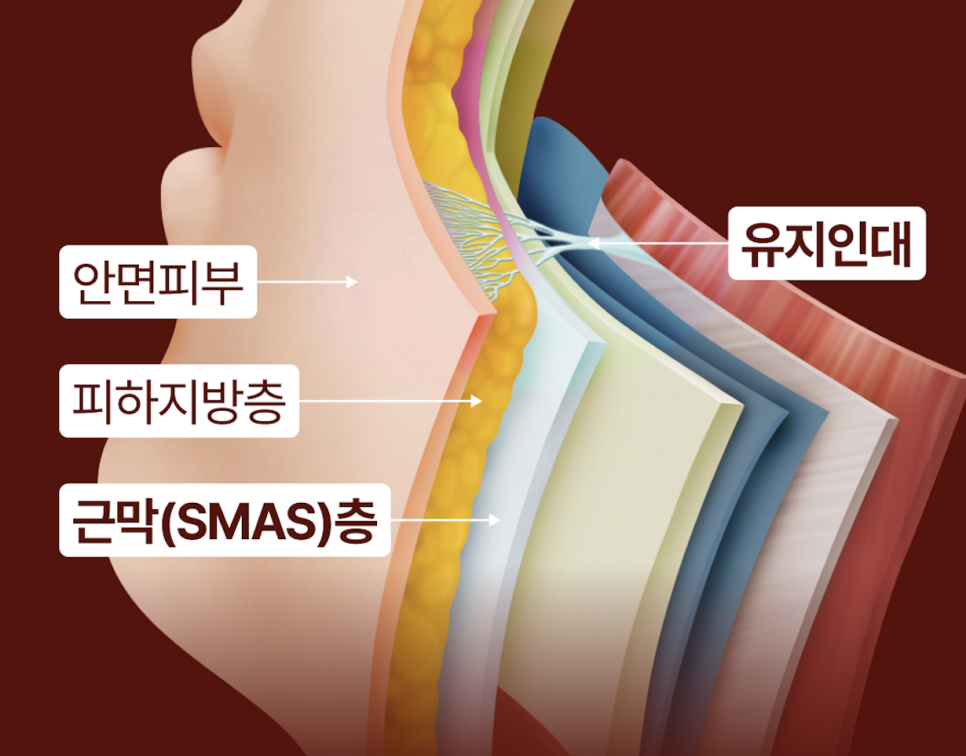
After the incision, the skin layer, the SMAS layer,
and the dermal layer are adjusted in sequence.
Tension is distributed so that the SMAS layer is not pulled excessively,
and the suture direction is designed so that lip movement during facial expressions continues naturally.
Because this process is applied differently depending on the individual’s facial structure
and skin thickness,
postoperative recovery requires attention to daily habits.
A philtrum that has gradually lengthened due to aging
can make the face appear longer
and emphasize flat, thin lips.
For those with these concerns,
please take a direct look at the changes in facial central proportions
experienced through philtrum reduction surgery.
- Philtrum Reduction Surgery -
Before & After by case
Case 1
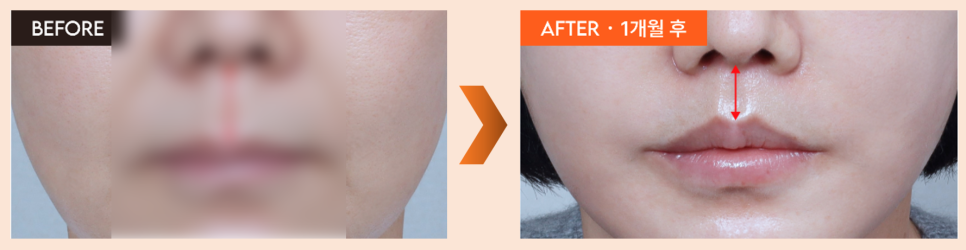
Case 2
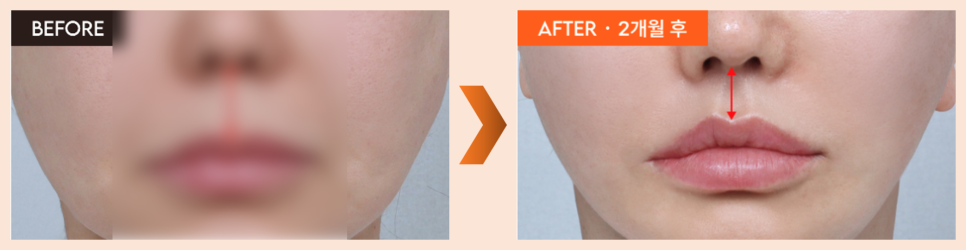
※ The patients above are clients who underwent surgery at our clinic, and the photos are used with consent.
※ Please note that recovery and results may differ from person to person.
To achieve a successful change like this,
let’s continue by looking at what is good to know
before and after surgery.
- Things to know when considering philtrum reduction surgery

Philtrum reduction surgery may be approached differently depending on the individual’s facial structure
and purpose.
For some people, even a slight adjustment in length
can soften the impression,
while for others, it may need to be designed together with the shape of the lips
and the contour under the nose in order to look natural.
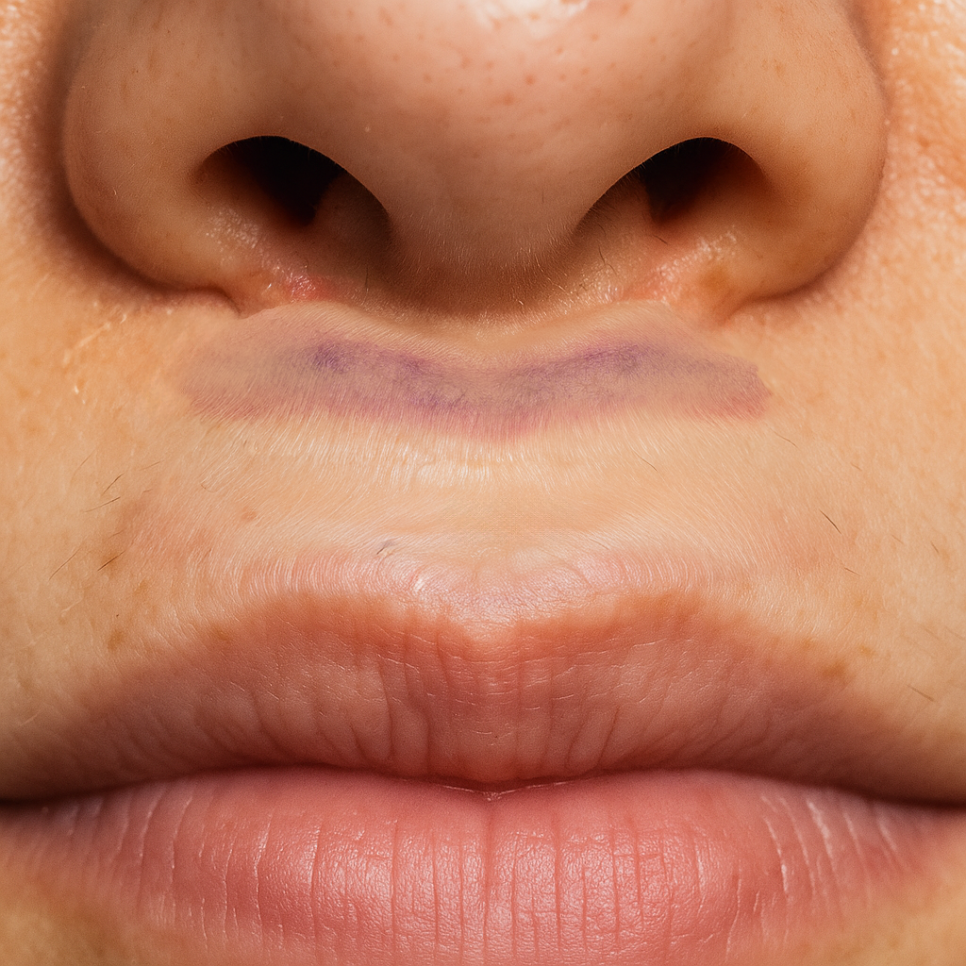
After surgery, depending on the individual,
temporary swelling or discomfort may occur,
and these changes are usually part of the process of gradually easing over time.
However, recovery speed and final results differ depending on the individual’s skin condition,
lifestyle habits, and recovery ability.
It is advisable to follow the medical staff’s guidance for wound care, moisturizing,
and regeneration care.
- Insights from philtrum reduction surgery reviews

What I have felt in practice is that,
rather than the reviews themselves,
it is more important to look at the “flow of concerns” contained within them.
When looking at philtrum reduction surgery reviews,
it is not just stories about the surgical results,
but inner concerns such as
“Why did I choose this change?”
“What was uncomfortable?”
and “Which part felt different?”
that come to the surface.
Ultimately, the approach to philtrum reduction surgery is often not simply a process of changing appearance,
but something that begins with the desire to understand one’s own face again.
Respecting that feeling,
I want to help ensure the process does not become overly fixed or swept up in trends.
This flow is also connected to
today’s changing standards of beauty.
- An era that considers harmony over change
These days, more than making a big change as in the past,
a “natural change” is preferred.
This shift also means that people’s sense of beauty
has become more refined,
not just surgical preferences.
When consulting at Leting Plastic Surgery,
rather than emphasizing results,
we first ask,
“Will this change suit me?”
Sinsa Lifting Plastic Surgery also approaches things in the same direction.
The process of finding the facial proportions that suit each patient best
is an essential step,
even if it takes time.
In the end,
carefully designing the center of the face in a stable way is not just a matter of aesthetics,
but is also related to
“restoring one’s self-image.”
Adjusting facial proportions delicately is ultimately a process of finding one’s own identity.
I hope you become more naturally youthful tomorrow than today,
and today more than yesterday.
This was Director Lee Seong-jun of Seoul Leting Plastic Surgery.
This article is content intended to provide general information about philtrum reduction surgery reviews.
Whether to undergo the actual procedure should be decided according to the individual’s health condition and purpose,
and should be determined through consultation with a professional medical team.
If you would like more details,
please check the YouTube link below for further information.
https://youtube.com/shorts/52u18Q1wouU?si=nis0-SgZYdXJ4DGP