
Hello.
I am Director Lee Seong-joon of the Seoul branch of Liting Plastic Surgery.
What time leaves on the face
is not just wrinkles.
Rather than visible changes,
subtle differences in facial proportions can first
change the impression.
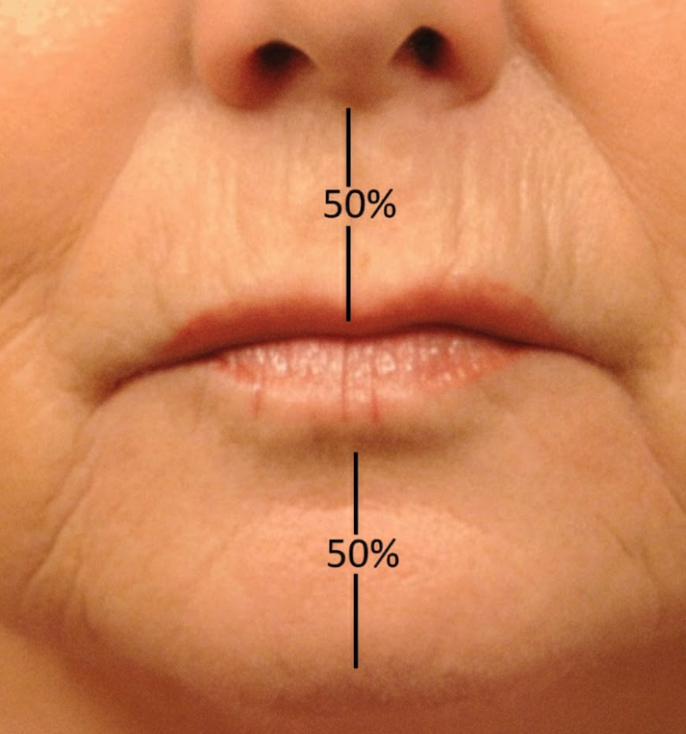
The slight changes in the distance
between the nose and lips, and extending to the chin,
can make the overall balance of the face
look different.
That is why, as the year comes to an end,
a natural trend sometimes emerges toward
reorganizing the “center of the face.”
In particular, because the central area of the face
can look significantly different even with small changes,
it naturally draws attention.
Rather than changing something,
it can be seen as an attempt to refine the original image
into a more polished form.

Recently, rather than excessive change,
a trend of “self-care-oriented cosmetic surgery”
focused on creating a natural impression
has taken hold.
In this process, one field that has continued to
draw attention along with lifting is philtrum reduction surgery.
When the philtrum becomes longer, the face may look longer
or the lips may appear less three-dimensional.
Because these changes appear gradually over time,
there is a growing number of people who want to
restore their proportions.

Liting philtrum reduction surgery is not simply a method
for adjusting length,
but an approach that reorganizes the flow of the structure
connecting the center of the face
(nose - philtrum - lips - chin).
In other words, it can be understood as a process
of arranging the facial center line based on
proportional harmony.
Today, let’s take a closer look at this
philtrum reduction surgery.
| Table of Contents🖊️ |
|---|
| 1. The philtrum as a section: the central structure of facial impression2. The principles behind philtrum reduction surgery3. Liting philtrum reduction surgery: micro-incision design4. Recovery and care after surgery5. The naturalness pursued by philtrum reduction surgery |
- The philtrum as a section: the central structure of facial impression

The philtrum is the distance
from under the nose
to the upper lip.
This section is small, but it is a key factor
that influences facial impression.
If this distance becomes longer,
the face may look flatter
or give the impression of being saggy,
and conversely, if it is too short,
it can create the impression that the lips are protruding.
Therefore, the philtrum is not simply a matter of “length,”
but an important structural element that determines
facial proportion, three-dimensionality,
and the naturalness of expression.
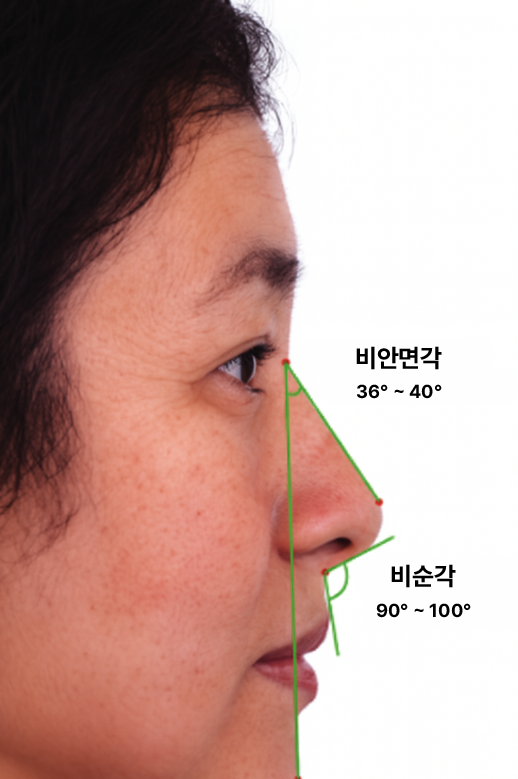
When I design philtrum reduction surgery,
I look at the following four elements together.
1️⃣ The position and tilt of the nose tip
2️⃣ The length and curve of the philtrum
3️⃣ The thickness and shape of the lips
4️⃣ The length and angle of the chin tip
When these four elements are harmoniously
connected, the center of the face gains a sense of stability.
In other words, philtrum reduction surgery can be understood
as a process of “proportionally rearranging”
the central structure of the face.
Understanding the structural meaning of the philtrum
is important for deciding how to approach it surgically.
- The principles behind philtrum reduction surgery
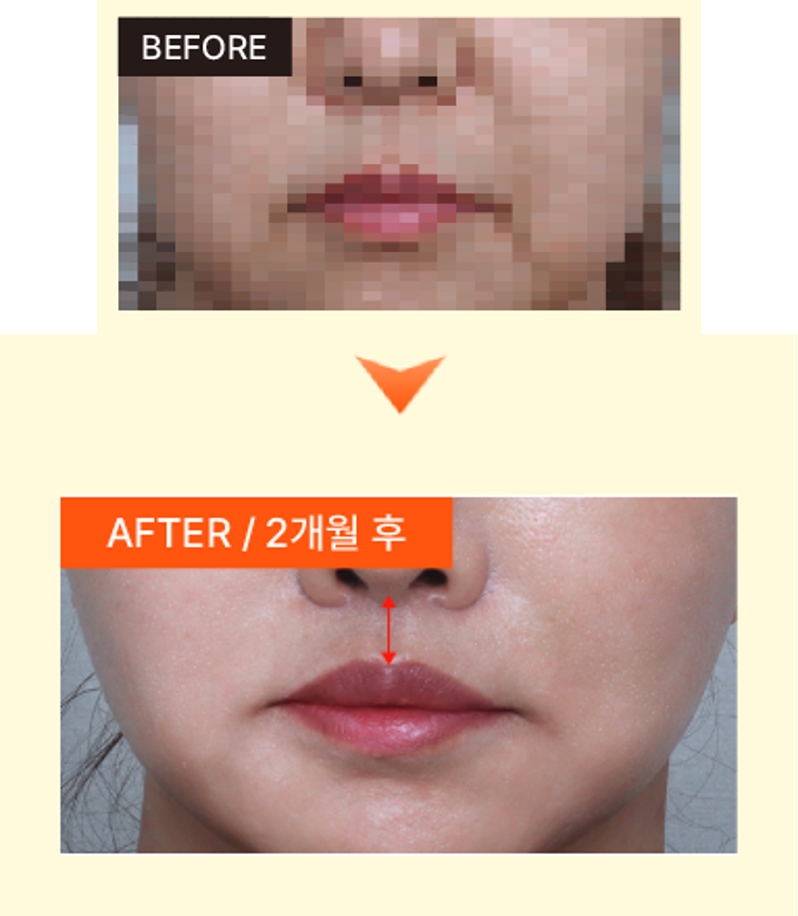
※ The patients above are clients who had surgery at Liting, and we inform you that the photos are used with consent.
※ The results in the above cases may differ depending on each individual’s condition,
and the recovery process and degree of change may vary from person to person.
Philtrum reduction surgery is an operation that redefines
the midface proportion by reducing the distance
between the nose and the upper lip.
The core of the surgery is not simple excision,
but precise micro-design that takes facial proportion
and three-dimensionality into account.
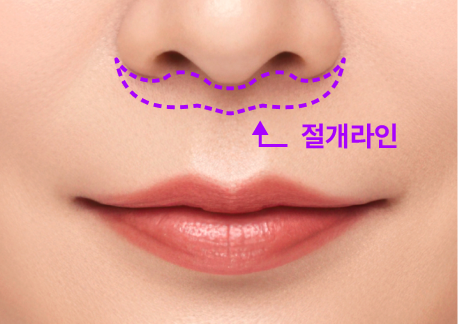
| Main surgical principles |
📌 The incision line is designed along the line
under the nose and below the columella to reduce visibility.
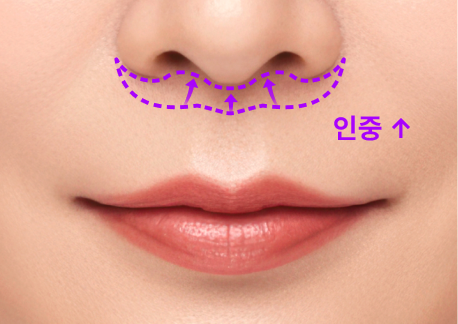
📌 While pulling the philtrum upward,
the upper line of the lip is also lifted
to enhance three-dimensionality.
📌 The continuous proportions of the nose - lips - chin
are aligned to organize the flow of the center of the face.
The important point in this process is not
“how much the philtrum is shortened,”
but “what amount is a natural proportion.”
Therefore, before surgery, the frontal facial proportion,
the position of the bridge of the nose and jawline,
and the shape of the lips must all be considered
in a comprehensive design.
Based on these basic principles, the actual surgery
leads into a detailed incision and design process.
- Liting philtrum reduction surgery: micro-incision design
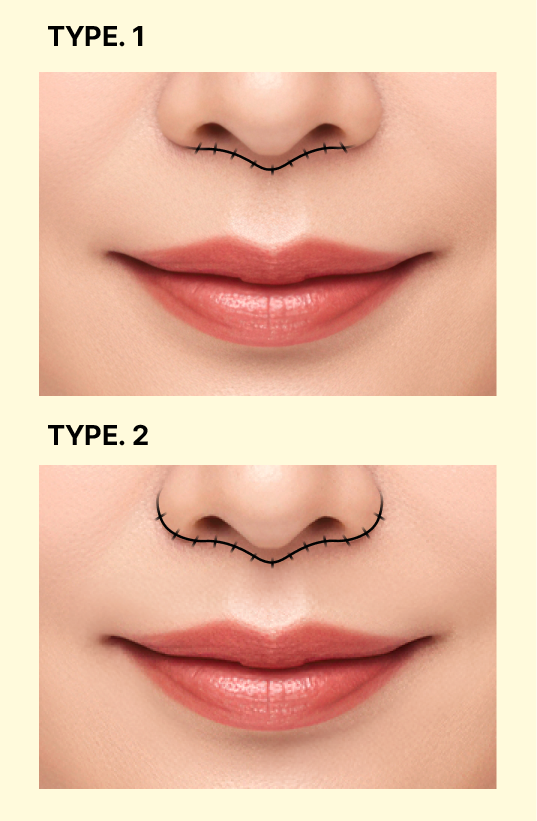
Liting philtrum reduction surgery is an operation
based on the precision of incision placement and design.
The incision line of this surgery is made in a curved shape
along the underside of the columella,
and the range of the incision varies depending on
each individual’s philtrum length, nose shape,
and skin thickness.
Philtrum reduction surgery method
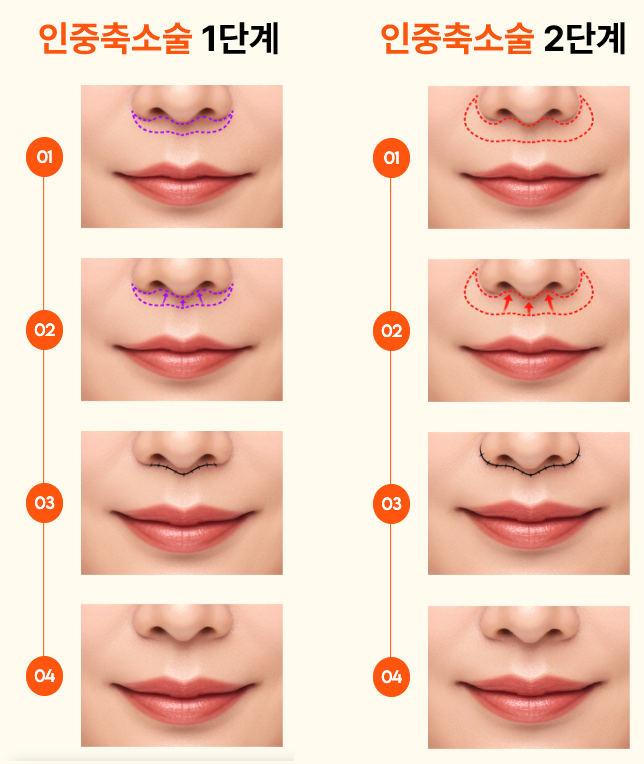
| Surgical stage structure |
| Category | Incision range | Main adjustment area | Description |
|---|
| Stage 1 Liting philtrum reduction | Incision under the columella | Shortening the philtrum length, with upper lip lifting performed at the same time | Focused on basic proportion redesign |
| Stage 2 Liting philtrum reduction | Incision under the columella + lateral alar incision | Adjustment of the philtrum and alar width | Aimed at enhancing the three-dimensionality of the midface |
This method places the incision site
along the natural shadow line of the columella,
so it is designed to reduce the burden of scar visibility
even in daily conversation or under lighting.
The incision area is adjusted according to
each person’s facial structure,
and the incision depth is also set differently
depending on skin thickness and muscle-layer structure.
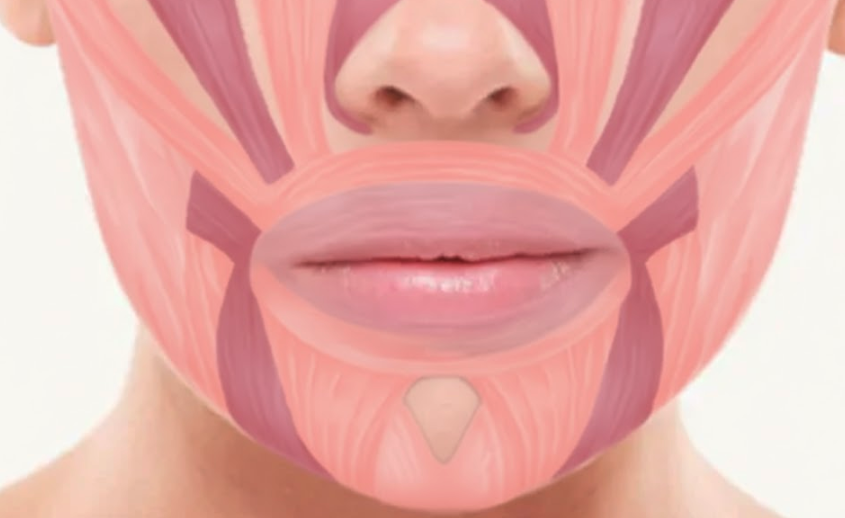
The key point of this surgery is to control the tension
of both the muscle layer and the skin layer
at the same time in order to maintain natural expression.
Rather than an unconditional pull,
it is more important to preserve the natural flow
of the muscles when the lips move.
Once the surgery is structurally completed,
time is needed for the tissue to stabilize during recovery.
- Recovery and care after surgery

After surgery, the recovery process may vary
depending on each person’s skin regeneration ability.
In the early stage, swelling or a feeling of tightness
may occur,
and this will gradually ease over time.
The incision area should be kept clean,
sun exposure should be avoided, and moisturizer should be used consistently.

Scar care products such as regenerative ointment
or silicone patches may be helpful,
but their use should follow the guidance of medical staff.
The process by which the tissue stabilizes and settles
as the surgical area recovers differs from person to person,
and overall recovery speed may vary
depending on skin thickness, blood flow,
lifestyle habits, and other factors.
After the recovery process passes,
the natural balance of proportion that
philtrum reduction surgery aims for becomes
more clearly noticeable.
- The naturalness pursued by philtrum reduction surgery

In the end, philtrum reduction surgery can be seen as
a process of anatomically refining the many elements
that make up the facial impression,
in order to restore the original naturalness.
What matters more than a noticeable change is
comfortably restoring the “impression of me”
that has gradually changed over time.
Naturalness does not simply mean that the philtrum
looks shorter.
When the flow of the center line running through the
nose - philtrum - lips - chin,
the thickness and movement of the lips,
and the connection to the jawline are balanced together,
stability is finally created.
Therefore, when considering philtrum reduction surgery,
it is important to look at the overall composition of the
center of the face, not just the length.
Because each person has different structural features,
a design that respects the original proportions
leads to natural results.
Ultimately, naturalness does not come from the size of the surgery,
but from how precisely one designs the face’s unique proportions.
From this perspective, philtrum reduction surgery is not
a procedure to imitate someone else,
but a process of finding a face that looks like me.
I hope you become more naturally youthful
tomorrow than today,
and today more than yesterday.
This was Director Lee Seong-joon
of Seoul Liting Plastic Surgery.
This article is content intended to provide general information
about philtrum reduction surgery.
Whether to undergo the actual procedure should be decided
according to your individual health condition and purpose,
and please make your decision through consultation
with a medical professional.
If you would like more detailed information,
please check the YouTube link below
for more details.
https://youtube.com/shorts/MME3Pv-zsAw?si=FhlW4y7TOWM8nAE4