❝
Gangnam Revision Rhinoplasty
When Autologous Rib Cartilage Is Needed and Surgical Methods
VERYGOOD PLASTIC SURGERY
❞
Verygood Plastic Surgery
Revision Rhinoplasty

The nose is located at the center of the face,
so even a small change
can alter the overall impression.
That is why many people give the decision to undergo their first rhinoplasty
careful consideration.
However, after already having undergone surgery once,
those exploring revision rhinoplasty
naturally have even more factors to consider.
People consider revision rhinoplasty for various reasons, such as when
the shape of the nose differs from what they expected after the first surgery,
the tip appears to have drooped over time,
or the connection between the bridge and tip feels unnatural.
Rather than simply creating a nose that is higher or more defined than before,
it is important to first check the current condition of the nose
and what technique was used during the initial surgery.
Today, together with Verygood Plastic Surgery,
we will take a detailed look at
what should be considered
when exploring revision rhinoplasty.
There Are Various Reasons
People Consider Revision Rhinoplasty
Even if someone is initially satisfied after their first rhinoplasty,
changes in the shape may become noticeable over time.
Conversely, once the swelling has sufficiently subsided
and the final contour has become visible,
they may explore revision surgery
because it differs from what they had expected.
Common examples include:
when the bridge appears too high or too low
in proportion to the face,
when the tip appears bulky or drooped,
when the nose appears shifted to one side from the front,
or when the line from the bridge to the tip
does not connect naturally.
Revision rhinoplasty may also be necessary because of internal issues,
such as the position of an implant,
the condition of cartilage used previously,
contracture, or adhesions.
Therefore, the surgical method should not be decided
based only on the appearance from the outside.
Even when the procedure is referred to as “revision rhinoplasty,”
the approach may differ depending on
what issue necessitates the repeat surgery.
Revision Rhinoplasty Does Not
Automatically Require Autologous Rib Cartilage

When searching for revision rhinoplasty,
you may come across a great deal of information
about autologous rib cartilage.
However, revision surgery alone
does not mean that autologous rib cartilage
is necessary in every case.
The appropriate material should be selected
after considering the amount of septal cartilage remaining,
whether ear cartilage has been used,
the amount of support needed for the tip,
and the extent of the desired changes.
Depending on the case, septal cartilage
or ear cartilage may be used.
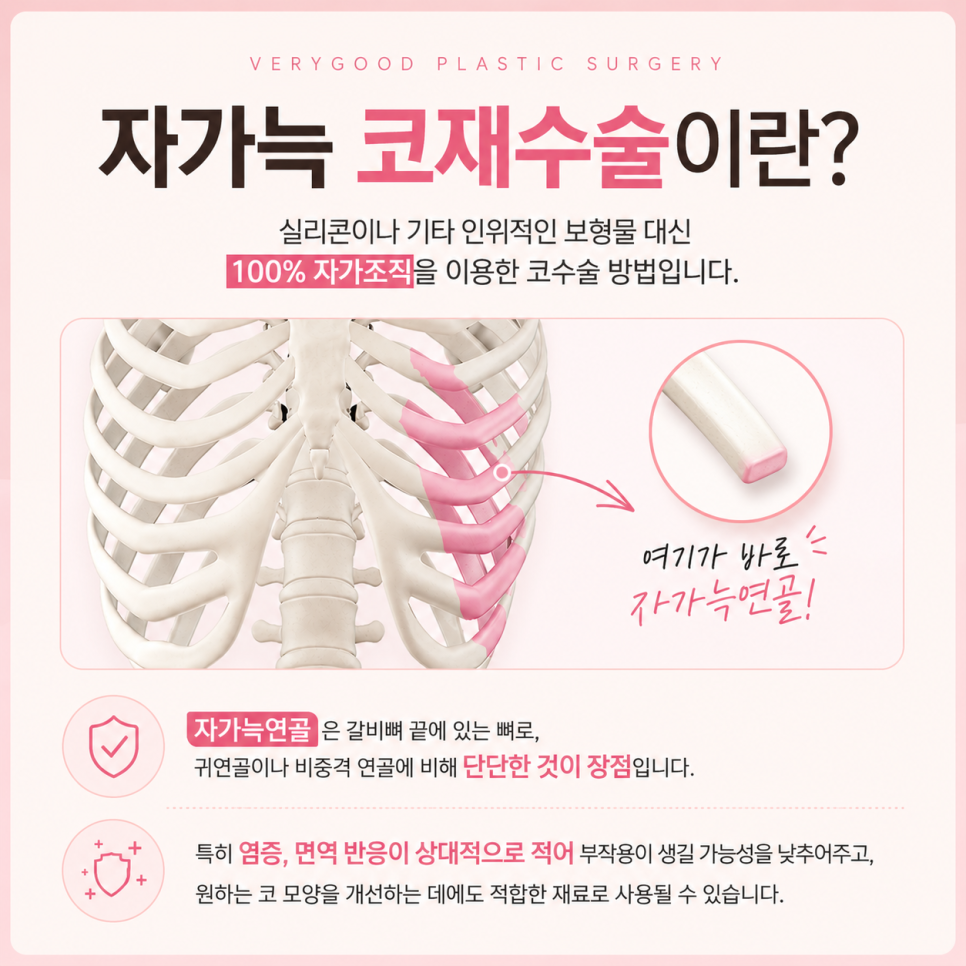
Autologous rib cartilage may also be considered
when sufficient support is needed
or when much of the cartilage that could be used
has already been harvested during previous surgery.
Ultimately, what matters is not the specific material itself,
but first determining the degree of change and support
currently needed by the nose.
The Timing of Revision Rhinoplasty
Should Be Decided After Sufficient Recovery
Even if you are dissatisfied with the results of your first surgery,
it is important to carefully consider
deciding on revision surgery too soon.
Immediately after surgery, swelling may remain
and the tissues may still be recovering,
which can make it difficult to assess the actual shape of the nose.
As time passes, swelling in the tip and bridge may subside,
and the contour may appear different.
The timing at which revision surgery can be performed
may vary depending on the type of previous surgery
and the current condition of the tissues.
Therefore, the appropriate timing should be confirmed
through an examination by a medical professional.
If there is a problem requiring prompt treatment,
such as inflammation or implant exposure,
a different assessment from the usual revision-surgery timing
may be necessary.
Verygood Plastic Surgery Revision Rhinoplasty:
Starting With an Assessment of the Current Condition
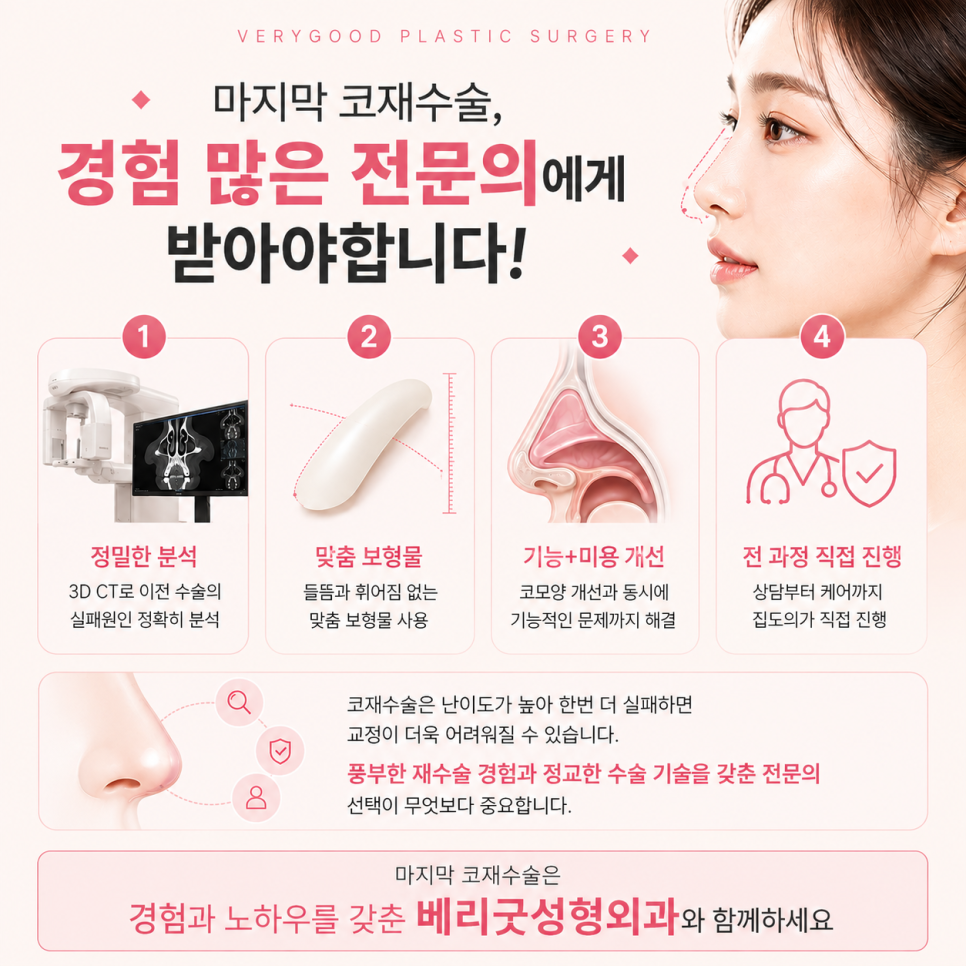
At Verygood Plastic Surgery,
during revision rhinoplasty consultations,
we do not simply assess the desired shape.
Instead, we review the details of the previous surgery,
the current condition of the nose,
and the areas the patient wishes to improve
before developing a surgical plan.
Because revision rhinoplasty requires consideration
of everything from the condition of existing implants or cartilage
to the support structure of the tip
and the condition of the skin and soft tissues,
the scope of surgery needed may differ for each individual.
In addition to rhinoplasty, we also provide consultations
in various fields of plastic surgery, including eye surgery,
facial contouring, and facelift procedures.
This allows patients to receive consultations
that take the proportions and harmony of the entire face into account.
The newly expanded and relocated Verygood Plastic Surgery
has separately organized treatment spaces on each floor
and private pathways,
allowing consultations, surgery, and recovery
to take place in a more comfortable environment.
If you are considering revision rhinoplasty,
rather than choosing another person’s surgical method
or a specific material without further consideration,
first accurately assess the structures and tissue condition
remaining in your own nose.
After discussing in sufficient detail
what was unsatisfactory about the first surgery
and how you would like to improve it this time,
please decide on a method appropriate for your current condition.
Inquiries and Consultation Reservations
Phone consultation: 02-596-9006
KakaoTalk consultation: @베리굿성형외과
Verygood Plastic Surgery will be with you
on the first step toward your beautiful transformation!