❝
Can Rhinoplasty and Rhinitis Surgery,
Be Done at the Same Time?
What to Know Before Functional Rhinoplasty
VERYGOOD PLASTIC SURGERY
❞

If you have rhinitis or nasal congestion
and are also concerned about the shape of your nose,
you may wonder,
“Can rhinitis surgery and rhinoplasty be performed at the same time?”
To give the conclusion first,
if a structural problem causing nasal congestion is identified
and cosmetic rhinoplasty is also needed,
functional surgery and cosmetic rhinoplasty
can be planned together.
However, not everyone with rhinitis
undergoes the same surgery.
Nasal congestion may occur
because of a structural problem
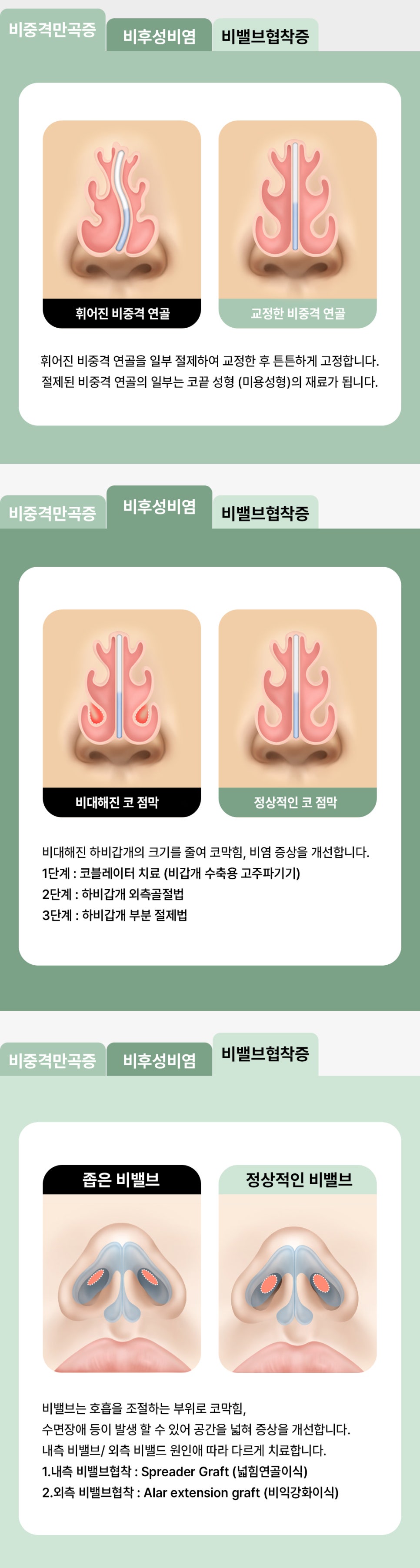
such as a deviated septum,
or because enlarged inferior turbinates
have narrowed the space through which air passes.
Conversely, in cases such as allergic rhinitis,
inflammation of the nasal mucosa
may be the primary cause,
so it is first necessary to determine
why your nose is blocked.
Today, if you are researching rhinoplasty for rhinitis
or functional rhinoplasty,
we will look at the questions people ask most often,
one by one.
Table of Contents
-
Can rhinitis surgery and rhinoplasty be performed together?
-
How are functional rhinoplasty and ordinary rhinoplasty different?
-
Is septoplasty necessary if I have nasal congestion?
-
When is inferior turbinate surgery considered?
-
Will surgery eliminate allergic rhinitis as well?
-
What examinations are needed before functional rhinoplasty?
-
How is the shape of the nose planned in rhinoplasty for rhinitis?
-
Frequently asked questions before rhinoplasty for rhinitis
- Can Rhinitis Surgery and Rhinoplasty
Be Performed Together?
There are cases in which this is possible.
If the cause of nasal congestion is related to
structural problems inside the nose,
such as a deviated septum or enlarged inferior turbinates,
and you also have cosmetic concerns
such as a low nasal bridge,
a dorsal hump, a crooked nose, a bulbous nose, or a drooping nasal tip,
both aspects can be evaluated together
and a surgical plan can be established.
The important point here is that
it is not simply “having rhinitis means having functional rhinoplasty.”
Rather, the cause of the nasal congestion is identified first,
and only the areas that require correction are treated.
For example, if a deviated septum
has narrowed one nasal passage through which air flows,
the condition of the septum must be assessed.
If enlarged inferior turbinates are narrowing the space,
their condition must also be examined.
Conversely, if repeated swelling of the mucosa
caused by allergies is the primary issue,
it cannot be assumed that
structural surgery alone
will resolve all symptoms.
Therefore, rather than deciding on a surgical method
based solely on the presence of nasal congestion,
a diagnosis that distinguishes structural problems
from mucosal problems must come first.
- How Are Functional Rhinoplasty
and Ordinary Rhinoplasty Different?
The biggest difference
is the scope of the evaluation used when planning the surgery.
Ordinary rhinoplasty for cosmetic purposes
is planned primarily around external features,
such as the nasal bridge and tip,
the length and width of the nose,
a dorsal hump, and a bulbous nose.
By contrast, what is commonly called functional rhinoplasty
includes evaluating not only the shape of the nose
but also the internal structures
that may affect breathing through the nose.
| Category | Ordinary Rhinoplasty | Rhinoplasty That Also Considers Functional Aspects |
|---|
| Main purpose | Improve the shape of the nose and its harmony with the face | Assess structures that affect breathing along with the shape of the nose |
| Main areas examined | Nasal bridge, nasal tip, width, length, and angle | Septum, inferior turbinates, nasal passages, nasal valves, and more |
| Typical concerns | Low nasal bridge, dorsal hump, bulbous nose, and nasal tip | Nasal congestion, one-sided nasal congestion, and structural narrowing |
| Surgical planning | Focused on external design | Functional causes and external design are evaluated separately |
| Important point | Harmony with the entire face | First distinguishing the cause of nasal congestion |
Therefore, rather than understanding functional rhinoplasty
simply as “rhinoplasty with rhinitis surgery added,”
it is better understood as a process in which
the internal function and external design of the nose
are evaluated separately,
and the necessary procedures are planned together.
- If I Have Nasal Congestion,
Do I Need Septoplasty?
Not everyone with nasal congestion
needs septoplasty.
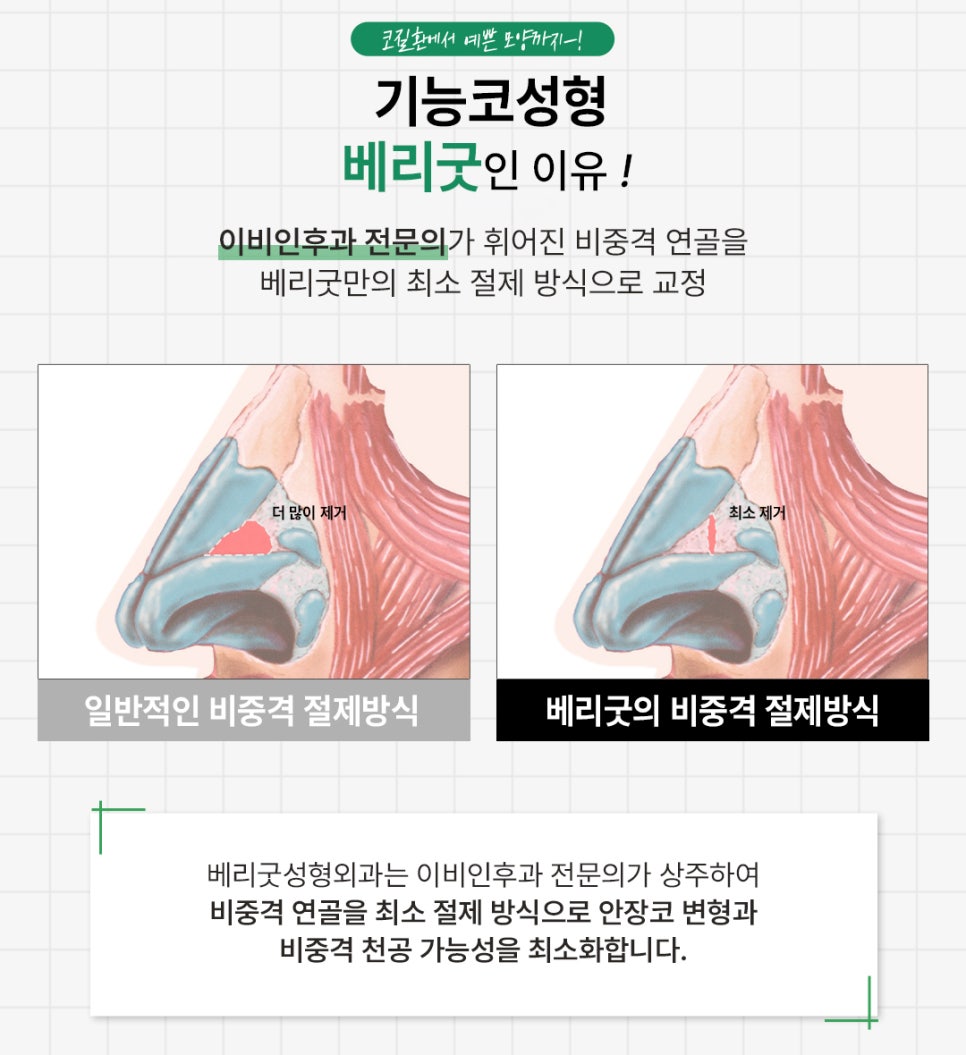
The septum is the wall that divides
the inside of the nose into left and right sides,
and it is made of bone and cartilage.
If the septum is significantly deviated to one side,
narrowing the space through which air passes
and actually contributing to breathing difficulties,
septoplasty may be considered.
However, some people may have
a certain degree of septal deviation
without experiencing any particular symptoms.
Therefore, it cannot be said that
“a deviated septum = surgery is always necessary.”
The important thing is to determine
whether the shape of the septum
is actually related to the nasal congestion symptoms.
In particular, if one side of the nose
repeatedly becomes blocked
or difficulty breathing through the nose persists,
it is worth identifying the cause
through an examination of the inside of the nose.
- In What Cases Is Inferior Turbinate Surgery Considered?
If the inferior turbinates are enlarged,
narrowing the air passages inside the nose,
and nasal congestion persists despite appropriate treatment,
surgical treatment may be considered.
The inferior turbinates are structures
located on both sides inside the nose
and are involved in regulating the temperature and humidity
of incoming air.
However, if the inferior turbinates remain enlarged
because of rhinitis or other causes,
the space through which air passes becomes narrower,
which can cause a sensation of nasal congestion.
Even in this situation, surgery is not automatically performed.
After first checking the current size of the inferior turbinates,
the condition of the mucosa,
and the response to rhinitis treatment,
treatment to reduce the volume of the inferior turbinates
may be considered if necessary.
The approach also varies depending on the cause of nasal congestion
| Identified condition | Relationship to nasal congestion | General evaluation direction |
|---|
| Deviated septum | May narrow one or both nasal passages | Determine the relationship between the septum and the symptoms |
| Enlarged inferior turbinates | May narrow the internal space through which air passes | Assess the degree of enlargement and response to medication |
| Allergic rhinitis | May cause repeated mucosal swelling, runny nose, sneezing, and nasal congestion | Allergy and inflammation control may be needed |
| Nasal valve problem | May narrow the airway when inhaling | Assess the nasal valve structure and support |
| Multiple causes | Two or more causes may contribute simultaneously | Evaluate each cause separately |
Even a single symptom such as nasal congestion
can have various causes,
so it is important to distinguish the cause first
rather than deciding on the name of the surgery.
- Will Surgery Also Eliminate
Allergic Rhinitis?
It is difficult to say that allergic rhinitis itself
can be completely eliminated
with structural nasal surgery alone.
Allergic rhinitis is a condition in which
an immune response to a specific allergen
causes inflammation in the nasal mucosa,
leading to symptoms such as sneezing,
runny nose, and nasal congestion.
Therefore, undergoing septoplasty
or inferior turbinate surgery
does not make the allergic reaction itself disappear.
However, if you have allergic rhinitis
and structural problems such as a deviated septum
or enlarged inferior turbinates
are also making the nasal congestion worse,
a treatment plan can be established
by distinguishing each cause.
In other words,
treatment for rhinitis
and treatment for structural nasal congestion
are not the same thing.
This is why it is important
to distinguish between them
when researching rhinoplasty for rhinitis.
- What Examinations Are Needed
Before Functional Rhinoplasty?
The most important step
is examining the actual inside of the nose.
To identify the location and cause
of nasal congestion,
taking a medical history about the symptoms
and examining the inside of the nose
are fundamental.
Depending on the situation,
examinations such as nasal endoscopy may also be used.
A CT scan is not necessarily required
for every functional rhinoplasty,
but it may be performed at the medical professional’s discretion
when additional evaluation of the structural condition
of the nose and sinuses is needed.
Therefore, rather than deciding on rhinoplasty
based only on front and side photographs,
it is important to also check:
which side of the nose is more blocked,
whether symptoms worsen during a particular season,
whether congestion becomes worse when lying down,
whether the septum is deviated,
whether the inferior turbinates are enlarged,
whether there are other structural problems, such as nasal valve issues,
and whether you have previously received treatment for rhinitis.
📌 The purpose of examinations in functional rhinoplasty
is not to “find a problem to operate on,”
but to distinguish the cause of your current nasal congestion.
- If I Undergo Rhinoplasty for Rhinitis,
Can the Shape of My Nose Also Be Changed as Desired?

Functional concerns and the external shape
of the nose can be considered together,
but both the desired design
and the current nasal structure must be taken into account.
The shape of the nose
is not determined by the nasal bridge alone.
The starting point where the forehead transitions into the nasal bridge,
the height of the bridge,
the projection and angle of the tip,
the length and width of the nose,
and the side-profile proportions extending to the lips and chin
all affect the overall impression.
Therefore, even when functional correction is needed,
it is not always appropriate to simply raise the bridge
or make the nasal tip more prominent.
In some cases, it may be more appropriate
to preserve the existing shape of the nose as much as possible
while correcting only the functional aspects.
If you have long been concerned about a dorsal hump,
a low nasal bridge, a bulbous nose,
or a drooping nasal tip,
external design can also be planned.
Ultimately, what matters is
separating the functional plan
from the cosmetic plan,
then applying both harmoniously
within one nose.
- Four Things to Check Before Researching
Rhinoplasty for Rhinitis
If you are considering functional rhinoplasty,
before searching for surgical methods or materials,
it is helpful to check these four things first.
First, determine the cause of your nasal congestion.
You need to distinguish whether it is a deviated septum,
enlarged inferior turbinates,
allergic rhinitis,
or a combination of multiple causes.
Second, determine whether structural surgery is actually necessary.
Not everyone with nasal congestion
is a candidate for surgery.
In some cases, controlling inflammation
or medication may be needed first.
Third, check whether function and design are being planned separately.
A structure that allows easier breathing
and the desired shape of the nose
must each be evaluated
and then coordinated together.
Fourth, determine whether rhinitis management will still be needed after surgery.
If there is a mucosal problem such as allergic rhinitis,
separate management may still be needed
after structural surgery.
Functional Rhinoplasty Q&A
Q. If I have rhinitis,
should I avoid rhinoplasty?
Not necessarily.
After checking the type and severity of the rhinitis
and the current structural condition inside the nose,
it can be determined whether cosmetic rhinoplasty is possible.
Q. If my septum is deviated,
do I automatically need septoplasty?
No.
In addition to the degree of deviation,
it is necessary to check whether it is actually narrowing the airway
and whether it is related to the nasal congestion symptoms.
Q. Is inferior turbinectomy
necessary for every patient with rhinitis?
No.
Surgery may be considered depending on the individual’s condition,
such as when enlarged inferior turbinates are causing nasal congestion
and symptoms persist despite appropriate treatment.
Q. If I undergo functional rhinoplasty,
will my rhinitis be cured?
Functional nasal surgery
and treatment for allergic rhinitis
must be considered separately.
There are cases in which structural nasal congestion
can be improved through surgery,
but it is different from treatment
that eliminates the allergic reaction itself.
Q. Which is better, rhinoplasty for rhinitis
or ordinary rhinoplasty?
Neither can be considered
inherently better than the other.
The necessary surgery varies
depending on whether there is currently a functional problem.
If there is no particular problem with nasal function,
cosmetic rhinoplasty alone may be planned.
If nasal congestion is caused by a structural problem,
that cause can also be evaluated.
Rhinoplasty for Rhinitis,
The First Thing to Check Is the “Cause”
When researching rhinoplasty for rhinitis
or functional rhinoplasty,
the first things to decide
are not the type of implant
or the height of the nasal tip.
The first step is to determine
why the nasal congestion is occurring.
After checking whether there is a structural cause,
such as a deviated septum or enlarged inferior turbinates,
whether a mucosal problem,
such as allergic rhinitis, is the primary cause,
or whether both are contributing,
the necessary treatment and scope of surgery should be determined.
If you are considering both functional and cosmetic aspects,
it is also important to discuss each purpose separately
during your consultation.
At Very Good Plastic Surgery,
we provide consultations about the shape of the nose
and, when functional discomfort is also present,
check your current symptoms and the internal structure of your nose
before discussing the surgical approach
according to the necessary scope.
Since not everyone with rhinitis or nasal congestion
undergoes the same type of functional rhinoplasty,
it is important to first check the condition of your nose
and then decide on the necessary treatment and surgery.
Contact and Consultation Reservations
Telephone consultation: 02-596-9006
KakaoTalk consultation: @베리굿성형외과
Very Good Plastic Surgery will be with you
on the first step toward your beautiful transformation!