During consultations, many people ask this question at least once.
"Can my nose also be improved through surgery?"
For those considering nose surgery,
this may be the first thing they want to know.
So what is the most important factor in rhinoplasty?
Many people cite the surgeon’s skill and experience as the most important factor,
but in fact, each patient’s facial structure and skin condition also
play an important role in the outcome.
In today’s post, let’s look at facial shapes and conditions in which changes may appear more clearly after nose surgery.
- When the skin is not thick and feels soft
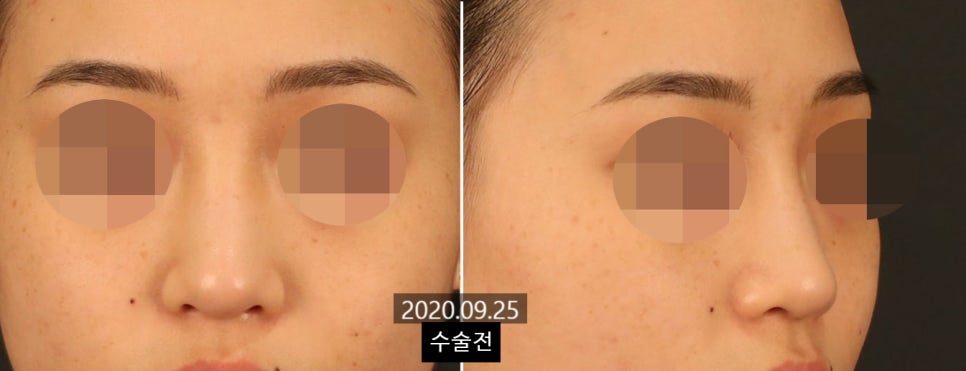
Bridge augmentation + tip plasty + osteotomy + bulbous nose correction (before surgery)
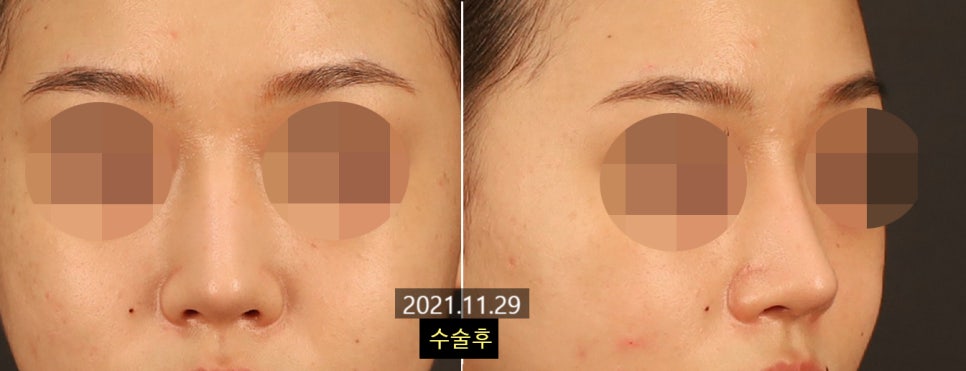
Bridge augmentation + tip plasty + osteotomy + bulbous nose correction (1 year and 2 months after surgery)
One type that tends to show changes relatively well after nose surgery is when the skin on the nose feels soft and flexible to the touch.
In such cases, the skin has some room, so it tends to respond more flexibly to adjustments in tip design or height during surgery.
That means there are fewer limitations when it comes to achieving the desired line.
On the other hand, if the skin is firm and thick,
the skin may feel tighter when raising the tip or adjusting the shape,
so sufficient consultation and planning are needed in terms of design and long-term support.
Also, if the skin is too thin, the outline of an implant or cartilage may become visible,
so it is important to design with each person’s appropriate skin thickness and elasticity in mind.
- When the bridge bone is high and narrow
First nose surgery, hump nose + bulbous nose + septal extension + cartilage repositioning + cartilage suturing (before surgery, 2020.03.27)
First nose surgery, hump nose + bulbous nose + septal extension + cartilage repositioning + cartilage suturing (10 days after surgery, 2020.04.06)
Sometimes the nasal bridge is already relatively high, but the tip looks lower in comparison.
In these cases, it is often that ① the bridge is high, ② the width of the nasal bridge is narrow,
and ③ a hump is also present on the bridge.
At times like this, the surgery may be planned in a way that shaves down the hump to refine the bridge line,
and also adjusts the height and angle of the tip to create a smoother and more harmonious overall nose line.
Because the bridge is already somewhat high, in some cases
an implant-free rhinoplasty using only the patient’s own cartilage may be considered,
and natural changes may appear depending on the individual nose structure.
On the other hand, when the bridge is low and the nose is wide,
there may be certain limitations in adjusting height or reducing width.
A wide nasal bone can be narrowed through osteotomy,
but since bone has the tendency to return toward its original position,
the change after surgery may feel relatively modest.
Also, if the bone width is narrowed too much, it can affect the internal structure,
so the surgical plan must also take functional aspects such as airway 확보 into account.
For these reasons, when the bridge bone already has a certain height and the nose is narrow,
it may work more favorably for line adjustment during surgery,
and from the front, it can also create a more balanced impression.
- When the tip is not thick
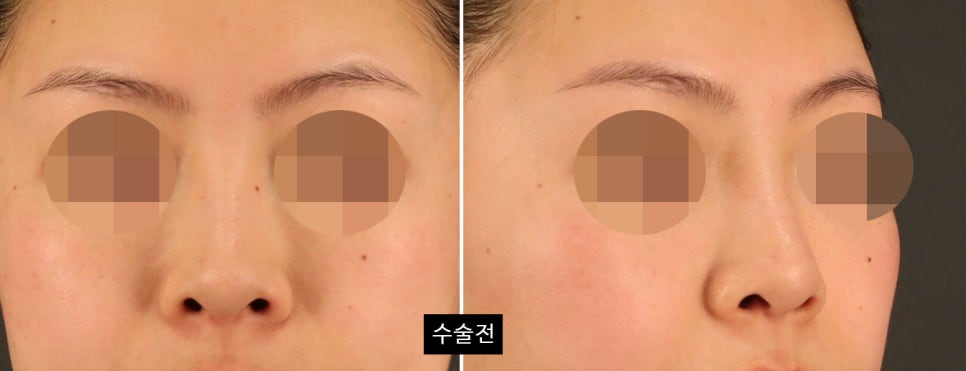
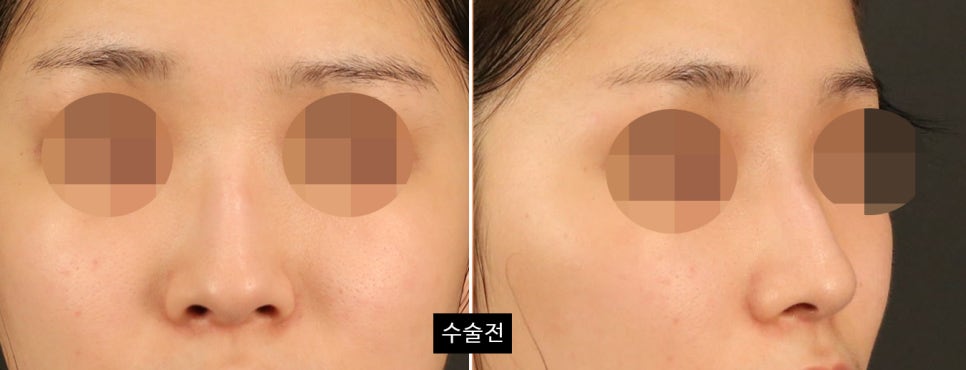
First nose surgery, short nose + septal extension + cartilage repositioning + cartilage suturing + nostril correction (before surgery, 2020.05.18)
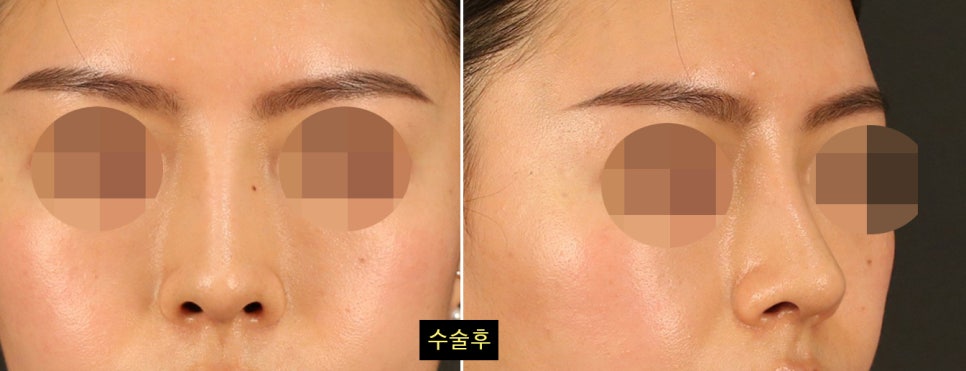
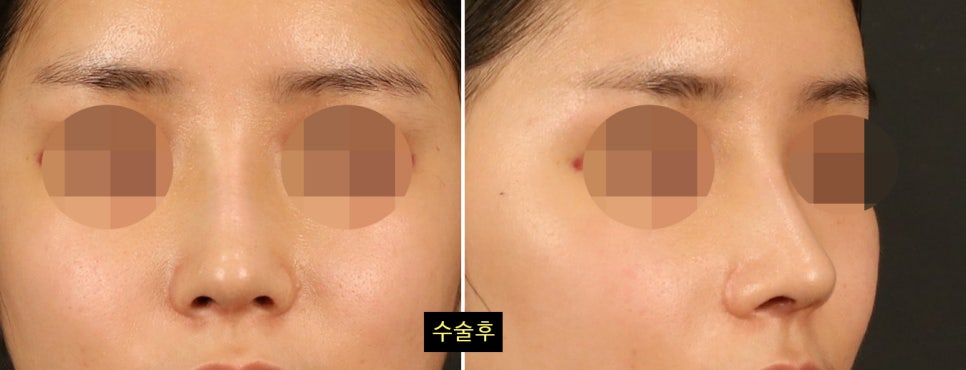
First nose surgery, short nose + septal extension + cartilage repositioning + cartilage suturing + nostril correction (2 months after surgery, 2020.07.06)
If the skin on the nasal tip is thick, the desired shape may not show clearly even after surgery.
In such cases, improvement may be attempted by removing some of the soft tissue inside the tip, such as fat or muscle,
in order to reduce volume,
but if the epidermis and dermis themselves are thick, it is difficult to reduce that part as well,
so there may be some limitations in how clearly the tip shape can be expressed.
On the other hand, when the skin on the nasal tip is moderately thin,
the design intended through surgery may show more clearly,
and in many cases a more three-dimensional shape can be expected.
- When the area between the eyebrows is low and flat
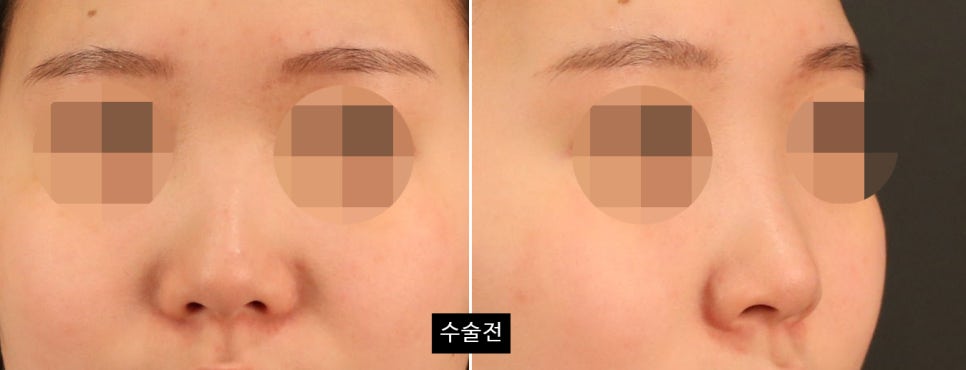
First nose surgery, bulbous nose + short nose + septal extension + cartilage repositioning + cartilage suturing (before surgery, 2020.01.21)
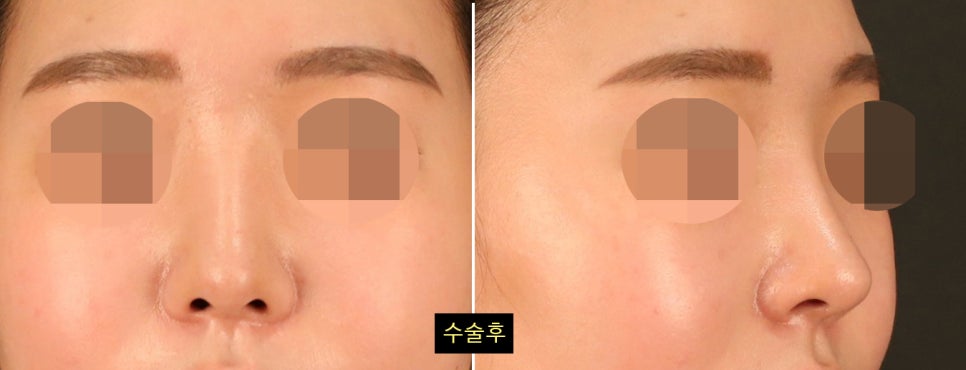
First nose surgery, bulbous nose + short nose + septal extension + cartilage repositioning + cartilage suturing (8 months after surgery, 2020.09.24)
When the area between the eyebrows is low and flat, facial features may appear less three-dimensional.
In such cases, even adjusting the nose height by about 3 to 4 mm
can make the overall facial impression feel more three-dimensional,
so the difference before and after surgery often feels relatively noticeable.
Today, we briefly looked at what are commonly called "facial types that show changes well with rhinoplasty."
That said, this does not mean that people who do not fall into the conditions above will not benefit from surgery.
In reality, it is rare for all of the conditions described above to be present,
and in most cases, a surgical plan is made through detailed examination and analysis.
Using 3D-CT scans and other evaluations, the nasal bone, septal cartilage, the thickness and shape of the skin and soft tissue, and any asymmetry are assessed,
and the patient’s current nose condition and desired image are considered together.
Because individualized surgery is performed, including harmonious line design and implant selection,
if a plan suited to the individual is made, a satisfying outcome can be expected.
※ Depending on the individual, side effects such as inflammation, bleeding, and nerve damage may occur, so sufficient consultation with medical staff before surgery is necessary.
The image is provided to help with understanding.