In the past, when people talked about eye surgery, it was often mainly limited to double eyelid surgery.
Recently, however, in addition to double eyelid surgery, procedures such as ptosis correction and canthoplasty
are often performed together depending on a person’s eye shape, concerns, and desired improvements.
Among them, dual canthoplasty (outer canthoplasty + lower canthoplasty)
may be considered for cases where the horizontal length of the eyes is short or the outer corners are turned upward,
making the impression appear somewhat sharp,
and it is drawing more interest from people who want a softer and more refreshed eye shape.
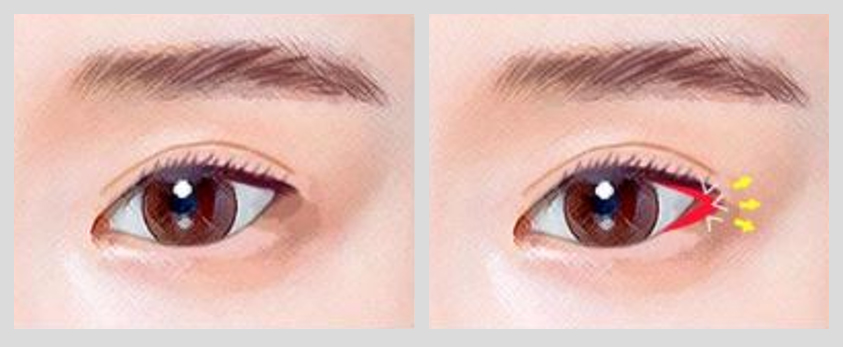
Example of dual canthoplasty
Source: TS Plastic Surgery website
Dual canthoplasty is a procedure that combines outer canthoplasty and lower canthoplasty,
and it naturally widens the expandable area on the outer side of the eyes through a skin incision.
Not only does it create the visual effect of widening the horizontal length of the eyes,
but as the upward outer corner line is adjusted downward,
the overall eye shape can give a softer and gentler impression.
When can dual canthoplasty be considered?
- When the outer corners of the eyes are turned upward, making the eye shape look sharp
- When the outer side of the eyes is blocked, making the field of vision or overall impression look cramped
- When the horizontal length of the eyes is short and a more refreshed impression is desired
In the cases above, dual canthoplasty may be helpful,
and in practice, there are many cases where it is performed together with double eyelid surgery or ptosis correction.
This is because rather than applying only one method,
a combination of approaches can help more naturally adjust the balance and impression of the eyes.
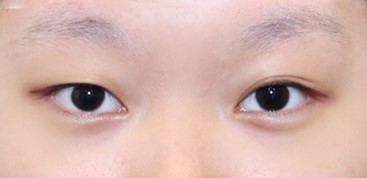
Natural adhesion + dual canthoplasty (before surgery 2017.12.02)
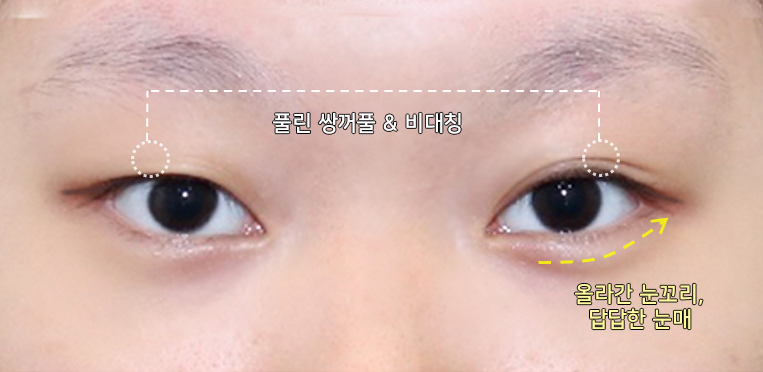
Natural adhesion + dual canthoplasty (before surgery 2017.12.02)
Preoperative condition:
- Eye asymmetry 2) Loose double eyelid line 3) Sharp impression due to upward outer corners
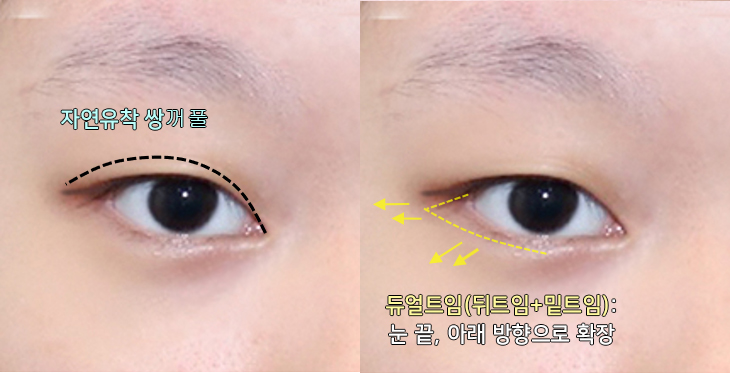
Natural adhesion + dual canthoplasty (before surgery 2017.12.02)
Customized diagnosis:
Natural adhesion method + dual canthoplasty (outer canthoplasty + lower canthoplasty)
The double eyelid line was naturally created through the natural adhesion method,
and dual canthoplasty was performed together to adjust both the outer corner line and the horizontal length.
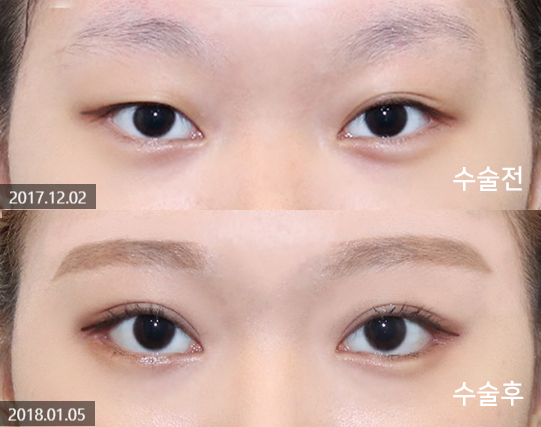
Natural adhesion + dual canthoplasty (1 month and 4 days after surgery)
Compared with before surgery, it can be seen that the eye shape has improved to look softer and more refreshed.
Before/after comparison
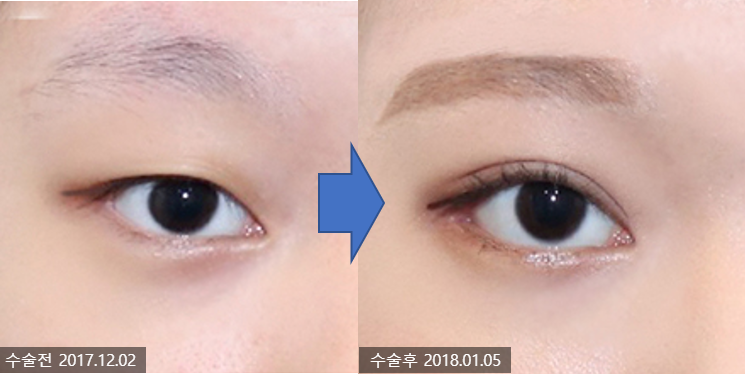
Natural adhesion + dual canthoplasty (1 month and 4 days after surgery)
→ In cases like the above, where the eyes look small and cramped,
a procedure that combines canthoplasty rather than double eyelid surgery alone
may help create a more natural and defined overall eye impression.
- Other dual canthoplasty before/after cases -
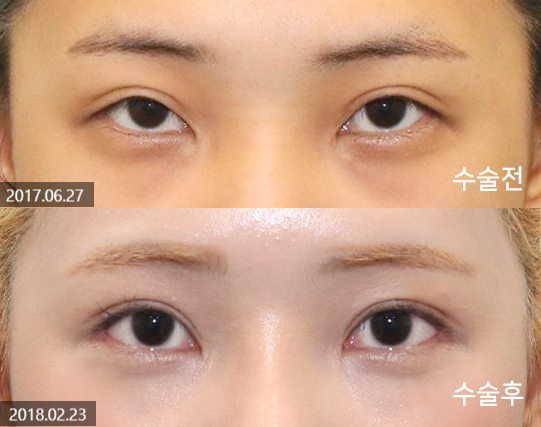
Incisional double eyelid surgery + incisional ptosis correction + dual canthoplasty (8 months after surgery)
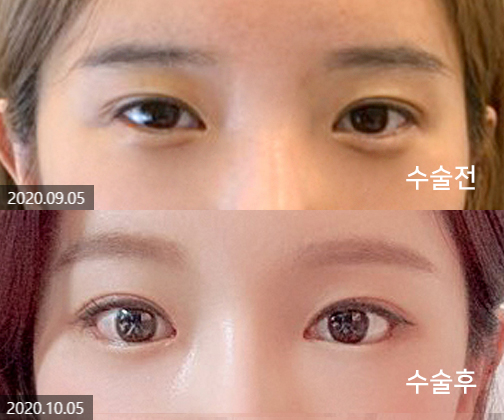
Dual canthoplasty + lower eyelid fat repositioning (1 month after surgery)
Q. Why are outer canthoplasty and lower canthoplasty performed together?
When outer canthoplasty is performed alone, the degree of expansion at the outer corner line may be limited,
so the change in the eye shape may feel relatively small.
In particular, as in the case above, when the outer corners are turned upward,
or when both the horizontal and vertical dimensions of the eyes are narrow and create a cramped impression,
dual canthoplasty, which combines outer canthoplasty and lower canthoplasty, may be considered a more suitable method.
Because the outer and lower sides are expanded at the same time, the eyes may appear larger and clearer,
and by naturally adjusting the curve under the eyes,
a softer and more stable overall impression can be encouraged.
The eyes are an area that greatly affects first impressions,
and even a small difference of 0.1 mm in shape, size, or the position of the outer corners
can change the appearance.
As much as surgery can be expected to improve the eye shape,
if unexpected results such as excessive correction, scarring, or asymmetry occur,
some people may also feel psychologically burdened.
Because canthoplasty is a relatively small-area procedure that still requires precise adjustment,
consultation with a specialist who has a high level of clinical experience and understanding of eye-shape analysis should come first
in order to establish a surgical plan suited to the individual.
Through this, the possibility of unnecessary revision surgery can be reduced,
and more satisfactory results may be expected.
※ Depending on the individual, side effects such as inflammation, bleeding, or nerve damage may occur, so sufficient consultation with the medical staff is necessary before surgery.