When meeting someone, the first area that catches the eye is the eyes.
Although the eyes are a relatively small part of the face,
even minor changes in shape can have a major impact on the overall impression and atmosphere.
So when the results after eye surgery are satisfying,
you can feel not only an aesthetic change but also a significant boost in confidence.
On the other hand, if the desired results are not achieved,
it can actually deepen complexes about the eyes
or make you feel psychologically withdrawn.
Extreme Eye Revision Review (1)
Pre- and post-operative changes in a patient with severe skin deficiency, asymmetry, and lagophthalmos
Today, among eye revision surgery cases,
I’d like to review the before-and-after course of a difficult type often called an “extreme eye.”
It was a complex case accompanied by skin deficiency, severe asymmetry, and lagophthalmos.
When several issues exist at the same time like this,
careful planning is needed from the very beginning,
mand the surgeon’s experience and skill become the most important points.
Through this case, let’s look at how a complex eye revision surgery is performed and how it changes.
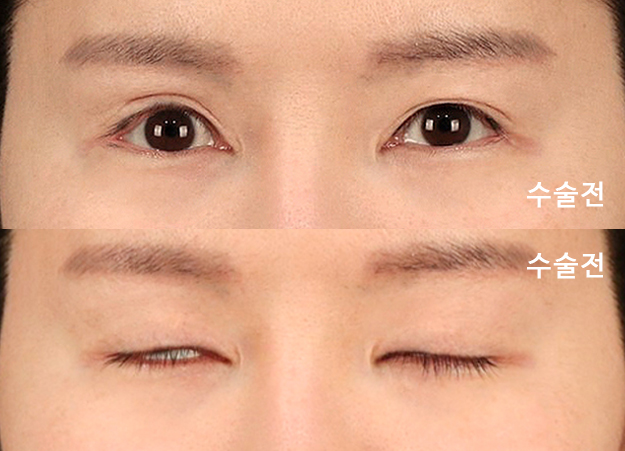
Incisional eye revision + asymmetric incisional ptosis correction + dual canthoplasty (pre-op 2020.11.05)
The patient had undergone multiple revision surgeries while moving between hospitals,
but came in experiencing major discomfort both aesthetically and functionally
because the asymmetry was severe and the eyes did not close well.
In cases like this, where left-right asymmetry is pronounced and skin contracture is severe,
simply refining the double eyelid line is not enough.
It is necessary to balance the eye shape itself while also sufficiently releasing the contracture
in order to secure the missing skin laxity,
so the surgery can become quite challenging.
When performing revision surgery, you should not look only at the double eyelid line;
you must comprehensively consider various factors such as
- the thickness of the line, 2. the amount of skin laxity, 3. levator function, and 4. the degree of globe protrusion.
In particular, extreme eye revision cases like this patient’s
are entangled with multiple problems caused by previous surgeries,
so it is difficult to predict the outcome with 100% certainty.
Therefore, in many cases, it is difficult to achieve complete improvement with just one surgery.
Like carefully untangling a knotted thread one strand at a time,
a step-by-step process is needed to resolve the various problems caused by the prior surgery.
In such cases, it may be difficult to fully correct every problem with a single operation,
so it is very important to fully consider that two to three surgeries may be needed and to set up a surgical plan accordingly.
With a meticulous plan that prioritizes safety, it becomes possible to move closer to a satisfying result.
Incisional eye revision + asymmetric incisional ptosis correction + dual canthoplasty (pre-op 2020.11.05)
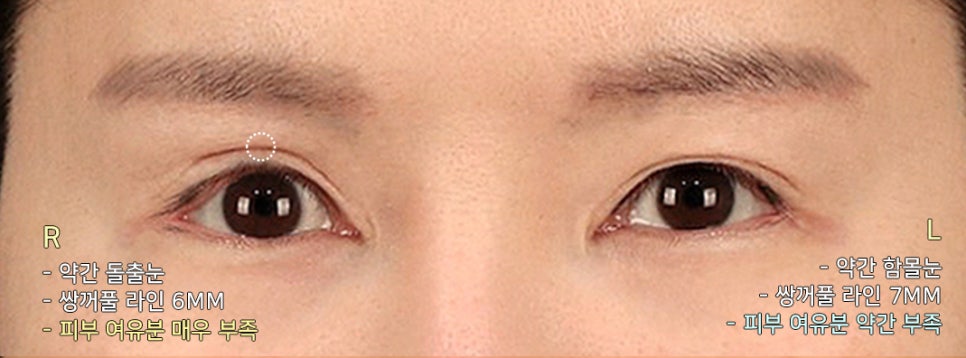
| First, if we analyze the patient’s preoperative condition in detail: 1. The line on the right side appears relatively thicker, while the left side looks somewhat thinner. 2. After measuring the skin laxity, the skin on the right eye is lacking by about 2 mm or more. 3. Levator function is evaluated to be within the normal range. 4. In terms of globe protrusion, the left eye shows a slightly sunken appearance, while the right eye is relatively more protruded. |
When the actual double eyelid thickness was measured, the right side was 6 mm and the left side was 7 mm,
but visually the right double eyelid looked thicker.
This was because too much skin had been excised during the previous surgery, leaving about 2 mm of skin deficiency on the right eye.
The left eye did not have abundant skin laxity either, but it can be considered relatively better than the right side.
Also, the right eye showed overcorrection, making it appear wide-eyed,
while the left eye felt as though it opened less, so the balance between both eyes needed to be corrected.
Therefore, the surgical plan needed to slightly relax the right eye opening and slightly raise the left eye opening.
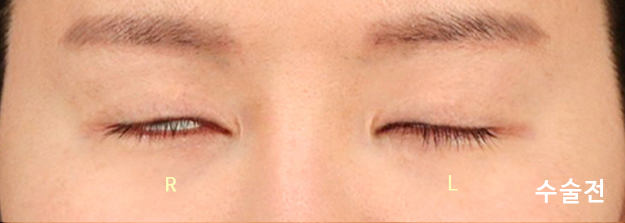
Incisional eye revision + asymmetric incisional ptosis correction + dual canthoplasty (pre-op 2020.11.05)
Looking at the closed-eye photo, the right eye does not fully close even when the patient tries to shut it forcefully.
This was also a problem caused by excessive skin excision in the previous surgery,
and it required correction by sufficiently releasing the contracted skin so the eyes could close as comfortably as possible.
<The slightly protruded right eye compared with the slightly sunken left eye>
The revision surgery plan was established while comprehensively considering these structural differences in the eyes.
Carefully analyzing the anatomy of the eyes and the issues caused by the previous surgeries,
and designing the optimal surgical approach based on that, is the core of revision surgery.
Incisional eye revision + asymmetric incisional ptosis correction + dual canthoplasty (pre-op 2020.11.05)
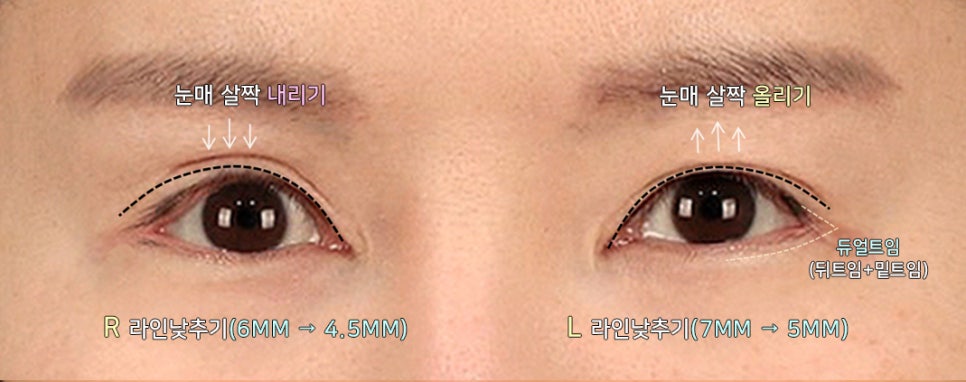
<Double eyelid revision>
Left side: designed from 7 mm → 5 mm
Right side: designed from 6 mm → 4.5 mm
Because the skin contracture on the right eye was severe, it needed to be released, and since the eyeball was slightly protruded,
even with the same height, it looked much higher than the left side, so the line had to be lowered more to correct it.
<Ptosis correction revision>
The left side was slightly raised and the right side was slightly relaxed.
※ What does ptosis correction mean here?
It refers to surgery that controls the lifting force of the eyelid muscle to increase the amount of the iris exposed.
▼ After the first surgery ▼
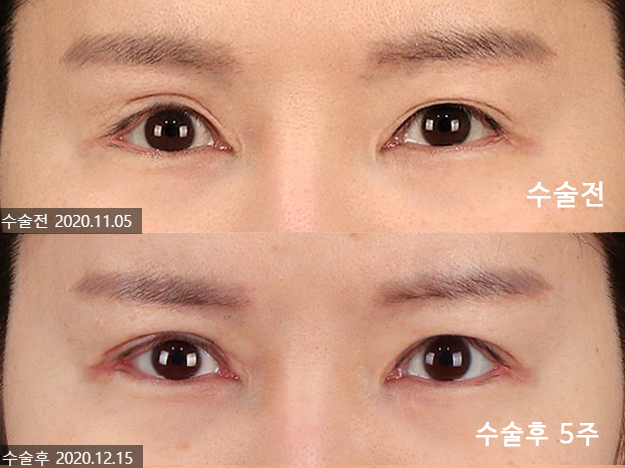
Day 5 after surgery: after the first operation, the overcorrected state of the right eye improved significantly,
and the skin contracture was also released, making the double eyelid line look more natural.
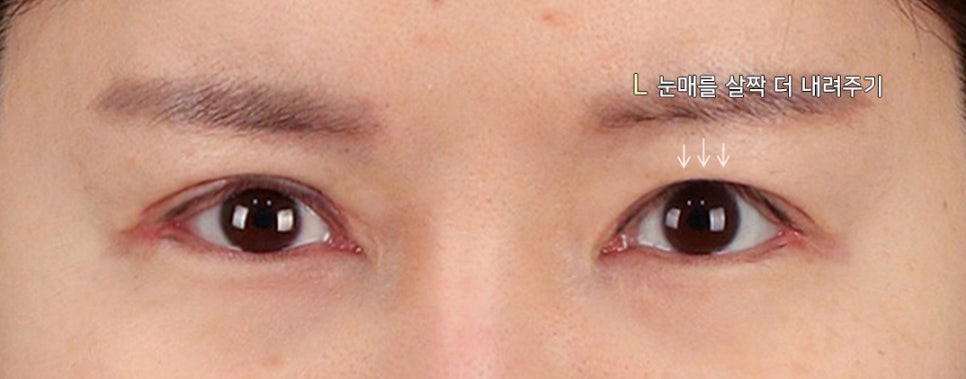
Incisional ptosis correction performed (2020.12.15 after first surgery)
However, in the case of ptosis correction, the right eye was relaxed a bit more,
while the left eye was raised slightly,
but when looking at the photo about a month later, the left eye seemed to have been lifted a bit more,
so a second surgery was performed to slightly lower the left eye opening and match this subtle difference.
▼ After the second surgery ▼
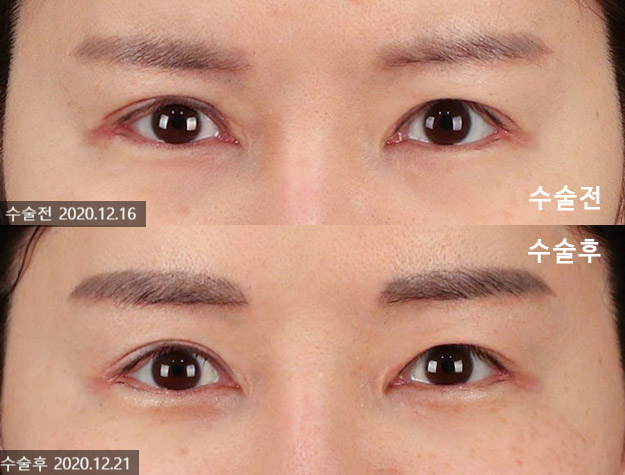
Incisional ptosis correction performed (Day 5 after second surgery, 2020.12.21)
In the five-day post-op photo after the second surgery, the left eye opening had become softer and more comfortable,
and the symmetry between the left and right eyes had improved considerably.
However, even though the left double eyelid line was designed to be slightly thicker than the right,
it tended to look relatively thinner to the naked eye.
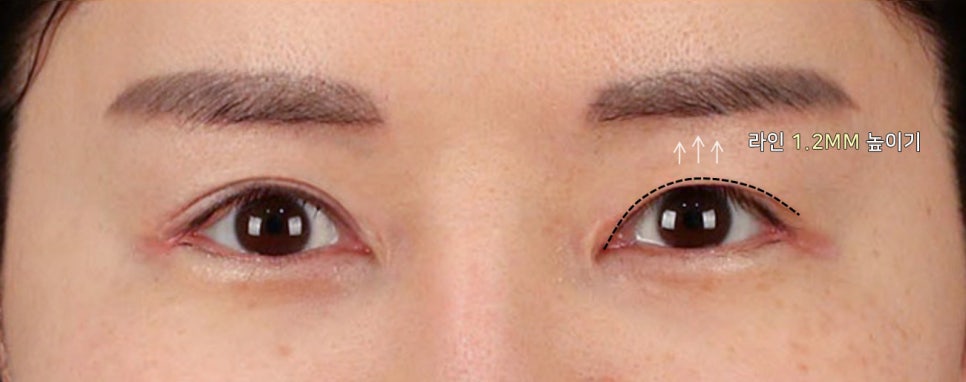
Incisional ptosis correction performed (Day 5 after second surgery, 2020.12.21)
After six months post-op, the thickness of the double eyelid line was measured accurately,
and the final surgery was performed to slightly raise the left double eyelid by about 1.2 mm.
▼ Comparison after the third surgery ▼
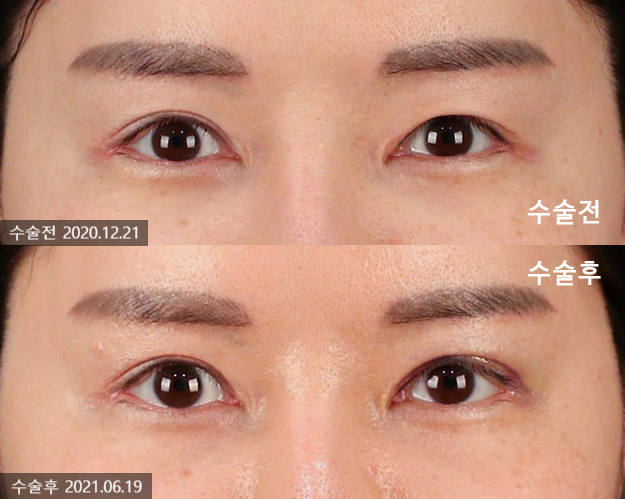
▼ Six months after the third surgery ▼
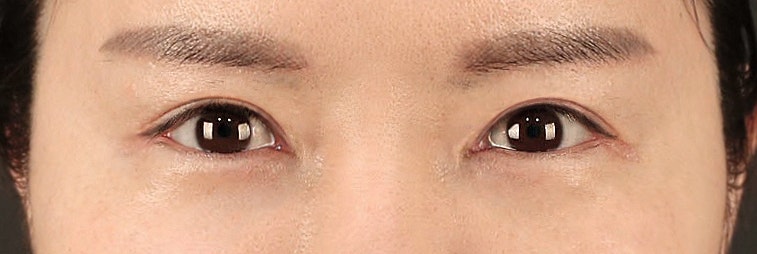
Incisional eye revision performed (6 months after the third surgery, 2021.12.19)
Compared with before surgery, it is clear that the asymmetry of the line and eye opening has improved.
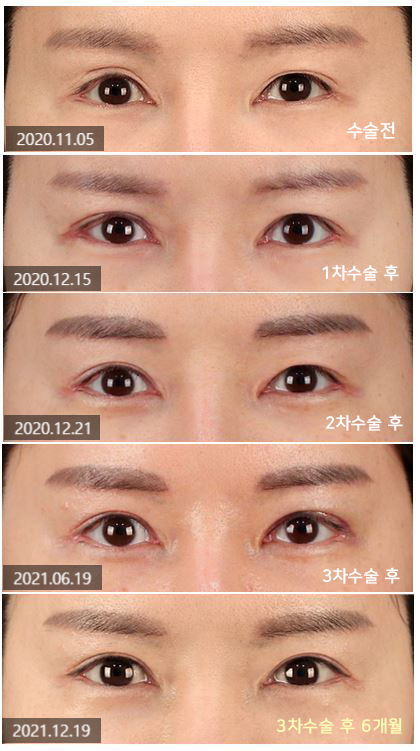
Changes through the 1st, 2nd, and 3rd surgeries
In particular, in the right eye, where the skin contracture was severe,
satisfactory improvement was achieved with just the first surgery.
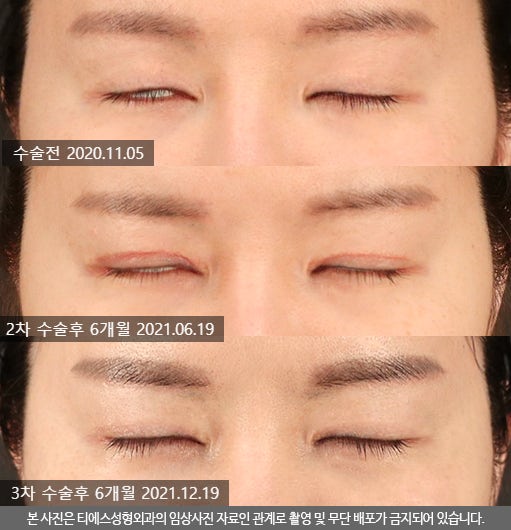
Changes through the 1st, 2nd, and 3rd surgeries
The eye that could not fully close even when forced shut
was able to close much more comfortably after surgery.
▼ One year after the final surgery ▼
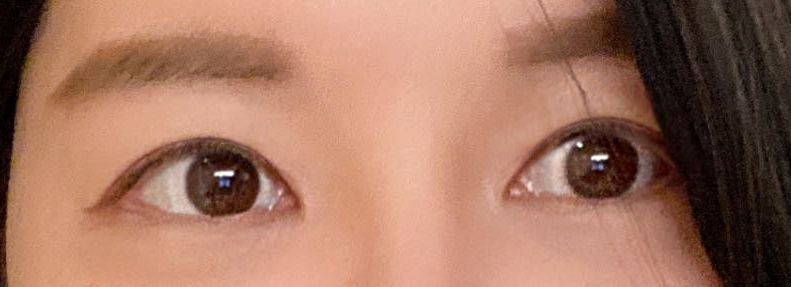
2022.06.19 (1 year after the third surgery)
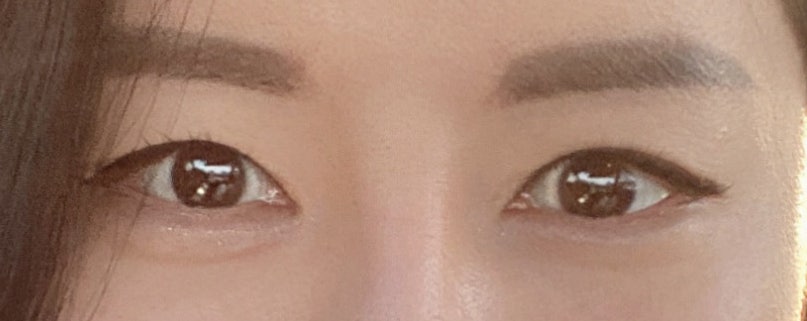
2022.06.19 (1 year after the third surgery)
The patient also said they were very satisfied that the eye opening became more natural after surgery,
and that opening and closing the eyes became much more comfortable than before.
When consulting about revision surgery, there are also people who have lived for a long time with both cosmetic and functional difficulties in their eyes.
There are also cases where people come in after hearing from several hospitals that revision surgery would be difficult,
so as a plastic surgery specialist, I often feel sorry.
However, even if there are limits to the current condition of the eyes, improvement can still be expected through an accurate diagnosis and a customized surgical plan.
Please do not give up just because it is an extremely difficult case,
and I recommend having a thorough consultation with a medical team that has extensive revision surgery experience.
※ Depending on the individual, side effects such as inflammation, bleeding, and nerve damage may occur, so sufficient consultation with the medical team before surgery is necessary.