One of the most common reasons people consider revision eyelid surgery is dissatisfaction with the double-eyelid line.
Not only the shape of the double eyelid, such as in-line, out-line, in-out line, or semi-out line, but also cases where the line is set too low or too high and feels excessively thick can lead patients to consider revision surgery.
In particular, when the double-eyelid line is formed too high,
there are many cases where the eyelid skin does not have enough excess, so the range that can be excised is limited.
In such cases, revision surgery can be performed using a “double-line method.”
Following the complex revision eyelid surgery case introduced last time,
today I will review the improvement process of a patient who had been uncomfortable due to an excessively high and thick double eyelid after surgery.
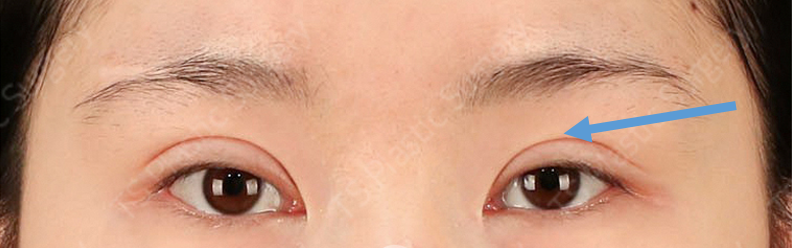
Incisional revision eyelid surgery + asymmetric incisional ptosis correction + dual epicanthoplasty (before surgery, 2021.02.20)
First, if we analyze the patient’s preoperative condition in detail, it is as follows.
- The double-eyelid line is formed high overall, and the thickness is clearly noticeable, making it look overly thick.
- The pupil exposure is relatively insufficient at about 60%, giving the impression that the eyes are not fully opened.
- The outer corners of the eyes are turned upward, and because the white of the eye is less visible at the outer corners, the eyes may appear somewhat constricted.
- Looking at the area marked by the arrow, it can be seen that the tissue above the eye is being pulled upward, creating the appearance of reduced fat.
In such cases, there is a risk of double-fold lines forming during the double-line method, so caution is needed.
Taking these points into consideration, when performing the double-line method, the approach of also repositioning fat above the eye is selected.
Some people worry that repositioning fat above the eye may make it look puffy,
but since the fat is distributed very thinly during surgery, there is no need to worry about that.
Let’s look at this patient’s recovery stages.
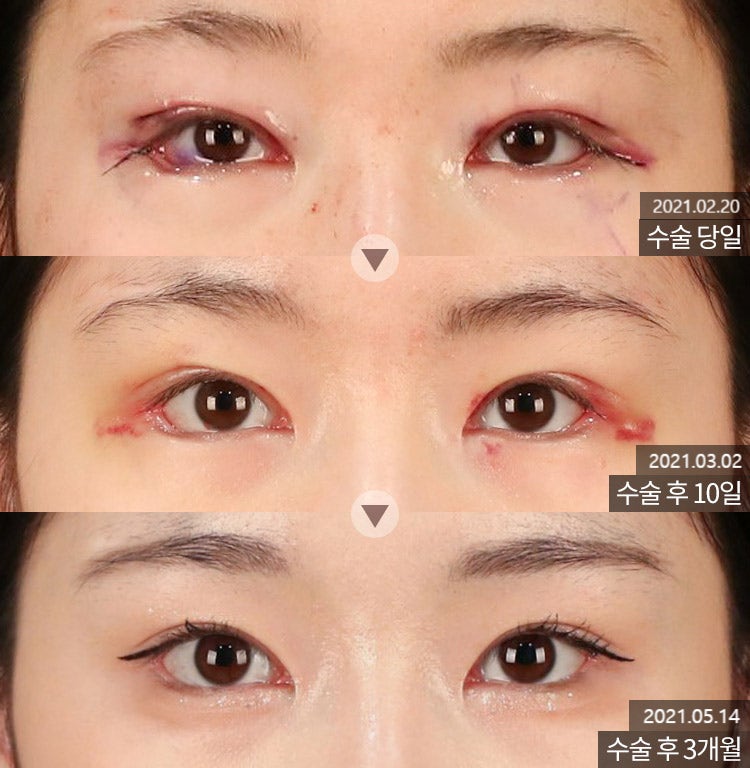
Incisional revision eyelid surgery + asymmetric incisional ptosis correction + dual epicanthoplasty in progress
If you look at the photo taken on the day of surgery, both eyes have swelling and bruising,
but the high and thick double-eyelid line from before surgery has settled down stably,
and the repositioning of fat above the eye appears to have been performed naturally and well.
As the amount of pupil exposure increased, the eye shape became more defined.
The dual-epicanthoplasty area performed together may appear somewhat different on each side because of the initial swelling and bruising, but
In the photo from day 10, when much of the swelling had subsided, the left and right sides were well balanced,
and the outer corner area that had looked constricted could be seen opening up more clearly.
In addition, the thick impression felt in the preoperative double-eyelid line had improved considerably.
However, at 10 days after surgery, some residual swelling was still present, so there was still a slightly puffy feeling.
By about 3 months after surgery, most of the swelling had gone down, and the double-eyelid shape settled into a more natural appearance.
The eye shape also became clearer, and the dual-epicanthoplasty area appeared neat and refined without a pinched look.
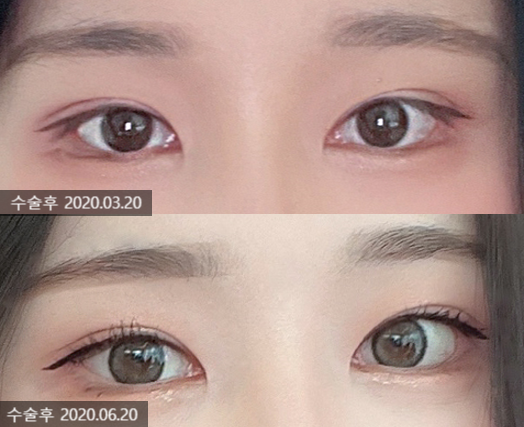
Incisional revision eyelid surgery + asymmetric incisional ptosis correction + dual epicanthoplasty in progress (1 month post-op, 3 months post-op)
Looking at the recovery process through the selfies sent by the patient,
at 1 month after surgery, a slight amount of swelling remained, but the double-eyelid line looked relatively natural and stable.
Also, in the 3-month selfie, with even more swelling gone, the double-eyelid line can be seen settling into a more natural and attractive shape.
After the double-line method surgery
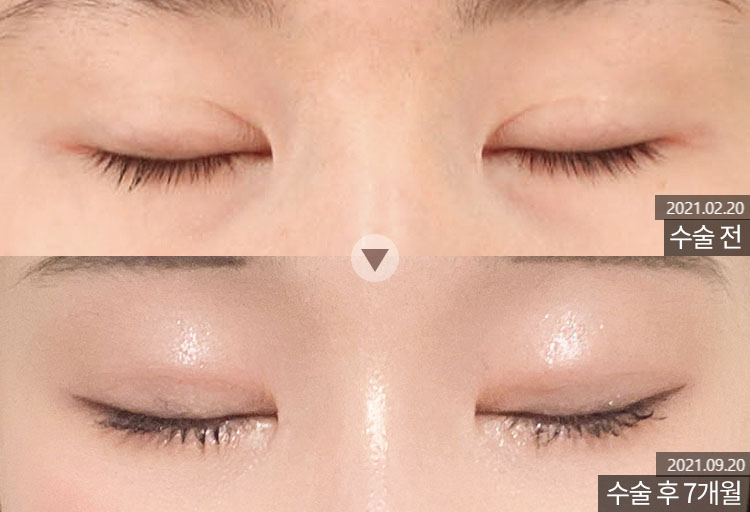
Scar
The part patients ask about and worry about most in double-line surgery is the scar.
In particular, there are many questions about the scar from the existing double-eyelid line and how the line changes.
As you can see in the post-op photos, the original line has faded and is almost unnoticeable.
In this surgery, the overlapping scar area, which is characteristic of the double-line method, was naturally spread out,
and fat above the eye was delicately repositioned to prevent the formation of double folds.
As a result, even 10 months after surgery,
the double-eyelid line remained naturally maintained without double folds.
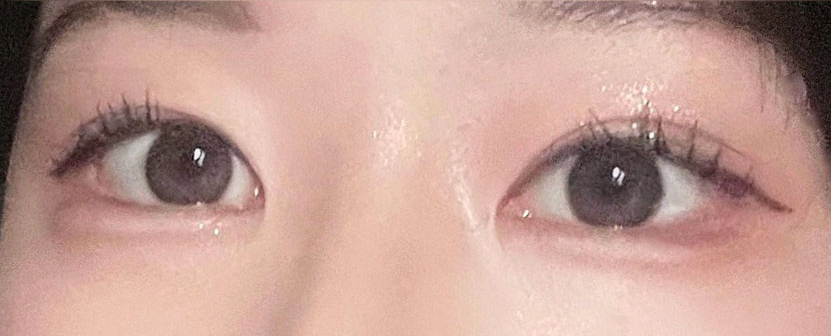
Incisional revision eyelid surgery + asymmetric incisional ptosis correction + dual epicanthoplasty in progress (10 months post-op, 2021.12.20)
Postoperative swelling
In general, major swelling after surgery subsides mostly within about 3 to 4 weeks,
but residual swelling remains for a longer period of time.
The time when residual swelling completely disappears varies from person to person, but in general, it can last up to about 1 year after surgery.
In particular, scar lines gradually fade over time,
and they can continue to improve even more than 1 year after surgery.
Therefore, rather than making a rushed judgment, it is better to observe the progress over enough time.
Summary of the case of sausage-eye double-line surgery, ptosis correction, and dual epicanthoplasty
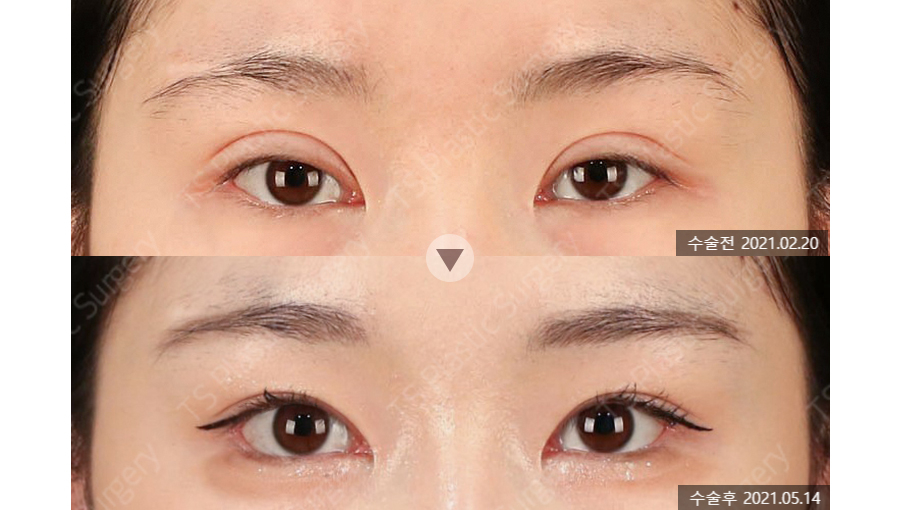
Incisional revision eyelid surgery + asymmetric incisional ptosis correction + dual epicanthoplasty in progress (3 months post-op)
Through the double-line method, the existing high and thick double-eyelid line was lowered, improving the unnatural sausage-like shape.
Through fat repositioning above the eye, the fat was spread thinly and evenly to help prevent double folds from forming.
Through ptosis correction, the pupil that had been exposed by about 60% before surgery was increased to 80–90%, correcting the eye shape to look clearer.
Through dual epicanthoplasty, the visible white of the eye that had looked constricted was widened, and the previously short horizontal length was extended while gently lowering the upward-tilted outer corners,
improving the impression to a more refreshed look.
As in the patient case introduced today, even high and thick sausage-like double eyelids can be sufficiently improved through the double-line method.
There is no need to have vague fear or worry about the double-line method.
Also, the double-fold issue often cited as a drawback of the double-line method can be prevented by repositioning fat above the eye, so a more stable result can be expected.
If you are struggling with sausage-like double eyelids or a constricted eye shape, we recommend visiting for an in-person consultation.
※ Because side effects such as inflammation, bleeding, and nerve damage may occur depending on the individual, sufficient consultation with medical staff before surgery is necessary.