In the past, plastic surgery was not as widely accepted as it is today,
so many people preferred improvements that looked as natural as possible, without making it obvious that they had surgery.
However, with recent changes in trends, more people now want a more glamorous and sophisticated line, whether for the eyes or the nose.
In consultations especially, many people say they want a nose shape with a refined and glamorous feel, like aespa’s Karina,
and many bring celebrity photos as references.
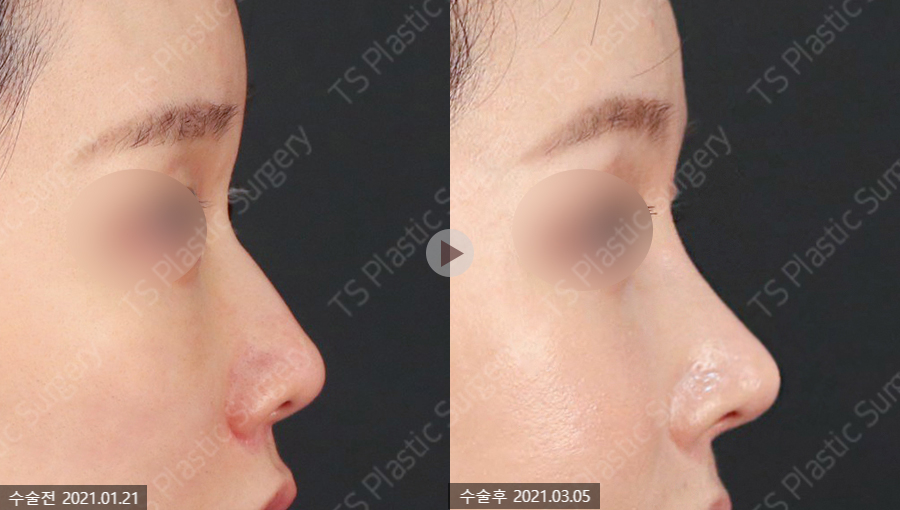
Primary rhinoplasty: septal extension + cartilage repositioning + cartilage tying (1 month and 2 weeks after surgery)
Even if you prefer a glamorous and high nose,
if it does not harmonize with the face and looks awkward or unnatural, satisfaction may be low.
Conversely, even if you want a natural surgical result,
you would not want it to look almost unchanged from before surgery.
The tip of the nose is the most protruding part of the face,
and the shape and height can change the overall impression of the face,
so rhinoplasty of the nasal tip is an important factor that affects satisfaction with nose surgery.
Then, to create a glamorous nose line,
is it enough to simply raise the nasal tip?
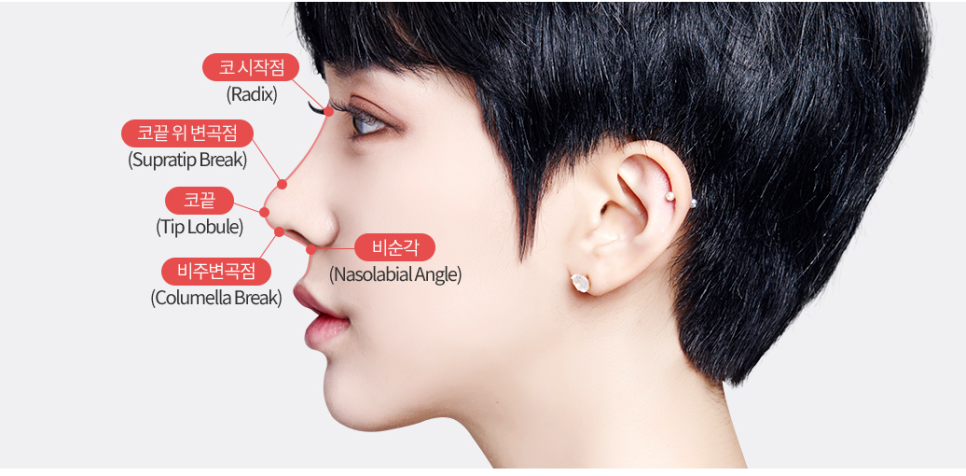
Source: TS Plastic Surgery website
To achieve a glamorous rhinoplasty result, it is important to consider five major angles.
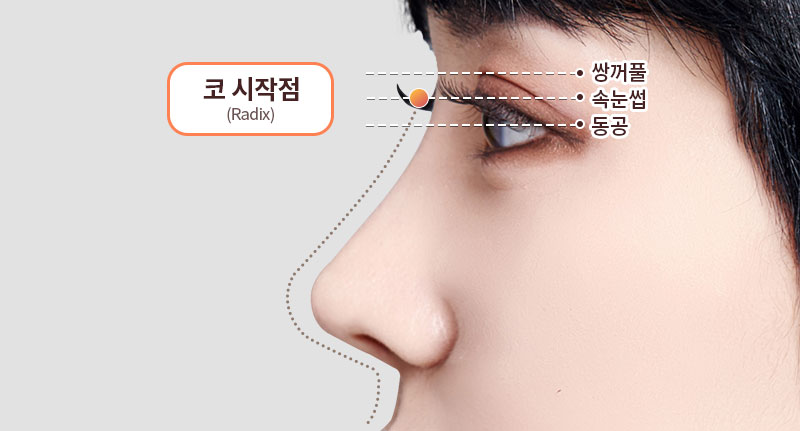
Source: TS Plastic Surgery website
First, the starting point of the nose refers literally to the point where the nose, that is, the nasal bridge, begins.
Generally, if the starting point of the nose is formed at the level of the pupils, the nasal bridge appears natural.
If the starting point is lower than the pupils, the nose appears relatively low,
if it starts around the eyelashes, it can be seen as a moderately high nose,
and if it rises to about the double-eyelid line, it can be considered a higher nose line.
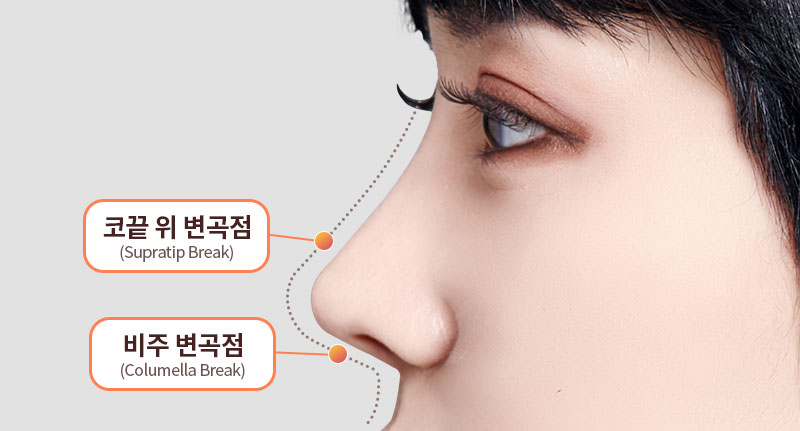
Source: TS Plastic Surgery website
Next, the inflection points above the nasal tip and at the columella are also very important,
and the line of the nose, such as straight, slightly straight, or half-curved, is determined by the inflection point above the nasal tip.
Since the line changes the image conveyed by the face,
it is advisable to choose one while considering the overall facial mood of the patient.
Also, some people may be unfamiliar with the columellar inflection point.
The columellar inflection point refers to the point where the part descending from the nasal tip to the columella is bent.
If the columellar inflection point is formed, the nasal tip can appear higher while not looking overly upturned.
It creates a high nasal tip without making the nostrils excessively visible,
and can give the whole nose a refined impression.
On the other hand, if the nasolabial angle and nasal tip are directly connected without a columellar inflection point,
the nasal tip may appear upturned, that is, like a button nose,
and the overall nose shape may feel less sophisticated and somewhat old-fashioned.
Therefore, if you want a higher and more refined nose shape,
the presence or absence of a columellar inflection point is also an essential factor to consider.
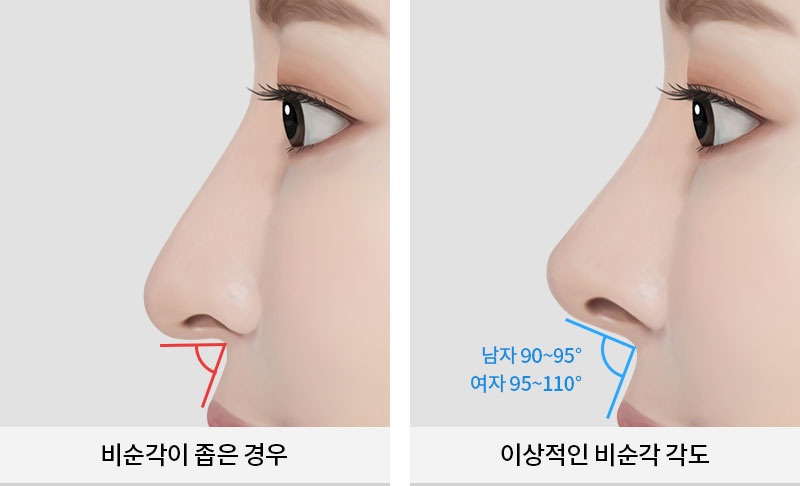
The last one is the nasolabial angle.
Source: TS Plastic Surgery website
The nasolabial angle refers to the angle where the philtrum and the nose meet.
In general, an appropriate range is about 95–110 degrees for women and 90–95 degrees for men.
If the nasolabial angle is too small, it may create an impression that the mouth is relatively protruded,
and the nasal tip may appear drooped or the nose may look longer.
Conversely, if the nasolabial angle is too large, the nasal tip may appear upturned and can give an impression similar to a button nose,
so in some cases, surgery to adjust the nasolabial angle is also considered.
By fully considering these five angles of the nose when planning surgery,
it can help complete a nose line that is closer to the desired image.
In particular, many surgical plans involve raising the height of the nose while adjusting the angles,
and to build up the nasal tip, the columella must be able to provide sufficient support.
This is because a sturdy columella is advantageous for maintaining a high nasal tip.
It is ideal to firmly support the nasal tip using 충분한 septal cartilage,
but the amount of septal cartilage available for use can be limited from person to person.
In such cases, one option is rib cartilage.
For this reason, when people want a glamorous nose line,
many consider surgery using rib cartilage.
Rib cartilage is a material with excellent support and durability,
and it has the advantage of helping to firmly build the nasal tip and maintain its shape over time.
Rib cartilage can be broadly divided into donated rib cartilage and autologous rib cartilage.
Autologous rib cartilage uses the patient’s own tissue, so it can be seen as a relatively stable material,
but over time it may develop a bending phenomenon called warping.
In addition, a separate operation is required to harvest the rib cartilage, and scars may remain at the harvest site.
To address these drawbacks,
we use the 10th rib cartilage and make an incision of only about 2 cm,
performing the surgery in a way that minimizes scarring.
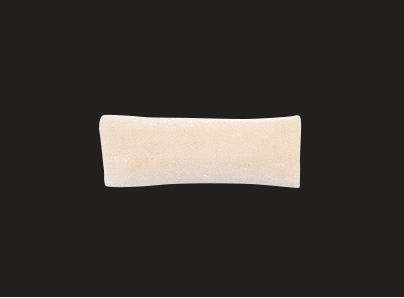
Donated rib cartilage
Source: TS Plastic Surgery website
On the other hand, donated rib cartilage has the advantage of allowing rib cartilage material to be used without leaving a scar on your own body.
For people who find the separate procedure of harvesting rib cartilage burdensome,
or who are sensitive about scars, rhinoplasty using donated rib cartilage can be one option.
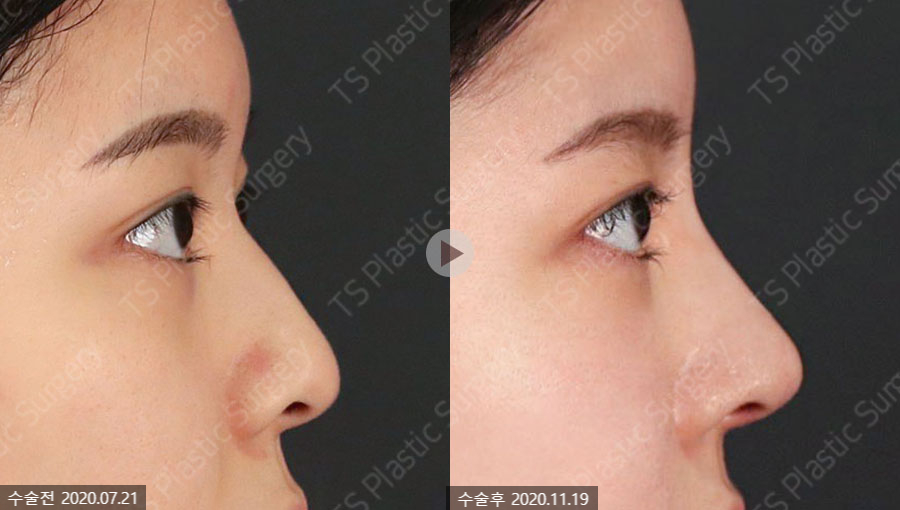
Primary rhinoplasty: septal extension + cartilage repositioning + cartilage tying (4 months after surgery)
Rhinoplasty is a surgery in which the line and shape change depending on the angles.
Also, the nasal materials used to achieve these angles are diverse,
and since each material has its own characteristics, advantages, and disadvantages,
it can be said that this is a surgery where personalized planning is more important than anything else.
Even when using rib cartilage to build a high, glamorous nose,
if the surgery is performed with overall facial harmony in mind,
it can be completed naturally without any awkward or unnatural feeling at all.
Conversely, natural rhinoplasty using septal cartilage or ear cartilage can also
create a refined yet naturally appearing nose if the angles are carefully adjusted during surgery.
Before surgery, be sure to consult thoroughly with the medical team about the nose line, the materials used in surgery,
and how the shape of the nose changes depending on the angles, before making a decision,
so that you can expect a more satisfying surgical result.
※ Because side effects such as inflammation, bleeding, and nerve damage may occur depending on the individual, sufficient consultation with the medical team is necessary before surgery.
The images are examples to help with understanding.