Extreme eyes can be classified into the following cases.
-
When there is not enough skin, causing contracture
-
When the eyelid-opening muscle is excessively tightened, or conversely, when the muscle strength is insufficient
-
When there is insufficient fat on the inside of the eyelid, causing many double folds
The case I’m reviewing today is the second type: an overcorrection case related to the eyelid-opening muscle.
One of the side effects people worry about most during eyelid correction is “overcorrection.”
I will explain in detail how an overcorrected eye shape can be improved.
Overcorrection
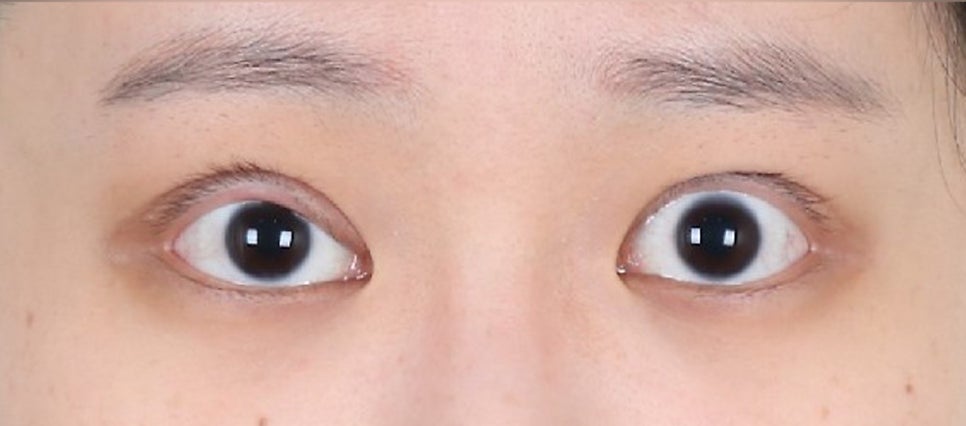
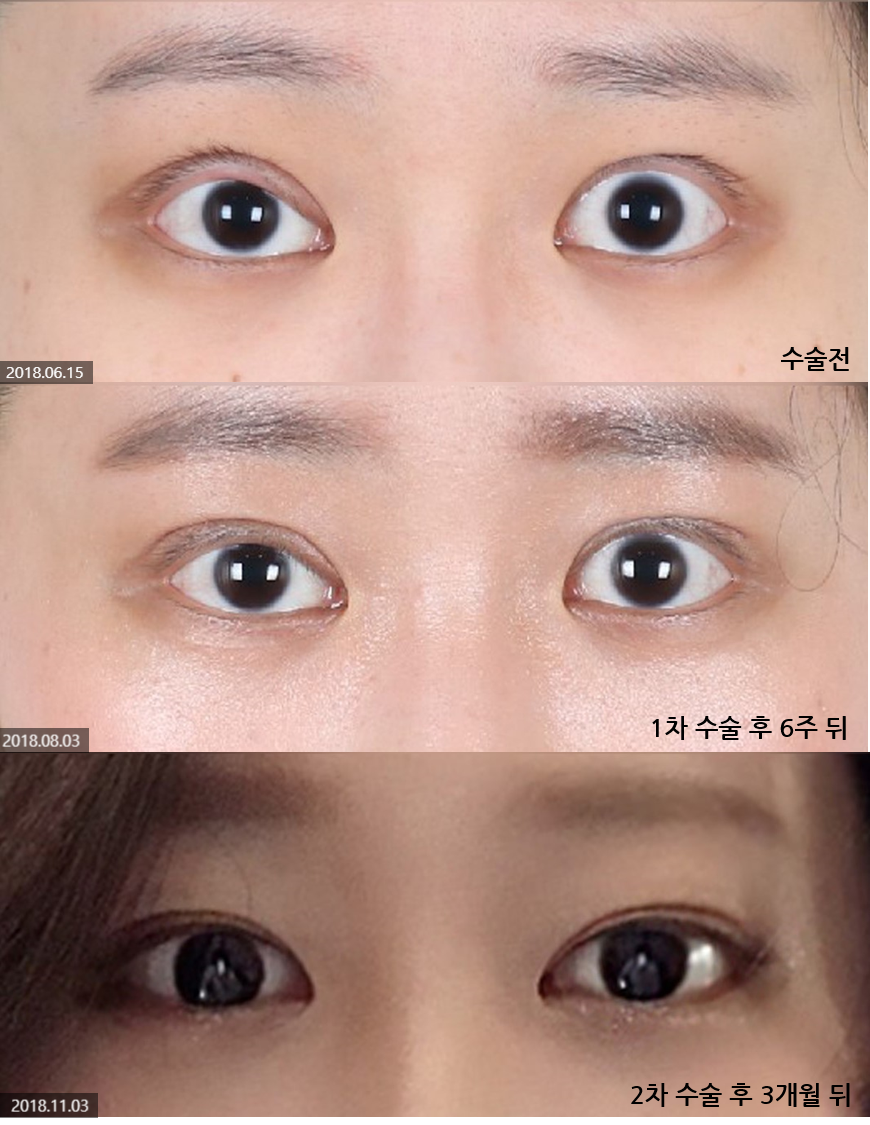
Incisional double eyelid surgery + incisional eyelid correction performed (Pre-op, 2018.06.15)
A normal eye usually has about 10–20% of the iris covered by the eyelid.
Eyelid correction is a surgery that increases the exposure of an iris that is covered more than this, making the eyes look clearer and more defined.
However, when the iris is exposed 100% after eyelid correction, or even the white of the eye becomes visible because the eyes are opened too much, this is called “overcorrection.”
This is outside the normal range and requires caution.
How to Improve Overcorrection
Overcorrection that can occur after eyelid correction should be judged by observing the changes in the eye shape during the so-called “golden time,” about 3–4 weeks after surgery, when most of the major swelling has gone down.
If overcorrection is suspected at this point, improving it through corrective surgery right away is effective.
Eyelid correction is broadly divided into two methods.
-
A method that ties the muscle
-
A method that removes part of the muscle
In particular, when eyelid correction is performed using the method of tying the eyelid-opening muscle,
revision within the golden time makes it much easier to improve overcorrection.
So, in eyelid correction surgery, most procedures are performed using the method of tying the eyelid-opening muscle.
At the follow-up visit around 3–4 weeks after surgery,
we carefully check for any changes in the eye shape and cautiously determine whether overcorrection is present.
Then, if the golden time is missed and the overcorrected state has been maintained for a long time,
how can it be improved?
In this case, surgery to lengthen the eyelid-opening muscle is needed.
To lengthen the muscle, the adhesions in the surgical area must first be carefully released,
and then the length of the eyelid-opening muscle must be increased.
However, once a muscle has adhered, it is not easy to release,
and even after the adhesions are freed, the area may re-adhere and shorten again.
In such cases, overcorrection may recur, so
careful surgical planning and skilled technique are required.
Overcorrection Case Review
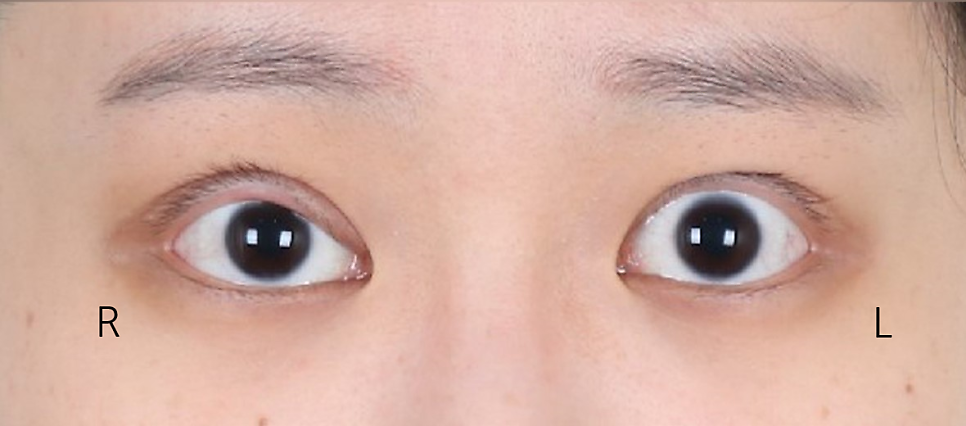
Incisional double eyelid surgery + incisional eyelid correction performed (Pre-op for first surgery, 2018.06.15)
Looking at the patient’s condition,
-
Severe overcorrection was present in the left eye (L), and the right eye (R) also had mild overcorrection.
-
The mucosa was lifted, and the double eyelid had a sausage-like appearance
-
Asymmetry in the thickness of the double eyelid line
-
Asymmetry in eye size (eye shape)
and other complex issues were observed.
At the same time, we established a surgical plan to correct the asymmetry in both eye size and the double eyelid line.
In particular, the focus was on removing the unnecessarily puffy sausage-like appearance
and refining the double eyelid line to create a more natural-looking eye shape.
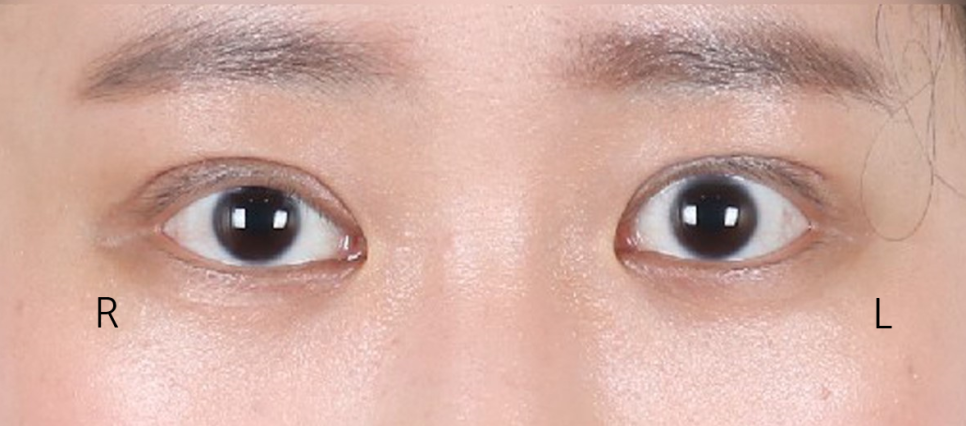
Incisional double eyelid surgery + incisional eyelid correction performed (6 weeks after first surgery, 2018.08.03)
When comparing the before-and-after photos at 6 weeks, when the major swelling had subsided somewhat after the first surgery,
the lifted mucosa had come down significantly and the sausage-like appearance had been removed,
and the double eyelid line had also settled in stably.
However, the two eyes were still not perfectly symmetrical,
and in the left eye (L), the iris was still 100% exposed,
showing that the overcorrection had not yet been fully corrected.
As explained earlier, this is why it is difficult to reverse eyelid correction after the golden time has passed.
It is because the released muscle can adhere again or be pulled upward again, causing overcorrection to recur.
In this patient’s case as well, the released muscle re-adhered, so the overcorrection was not fully improved.
Accordingly, a second surgery was performed at the 6-week point to further release the overcorrection in the right eye (as shown in the photo).
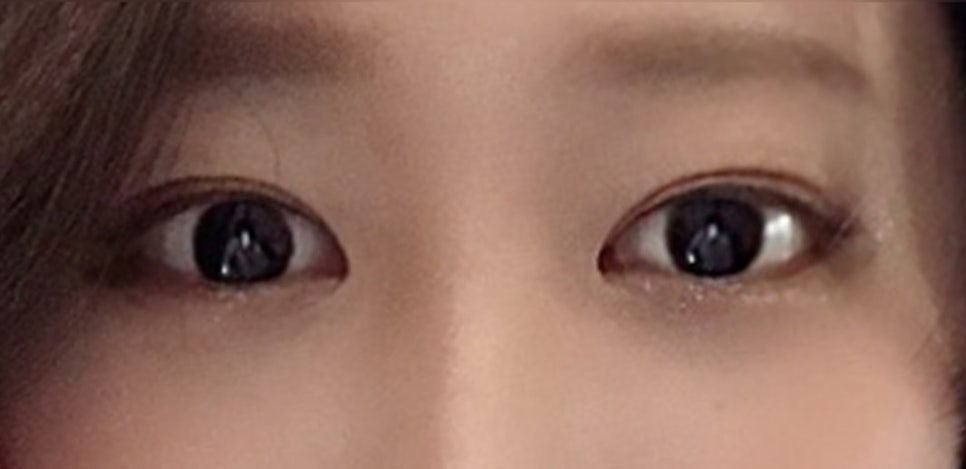
Incisional eyelid correction performed (3 months after second surgery, 2018.11.03)
The left and right sides of the iris became symmetrical, and the double eyelid line also settled in naturally.
Through two surgeries, the overcorrected eye was improved into a more natural form.
When improving overcorrection, timing is very important.
After overcorrection occurs, it is desirable to perform corrective surgery as soon as possible, usually within 3–6 weeks,
and no later than 2 months.
If corrective surgery for overcorrection is performed after 2 months,
adhesions may become firmly established, making the surgery more difficult and complex.
As in this patient’s case, the surgery may not be completed in one procedure,
and more than two surgeries may be necessary.
How can you find a clinic that does overcorrection correction surgery well?
Overcorrection correction surgery is one of the most difficult types of eyelid plastic surgery.
Even for board-certified plastic surgeons, this is not a field that everyone can perform confidently,
so it is important to choose an experienced medical team.
During the consultation, it is good to check whether the medical team carefully evaluates the patient’s eye condition
and clearly explains the current overcorrection.
It is also an important factor whether they explain the surgical method and the expected progress with confidence.
In addition, you should check whether the function of the eyelid-opening muscle is measured precisely.
When overcorrection has occurred or the function of the eyelid-opening muscle is reduced,
it is very important to assess whether the muscle’s basic function is being maintained before planning surgery.
Whether precise measurement of muscle function is performed is an important point to confirm during consultation.
However, these details are difficult to determine online unless you meet the medical team in person through an actual consultation.
If you are considering surgery to improve overcorrection or to release eyelid correction,
we recommend visiting several clinics in person for consultations and comparing the medical team’s explanations and approach.
※ Because side effects such as inflammation, bleeding, and nerve damage may occur depending on the individual, sufficient consultation with the medical team before surgery is necessary.