Many people who have sunken upper eyelids or multiple eyelid folds often seek consultation while considering upper eyelid fat grafting.
The reason the upper eyelids may look sunken can be congenital, with naturally little fat in the area, but it can also occur as fat decreases with age. In addition, if too much fat is removed during surgery, the upper eyelids can become noticeably hollowed.
When the area above the eyes becomes hollow, it may feel uncomfortable to open the eyes, or multiple folds may increase from two to three or even four.
Multiple folds can also occur because the upper eyelid appears hollow due to fat loss, but they may also appear because of skin aging. If multiple folds develop after surgery, they can result from various causes such as weakened fixation, reduced strength of the muscles that open the eyes, or excessively thin eyelids. It is important to identify the exact cause of these multiple folds and approach them with the appropriate method.
In cases of sunken eyes and multiple folds caused by fat loss, improvement methods can be broadly divided into two types: upper eyelid fat repositioning and upper eyelid fat grafting. Since the main cause is a lack of fat, the primary goal is to replenish the missing fat appropriately.
Upper Eyelid Fat Repositioning
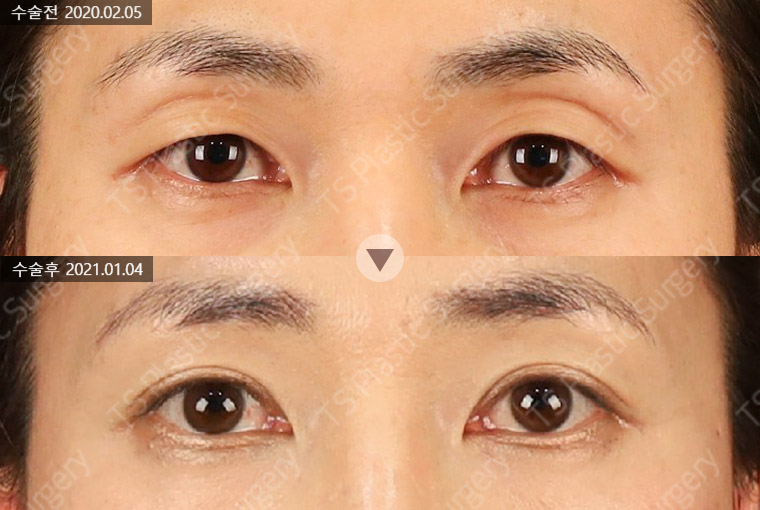
Incisional double eyelid surgery, ptosis correction, and upper eyelid fat repositioning performed (1 year after surgery)
Upper eyelid fat repositioning is a method in which, when the orbital fat in the upper eyelid has clumped upward or decreased due to surgery or aging, it is spread out as much as possible and moved down to just above the double eyelid line. This can help prevent multiple folds and keep abnormal adhesions from forming.
This method improves hollowness by repositioning the person's own upper eyelid orbital fat, so upper eyelid fat repositioning is considered first. However, if a large amount of fat has already been removed, the remaining fat may be insufficient. In such cases, fat grafting may be combined for improvement.
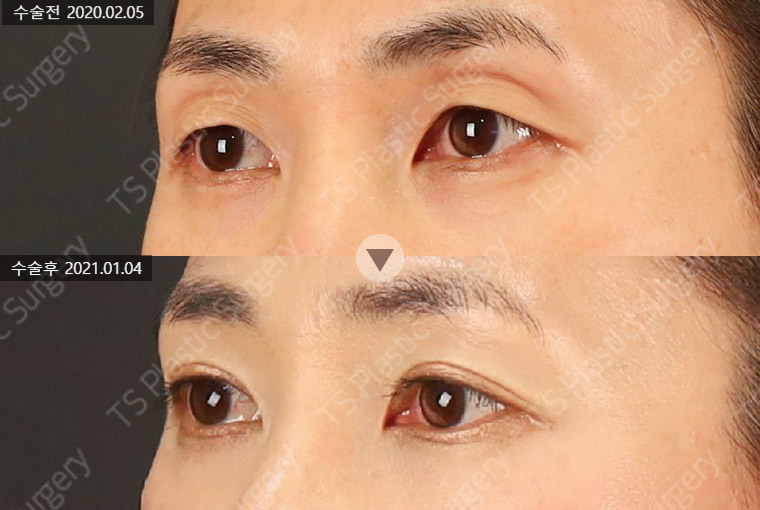
Incisional double eyelid surgery, ptosis correction, and upper eyelid fat repositioning performed (1 year after surgery)
Upper Eyelid Fat Grafting (Upper Eyelid Fat Injection)
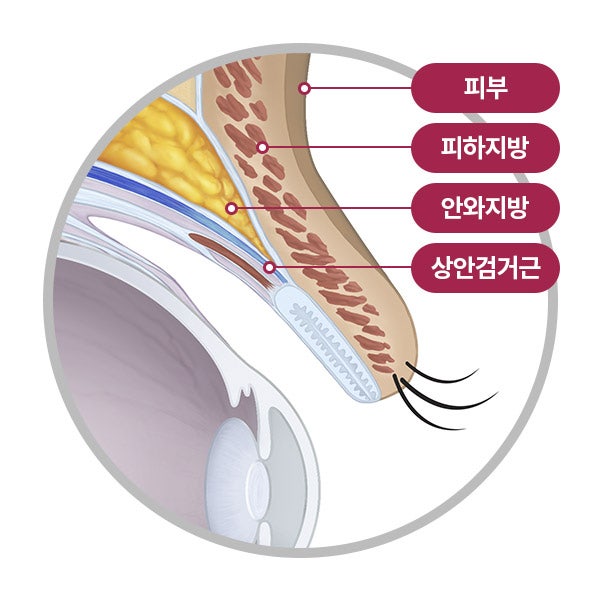
Source: TS Plastic Surgery website
Upper eyelid fat grafting is a method of transplanting fat into the fat pocket when there is not enough fat available for repositioning to bring the fat down sufficiently to just above the double eyelid line. The important point here is that the fat must be grafted precisely into the fat pocket so that it does not interfere with other tissues.
The structure of the eye is very delicate. Orbital fat exists above the levator palpebrae superioris muscle, which opens the eye, and above that are the subcutaneous fat and skin. If fat is grafted without distinguishing these layered structures, the fat may settle in the wrong place and cause deformity of the eyelid shape or functional problems.
Therefore, the process requires dissection through incisional double eyelid surgery before grafting the fat. If fat is injected only with a syringe without an incision, it may be injected into the subcutaneous fat layer, resulting in a lumpy appearance, or it may adhere to the muscle that opens the eye, causing functional problems such as ptosis, so caution is needed.
When performing upper eyelid fat grafting,
it is essential to first separate the levator palpebrae superioris muscle from the skin layer through incisional double eyelid surgery,
and then accurately graft fat into the fat pocket located between them.
Because the eyelid is made up of multiple layers,
it is most important to clearly identify the structure and precisely graft the fat into the place where it should be.
Through this careful approach, shape changes or functional problems that can occur when fat is grafted into the wrong place can be prevented.
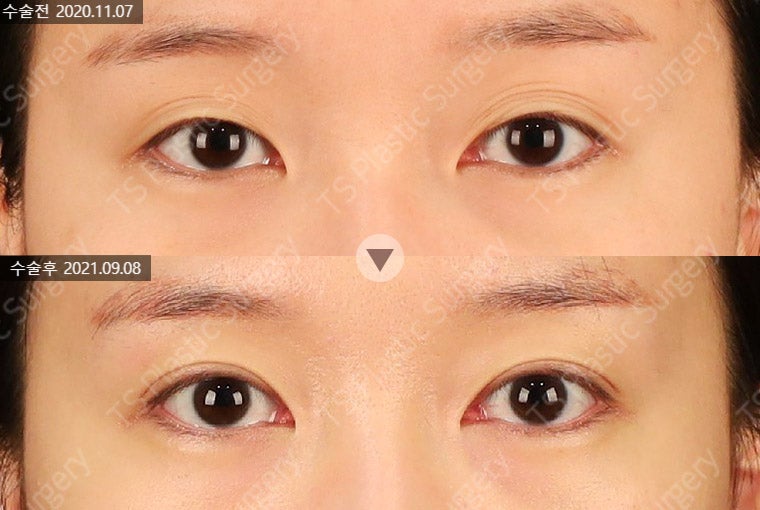
Incisional double eyelid surgery, ptosis correction, and upper eyelid fat repositioning performed (10 months after surgery)
When performing fat grafting, it is important to proceed carefully with the minimum amount possible.
If too much fat is grafted, it is difficult to remove later.
In general, hollow areas or multiple folds can often be improved sufficiently with only a small amount of fat.
If there is still not enough volume after the first grafting, additional fat grafting can be done during the recovery period within about two months after surgery.
During this period, the missing areas can be filled naturally even without an incision, allowing for a more effective final result.
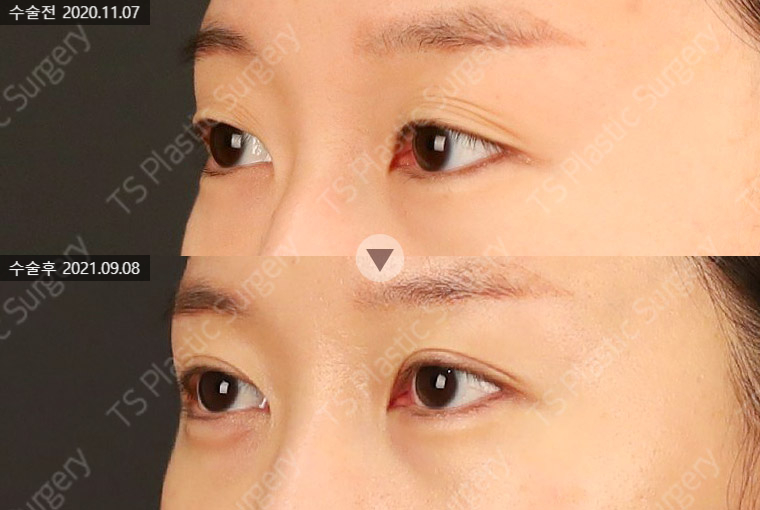
Incisional double eyelid surgery, ptosis correction, and upper eyelid fat repositioning performed (10 months after surgery)
Upper Eyelid Fat Repositioning vs. Upper Eyelid Fat Grafting: How Should You Choose?
It is not actually easy to decide simply which method is more appropriate between upper eyelid fat repositioning and fat grafting.
In practice, cases that truly require upper eyelid fat grafting are less common than expected, and it is often difficult to judge visually before surgery. Therefore, in some cases, the final decision is made after directly checking the eye structure during surgery.
When the upper eyelid is hollow and has multiple folds, it can make a person look older or tired, so many people look for different ways to improve it. However, choosing fat grafting or filler treatment simply to fill the hollow area requires caution.
If fat is injected into the wrong place, side effects may occur over time. Even if there appears to be no major problem in the short term, shape changes or functional problems may emerge after one or two years.
If the upper eyelid lacks a significant amount of fat and fat grafting is truly necessary, it is advisable to perform it together with incisional double eyelid surgery.
Also, deciding where, how much, and by what method to perform fat grafting requires extensive clinical experience and advanced skill. Therefore, it is recommended that you consult a specialist medical team with sufficient experience and expertise before carefully deciding on surgery.
※ Depending on the individual, side effects such as inflammation, bleeding, and nerve damage may occur, so sufficient consultation with the medical staff before surgery is necessary.