Male and female rhinoplasty takes different approaches, taking anatomical differences and aesthetic preferences into account.
In female rhinoplasty, soft and natural curves are emphasized,
and a straight-but-slightly-upturned line is often preferred.
On the other hand, men often want a stronger impression,
so they tend to prefer a line in which the bridge and tip connect in a straight line.
Generally, women have relatively thin skin and a delicate nasal structure, so soft curves suit them well,
while men often have thicker skin and a thicker framework, so a more defined straight nasal line can create harmony.
In addition, forming a clear T-zone that starts high between the eyebrows and connects from the brow bone to the bridge and tip of the nose can help create a balanced impression.
Source: TS Plastic Surgery website
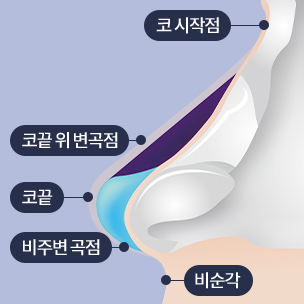
In male tip rhinoplasty, surgery is performed while considering five major angles to maximize facial dimension and harmony.
These angles play an important role in completing a strong and natural look suited to the male face.
Nose starting point
This is the point where the nose begins below the eyebrow line.
As a starting point that naturally harmonizes with the face, it is an important part that determines the overall proportion of the nose.
Supratip break
This is the inflection point connecting the bridge of the nose to the tip before the volume of the tip begins.
By appropriately designing this area, the tip does not look too sharp or too round,
allowing it to connect in a natural form.
Nasal tip
This is the end part of the nose. In male nose surgery,
the tip is often designed to be slightly pointed yet soft in order to create a natural and masculine impression.
Columella inflection point
This is the location where the inflection point is formed at the columella, the part that divides the nostrils.
It is important so that the proportion to the tip connects naturally, and this point is designed so that it does not become too pointed or angular.
Nasolabial angle
This is the angle formed by the tip of the nose and the upper lip. In general, an angle of about 90 to 95 degrees is ideal for men.
This angle is an important factor that determines the length of the nose and the balance of the entire face, and it affects the overall impression.
Male rhinoplasty is performed by comprehensively considering these five angles,
and through customized surgery tailored to each patient's facial shape and characteristics, the goal is to achieve natural results suited to the individual.
※ Because side effects such as inflammation, bleeding, and nerve damage may occur depending on the individual, sufficient consultation with the medical staff before surgery is necessary.
Example image for explanatory purposes.