Dual canthoplasty is a method that expands the horizontal width of the eyes by performing outer canthoplasty and lower canthoplasty at the same time,
and can create a softer, brighter eye shape by lowering the raised outer corners of the eyes.
This method can be especially helpful for people whose eyes look small and constricted, or whose raised outer corners make them appear sharp.
Dual canthoplasty enlarges the outer area of the eyes through a skin incision method, making the eyes look bigger,
while also lowering the outer corners to create a softer, kinder impression.
In addition, it is said to produce even better results when performed together with double eyelid surgery or ptosis correction.
�a0
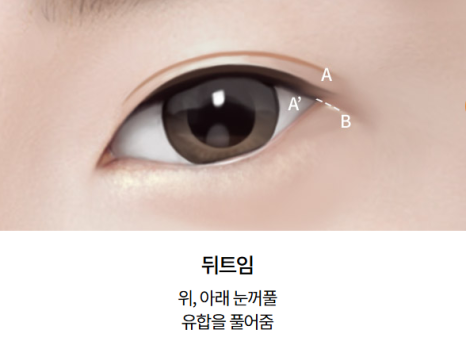
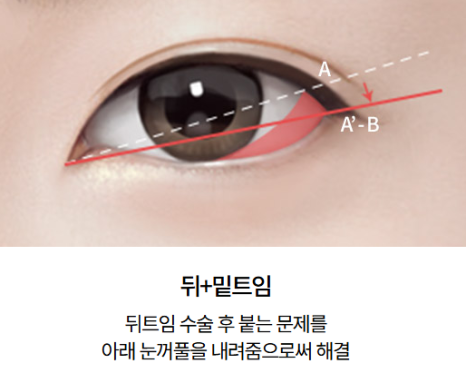
Why perform outer canthoplasty and lower canthoplasty at the same time?
Source: TS Plastic Surgery website
Reason for adhesion and recurrence prevention
�a0
The outer corners of the eyes are connected between the upper and lower eyelids, and the lower eyelid has natural elasticity.
When outer canthoplasty releases the connection between the upper and lower eyelids, the lower eyelid can move downward more easily,
and when lower canthoplasty lowers the lower eyelid and widens the angle of the outer corner of the eye,
it can help prevent adhesion problems after outer canthoplasty and maintain the result more stably.
Adhesion problems that often occur after outer canthoplasty can be improved through lower canthoplasty.
�a0
Source: TS Plastic Surgery website
Aesthetic reasons
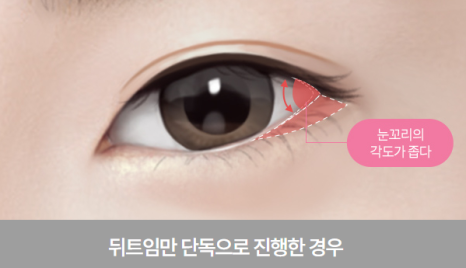
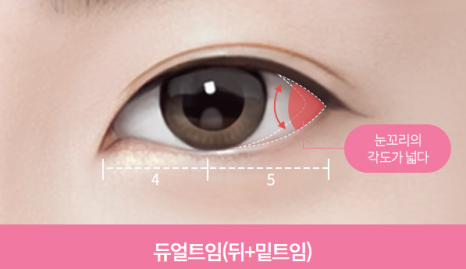
If outer canthoplasty is performed alone, there is a limit to how much the horizontal length of the eyes can be extended, so the amount of change is not very large.
However, when the outer and lower areas are expanded at the same time through dual canthoplasty, the outer corners of the eyes become naturally wider,
and the proportions of the eyes improve, creating a more harmonious and balanced eye shape.
�a0
�a0
What to expect from dual canthoplasty
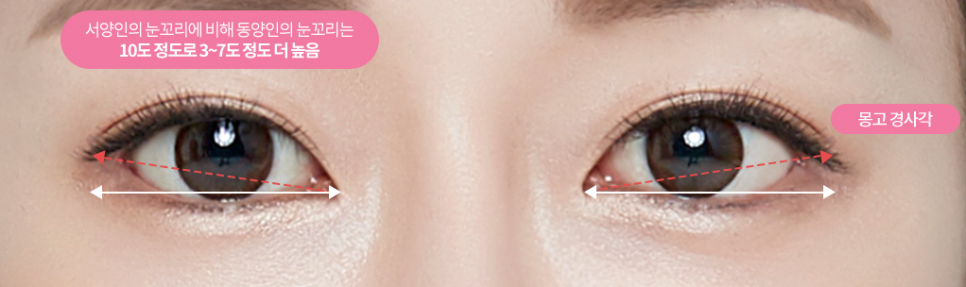
Source: TS Plastic Surgery website
Outer canthoplasty widens the horizontal length of the eyes, creating a more open and clearer eye shape,
while lower canthoplasty lowers the outer corners of the eyes to create a softer and more natural impression.
In cases where the outer corners are raised or the eyes are short in length and give a constricted impression,
performing both procedures at the same time can create a more balanced eye shape.
Dual canthoplasty is especially effective when the eyes appear small or the outer corners are raised, and performing both procedures together helps improve the proportions of the eyes and balance the overall harmony of the face.
�a0
�a0
Key point of dual canthoplasty

Source: TS Plastic Surgery website
The angle adjustment that is central to dual canthoplasty
plays a key role in achieving a natural expansion and harmony of the eye shape.
�a0
When expanding the outer area of the eyes, the angle of outer canthoplasty is carefully adjusted so that the eyes appear naturally larger,
and the slope of the outer area of the eyes is maintained to prevent excessive expansion.
�a0
Then, by adjusting the angle of lower canthoplasty, the outer corners are gently lowered to complete a natural eye shape.
The angles are set carefully so that the outer corners do not drop too far or become overextended,
allowing for a natural-looking change.
�a0
The medical team customizes the angles according to the patient's eye shape and desired eye style,
and adjusts the angles and range of both outer canthoplasty and lower canthoplasty while considering the size and proportions of the eyes,
creating a harmonious impression across the entire face.
�a0
This delicate angle adjustment is an important process that makes the eyes look larger while still giving a soft and natural impression,
and it reflects precise design and skilled technique.
�a0
�a0
※ Because side effects such as inflammation, bleeding, and nerve damage may occur depending on the individual, sufficient consultation with medical staff is necessary before surgery.
This is an example image for easier understanding.