Interest in facelifts has been rising a lot these days.
When should a facelift be considered?
Today, let’s take a look at facelifts together.
A facelift is a surgery that can be considered when sagging in the face becomes a concern as skin elasticity decreases,
so many people usually look into facelifts when they feel their skin has lost elasticity.
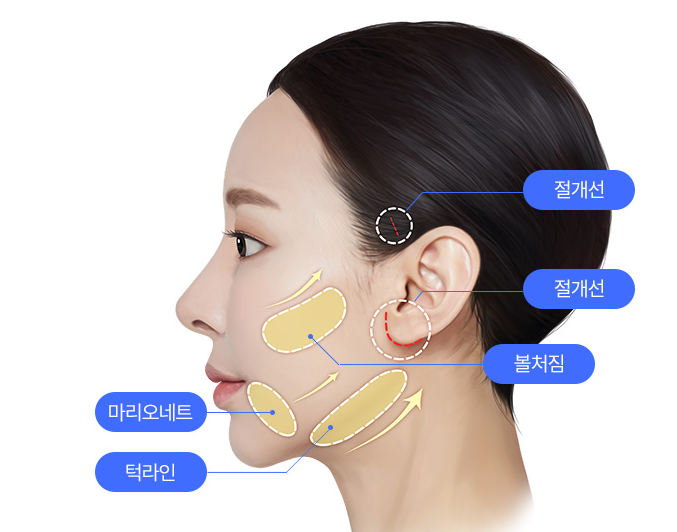
When wrinkles and sagging are severe due to decreased skin elasticity
Source: TS Plastic Surgery website
As we age, the skin and the muscle layer (SMAS) loosen,
which makes nasolabial folds and sagging around the mouth more pronounced.
In addition, the jawline gradually loses definition, and overall facial elasticity decreases.
For people with severe sagging, fillers or lifting procedures alone may have limits
in how much improvement they can provide.
One method that can be considered in cases like this is a facelift.
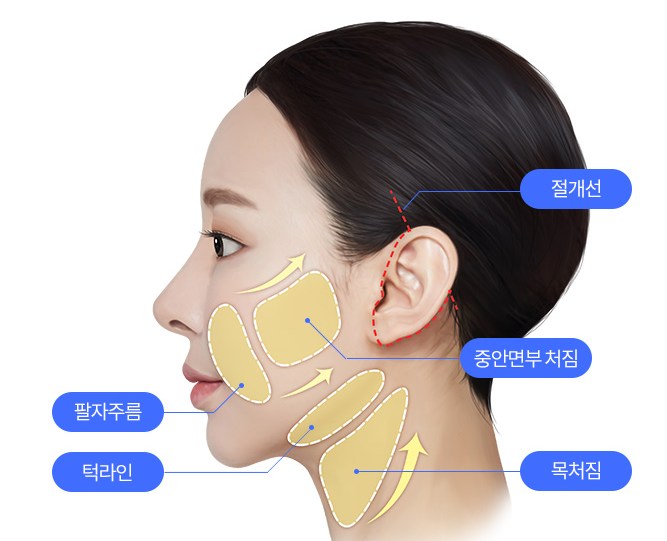
When neck wrinkles or a double chin are severe
In many cases, sagging extends beyond the midface to the neck area as well.
In such cases, it may also be worth considering a neck lift together.
When sagging extends broadly to the eye area and temples
Source: TS Plastic Surgery website
Not just simple cheek sagging, but when under-eye fat becomes more prominent or
loss of volume in the temple area gives the face an overall aged appearance,
a facelift may also be helpful.
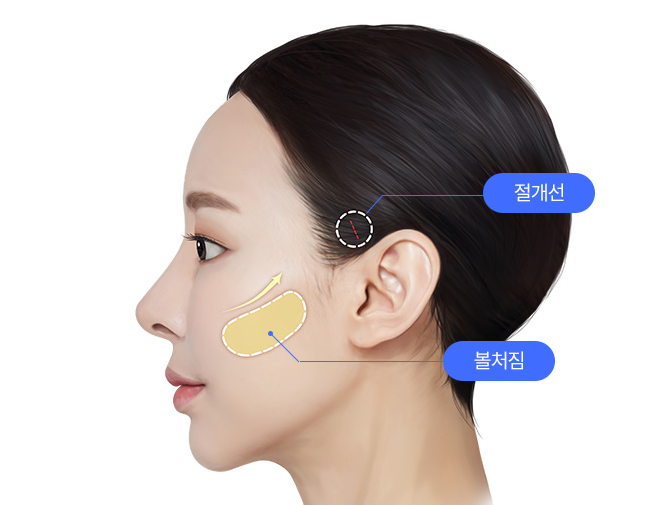
When sagging is severe after contour surgery
Source: TS Plastic Surgery website
In addition to natural sagging caused by aging,
many people undergo a facelift because of loose skin after contour surgery.
Even if thread lifting or radiofrequency and ultrasound lifting procedures were performed after contour surgery,
if other methods do not produce the desired results,
a facelift may be helpful.
If you have tried non-surgical methods several times
but have not been able to fundamentally resolve skin sagging,
surgical methods such as a facelift
may be considered as one of the long-term options.
So far, we have looked at the various types of cases in which a facelift may be needed.
Many people also worry about scars when it comes to facelifts.
When performing a facelift, the incision is placed around the ear
so that the scar is as inconspicuous as possible,
and careful attention is paid to the suturing method to help minimize scarring.
A facelift is not simply a surgery that pulls the skin tight.
It requires looking at the overall balance of the face,
and it is important to consider a natural and well-balanced result.
※ Because side effects such as inflammation, bleeding, and nerve damage may occur depending on the individual, sufficient consultation with medical staff is necessary before surgery.
This is an example image to help with understanding.