After the first double eyelid surgery
Sometimes people end up considering revision surgery because the line became too thickly set or because their eyes feel heavy and sleepy.
In particular, there are not a few cases where the line looks swollen like a “sausage eye,” or where eye correction is recommended because the eyeballs are not sufficiently exposed.
However, in revision double eyelid surgery, eye correction is not performed simply because the eyes look uncomfortable.
That is because the surgical direction can change depending on whether the current eye condition is actually a problem with the function of opening the eyes, or whether it is due to existing adhesion, the eyelid line structure, or sagging skin.
Therefore, in revision eye surgery, it is important to first check the current eye structure and functional condition together, and then accurately determine what kind of correction is needed for your eyes.
Previous image
Next image
Source: TS Plastic Surgery website
Distinguishing between pseudoptosis and true ptosis
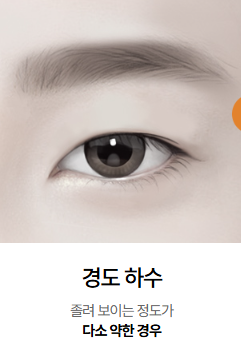
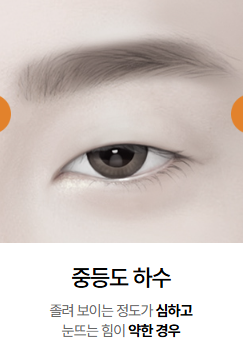
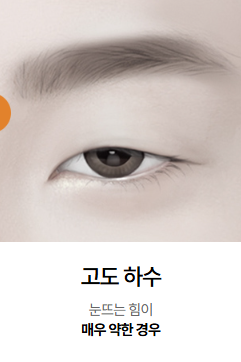
When the eyes look uncomfortable or sleepy, they can broadly be divided into pseudoptosis and true ptosis.
What is pseudoptosis?
Pseudoptosis refers to a state in which the muscles that open the eyes are functioning normally, but the eyes look small and heavy due to thick skin, eyelid fat, sagging skin, or the structure of the existing double eyelid.
In other words, there is no actual functional problem, but the eyes appear unclear because of the outward structure.
What is true ptosis?
On the other hand, true ptosis is a condition in which the strength of the levator muscle, the muscle that opens the eyes, is weak, so the eyelid cannot be lifted sufficiently.
In this case, when opening the eyes, people often develop a habit of using the forehead or eyebrows, or they may feel easily fatigued when keeping their eyes open for a long time.
Therefore, true ptosis may have limitations if treated only by simply re-establishing the eyelid line, and an approach that also corrects the function of opening the eyes may be necessary.
What matters in revision eye surgery is accurately distinguishing which type the current eye condition belongs to.
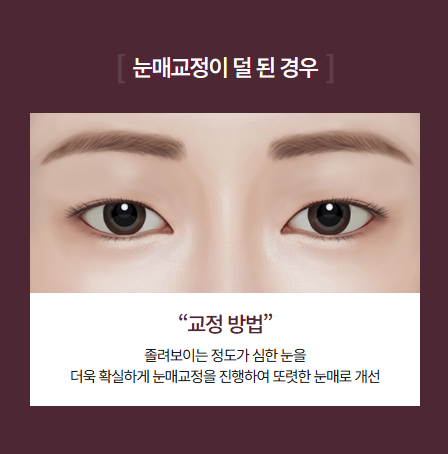
Among revision eye surgery patients, there are cases where eye correction is actually needed
Among patients considering revision eye surgery, there are also cases where eye correction is actually needed.
 Source: TS Plastic Surgery website
In particular, these are cases where even after the previous surgery,
there was not enough improvement in eyeball exposure,
a lot of force was used in the forehead when opening the eyes,
and the eyes still looked sleepy even when open.
Also, if the following symptoms repeat, it is necessary to check not only a simple line issue but also the function of opening the eyes itself.
-
When opening the eyes, too much force goes into the forehead
-
Having a habit of lifting the chin to open the eyes
-
By the afternoon, the eyes feel heavier and more droopy
-
Easily becoming fatigued when keeping the eyes open for a long time
In particular, if it is true ptosis, but only a simple double eyelid surgery was performed at the time of the first surgery, the line may gradually appear thicker, or repeated force may be applied to the tissue to open the eyes, causing the line to become thicker or adhesions to form more strongly.
In such cases, after analyzing the current opening strength of the eyes and tissue movement together, the surgical approach may include eye correction.
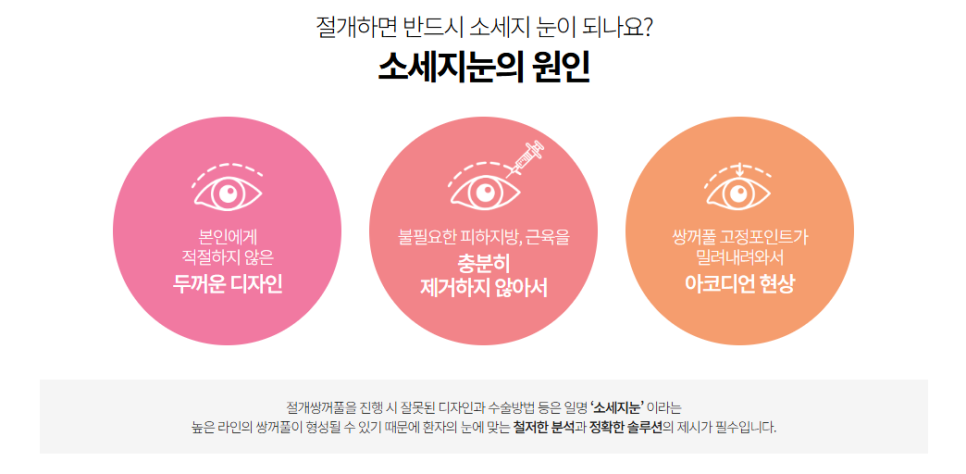
Why thickened lines like “sausage eyes” persist
One of the types often seen in revision eye surgery consultations is when the double eyelid line settles in an excessively thick way.
At first, it may be thought to be simple swelling, but even as time passes, the line does not fold naturally and remains in a rounded, raised shape.
This is commonly referred to as “sausage eyes.”
 Source: TS Plastic Surgery website
This shape is often not just a matter of prolonged swelling, but rather appears as a combination of changes in muscle tension, tissue adhesion, and excessive scar formation.
Source: TS Plastic Surgery website
This shape is often not just a matter of prolonged swelling, but rather appears as a combination of changes in muscle tension, tissue adhesion, and excessive scar formation.
In particular, if a high line that does not match the current eye structure is maintained, or if excessive correction is added relative to the eye-opening function, repeated force is transferred to the tissue and the line can become even thicker.
Therefore, in revision eye surgery, it is important not simply to lower the line, but to also check the current eye-opening function, the adhesion condition, and tissue movement.
What to consider when performing revision eye surgery
In revision eye surgery, the following points are first checked together.
-
Current eye-opening strength
-
Existing adhesion condition
-
Double eyelid line height
-
Skin thickness and degree of sagging
-
Tissue movement and eye-opening pattern
Then, by analyzing whether the tissue moves naturally when the eyes are open,
and at what position the line folds most stably,
the surgical direction is planned.
If it is pseudoptosis,
there are cases where the eyes become much clearer with only adhesion release, line adjustment, and skin and fat removal, without needing to touch the muscles.
If it is true ptosis,
eye correction may be considered together in order to stably supplement the function of opening the eyes.
In other words, what matters in revision eye surgery is not adding eye correction unconditionally, but accurately determining what surgery is truly needed for the current eyes.
The most important thing in revision eye surgery
What matters in revision eye surgery is
not simply making the eyes bigger,
but creating a state where the tissue moves naturally when the eyes are open
and the eyes open comfortably.
In particular, if unnecessary eye correction is repeated when strong adhesion has already formed,
there is also a possibility of overcorrection, sausage eyes, or an unnatural impression.
Therefore, in revision eye surgery, it is important to first accurately analyze whether the current eye condition is pseudoptosis or true ptosis, and then approach only the necessary parts step by step.
If planning is based on sufficient consultation and diagnosis while considering the current eye structure and functional condition, a more natural and stable improvement in the eyelids can be expected.
※ Depending on the individual, side effects such as inflammation, bleeding, and nerve damage may occur, so sufficient consultation with medical staff before surgery is necessary.