When people think of a hump nose, they commonly picture a nose with a protrusion in the middle of the nasal bridge. However, not all hump noses have the same shape.
The surgical approach may vary depending on the location and degree of the hump, the height of the area between the eyes and the nasal tip, and the overall nasal bridge line.
Therefore, hump nose surgery is not simply a procedure to remove a protruding bone. It is important to plan the surgery by considering the current nasal structure, the desired contour, and harmony with the face as a whole.
There Are Several Types of Hump Noses
Hump noses can generally be divided into three types.
The first type has a low area between the eyes and a low nasal tip, with only the middle part of the nose protruding prominently.
The second type has an overall high nose, along with a well-developed, elevated bone in the middle of the nose.
The third type has an overall low nasal bridge with a slightly protruding bone in the middle of the nose.
Although all of these may appear to be the same type of hump nose from the outside, the required surgical method may vary depending on the current condition of the nose.
Hump Nose with a Low Area Between the Eyes and a Low Nasal Tip, but a High Middle Section
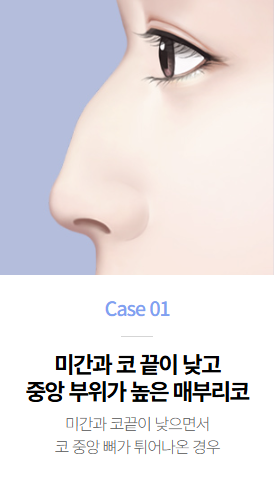
When the area between the eyes and the nasal tip are low while only the middle part of the nose protrudes prominently, simply removing the hump may instead make the nose look lower or create an unnatural contour. In such cases, it may be necessary to first refine the protruding hump and organize the nasal bridge line, then compensate for the low area between the eyes and the low nasal bridge.
An implant may be used to enhance the lines of the nasal bridge and the area between the eyes, while the drooping nasal tip may be lifted and defined using cartilage.
In these cases, autologous cartilage such as ear cartilage or autologous rib cartilage is often used for the nasal tip. The appropriate material is selected based on the tip’s support and the desired contour.
Hump Nose with a High Nasal Bridge and a High Central Bone
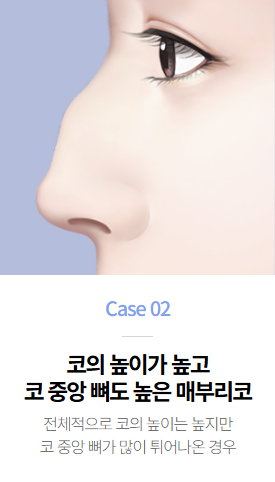
When both the nasal bridge and the central nasal bone are highly developed, the area where the hump has formed may protrude significantly, making the nasal contour look uneven. In this situation, rather than making the nose excessively higher, it is important to selectively remove only the protruding hump and smooth out the nasal contour.
Because the existing height of the nasal bridge is preserved as much as possible while unnecessarily protruding areas are refined, the focus is on achieving a natural improvement in the contour.
Hump Nose with an Overall Low Bridge and a Slightly Protruding Central Bone
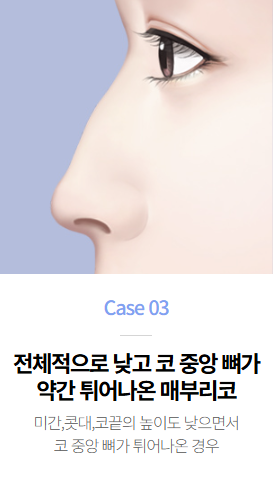
In cases where the nasal bridge is generally low and the central nasal bone protrudes slightly, the hump may not be severely prominent. Instead, the middle bone may protrude slightly from a low nasal bridge, making the contour appear less smooth.
In such cases, the hump may be lightly refined, followed by the insertion of a customized implant suited to the desired nasal contour and height to enhance the nasal bridge line. At the same time, a septal extension may be performed, and autologous cartilage may be used to refine the nasal tip as well, improving the line from the nasal bridge to the tip so that it appears more defined and smooth.
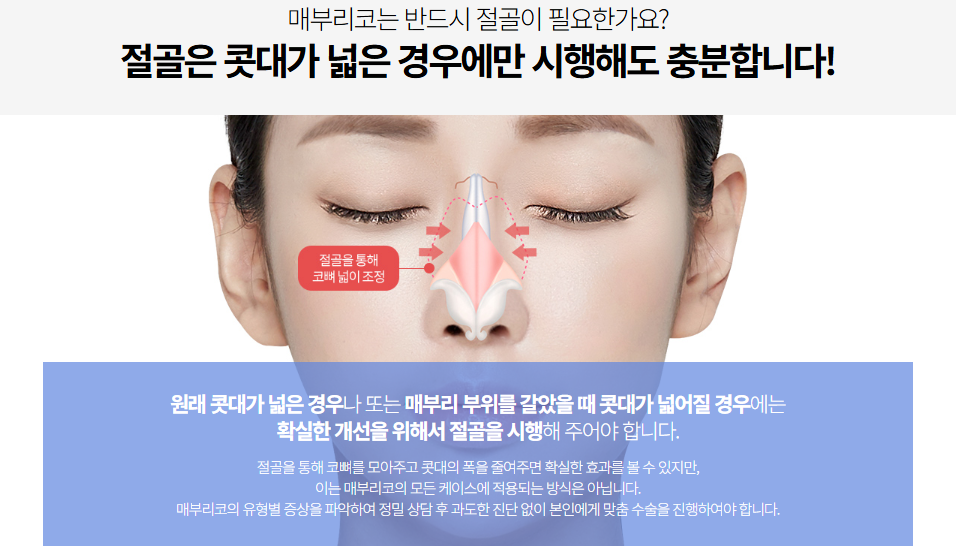
It Is Important to Consider the Entire Contour in Hump Nose Surgery
Hump nose surgery is not performed simply by shaving down a protruding bone.
Even when noses appear to have the same type of hump, some cases may require the use of an implant, while in others, the contour may be improved substantially by refining the hump alone.
In addition, if the nasal tip is drooping or if it is otherwise necessary, the tip may need to be supplemented using autologous cartilage such as ear cartilage or autologous rib cartilage.
Therefore, if you are considering improving a hump nose, it is important not to assess the situation based solely on the degree of hump protrusion. Instead, the overall contour extending from the area between the eyes through the nasal bridge to the nasal tip should be analyzed through a consultation, and a surgical approach suited to the individual should be established.

※ Swelling, bruising, bleeding, inflammation, asymmetry, or changes that may appear to be recurrence can occur depending on the individual, so a thorough consultation with a medical professional is necessary before surgery.