“Do I definitely need revision surgery at some point after having rhinoplasty once?”
If you are considering rhinoplasty or have already undergone the procedure, you have probably had this concern at least once. In particular, after hearing about people who have undergone multiple revision rhinoplasty procedures, you may come to think that rhinoplasty is a procedure that must inevitably be repeated as time passes.
However, not every rhinoplasty procedure leads to revision surgery. If the shape and function of the nose remain stable after the initial surgery and the patient is satisfied with the results, additional surgery may not be necessary. In what situations, then, is revision rhinoplasty performed?
Is revision surgery inevitably necessary someday after rhinoplasty?
Revision rhinoplasty is not always necessary. Many people worry that if a silicone implant is used, inflammation will eventually develop, or that inflammation will cause the nose to become hard and shortened due to contracture, ultimately making revision surgery necessary. Of course, implant-related inflammation or contracture can be reasons for revision rhinoplasty. However, during actual revision consultations, quite a few people also visit the hospital because they are dissatisfied with the shape of their nose after surgery, not only because of inflammation or contracture.
In other words, the causes of revision rhinoplasty cannot be explained simply as problems with an implant. Various factors must be considered together, including the difference between the shape the patient wanted and the actual result, the support of the nasal tip, and the characteristics of the cartilage used.
The most common reasons people consider revision rhinoplasty
One of the most common reasons for revision rhinoplasty is that the postoperative shape turns out differently from what the patient expected. Someone who wanted a natural-looking nose may feel disappointed that the change was not as significant as expected, leaving the volume of the bridge and tip lacking. Conversely, someone who wanted a subtle improvement may feel that the bridge is too high or the tip is too prominent, making it look obvious that they had surgery. Even if a glamorous nose shape was created well in itself, it may feel awkward if it does not harmonize with the facial features or overall impression. In such cases, revision rhinoplasty may be considered to lower an excessively high bridge or overly prominent tip and adjust the nose to a natural line that suits the face.
As such, revision rhinoplasty is performed not only because a problem has necessarily developed, but also to reduce the gap between the desired image and the actual result.
Cases in which revision rhinoplasty should be seriously considered
In addition to simple dissatisfaction with the shape of the nose, some people inevitably consider revision surgery when the shape of the nose changes over time. The following changes may occur in particular:
-
The nasal tip appears to have drooped lower than it was initially
-
The nose appears to be deviated to one side
-
You are experiencing functional difficulties with the nose, such as rhinitis
-
The nasal tip has gradually become blunt or shortened, and its support has weakened
These changes can occur for various reasons, including skin thickness, scar tissue, the characteristics of the cartilage, and the structure of the original nose. In particular, if the support structure holding up the nasal tip was not stably positioned correctly or has weakened over time, the possibility of nasal-tip drooping or deviation must be considered. Therefore, to reduce the possibility of revision rhinoplasty, it is important to consider not only how high to make the bridge, but also what material to use for the nasal tip, where to place it, and how stably to establish the support structure.
Important points to follow during rhinoplasty to reduce the likelihood of revision surgery
Source: 티에스 성형외과
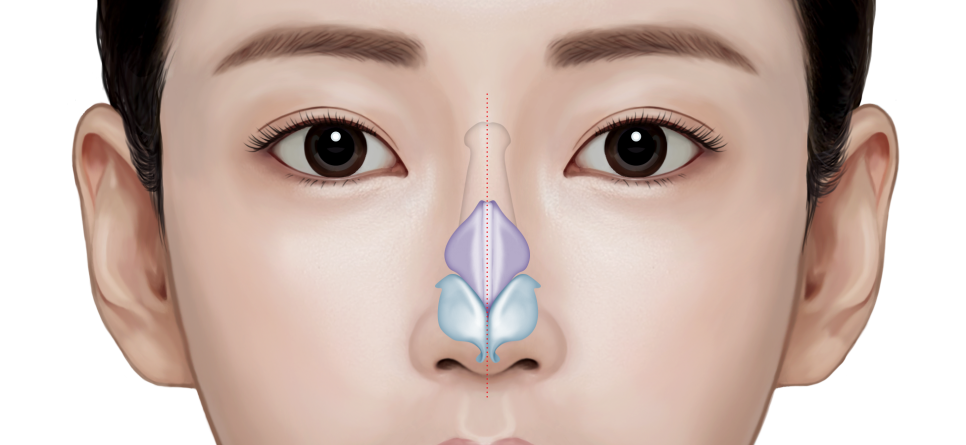
If possible, everyone wants to achieve a satisfying result with just one rhinoplasty procedure. To do so, it is necessary to clearly communicate the desired nasal shape before surgery. Rather than simply saying, “I want a natural-looking nose” or “I want a glamorous nose,” it is advisable to carefully discuss details such as the starting point of the bridge, the height and angle of the tip, the width of the tip as viewed from the front, and whether you prefer a straight or semi-straight line.
It is also necessary to consider the forehead and glabella, the degree to which the lips and chin project, and the length and width of the face, rather than applying an excessively high nose indiscriminately. An excessive height or shape that does not suit the face may feel glamorous immediately after surgery, but over time it may feel burdensome or unnatural. Along with sufficient consultation regarding the shape, it is also important to establish a surgical plan and select materials that can stably support the nasal tip.
Types of cartilage used for nasal-tip support
Source: 티에스 성형외과
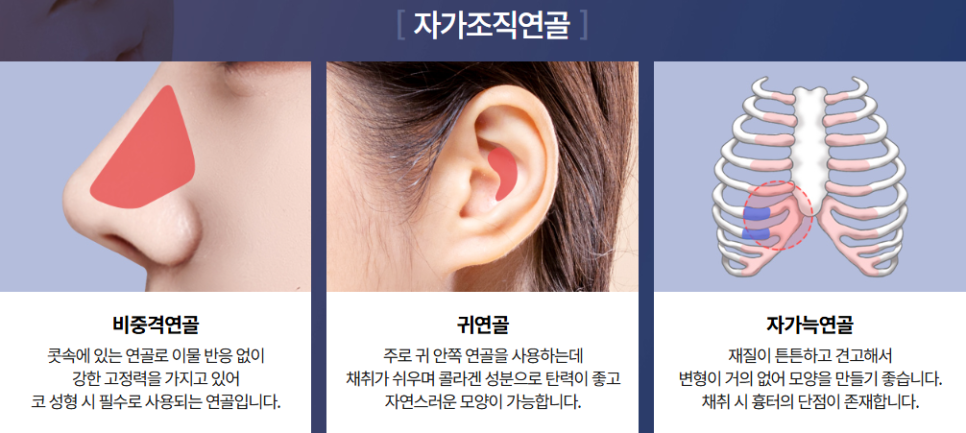
A cartilage-based support structure may be needed to create and maintain the height and position of the nasal tip. Commonly used materials include septal cartilage, ear cartilage, and costal cartilage. Costal cartilage can be further divided into donor costal cartilage and autologous costal cartilage.
Septal cartilage is a method that uses cartilage from inside the nose, with the advantage of causing relatively little concern about an additional external scar. However, because the size and thickness of the septal cartilage differ from person to person, it may be difficult to obtain a sufficient amount in some cases.
Ear cartilage is soft and curved, so it can be used to shape or supplement the nasal tip. However, when strong support is required, it may be difficult to obtain the desired height and stability using ear cartilage alone.
Costal cartilage provides a relatively sufficient amount of cartilage and has strong support, so it may be mainly considered when the nasal tip needs to be firmly elevated or in revision rhinoplasty cases where there is insufficient septal cartilage available due to previous surgery.
Why is autologous costal cartilage often preferred?
Autologous costal cartilage is material harvested from the lower chest area and used to create a nasal-tip support structure or shape the nose. Because it uses the patient’s own tissue, it has characteristics different from those of artificial implants. Since a sufficient amount of cartilage can be obtained, it can be used to adjust the height and direction of the nasal tip relatively precisely.
Autologous costal cartilage may be considered first, particularly when the septal cartilage is small or weak, when septal or ear cartilage was already used in previous rhinoplasty, or when the nasal tip needs more stable support.
However, autologous costal cartilage requires an incision in the lower chest area, so there may be concerns about scarring and postoperative pain. Also, the fact that a sufficient amount can be obtained does not mean that autologous costal cartilage is necessarily required for everyone.
The appropriate material should be selected after examining the amount and condition of the cartilage remaining in the nose, the thickness of the skin, the desired nasal shape, and the number of previous surgeries.
To avoid revision rhinoplasty, the overall surgical plan is more important than the material
Source: 티에스 성형외과
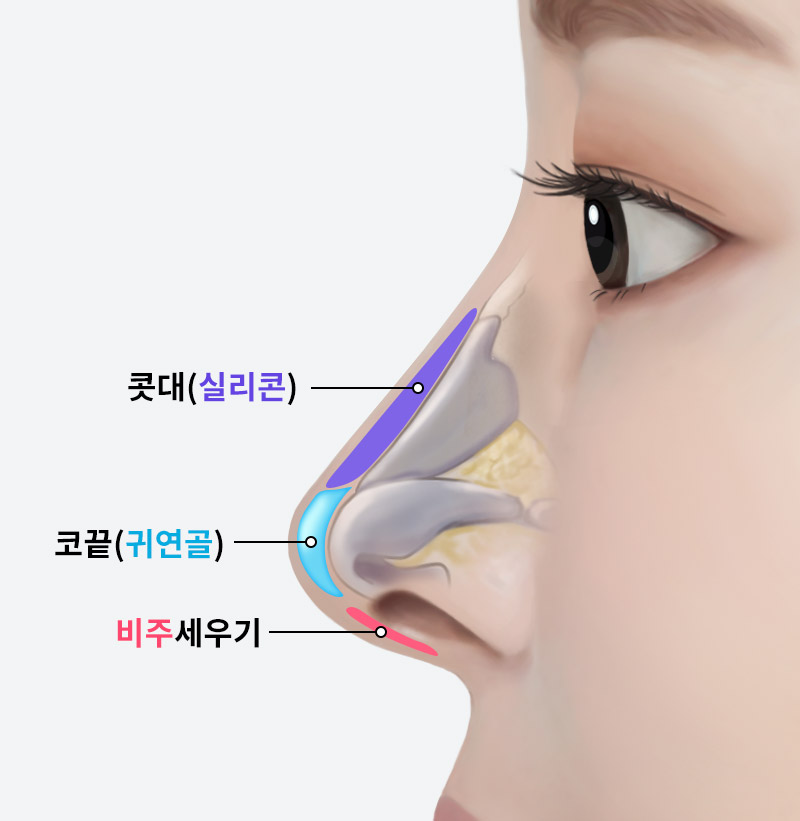
To reduce the possibility of revision rhinoplasty, it is important to carefully establish an overall surgical plan from the beginning rather than simply choosing one particular material.
The patient’s desired nasal shape must be accurately understood, and a height and line that suit the face must be established. In addition, a support structure should be created in an appropriate position so that the nasal tip can remain stable over time, and cartilage suited to the current condition of the nose should be selected.
Excessively high nasal tips or excessive changes beyond what the skin can tolerate should also be avoided. The appearance immediately after surgery should not be the only consideration; the appearance after swelling has subsided and the tissues have stabilized over time must also be taken into account.
With revision rhinoplasty, accurately diagnosing the current condition of your nose comes first
Just because you are dissatisfied with the shape of your nose after rhinoplasty does not necessarily mean that revision rhinoplasty is required. Conversely, even if there is no major discomfort, revision rhinoplasty may be necessary if functional or structural problems such as inflammation, contracture, implant issues, or weakened nasal-tip support are identified.
Therefore, if you are considering revision rhinoplasty, the first step is to accurately diagnose the current condition of your nose.
This is because the need for surgery and the surgical method may differ depending on whether your current discomfort is part of the recovery process during a certain period after rhinoplasty, dissatisfaction with the design, or a structural problem.
In addition, after checking the type of implant and cartilage used in the previous surgery, the surgical method, and the current condition inside the nose, it must be determined whether the existing materials can be retained, whether partial correction is needed, or whether the support structure must be rebuilt from the beginning.
Revision rhinoplasty is not simply having surgery one more time. Above all, it is important to accurately identify what is currently causing a problem in the nose and approach it using a method suited to that cause.
※ Depending on the individual, side effects such as inflammation, bleeding, or nerve damage may occur, so thorough consultation with a medical professional is necessary before surgery.