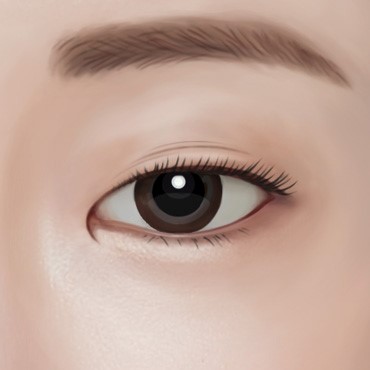
“I didn’t used to have this problem, but these days, my double-eyelid crease forms multiple layers every time I open my eyes.”
“Whenever I’m tired, several double-eyelid creases appear, and my upper eyelids look deeply sunken.”
As people age, some experience the development of overlapping creases above their original double-eyelid line.
At first, these creases may appear temporarily only when someone is tired or has not slept well. However, in some cases, they persist over time and make the face look fatigued.
This condition, in which the double-eyelid line does not appear as a single crease but instead forms several creases, is commonly referred to as multiple-crease eyelids.
Source: 티에스성형외과
Why do multiple-crease eyelids develop?
One of the main causes of multiple-crease eyelids is insufficient fat in the upper eyelid area.
There is fat above the eyes that helps maintain eyelid volume and allows the skin and surrounding tissues to move smoothly. However, as aging progresses, or when a significant amount of fat was removed during a previous eye surgery, the upper eyelid may gradually become sunken, causing the skin to fold in several places.
When there is insufficient volume in the upper eyelid area, not only the original double-eyelid line but also the skin above or below it may fold together, making the double eyelid appear as two or three lines.
In particular, if the crease looks different in the morning and evening, or if the position of the double-eyelid line changes every time you open your eyes, it is necessary to examine the eyelid fat and skin along with the condition of any existing adhesions.
Can multiple-crease eyelids become worse if left untreated?
Upper-eyelid hollowness can become more pronounced as aging progresses. As the volume of fat in the upper eyelid area continues to decrease, more areas of the skin may fold thinly, causing the multiple creases to become deeper and more noticeable than before. If these creases recur over a long period, unnecessary adhesions may also develop between the eyelid skin and the tissues around the muscles that open the eyes.
In this situation, the issue may go beyond the cosmetic concern of having several visible double-eyelid creases. It may also be accompanied by discomfort, such as a pulling or heavy sensation when opening the eyes or becoming tired easily. Therefore, if multiple creases appear repeatedly or upper-eyelid hollowness is gradually worsening, it is important to identify the cause before the condition progresses further.
How are multiple-crease eyelids corrected?
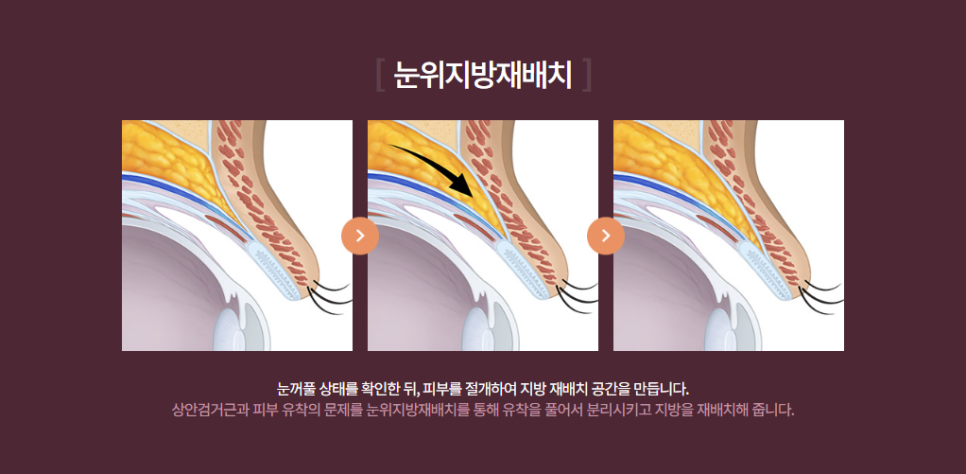
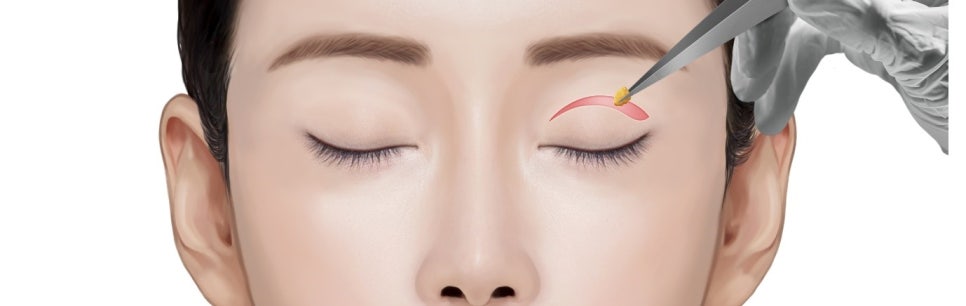
For multiple-crease eyelids caused by insufficient upper-eyelid fat, upper-eyelid fat redistribution is generally considered first. Just as lower-eyelid fat redistribution moves fat to hollow areas when the tear trough is deep or the lower eyelids are bulging, upper-eyelid fat redistribution moves the fat remaining in the upper eyelid area to where it is needed to fill hollow spaces.
This method supplements insufficient volume, helps reduce the tendency of the eyelid skin to fold in several places, and supports the more stable formation of a single double-eyelid line. However, the problem cannot necessarily be resolved simply by recreating the double-eyelid line when multiple creases are present. The amount and location of upper-eyelid fat, the condition of existing double-eyelid adhesions, and the strength of the muscles that open the eyes must all be assessed before selecting a method suited to the cause.
Why consider upper-eyelid fat redistribution before fat grafting?
Source: 티에스성형외과
Many people typically think of fat grafting as a way to fill sunken upper eyelids.
Fat grafting involves harvesting fat from another part of the body, such as the thighs or abdomen, and injecting it into the hollow area above the eyes.
Although it can supplement insufficient volume, not all of the grafted fat necessarily survives equally. Depending on the injection site and amount, there is also a possibility of an uneven surface or differences between the two sides.
By contrast, upper-eyelid fat redistribution uses the fat remaining inside the eyelid and moves it to the areas where it is needed. If there is enough usable fat, upper-eyelid fat redistribution may be considered before additional fat is injected from another part of the body.
Not all multiple-crease eyelids can be corrected with upper-eyelid fat redistribution alone
If a significant amount of upper-eyelid fat was removed during previous eye surgery, or if very little usable fat remains due to aging, it may be difficult to sufficiently fill the hollow areas with upper-eyelid fat redistribution alone. In such cases, fat grafting may also need to be considered depending on the degree of volume loss. If existing double-eyelid adhesions are strong or the crease is positioned inappropriately, it may also be necessary to readjust the double-eyelid line. Even when the creases look similar, the cause can differ from person to person.
It is important to accurately distinguish whether the issue is insufficient upper-eyelid fat, adhesions caused by previous surgery, sagging eyelid skin, or a problem with the strength of the muscles that open the eyes.
If multiple creases recur, the current condition of the eyes should be evaluated first
The appearance of several double-eyelid creases may simply be a temporary change caused by fatigue, but it may also be a sign that the fat in the upper eyelid area is decreasing and hollowness is developing.
If the creases are becoming deeper or it is becoming uncomfortable to open the eyes, the amount of upper-eyelid fat and the condition of any adhesions should be assessed first rather than automatically recreating the double-eyelid line.
Whether the current condition can be sufficiently improved with upper-eyelid fat redistribution alone, or whether fat grafting or double-eyelid line revision should also be considered, may vary depending on each individual’s eye condition. Therefore, if multiple-crease eyelids recur, it is important to identify the exact cause through a consultation with an experienced board-certified plastic surgeon and plan an appropriate correction method.
※ Depending on the individual, side effects such as inflammation, bleeding, or nerve damage may occur, so a thorough consultation with the medical staff is necessary before surgery.