Double eyelid line # double eyelid surgery # good place for double eyelid surgery # double eyelid line # double eyelid surgery # good place for double eyelid surgery # male double eyelid # double eyelid # good place for eyelid surgery # double eyelid surgery # revision surgery
double eyelid plastic surgery clinic # eye plastic surgery # eye plastic surgery # eye plastic surgery # good place for eye plastic surgery # well-known eye plastic surgery clinic # famous place for eye plastic surgery # eye plastic surgery clinic recommendation # Gangnam eye plastic surgery # Apgujeong eye plastic surgery
Sinsa eye plastic surgery # before and after double eyelid revision surgery # before and after double eyelid revision surgery # before and after double eyelid surgery # famous hospital for double eyelid surgery # hospital for double eyelid surgery # double eyelid revision # double eyelid revision # double eyelid plastic surgery
before and after double eyelid surgery # double eyelid revision near Sinsa Station # best place for double eyelid surgery in Seoul # hospital recommendation for double eyelid surgery # hospital recommendation for revision surgery # double eyelid surgery # best place for revision surgery in Seoul # best place for revision surgery in Gangnam # before and after revision surgery
double eyelid hospital # before and after double eyelid surgery # double eyelid scar # scar removal after double eyelid surgery # double eyelid scar removal # eye revision surgery # best place for eye revision surgery in Gangnam # best place for eye revision surgery in Apgujeong # eye revision surgery in Sinsa
double eyelid revision surgery # incision scar # surgery to remove double eyelids # double eyelid revision # double eyelid scar treatment # double eyelid surgery scar # double eyelid surgery scar # multiple-layer double eyelid # triple eyelid
triple double eyelid # three-layer double eyelid # two-layer double eyelid # incision scar # double eyelid scar adhesion # double eyelid scar tissue # levator palpebrae superioris muscle # orbital fat removal # incision method revision surgery # sunken eyelid line
sunken eyelid # double eyelid wrinkle # excessive fat removal # Duhan # Duhan Plastic Surgery Clinic # Duhan eye plastic surgery # Duhan double eyelid revision surgery # Duhan eye revision surgery # Dr. Shin Duhan # revision eye plastic surgery
good place for eye plastic surgery # double eyelid surgery # best place for double eyelid revision surgery # double eyelid restoration # double eyelid restoration # loosened double eyelid # double eyelid revision # famous place for double eyelid revision surgery # hospital for double eyelid revision surgery
incision revision surgery for double eyelids # revision incision surgery for double eyelids # famous place for eye revision surgery # hospital for double eyelid revision surgery # double eyelid revision # famous hospital for eye revision surgery # double eyelid revision in Apgujeong # eye revision surgery hospital
best place for double eyelid revision surgery # double eyelid reconstruction # double eyelid reconstruction surgery # double eyelid fat grafting # double eyelid wrinkle fat grafting # double eyelid wrinkle # double eyelid line wrinkle # eyelid fat grafting # eye surgery
double eyelid revision surgery in Seoul # male eye revision surgery # eye revision surgery in Seoul # folded double eyelid # folded double eyelid # folded double eyelid # folded double eyelid # eye revision surgery near Gangnam Station # please recommend a good place for eye revision surgery.
incision revision surgery for eyes # partial incision for triple eyelids # types of double eyelid surgery # good place for ptosis revision surgery # double eyelid scar revision surgery # repeat double eyelid revision surgery # multiple double eyelid revision surgeries # revision surgery for ruined double eyelids
Double Eyelid Revision Surgery
If the double eyelid line
is too large, uneven, or has loosened,
this is a surgery that corrects the double eyelid line
to restore the original natural,
clear double eyelid shape.
Dr. Shin Duhan
The purpose of general double eyelid surgery
Double eyelid surgery is not simply meant to create a double eyelid line.
The purpose of double eyelid surgery is to make the eyes look bigger and clearer and to create bright-looking eyes and a refined eye shape.
Surgery performed only to make a double eyelid line is likely to lead to unwanted results.
The purpose of double eyelid revision surgery is the same.
Its goal is to correct the eye shape so that the eyes look bigger, clearer, and more natural.
Candidates for double eyelid revision surgery
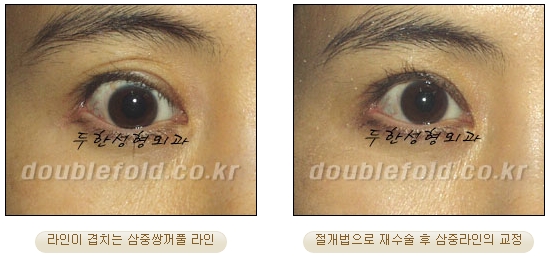
When a triple eyelid line occurs
This refers to a case where, in addition to the existing incision line, another line appears.
It can occur below the incision line or above it.
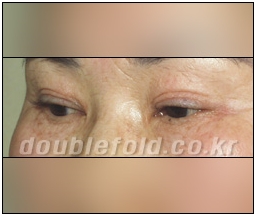
The causes include scar adhesion, sagging skin, sunken eyelids, and loosening of the line. The correction method should be applied differently depending on the cause, but the line other than the incision line that serves as the standard must be excised and corrected through revision surgery.
Candidates for double eyelid revision surgery
When wrinkles are present below the line
If there are multiple lines below the double eyelid line, the double eyelid line looks messy.
A beautiful line should be a single, clearly defined line that is not too small. If there are many fine wrinkles in addition to the double eyelid line, the eyes can look older and the impression may appear less favorable.
In such cases, correction is done with the partial incision method, or if that is not feasible, a certain amount of skin must be removed with the full incision method to correct it.
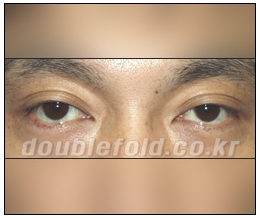
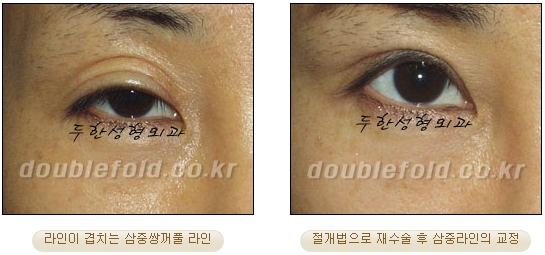
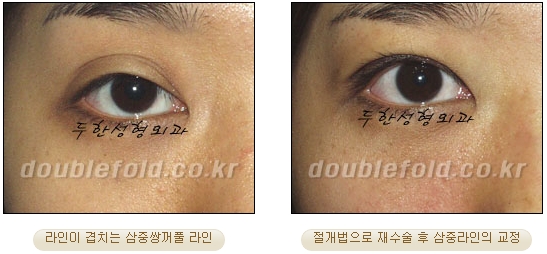
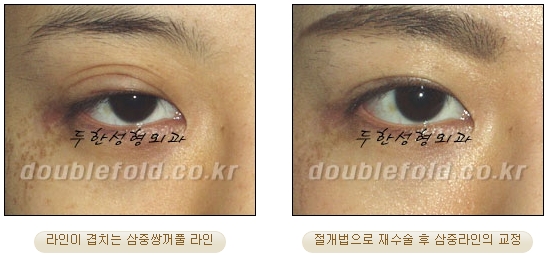
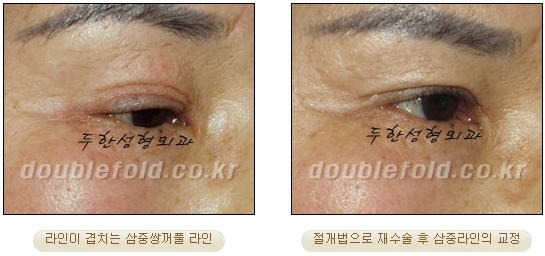
Triple eyelid line
This is a case where the line appears in three layers.
In such cases, it should be organized into a single line.
Usually, among the two lines, the upper line is removed,
and correction is made to match the lower single line.
Dr. Shin Duhan
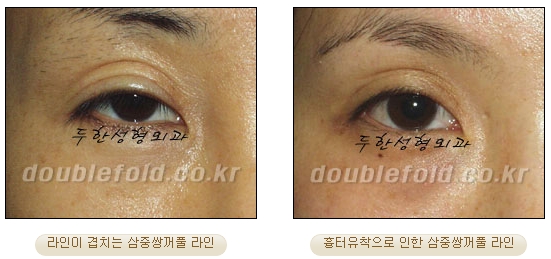
Causes of triple eyelid lines
① As the line loosens and loses its center of tension, an additional line appears above the incision line
② Due to excessive fat removal, another line forms above the incision line because of scar adhesion
③ Skin slides downward below the scar line, creating a new line
④ Excessive scar formation at the sutured site causes a line to form above the scar
Triple eyelid line surgical method
♥ When scar adhesion is not severe ♥
In cases where the triple line occurs as the line loosens, the original line is firmly fixed with the partial incision method so that the line above the incision line naturally loosens and disappears.
♥ Partial incision method
This is a surgical method used to restore a blurry line back to its original clear line.
It is a method that can slightly enlarge a small double eyelid line.
♥ Partial incision method surgical process
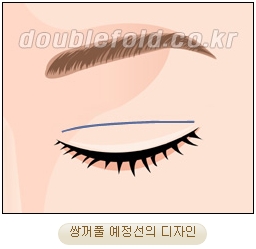
- Design the desired double eyelid line.
In most cases, the design is made along the existing scar line.
Sometimes the design is made to match the height and shape the patient wants, or the surgeon determines the most suitable line and designs it accordingly.
The direction of the design line also changes depending on whether it will be an outfold or an infold.
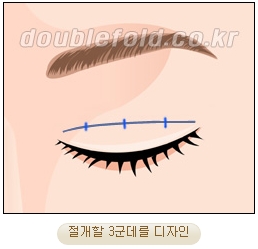
- Mark three incision points with design ink.
The locations are lightly marked on the inner, middle, and outer parts.
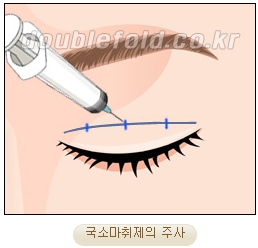
- Under sleep anesthesia, after about 5 minutes of sleep, local anesthetic is injected into the three marked areas.
The local anesthetic is administered in minimal amounts so that swelling does not occur as much as possible.
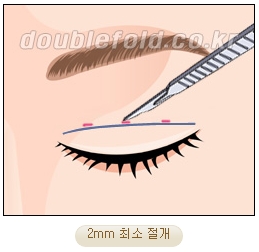
- A very small incision of about 2 mm is made at the three marked areas.
If the incision is made too large, much scarring remains, so the surgery is performed with minimal incisions to leave almost no scar.
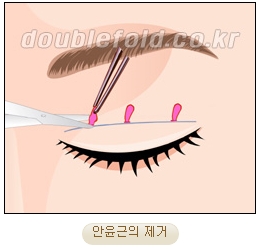
- Through the incision, the orbicularis oculi muscle is first pulled and removed with scissors.
The orbicularis oculi muscle is the muscle layer covering the eyelid and is tissue that interferes with double eyelid formation, so it must be removed to prevent the double eyelid line from loosening.
Along with removal of the orbicularis oculi muscle, the preaponeurotic fat beneath the muscle layer is also removed.
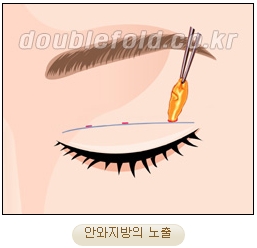
- If there is a large amount of orbital fat, the fat is pulled out through the outer incision.
Fat removal is mainly performed from the outer side.
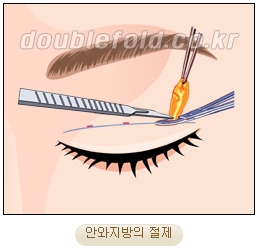
- The fat is grasped with a hemostatic forceps and the base of the protruding fat is cut with a scalpel.
Excessive fat removal can cause a sunken eyelid, so it is better to remove only the amount that protrudes.
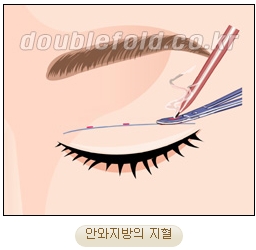
- After fat excision, bleeding is controlled with an electrocautery device to prevent bleeding.
If hemostasis is not properly achieved, orbital bleeding may occur, worsening bruising and swelling, so careful hemostasis is important.
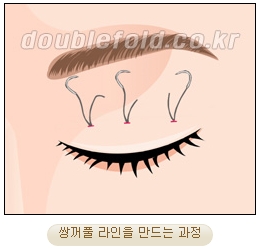
- Through the three incision sites, a very fine dissolvable suture is used to connect the upper eyelid levator muscle and the skin to create the double eyelid line.
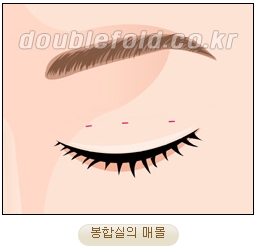
- After burying the sutures and applying ophthalmic ointment, the surgery is completed.
Washing the face and applying makeup are possible from the next day.
Use the cold pack provided by the hospital for cold compresses for 3 days.
If cold compresses are applied for more than 3 days, the swelling may not go down as well, so it is best to do it for exactly 3 days.
Triple eyelid line surgical method
♥ When scar adhesion is severe ♥
The surgery is performed with the full incision method.
The correction is done by fully incising, removing scar tissue, and dissecting to reposition the orbicularis oculi muscle and orbital fat.
♥ Full incision method
For correcting ptosis with a thick line, the full incision method can be used.
The full incision revision process is very complicated and requires extensive experience, advanced skill, and know-how.
It usually takes about 2 to 3 hours.
The surgical process proceeds in 10 steps, and if even one step is omitted, the results may be below expectations.
Even if it takes a somewhat long time, better results can be achieved only by carefully checking each of these steps and performing the surgery with sincerity.
♥ Full incision method surgical process
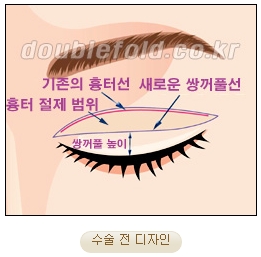
- The planned incision line is designed including the existing incision scar tissue.
Before surgery, the design is made to create a new double eyelid line below the scar line and determine the amount of skin excision up to the scar line.
The excision width is measured from the new double eyelid line, up to the existing scar line.
For example, if the existing scar line is 10 mm above the eyelashes and the new double eyelid line is set at 7 mm, the skin excision width will be 3 mm.
The standard is determined based on the width at the center.
The new double eyelid line is determined by considering how much to reduce the line and the amount of excess skin.
The average height of the revision line is 5 to 7 mm.
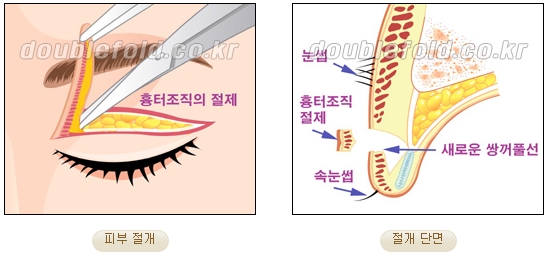
- The skin and scar tissue are cut out.
The scar tissue is excised along the design line.
The incision is made precisely with a scalpel, and then the tissue is excised with surgical scissors.
The lower excision line becomes the new double eyelid line, and the upper line must be naturally pulled downward after tissue dissection so that it can be sutured.
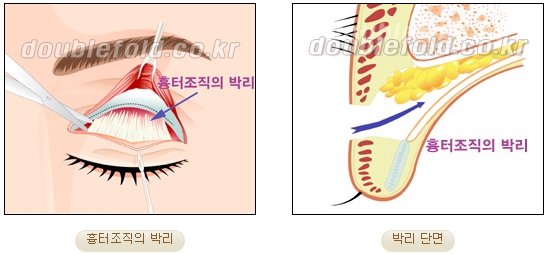
- The orbicularis oculi muscle, orbital fat, and skin that are adhered to the upper eyelid levator muscle are dissected.
Because the skin above the incision line must be pulled downward, the firm scar tissue that is stuck together must be dissected.
Scar tissue dissection is performed by dissecting between the orbital fat layer and the upper eyelid levator muscle, and in some cases, dissection is also done between the muscle and the fat for forward repositioning of the fat.
Through this dissection process, the tissue can be advanced downward and repositioned, and it is an important preparatory step for obtaining a natural double eyelid line.
- If there is contracture of the orbicularis oculi muscle, the muscle is incised or excised to remove the contracture.
When adhesion of scar tissue is very severe, in rare cases a vertical 1 to 2 mm incision is made in the orbicularis oculi muscle to release the contracture.
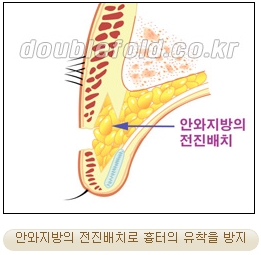
- To prevent readhesion, the orbital fat is repositioned up to the incision line.
Forward repositioning of the orbital fat is a process to prevent readhesion of tissues.
If the fat is not repositioned, the tissue will stick together again, and as a result, ptosis may occur, making the eyes look sleepy and half-closed.
Sometimes this also causes a triple eyelid, which becomes a cause of distortion of the double eyelid line.
Another effect of orbital fat repositioning is that when the eyelid is sunken, the depression is corrected to some extent, so if fat grafting would otherwise be needed later, the surgery itself may improve the condition enough that fat grafting is no longer necessary.
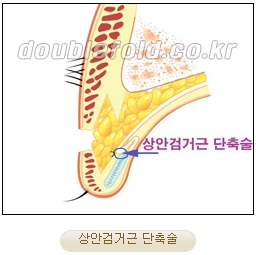
- The upper eyelid levator muscle is shortened to strengthen its function.
Upper eyelid levator shortening is one method for correcting ptosis.
It is simple and effective, with the advantage of being able to correct the condition with almost no tissue damage.
The method does not cut out the upper eyelid levator muscle but simply advances it and ties it to the tarsal plate (cartilage plate).
In revision surgery, the effect of upper eyelid levator shortening is twofold: it makes the eyes open wider so they can be corrected to look clearer, and because the eyes open wider, the double eyelid line also becomes smaller.
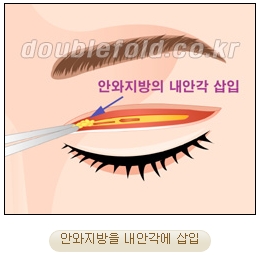
- After incising the orbicularis oculi muscle at the inner corner of the eye, orbital fat is inserted between the muscles to prevent readhesion.
In addition to forward repositioning of fat, fat is inserted into the inner corner of the eye to prevent adhesion of the orbicularis oculi muscle.
The inner side of the eye is the area most prone to scar adhesion, and adhesion in this area makes the eyes look sleepy and difficult to open, causing discomfort when opening the eyes.
To prevent this, orbital fat that can act as a lubricant is placed between the orbicularis oculi muscle and the tarsal plate and fixed with sutures.
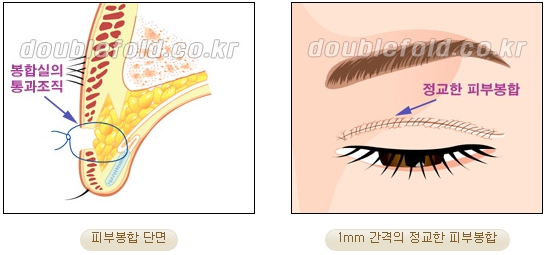
- During suturing, layered suturing is performed so that the repositioned structures do not shift.
The suturing method for revision surgery is not simple.
The purpose of suturing is to close the open wound and create the double eyelid line.
Therefore, in order to obtain the double eyelid line as originally designed, the skin below the incision line must not be pulled upward.
To do this, the skin below the incision line must be firmly fixed to the tarsal plate (cartilage plate), and the forward-repositioned fat must also be anchored with sutures so that it does not get pulled upward.
In addition, only when the orbicularis oculi muscle and skin above the incision line are all passed through by the sutures and firmly layered together can the desired double eyelid line be obtained.
- To prevent hematoma and inflammation, a small amount of anti-swelling agent (hyaluronidase) is administered to the surgical site.
Hyaluronidase, an anti-swelling agent, works by dispersing fluid, and it has the effect of rapidly reducing swelling as soon as it is administered.
However, excessive use can cause a side effect of more bruising, so it is used selectively only to reduce swelling.
- Suture removal is kept relatively late, from 7 to 14 days depending on the patient's condition.
The stitches are removed in two stages, on day 4 and day 7.
The reason the stitches are removed later is that in revision surgery, there is usually not enough excess skin, and the surgical process involves advancing all tissues, placing a lot of tension on the suture line.
Therefore, if the stitches are removed on day 3 or 4, the tense suture line may open or the scar line may widen, leading to a larger scar and causing the tissues to gradually pull upward, which in turn enlarges the double eyelid line.
So, before the tissue has stabilized, the sutures should hold the tissue in place, which is why it is better to leave them in longer.
In many hospitals, stitches are removed early out of concern that stitch marks may remain, but that applies to the first double eyelid surgery.
It does not apply to revision surgery.
To minimize stitch marks, most of the stitches are removed on day 4, leaving only 3 or 4 stitches, which are then removed on day 7. This minimizes stitch marks and prevents the scar from widening while also minimizing distortion of the double eyelid line.
To quickly reduce early inflammation and swelling, steroid preparations are administered for about 2 days.
After surgery, artificial tears are administered for about 1 month to prevent dry eye.
If all of the above principles are followed with skilled technique, satisfactory results can be achieved.
Examples of triple eyelid line correction with the incision method
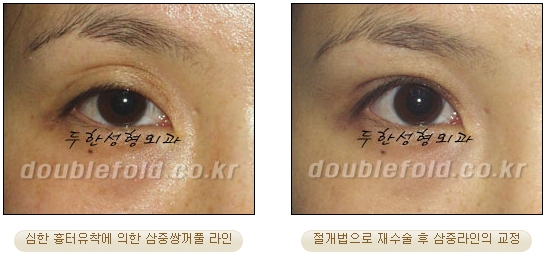
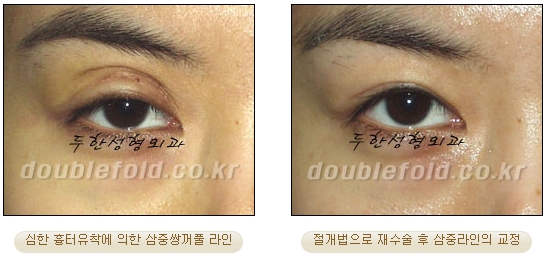
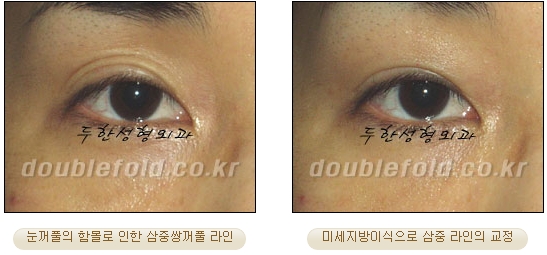
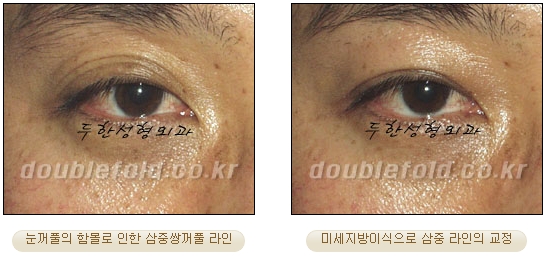
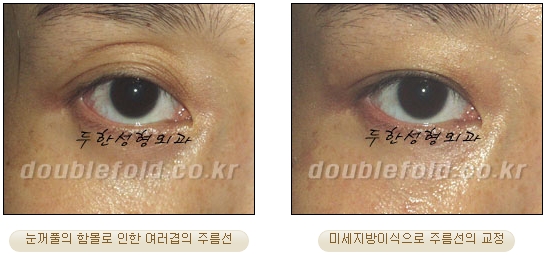
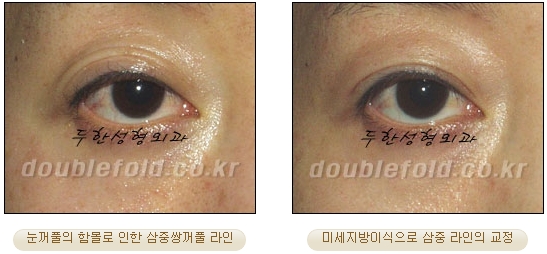
Triple eyelid line with sunken eyelids
When the eyelids become sunken,
the skin is pulled upward
and the line may become larger or a triple eyelid may appear.
Sometimes multiple layers of wrinkles also form.
In such cases, it can be simply corrected with micro fat grafting.
Dr. Shin Duhan
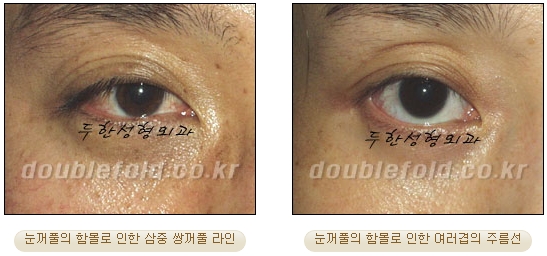
Causes of triple eyelid lines with sunken eyelids
▷ As the eyelid becomes sunken, the line loses its center of tension and an additional line appears above the incision line
▷ It can also occur when the eyelid becomes sunken due to excessive fat removal
▷ It can also occur when the eyelid fat naturally decreases over time
Surgical method for triple eyelid lines with sunken eyelids
It is corrected with micro fat grafting.
Fat is harvested from the lower abdomen with a syringe, purified, and then grafted into the sunken eyelid with a syringe.
A major advantage is that it can be corrected simply without an incision.
It is applied only when the eyelid is sunken.
If it cannot be corrected with fat grafting, the full incision method must be used.
Micro fat grafting method for triple eyelid lines with sunken eyelids
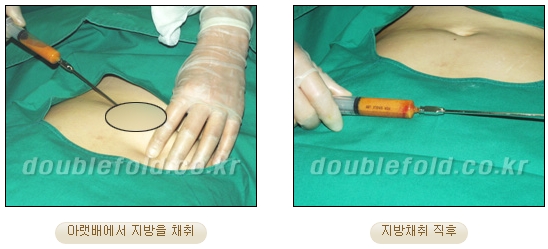
1. Fat is harvested from areas where your own fat is abundant, such as the lower abdomen, waist, or thighs.
○ Because local anesthesia (painless sedation anesthesia) is used, there is no pain at all.
○ A thin liposuction cannula is used to collect the fat into a syringe.
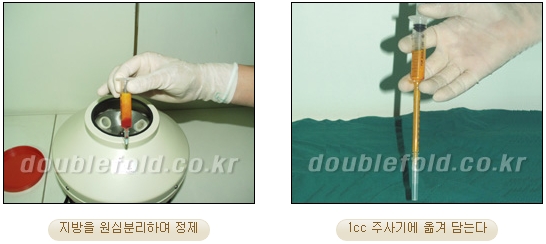
- The collected fat is placed in a centrifuge to remove impurities such as local anesthetic, serum, and red blood cells.
The purpose of centrifugation is to remove impurities in the fat, increase the concentration of the fat, and improve the graft survival rate.
After centrifugation, the fat undergoes a second concentration process to remove water and oil.
By removing water and oil, concentrated fat close to 100% is obtained.
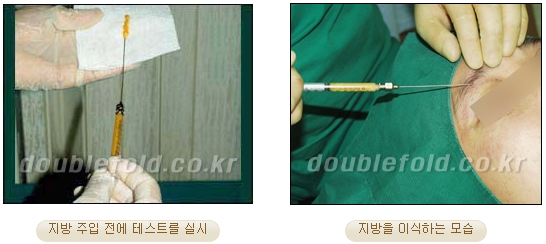
- The purified fat is transferred into a thin 1cc syringe and grafted into the desired area.
The fat is transferred again into a thin 1cc syringe and grafted into the desired area.
We use a micro needle (micro grafting cannula) developed in-house.
The micro needle is a special grafting cannula used only at our clinic that allows ultra-precise grafting.
When grafting, subcutaneous tunneling should be performed in advance before grafting so that it can be placed accurately in the wrinkle area and effectively correct the wrinkle.
The micro fat grafting cannula is inserted into the planned eyelid line for precise grafting.
The graft should be placed into the orbital fat layer to create a smooth contour and a high graft survival rate.
After fat grafting, daily life is possible immediately, and washing the face and applying makeup are possible from the next day.
Examples of micro fat grafting procedures for triple eyelid lines with sunken eyelids
Questions and answers about restoring the double eyelid line with fat grafting
Question) I was told that eyelid fat grafting has many side effects and should not be done at other clinics. Is that true?
Answer) That does not mean all other clinics are the same.
The areas that require the highest level of experience and skill in fat grafting are fat grafting for the upper eyelids and the under-eye dark circles.
These are areas that cannot be treated casually without accumulated experience and skill.
We always say in our consultation room that fat grafting is absolutely not a procedure that just anyone can perform.
As with all surgeries, results vary depending on the surgeon's level of experience and know-how.
Although there are many clinics that perform fat grafting, only a handful do it properly.
Fat grafting is easy to perform, but it is difficult to produce proper results.
In principle, fat grafting can lead to good results only when performed accurately.
Methods differ by clinic, and results can vary greatly depending on experience.
You may have a negative impression after experiencing or hearing about poor fat grafting, but if it is done properly, satisfactory results can be achieved in a single session.
In particular, the upper eyelid area (sunken eyelids, sunken eyelids) requires a great deal of experience, skill, detail, and precision, so it cannot be performed by just anyone.
Question) I had eyelid fat grafting at another clinic, but it almost completely disappeared. Is repeat treatment possible in this case?
Answer) Even after treatment at another clinic, if the graft survival rate is low and it almost disappears, repeat treatment is possible.
However, it must be performed at least 3 months later.
Since the graft survival period for fat grafting takes at least 3 months, you can undergo treatment again after 3 months have passed since the last procedure.
Even if repeat treatment is performed at our clinic, the result is almost no different from the first time.
Question) I had eyelid fat grafting at another clinic, but it is lumpy and uncomfortable when opening my eyes. Is this a side effect?
Answer) The goal of eyelid fat grafting is to restore the sunken eyelids and functionally improve the ability to open the eyes, thereby reducing eye fatigue.
To achieve this goal, the procedure must be performed accurately and precisely.
With fat grafting performed by someone with insufficient experience, grafting may be done into the orbicularis oculi muscle layer rather than the orbital fat layer, causing unevenness, or it may be placed near the deep upper eyelid levator muscle layer, resulting in the eye feeling even more uncomfortable to open than before the procedure.
If such side effects occur, the fat must be removed again, which is a difficult problem.
To prevent side effects, it is best not to receive treatment from someone with insufficient experience or from a non-board-certified plastic surgeon.
Question) What about injecting filler instead of fat into the eyelid?
Answer) Because the eyelid is a constantly moving structure, procedures that interfere with eyelid movement should not be performed.
When fat is grafted, it acts as a cushion and lubricant that helps the eyelid move more smoothly. However, if a foreign substance such as filler is injected, it can severely impair the function of opening the eyes regardless of the shape of the eyelid, and in severe cases the eyelid swelling may not subside or the eye shape may become distorted.
Inflammation can even occur, so filler should never be injected into the eyelid.
Question) Isn't eyelid fat grafting dangerous because it is close to the eyeball?
Answer) Not at all.
The risk is high when the procedure is done by a doctor with somewhat limited experience or a non-board-certified plastic surgeon. If you receive an accurate procedure from an experienced specialist, there is no need to worry.
Eyelid fat grafting must be performed with precise anatomical knowledge and know-how gained through extensive experience with double eyelid surgery, and if the procedure is carried out correctly according to principles, it is one of the safe procedures.
Question) I developed a bulging side effect after eyelid fat grafting at another clinic. Is correction possible?
Answer) Occasionally, after excessive fat injection at another clinic, the eyelids become heavy and bulging, and some patients come to our clinic for correction.
Depending on the condition, the fat must be removed by suction. If a fat mass can be grasped by hand, correction can be performed by inserting a micro cannula and suctioning it out.
However, 100% removal is impossible, and usually about 50 to 80% can be removed and corrected.
http://www.doublefold.co.kr
Features of the Duhan Plastic Surgery Clinic double eyelid revision clinic
-
We have accumulated more than 20 years of extensive experience and know-how in double eyelid revision surgery.
-
We have a systematic system for double eyelid revision surgery.
-
Before double eyelid revision surgery, we perform various examinations and tests through consultation to predict the postoperative result.
-
Surgery is performed only when there is sufficient room for improvement through examinations and tests.
As a principle, if we determine that the desired result cannot be achieved, we do not attempt surgery.
-
Through examinations, we identify the problems with the previous surgery, provide sufficient and clear explanations, and suggest the best surgical method for the best result.
-
We explain the surgical process and progress clearly so that patients fully understand, and we do not omit explanations about possible side effects after surgery.
-
We provide thorough postoperative care after surgery.
-
We closely monitor the postoperative progress to check whether recovery is proceeding properly.
-
We make our best effort and continue research so that those who want double eyelid revision surgery will not need any further surgery and will regard us as the last clinic they visit.

http://www.duhans.com