#Ptosis #Double Eyelid #Ptosis Correction #Double Eyelid Surgery #Ptosis Correction Double Eyelid Surgery #Ptosis Revision #Famous Eye Surgery Hospital in Gangnam #Famous Eye Surgery Hospital in Apgujeong #Famous Eye Surgery Hospital in Sinsa
#Uneven Eye Correction #Uneven Double Eyelid Surgery #Best Place for Double Eyelid Revision Surgery #Best Place for Sinsa Double Eyelid Revision Surgery #Ptosis Revision Surgery #Eye Revision Surgery Hospital #Gangnam Eye Revision Surgery Hospital #Gangnam Eye Surgery Hospital
#Double Eyelid Revision Surgery Hospital #Sinsa Eye Revision Surgery Hospital #Apgujeong Eye Surgery #Sinsa Eye Surgery #Best Place for Eye Surgery #Best Place for Eye Surgery in Gangnam #Best Place for Eye Surgery in Apgujeong #Best Place for Ptosis Correction
#Best Place for Eye Surgery in Sinsa #Best Place for Ptosis Correction in Gangnam #Best Place for Ptosis Correction in Apgujeong #Best Place for Ptosis Correction in Sinsa #Good Eye Surgery Hospital #Good Eye Surgery Hospital in Gangnam #Ectropion
#Ptosis Surgery #Famous Hospital for Double Eyelid Surgery #Famous Hospital for Double Eyelid Surgery in Gangnam #Famous Hospital for Double Eyelid Surgery in Apgujeong #Famous Hospital for Double Eyelid Surgery in Sinsa #Monolid Ptosis #Eye Surgery
#Uneven Ptosis Correction #Ptosis Revision Surgery #Ptosis and Ptosis Correction #Eye Revision Surgery #Outfold Double Eyelid #Best Eye Revision Surgery Hospital #Monolid Ptosis Correction #Sinsa Double Eyelid Revision Surgery #Double Eyelid Revision Surgery
#Big Eyes #Before and After Ptosis Correction Surgery #Ptosis Correction for Men #Monolid Ptosis Correction for Men #Gangnam Double Eyelid Revision Surgery #Double Eyelid Surgery #Double Eyelid Surgery #Gangnam Eye Surgery Clinic #Apgujeong Eye Surgery Clinic
#Sinsa Eye Surgery Clinic #Duhan #Duhan Eye Surgery #Duhan Double Eyelid Revision Surgery #Duhan Eye Revision Surgery #Dr. Shin Duhan #Dr. Shin Duhan Double Eyelid Revision Surgery #Double Eyelid Revision Surgery by Dr. Shin Duhan #Eye Surgery Clinic
#Sleepy Eyes #Sleepy Eye Shape #Drowsy Eye Shape #Half-Closed Eye Shape #Correction of the White Area Around the Iris #Before and After Ptosis Correction #Incisional Double Eyelid Surgery #Best Plastic Surgery Clinic for Eye Revision #Ptosis Symptoms #Ptosis Swelling
#Incisional Ptosis Correction #Full Incisional Ptosis Correction #Partial Incisional Ptosis Correction #Best Hospital for Double Eyelid Revision Surgery #Best Place for Double Eyelid Surgery #Best Place for Double Eyelid Surgery in Gangnam #Best Place for Double Eyelid Surgery in Apgujeong #Incisional Double Eyelid Surgery
#Ptosis Correction Surgery #Best Place for Double Eyelid Surgery in Sinsa #Best Place for Double Eyelid Surgery #Blocked Tear Gland #Surgery for Drooping Eyes #Ptosis Correction with Epicanthoplasty #Incisional Double Eyelid Surgery Method #Double Eyelid in Gangnam #Double Eyelid in Apgujeong
#Double Eyelid in Sinsa #Ptosis Test #Ptosis Diagnosis #Famous Eye Surgery Clinic #Famous Eye Surgery Hospital for Eye Surgery #Double Eyelid Line #Double Eyelid #Partial Incision #Before and After Ptosis #Levator Palpebrae Superioris
#Ptosis Correction for Men #Ptosis and Double Eyelid #Nonincisional Ptosis #Eye Surgery #Ptosis Correction for Women with Monolids #Famous Place for Eye Surgery #Uneven Eyes #How to Make Male Eyes Bigger #Incisional Double Eyelid
#Male Ptosis Correction Surgery #Plastic Surgery Clinic for Eye Revision #Ptosis Surgery Method #Ptosis Correction Surgery Method #Plastic Surgery Clinic for Ptosis #Ptosis in Gangnam #Revision Surgery for Uneven Eyes #Male Ptosis Correction Surgery
#Recommended Eye Revision Surgery #Revision Incisional Double Eyelid Surgery #Ptosis Surgery #Ptosis Recovery Period #Ptosis Correction Method #Eye Revision Surgery #Seoul Ptosis Correction #Double Eyelid and Ptosis Correction #Incisional Double Eyelid Surgery Method
#Famous Hospital for Double Eyelid Revision Surgery #Best Hospital for Double Eyelid Surgery #Double Eyelid and Ptosis Correction #Double Eyelid Plastic Surgery Clinic #Best Place for Double Eyelid Revision Surgery #Double Eyelid Surgery #Ptosis Correction for Women #Revision Surgery Hospital

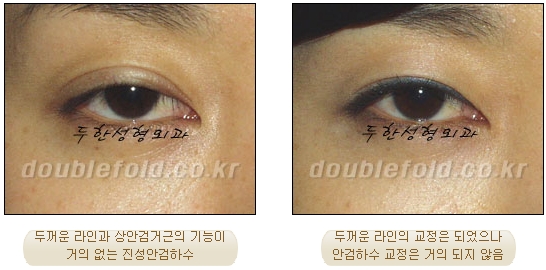
Problems When Ptosis Correction Is Not Possible
In the case of a levator muscle with no function, further ptosis correction may no longer be possible, or problems such as exposure keratitis may occur.
There are cases where the eyes still look sleepy even after several ptosis corrections have already been performed.
Even if ptosis correction is tried again, correction may be impossible when the levator muscle has almost no function.
In such cases, ptosis correction is not performed, and only the line is corrected.
If an overly aggressive attempt at ptosis correction is made, exposure keratitis only becomes worse, and ptosis is hardly corrected.
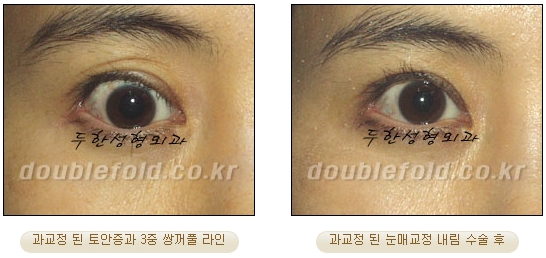
Problems When Ptosis Correction Has Been Overdone
Lowering an overcorrected eye shape back to a normal size is much more difficult than ptosis correction.
When ptosis correction or eye-shape correction has been overdone and the white of the eye is exposed, levator muscle relaxation surgery is needed to reduce the size of the eyes again. However, if the levator muscle is relaxed carelessly, ptosis may be induced several months later and the eyes may open less.
Surgery to reduce overcorrection is much more difficult than ptosis correction, and the future course is harder to predict.
The degree of levator muscle relaxation must be carefully adjusted through extensive experience and know-how.
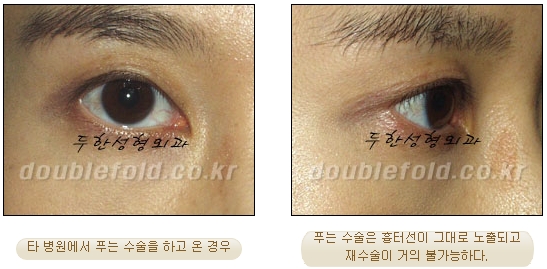
Problems When a Loosening Surgery Has Already Been Performed Before Visiting
When a patient visits after having had a loosening surgery at another hospital, it is often difficult or impossible to recreate the line.
One of the hardest problems in double eyelid revision surgery to overcome is when a patient comes in after having had a loosening surgery at another hospital.
Nine out of ten people cannot undergo revision surgery.
The reason is that, in order to loosen the line, the incision is made very low and the tissue is layered thickly so that no line forms at the incision site.
Because this tissue later turns into thick scar tissue, it is almost difficult to remove that thick scar tissue again and create a natural line.
For the future as well, loosening surgery is a procedure that should be avoided if possible.
Candidates for Double Eyelid Revision Surgery
Eyes that look half-closed (ptosis)
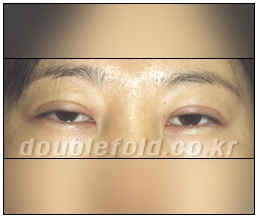
If the eyes do not open naturally after double eyelid surgery and look half-closed, they should be corrected so that the eyes open naturally and more clearly again.
A half-closed impression easily gives a bad impression to anyone.
Causes include congenital ptosis, pseudoptosis, and scar adhesion. In the case of ptosis, the most common correction method is surgery such as levator shortening or resection.
Candidates for Double Eyelid Revision Surgery
When the double eyelid line is asymmetrical
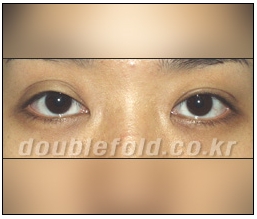
A slight asymmetry is normal for everyone, but a noticeably large asymmetry should be corrected.
Causes include poor design, loosening of the line, scar adhesion, and ptosis on one side. As a corrective method, if the double eyelid lines are uneven, the surgery must be done again to match the desired side.
However, if revision surgery is performed on only one side, the eyes will not be perfectly symmetrical immediately after surgery. Even with a properly performed operation, you need to be patient and observe the correction of the asymmetry for at least 1 to 2 months, so such one-sided surgery must be decided carefully.
Candidates for Double Eyelid Revision Surgery
When the double eyelid line has loosened
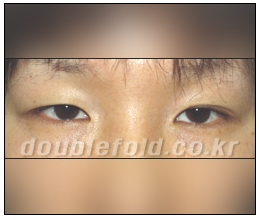
After surgery, it may look good at first, but as time passes the width of the line may narrow or loosen again. In these cases, especially after non-incisional surgery, the line often gradually loosens and descends.
Causes include performing a non-incisional procedure despite thick skin, incorrect double eyelid surgery techniques, a large amount of fat, inherently thick skin or orbicularis muscle in the individual, and a tendency for line adhesion not to form well constitutionally. As a corrective method, based on the patient’s eye condition, the line is corrected through the incisional method or partial incisional method so that it does not loosen again and becomes a clear line.
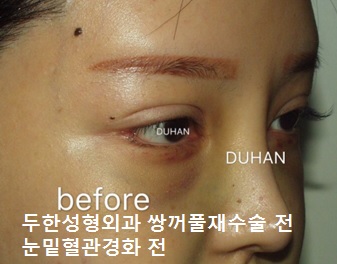


Ptosis
The purpose of double eyelid surgery is
to create large, clear-looking eyes
and to create a line on the eyelid
so that the eye shape looks more refined.
However, if after surgery
the eyes end up looking even more sleepy,
it becomes worse than not having surgery at all.
Eyes that do not open clearly and always look sleepy are called ptosis.
It is broadly divided into congenital ptosis and acquired ptosis.
It is divided into true ptosis, in which the function of the levator palpebrae superioris, the muscle that lifts the eyelid, is weakened, and pseudoptosis, which only appears to be ptosis.
The goal of ptosis correction (sleepy-looking eyes) is to restore large, clear-looking eyes.
Depending on the severity of the symptoms, an appropriate method must be chosen, and the surgeon’s skilled know-how and technique are required.
Examples of Ptosis
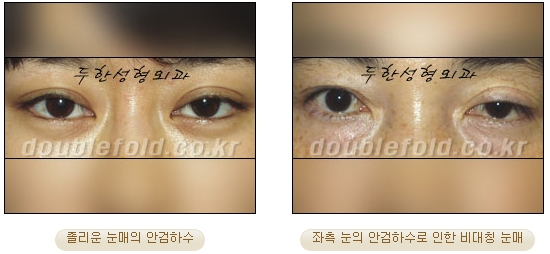
Types of Ptosis
① Congenital true ptosis
This occurs because the function of the levator palpebrae superioris, the muscle that lifts the eyelid, is weakened. Most cases are congenital ptosis, though ptosis may also occur due to trauma.
② Postoperative pseudoptosis
The function of the levator palpebrae superioris, the muscle that lifts the eyelid, is normal, but external factors interfere with its function, preventing the muscle from properly exerting force.
▷ The double eyelid line was made too high
▷ Habitually rubbing the eyes causes scar tissue to form on the inside of the eyelid, interfering with the function of the levator palpebrae superioris
③ Pseudoptosis due to drooping eyelids
When the eyelids droop, the pupil is covered, so it can look as though the eyes do not open fully, like ptosis.
In such cases, the eyelid skin must be temporarily lifted or a temporary double eyelid created to check the actual vertical opening of the pupil.
A condition where the eyelid is simply covering the eye should not be diagnosed as ptosis.
Difference Between Ptosis and a Normal Eye
▶ When the eyes are naturally open and looking straight ahead
It is normal for the upper part of the black pupil to be slightly covered by about 1 to 2 mm.
If the black pupil is covered any more than that, ptosis should be suspected.
▶ When the eyes are naturally open and looking straight ahead
The vertical opening of the eye should be at least 8 mm to be considered normal.
If the vertical opening is narrower than that, it is ptosis.
▶ When looking upward after looking as far downward as possible
The amount of eyelid movement should be about 14 to 16 mm.
If it is less than that, it can be judged as true ptosis.
How to Test for Ptosis
The method for testing ptosis is to check the vertical opening of the pupil when looking straight ahead.
In a normal person, the vertical opening is between 8 and 9 mm, and in general, cases of 8 mm or less are considered ptosis.
However, because everyone’s eye shape and size are different, ptosis is not diagnosed based on exact numbers alone.
A diagnosis is made by judging whether the appearance is objectively sleepy-looking, and this is compared with the measurements.
The function of the levator palpebrae superioris is also measured and assessed.
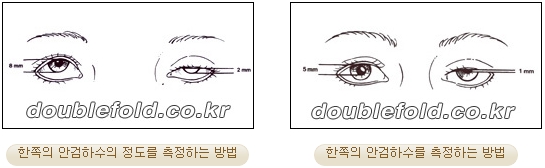
-
Measure the palpebral fissure height of the eye (measure the vertical opening)
-
Check whether the expression looks sleepy
-
Measure the function of the levator palpebrae superioris (normal: 14–16 mm)
Surgical Methods for Ptosis Correction
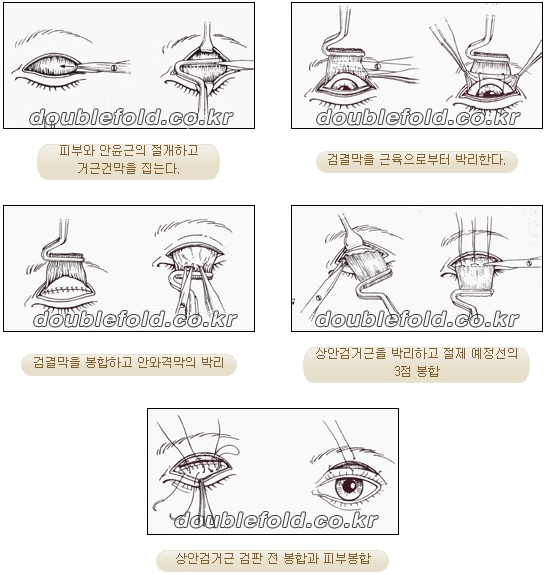
♠ Levator Shortening
This method shortens the eyelid-lifting muscle (levator palpebrae superioris) by overlapping and suturing it by about 4 to 8 mm, and is mainly applied in mild ptosis.
Because the surgery must always be done through an incision, a double eyelid line will be created in the process. Therefore, people without a double eyelid have no choice but to create at least a subtle inner double eyelid.
○ Levator Shortening Procedure
① Design is made and local anesthesia is administered.
② An incision is made along the design line.
③ After the incision, the orbital septum is opened to expose the levator palpebrae superioris.
④ After exposing the levator palpebrae superioris and marking the amount to be shortened, the marked area and the upper border of the tarsal plate are tied together with sutures.
⑤ To create the double eyelid line, sutures are buried at three points.
⑥ The outer skin is sutured.
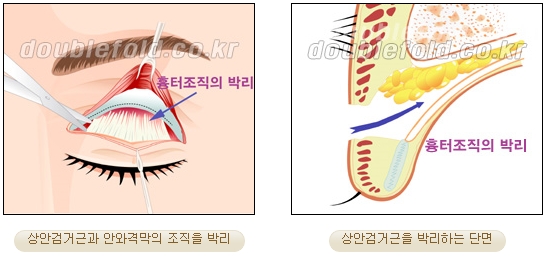
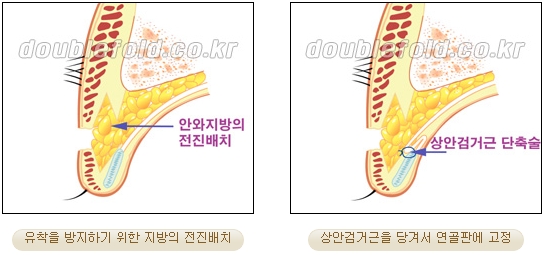
♠ Levator Resection
This method shortens the eyelid-lifting muscle (levator palpebrae superioris) by resecting about 5 to 10 mm and suturing the resected end of the levator palpebrae superioris to the tarsal plate.
It is mainly applied in moderate ptosis.
♠ Frontalis Suspension
This method is performed in cases of severe ptosis with levator function of 5 mm or less, and is used when functional recovery is difficult to expect with levator shortening or resection.
By advancing the frontalis muscle in the forehead and tying it to the tarsal plate of the eyelid, the frontalis muscle takes over the function of the levator palpebrae superioris.
General anesthesia is required, and serious exposure keratitis can occur as a side effect.
♠ Müller Muscle Shortening
Instead of levator shortening, a shortening procedure using the Müller muscle under the levator palpebrae superioris is sometimes used.
The advantage of Müller muscle shortening is that it can minimize exposure keratitis, but it is difficult to predict the postoperative outcome and recurrence is common.
To access the Müller muscle, surgery must be performed while damaging the levator palpebrae superioris, so it is a procedure without any special advantages.
Anatomically, many people have almost no Müller muscle or have a very thin one, so this procedure cannot be applied in such cases.
Postoperative Care After Ptosis Correction Surgery
- Apply a cold compress with the cool pack provided by the hospital.
It only needs to be done for 3 days, 2 hours per day.
The cold compress can be done continuously for 2 hours or in 20 to 30 minute intervals.
It is usually convenient to do it before sleeping.
-
Use the prescribed artificial tears and eye drops to prevent dry eye.
-
Follow-up visits after surgery are usually about twice: the day after surgery and on the day of stitch removal.
Stitches are removed on day 3 or 4.
- Makeup and face washing are allowed after the stitches are removed.
Until the stitches are removed, wash the face with a wet towel.
-
Since no bandage is applied to the surgical area, daily life is possible.
-
Swelling after surgery varies by individual. In most cases, the swelling subsides significantly in about 7 days, but it takes about 1 to 3 months for everything to settle completely.
-
Exposure keratitis, in which the eyes do not close fully, varies depending on the degree of ptosis and the amount the levator palpebrae superioris was shortened, but it usually takes 15 days and in some cases more than 6 months.
On average, it progresses for about 2 to 3 months and then the eyes close naturally.
Examples of Ptosis Correction
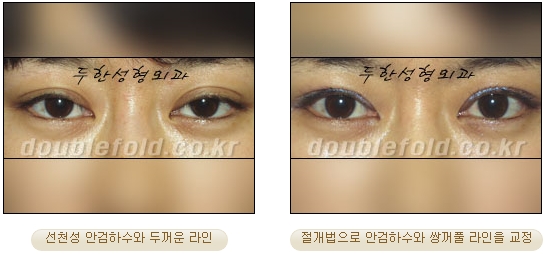
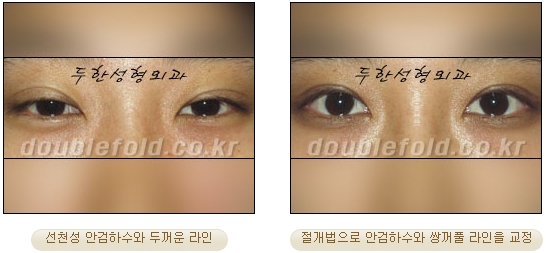
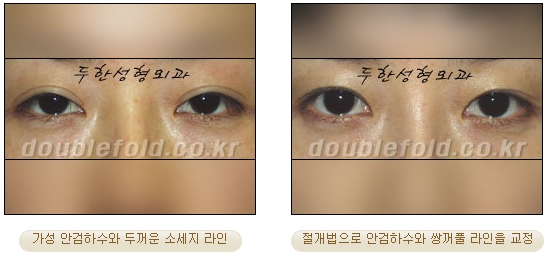
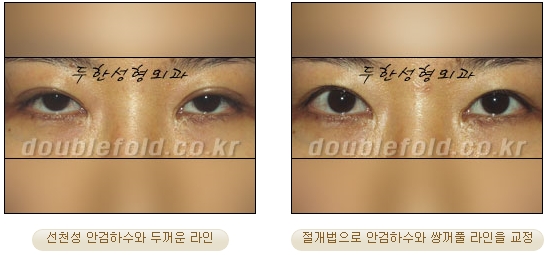
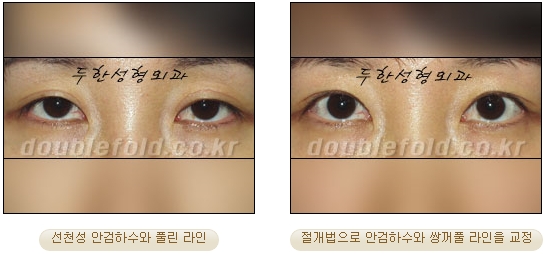
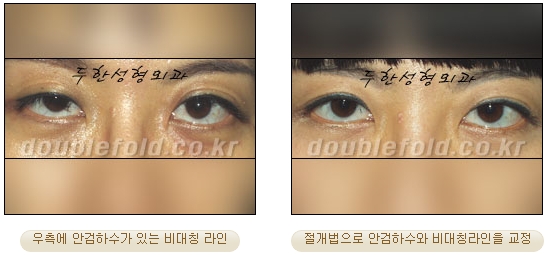
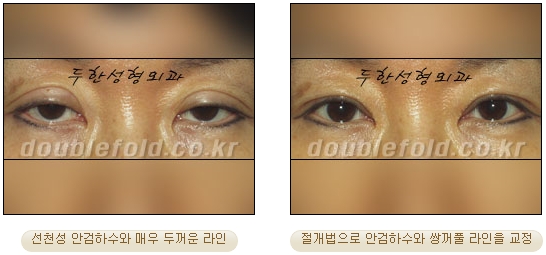
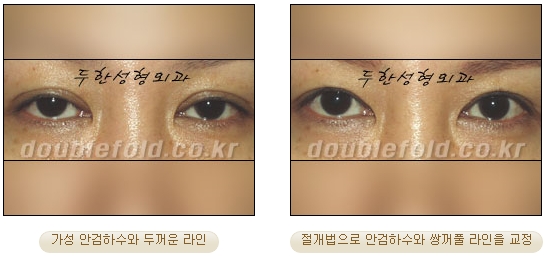
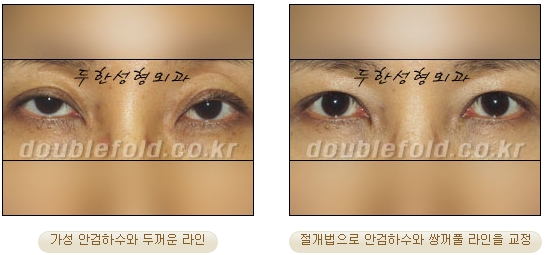
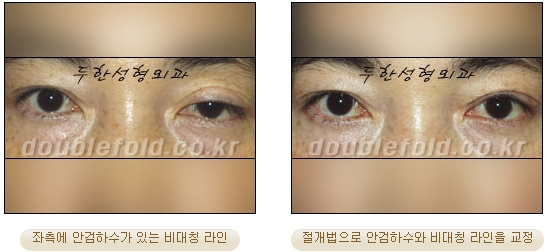
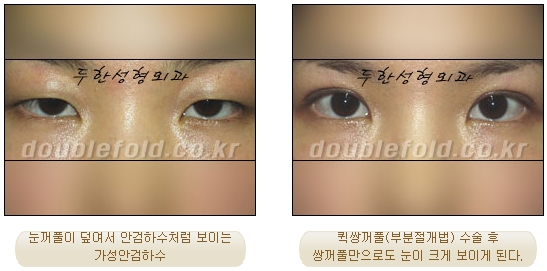
Line asymmetry usually occurs because the design was different, one side had a lot of skin removed, one side was partially loosened, scar tissue adhesion occurred on one side, or ptosis developed on one side.
Ptosis can be corrected through revision surgery, and uneven eyes can also be improved.
At our clinic, based on over 20 years of rich clinical experience and know-how, surgery is planned after various examinations and tests during consultation to predict the postoperative result, and we only perform surgery when there is a sufficient chance of improvement after surgery.
The biggest key point in revision surgery is the amount of extra skin and the location and depth of the scar line.
The purpose of revision surgery is largely twofold.
Restoring large, clear-looking eyes and restoring a natural double eyelid line.
After revision surgery, the double eyelid line is made thinner and more natural.
During surgery, the existing scar line must be removed and a new line created below it.
During revision surgery, the eyes are also opened more widely to correct the sleepy-looking eye shape.
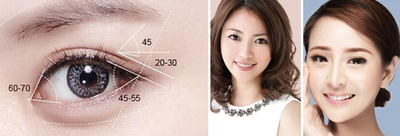
Ptosis Correction Methods
Partial Incision Method
This is a surgical method used to restore a blurry line back to the original clear line.
It can make a small double eyelid line slightly larger.
Partial Incision Procedure
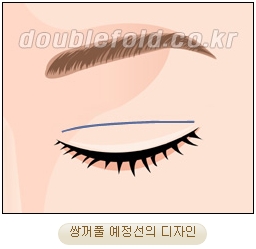
- Design the desired double eyelid line.
In many cases, the design is made along the existing scar line.
Sometimes it is designed to match the height and shape the patient wants, or the surgeon decides on the most suitable line.
Also, the direction of the design line changes depending on whether an outfold or an infold is chosen.
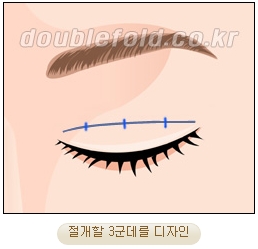
- Mark the incision points with design ink in three places.
The marks are placed lightly on the inner, middle, and outer parts.
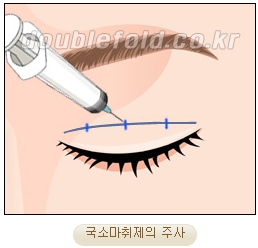
- Under sleep anesthesia, while the patient is asleep for about 5 minutes, local anesthetic is injected into the three marked areas.
The local anesthetic is given in minimal amounts to avoid swelling as much as possible.
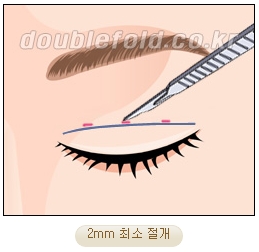
- Make very small incisions of about 2 mm at the three marked areas.
If the incision is made too large, a lot of scarring remains, so the surgery is performed with minimal incisions to leave almost no scar.
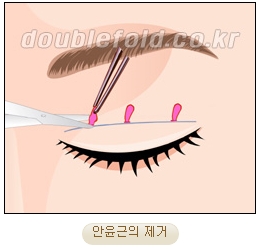
- Through the incision, first pull on the orbicularis muscle and remove it with scissors.
The orbicularis muscle is the muscle layer covering the eyelid and is a tissue that interferes with the formation of a double eyelid, so it must be removed to prevent the double eyelid line from loosening.
Along with the removal of the orbicularis muscle, preaponeurotic fat beneath the muscle layer is also removed.
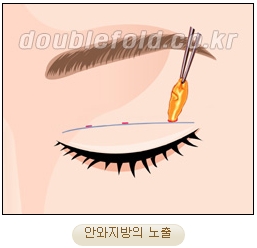
- If there is a lot of orbital fat, pull the orbital fat out through the outer incision and expose it.
Fat removal is mainly done from the outer side.
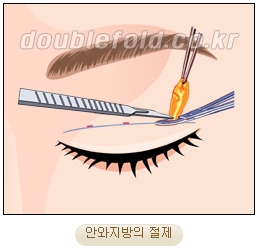
- Grasp the fat with a hemostatic forceps and cut the base of the protruding fat with a scalpel.
Excessive fat removal can cause a hollow eyelid, so it is better to remove only as much as protrudes.
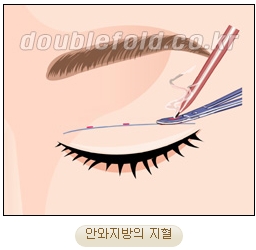
- After fat removal, use electrocautery to stop the bleeding so that no bleeding occurs.
If hemostasis is not performed properly, orbital bleeding may occur, causing severe bruising and swelling, so it is important to control bleeding well.
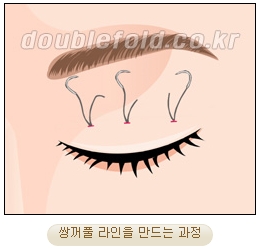
- Through the three incision sites, use very fine dissolvable sutures to connect the levator palpebrae superioris and the skin to create the double eyelid line.
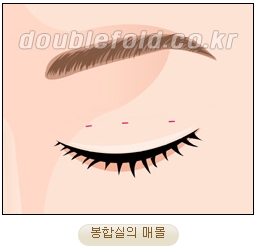
- After the sutures are buried, apply eye ointment and the surgery is complete.
Washing the face and applying makeup are possible starting the next day.
Use the cool pack provided by the hospital for cold compresses for 3 days.
If cold compresses are done for more than 3 days, swelling will not go down further, so it is best to limit them to exactly 3 days.
Examples of the Partial Incision Method
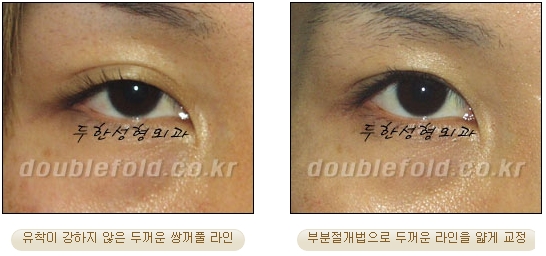
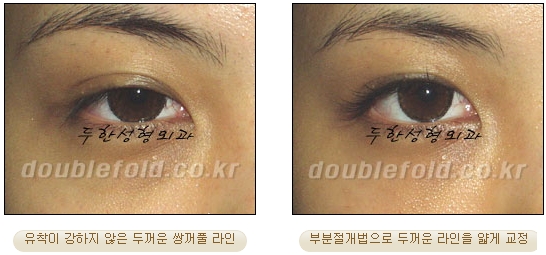
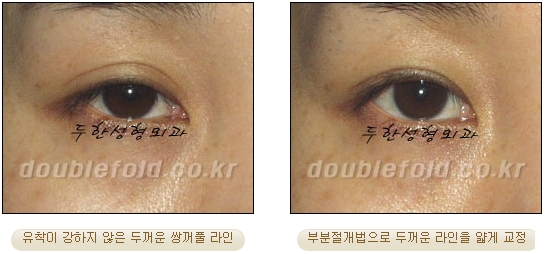
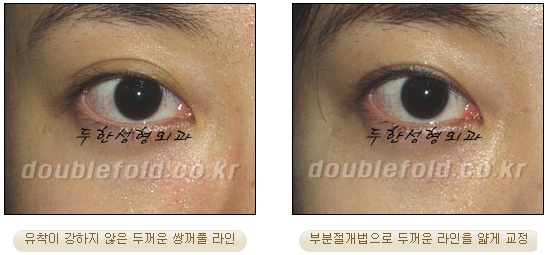
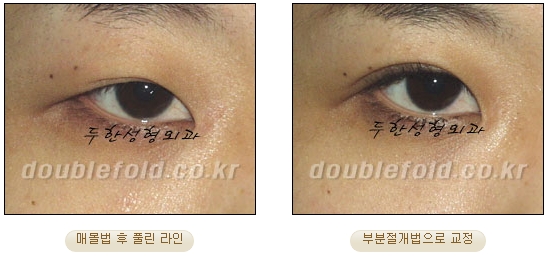
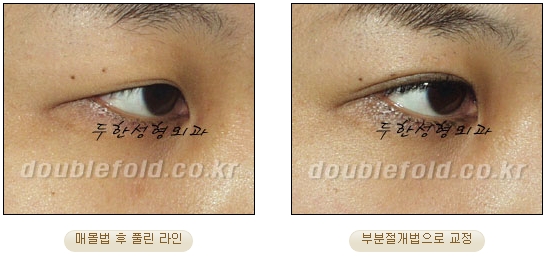
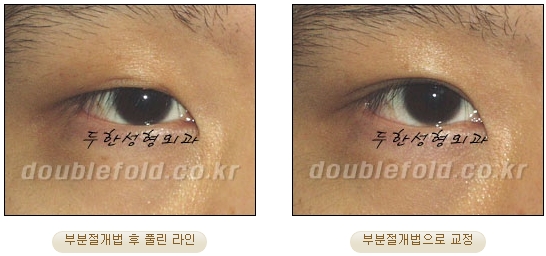

Ptosis Correction Method
Full Incision Method
For correcting pseudoptosis with a thick line, the full incision method can be used.
Full incision revision surgery is very difficult and requires extensive experience, highly advanced skill, and know-how.
It usually takes about 2 to 3 hours.
The procedure proceeds in 10 steps, and if even one step is omitted, the result may fall short of expectations.
Even if it takes a bit of time, a better result can be obtained only by carefully checking each step and performing the surgery with dedication.
▶ Two goals of the full incision method
The goals for correcting pseudoptosis with a thick line are largely twofold.
First: Reduce the large, unattractive double eyelid line and make it into a natural, thin double eyelid line
Second: Make the half-closed, sleepy-looking eyes open in a larger, clearer way
With these two goals, double eyelid revision surgery is performed as described below.
Full Incision Procedure
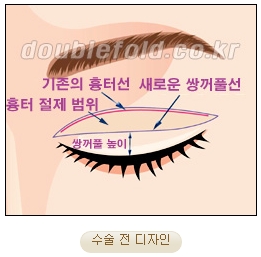
- Design the planned incision line, including the existing scar tissue.
Before surgery, the design is made to create a new double eyelid line below the scar line and determine the amount of skin to be removed up to the scar line.
For example, if the existing scar line is 10 mm above the eyelashes and the new double eyelid line is set at 7 mm, the skin excision width becomes 3 mm.
The new double eyelid line is determined by considering how much to reduce the line and how much extra skin is available.
The average line height in revision surgery is around 5 to 7 mm.
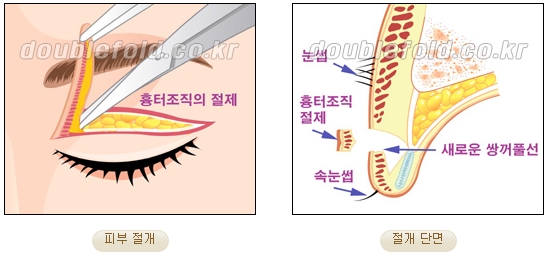
- Cut away the skin and scar tissue.
The scar tissue is excised along the design line.
The incision is made accurately with a scalpel, and then the tissue is excised with surgical scissors.
The lower excision line becomes the new double eyelid line, and the upper line must be naturally pulled downward after tissue dissection so that it can be sutured.
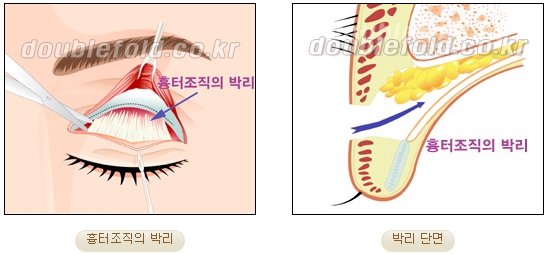
- Dissect the orbicularis muscle, orbital fat, and skin that are adherent to the levator palpebrae superioris.
Because the skin above the incision line must be pulled downward, the hard scar tissue that is stuck together must be released.
Scar tissue dissection proceeds by separating the area between the orbital fat layer and the levator palpebrae superioris, and in some cases, dissection is also done between the muscle and fat to advance the fat.
Through this dissection process, the tissue can be advanced and repositioned downward, and it is important as a preparatory step to obtain a natural double eyelid line.
- If there is contracture of the orbicularis muscle, cut or excise the muscle to remove the contracture.
When scar tissue adhesion is very severe, in rare cases a 1 to 2 mm vertical incision may be made in the orbicularis muscle to release the contracture.
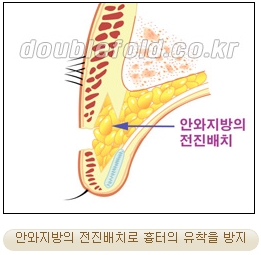
- To prevent re-adhesion, reposition the orbital fat up to the incision line.
Advancing the orbital fat is a process to prevent tissue from adhering again.
If the fat is not repositioned, the tissue will stick together again, and as a result, ptosis can occur and the eyes are likely to remain half-closed and sleepy.
Sometimes a triple eyelid may form, which becomes a cause of a damaged double eyelid line.
Another effect of repositioning the orbital fat is that if the eyelid is sunken, the hollowing can be corrected to some extent. Therefore, even in cases where fat grafting might otherwise be needed later, the surgery itself can improve the area to some degree, making fat grafting unnecessary in some cases.
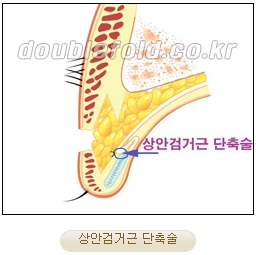
- Shorten the levator palpebrae superioris to strengthen its function.
Levator shortening is one method of correcting ptosis.
It is simple yet effective, and has the advantage of being able to correct the problem with almost no tissue damage.
It is a method of not cutting out the levator palpebrae superioris, but simply advancing it and tying it to the tarsal plate.
In revision surgery, the effect of levator shortening is to open the eyes more widely so they can be corrected in a clearer way, and to reduce the double eyelid line as the eyes open wider.
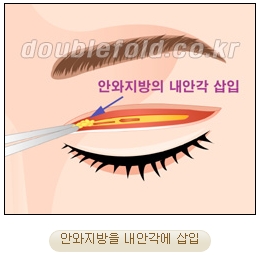
- After cutting the orbicularis muscle at the inner corner, orbital fat is inserted between the muscles to prevent re-adhesion.
In addition to advancing the fat, fat is inserted at the inner corner of the eye to prevent scar tissue adhesion.
The inner part of the eye is the area where scar tissue adhesion occurs most easily, and adhesion in this area can make the eyes look half-closed and make it difficult to open them.
To prevent this, orbital fat, which can act as a lubricant, is placed between the orbicularis muscle and the tarsal plate and fixed with sutures.
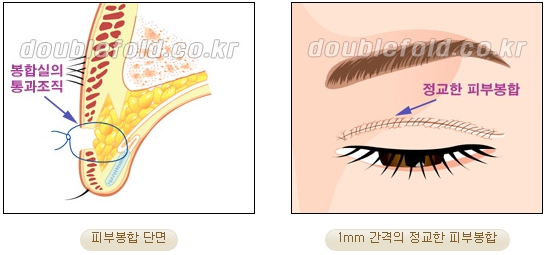
- During suturing, layered sutures are used to keep the repositioned structures from shifting.
The suturing method in revision surgery is not simple.
The purpose of suturing is to close the open wound and create the double eyelid line.
In order to obtain the double eyelid line as designed initially, the skin below the incision line must not be pulled upward.
To do that, the skin below the incision line must be firmly fixed to the tarsal plate, and the advanced fat must also be secured so it does not get pulled upward.
In addition, only when the orbicularis muscle and skin above the incision line are both passed through with sutures and firmly layered can the desired double eyelid line be achieved.
- To prevent hematoma and inflammation, a small amount of anti-swelling agent (hyaluronidase) is administered to the surgical area.
Hyaluronidase, an anti-swelling agent, is a medication with the effect of dispersing fluid, and it rapidly reduces swelling as soon as it is administered.
However, if too much is used, it can instead cause significant bruising, so it is used only in limited amounts for reducing swelling.
- The stitches are removed in two stages, on day 4 and day 7.
Stitches are usually removed around day 7.
The reason for removing stitches late is that in revision surgery, most cases do not have enough extra skin, and during surgery all tissues are advanced and repositioned, placing a lot of tension on the suture line.
Therefore, if the stitches are removed on day 3 or 4, the tense suture line may open or the scar line may widen, causing larger scarring, and the tissue may gradually be pulled upward, which also worsens the double eyelid line by making it larger.
Thus, until the tissue stabilizes, the stitches need to hold the tissue in place, so it is better to leave them in for longer.
To prevent the stitch marks from making the scar messy, most of the stitches are removed first on day 4 and only 3 to 4 stitches are left, so stitch marks are hardly noticeable.
A steroid preparation is administered for 1 to 2 days to quickly reduce early inflammation and swelling.
After surgery, artificial tears are used for about 1 to 3 months to prevent dry eye.
If all of the above principles are followed with skilled technique, satisfactory results can be achieved.
Examples of the Full Incision Method
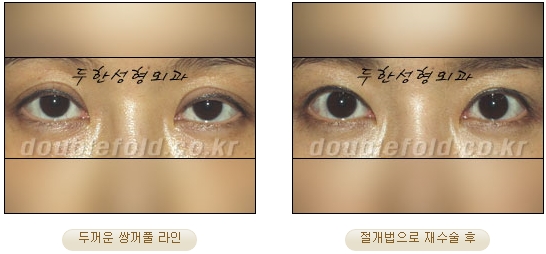
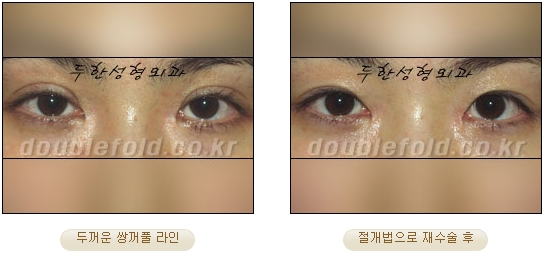
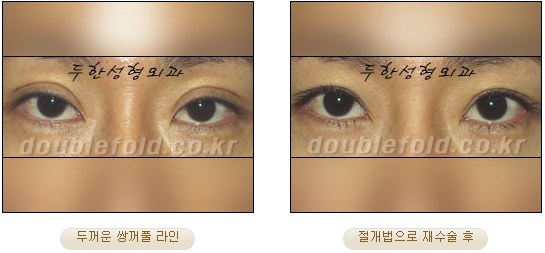
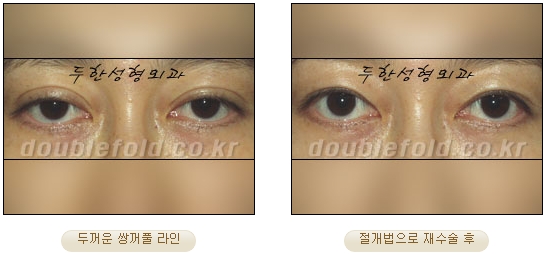
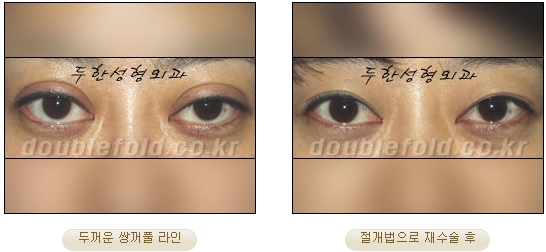
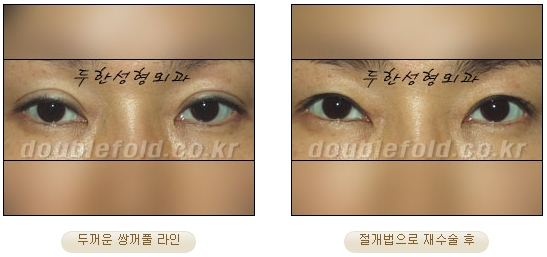
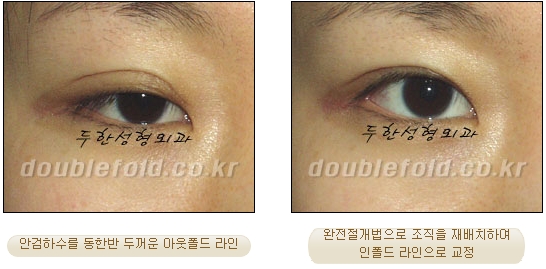
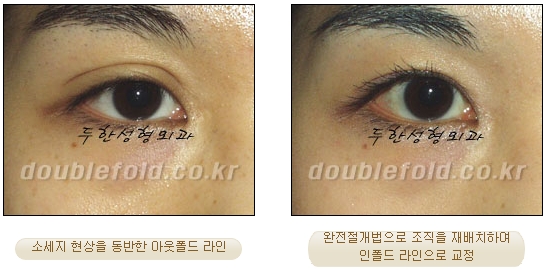
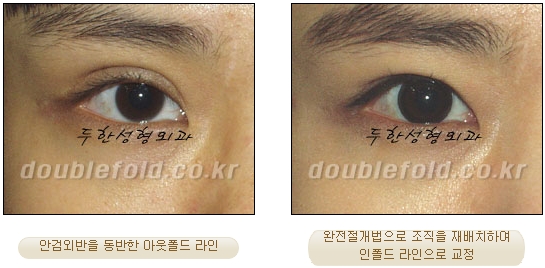
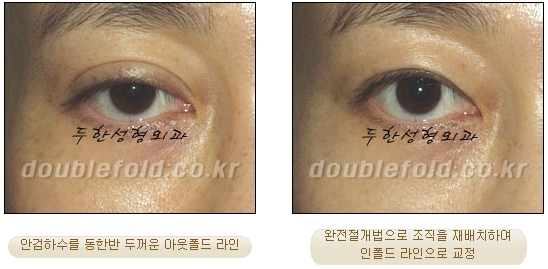
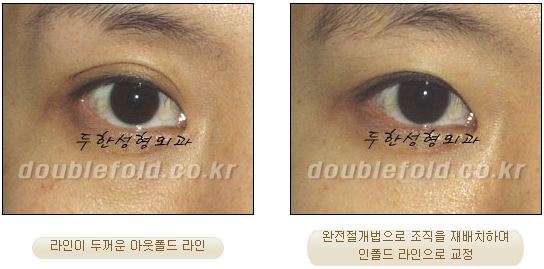
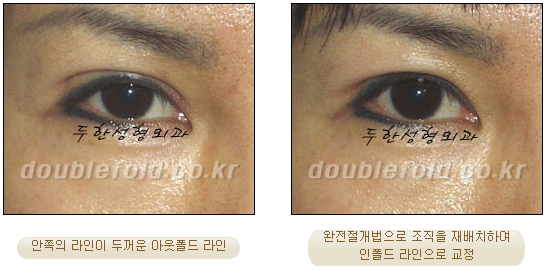
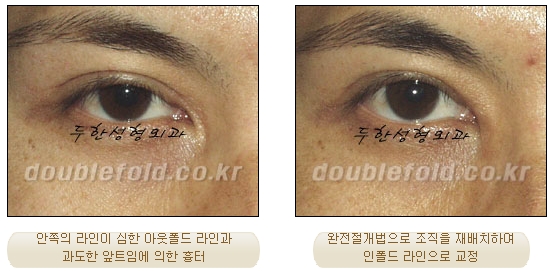
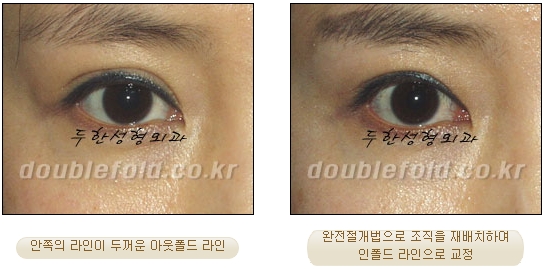
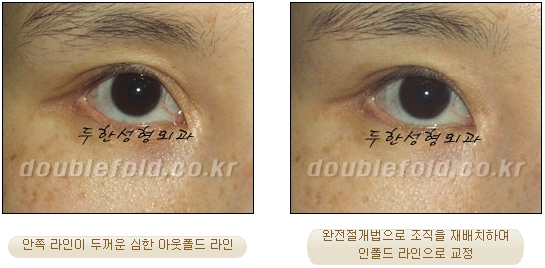
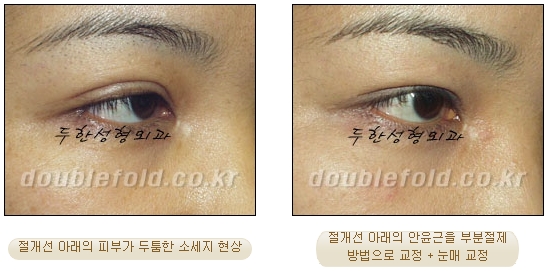
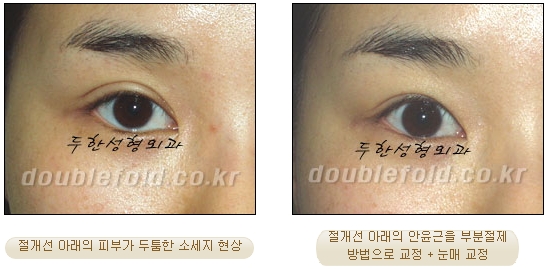
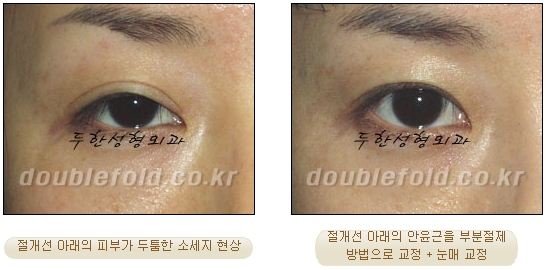
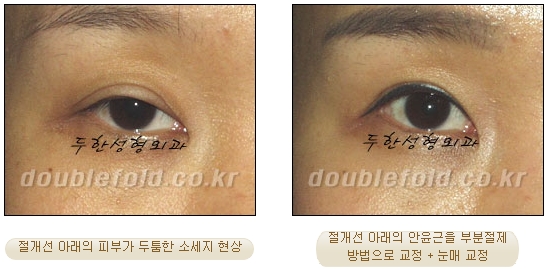
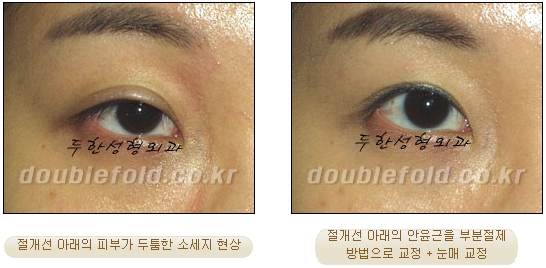
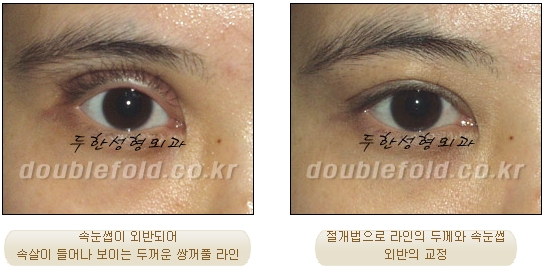
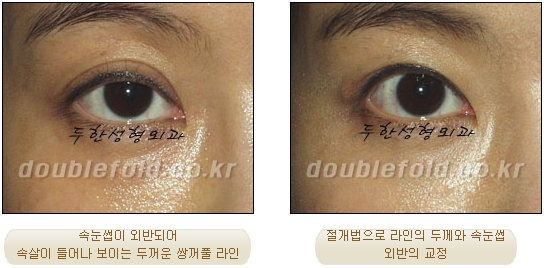
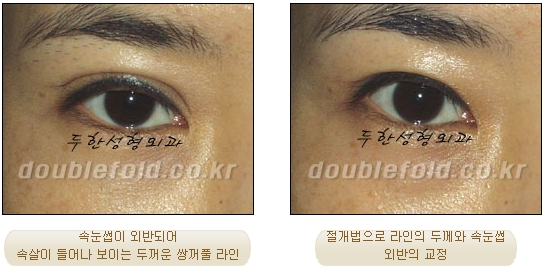
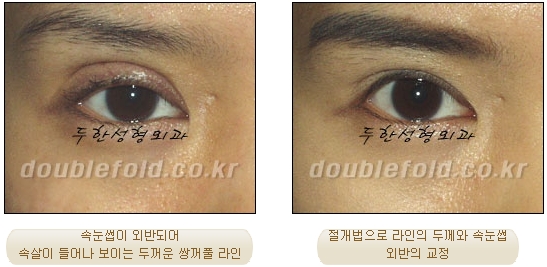
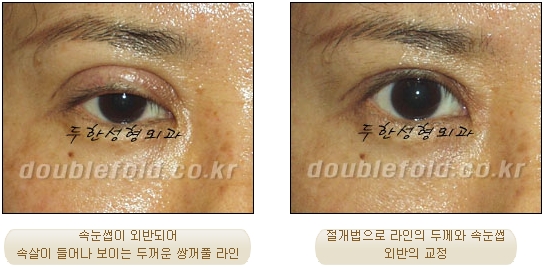
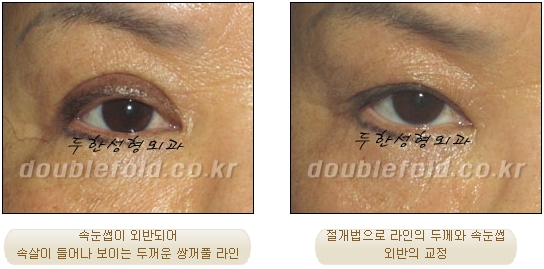
In revision surgery cases, sufficient clinical experience and the surgeon’s skill must be supported.
Revision surgery is being performed at many hospitals, but in most cases the results are not very good.
Revision surgery is a procedure that can only be performed when a great deal of experience and know-how have been accumulated, so it is not something just anyone can do.
Please understand that there are not many people in our country who can perform revision surgery and consistently produce results that satisfy patients.
One must accurately understand what went wrong in the original surgery and how it should be improved in order to obtain good results.
If there is enough extra skin, revision surgery is certainly possible.
The purpose of revision surgery is largely twofold.
Restoring large, clear-looking eyes and restoring a natural double eyelid line.
Dr. Shin Duhan

The Double Eyelid That Suits Me
Before surgery, it is necessary to judge which line suits you through consultation.
Because everyone’s eye shape and size are different, it is important to create a double eyelid line that suits you.
♥ Infold Double Eyelid
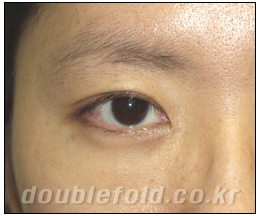
An infold double eyelid is one in which the double eyelid line disappears toward the inner side of the eye.
This type of double eyelid is created in eye shapes with a short horizontal length or with an epicanthal fold at the inner corner.
Therefore, if the line is made too strongly as an infold, it is sometimes designed artificially closer to an outfold, but an artificial line can create an awkward appearance.
♥ Outfold Double Eyelid
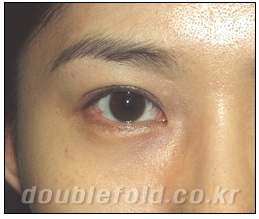
An outfold double eyelid is one in which the double eyelid line is visible all the way to the inner corner of the eye.
This type of double eyelid is created in eyes without an epicanthal fold and with a long horizontal eye shape.
Or, when surgery is performed with a larger line design, there is also a higher possibility of creating an outfold double eyelid.
♥ Inner Double Eyelid
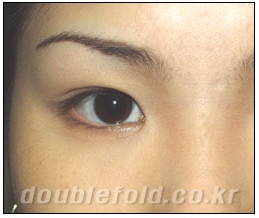
This refers to a double eyelid with a small line that is hardly visible when looking straight ahead.
Usually, this type of subtle inner double eyelid suits people with thicker skin or larger eyes.
It is suitable when a natural line with little visibility is desired.
♥ Outer Double Eyelid
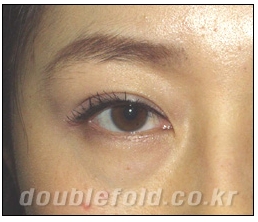
This refers to a double eyelid with a large line that is clearly visible when looking straight ahead.
In most cases, a double eyelid line that appears too clearly is not considered desirable from today’s perspective.
An excessively large double eyelid line can also lead to the need for revision surgery.

Finding the Right Line for Me
Before surgery, in order to find a suitable line, it is important to make a temporary line with a wire called iForm.
First, it is important to make a temporary line and find the line you like and the line that forms most naturally.
If the desired line is found and marked in that spot before surgery, the desired line can be obtained almost as it is.
Beautiful Double Eyelids
The following is the general standard for beautiful double eyelids. Please use it as a reference.^^
The double eyelid line should only show slightly.
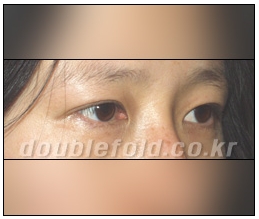
When the eyes are open and looking straight ahead naturally, it is best if the double eyelid is barely visible.
Many people mistakenly think that after double eyelid surgery, the eyelid must look large and distinct when the eyes are open for the surgery to be successful.
If a large, distinct line appears when the eyes are open, it is often an incorrectly done double eyelid.
If you look in the mirror and the double eyelid line is only slightly visible or almost invisible, you can consider it a very well-done double eyelid.
In such cases, when you lower your gaze slightly, the double eyelid line becomes visible, creating a more attractive eye.
The eyes should open clearly.
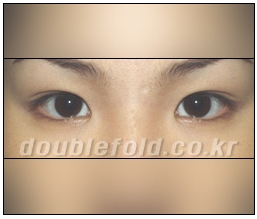
Sometimes the double eyelid line is large, but the eyes do not open well.
In such cases, it should be considered an unsatisfactory surgical result.
The eyes should be large, bright, and open clearly to create an attractive and beautiful eye shape.
If you look in the mirror and examine your eyes, you can tell whether the black pupil is almost fully visible or only partially visible because it is covered by the eyelids.
It is most natural when the eyelid slightly covers the black pupil, and there should be no sleepy or tired-looking impression.
It is better not to have an epicanthal fold.
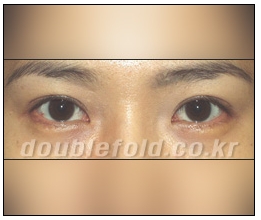
There are also double eyelids in which, because of an epicanthal fold (inner canthal fold), only the outer part of the line is slightly visible after double eyelid surgery, and the line disappears at the inner corner of the eye.
In such cases, if necessary, epicanthoplasty can be performed so the line appears all the way to the inner corner.
However, epicanthoplasty should be performed only when it is truly necessary.
If the distance between the eyes exceeds 40 mm, the presence of an epicanthal fold is considered, and if the patient wants it, epicanthoplasty (inner corner surgery) is performed.
However, it is better not to perform epicanthoplasty if possible when the distance between the eyes is not more than 40 mm.
If surgery is performed when it is 40 mm or less, the distance between the eyes may actually become narrower, making the eyes appear too close together, and in some cases the inner line of the eye may become wider than the outer line.
The eyelashes should lift slightly upward.
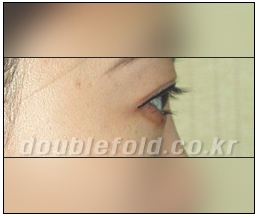
After double eyelid surgery, it looks more beautiful when the eyelashes lift slightly upward.
Even after double eyelid surgery, there are cases where the eyebrows remain drooped, but rather than that, if the eyebrows also lift slightly, it looks more beautiful. So while performing double eyelid surgery, it is better to slightly adjust the direction of the eyebrows as well.
http://www.doublefold.co.kr
Surgical results are not a matter of luck.
Consistent and safe results are proportional to the surgeon’s skill and ability.
As double eyelid revision surgery is repeated more times, the limitations and the possibility of surgery decrease.
Double eyelid revision surgery must be decided carefully.
Even for a board-certified plastic surgeon, not just anyone can do it, and the results vary greatly depending on the surgeon.
Never think of double eyelid revision surgery as something easy, and even if you think the surgery will be quick and simple, you may end up disappointed.
Our clinic has over 20 years of double eyelid revision surgery experience and accumulated know-how.
Double eyelid revision surgery is by no means an easy procedure.
Whether it is non-incisional or incisional, the eye tissue has already been deformed and damaged, so surgery must proceed with expectations based on sufficient experience.
Also, double eyelid revision surgery is not something anyone can do.
Revision surgery is being performed at many hospitals, but in most cases the results are not very good.
Because revision surgery can only be performed after a great deal of experience and know-how have been accumulated, people sometimes choose it based on low cost or advertisements, and the results can be hit or miss; in severe cases, some people undergo 7 to 8 double eyelid revision surgeries.
Our clinic places surgical effectiveness and safety above all else.
We also perform extreme eye revision surgery using techniques that minimize side effects, and we confidently state that we have produced safe and consistent results.
Severe side effects such as thick lines, ptosis, ectropion, and asymmetry are complications caused by doctors who lack experience.
Appropriate surgery must be performed while considering each patient’s skin tension, musculoskeletal factors, and other variables.
For any surgery, achieving high safety and precise results is something created by the doctor’s ability.
Unfortunately, some patients cannot undergo revision surgery because of insufficient extra skin and various other problems.
After consultation, the exact possibility of surgery is determined. At our clinic, we perform only surgeries whose safety and effectiveness have been verified, and for any surgery, we proceed only if the expected postoperative effect and satisfaction for the patient are at least 80 points.
People who have failed multiple times with eye surgery worry about the result, but the result depends on the surgeon’s ability.

http://www.duhans.com