Fat grafting # micro fat grafting # autologous fat grafting # fat injection # Indian fold # forehead wrinkle removal # Indian fold filler # face shape # wrinkle improvement # wrinkle plastic surgery # how to get rid of facial wrinkles
Indian fold surgery # Indian band # Indian band # Indian wrinkle # wrinkle improvement for men # Indian fold procedure # mom wrinkles # between-the-eyes wrinkles # Indian fold removal # silver plastic surgery
deep wrinkles # men’s forehead wrinkles # aging plastic surgery # full-face fat grafting # wrinkle treatment # making the face look younger # lift surgery # deep glabellar wrinkles # under-eye hollows # wrinkle care # skin volume # puffy cheeks
how to remove wrinkles # wrinkle removal # Duhan # Duhan Plastic Surgery # Director Shin Duhan # Duhan wrinkle plastic surgery # wrinkle plastic surgery clinic # plastic surgery lifting # wrinkle laser # facial wrinkle removal plastic surgery
anti-aging skin care # wrinkle injections # wrinkle lifting # wrinkle removal # youthful face # youthful plastic surgery # youthful surgery # rejuvenating plastic surgery # skin elasticity # skin wrinkles # sagging face lifting # facial wrinkles
fine wrinkles # cheek wrinkles # fine skin wrinkles # youthful lifting # wrinkle eraser # youthful injections # facial wrinkle removal # clinic good at lifting # making youthful skin # facial autologous fat grafting # fat grafting procedure
fat grafting surgery # fat grafting revision surgery # facial micro fat grafting # facial fat grafting # wrinkle fat grafting # facial wrinkle fat grafting # wrinkle correction fat grafting # wrinkle improvement fat grafting # autologous fat
place known for good facial fat grafting # place known for good fat grafting # fat grafting after fillers # before-and-after facial fat grafting # fat grafting retention period # retention period for facial autologous fat grafting # Gangnam fat grafting
Apgujeong fat grafting # Sinsa fat grafting # fat grafting hospital # fat grafting effect # fat grafting area # full-face fat grafting retention period # Indian fold fat grafting # men’s facial fat grafting
before-and-after fat grafting # facial fat grafting swelling # fat grafting survival rate # Seoul fat grafting # zygomatic fat grafting # front cheekbone wrinkles # front cheekbone wrinkle fat grafting # Indian band # Indian band fat grafting
Gangnam facial fat grafting # partial fat grafting # facial fat grafting # Gangnam Station fat grafting # Duhan fat grafting # fat insertion # fat grafting plastic surgery # front cheekbone fat grafting # famous fat grafting hospital
fat grafting specialist # famous fat grafting clinic # recommended fat grafting # hospital good at fat grafting # famous fat grafting clinic # recommended fat grafting hospital in Seoul # place good at fat grafting
What is fat grafting?
Fat grafting is also called fat injection.
Because it is a delicate and precise fat grafting procedure, it is also called micro fat grafting.
It involves harvesting a person’s own fat with a syringe and then injecting it again with a syringe into the desired area to correct the contours of the face.
The key to micro fat grafting lies in expressing natural, soft contours and achieving a high survival rate.
Using three-dimensional volumetric fat grafting and two-dimensional flat fat grafting, the most ideal fat grafting is performed for each area.
Except for bone surgery such as the cheekbones and jawbone, contour correction for other sunken areas can be performed with fat grafting.
The procedure is simple, has no side effects, and can naturally correct any area to the desired extent, making it one of the best facial contouring procedures.
Effects of wrinkle-removal fat grafting
Rather than injecting a large amount into one area using the tunneling technique, we perform three-dimensional micro fat grafting evenly and uniformly in layers using 100% concentrated fat.
A delicate and careful injection method allows for customized design.
Fat grafting also includes a process called “tunneling,” which allows the grafted fat to make maximum contact with the surrounding abundant blood vessels so that it can continuously receive nutrients.
Tunneling means creating spaces for the fat to go using micro needles just beneath the skin. Since the space is created first, as if making a tunnel, and then the fat is injected, the fat does not sag in the direction of gravity or become bumpy even after all of it has been injected.
The tunneling technique includes the dissection process for wrinkles, so because the fat is grafted under the dissected wrinkle area, wrinkles are improved more clearly than with fat grafting at other clinics.
Advantages of wrinkle correction with fat grafting
| The procedure is simple. |
|---|
| Because foreign materials such as fillers (Restylane, Radiesse, Artecoll) are not used, there is no need to worry about side effects. |
| Because the procedure does not involve cutting the skin, there is no need to worry about scars. |
| Because it uses autologous tissue, the shape looks natural. |
| There is almost no swelling or bruising. |
| You can return to daily life immediately after the procedure. |
| Because the fat tissue takes hold, the effect can be maintained for a long time. |
Points to keep in mind when correcting wrinkles with fat grafting
▷ After the procedure, avoid laughing too hard or making exaggerated facial expressions, because pressing on the grafted fat can increase absorption.
▷ Do not press on the fat-grafted area or massage it forcefully.
▷ Avoid running or other vigorous exercise for about a month.
Indian fold fat grafting
This refers to a sunken wrinkle line that runs across the front cheekbone area.
It is also called a front cheekbone wrinkle, and in most cases the cause is congenital. In some people, the wrinkle line is already distinct at a young age.
If the wrinkle line is present, it can make you look older and give a poor impression, so it needs to be corrected.
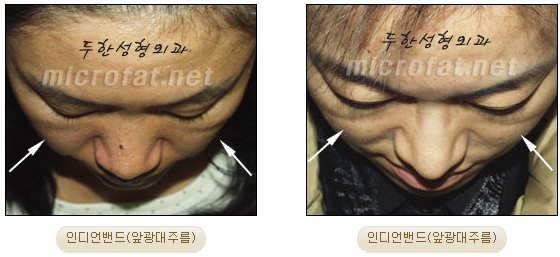
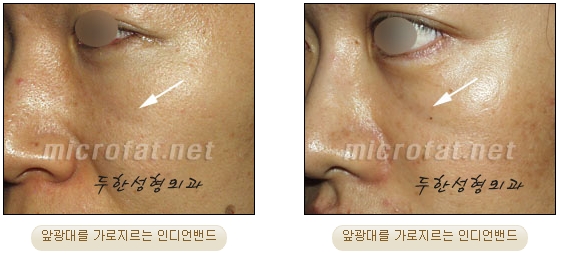
Indian fold fat grafting
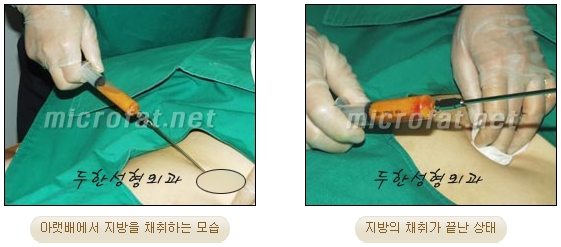
- Fat is harvested from areas where your own fat is stored in large amounts, such as the lower abdomen, waist, or thighs.
For wrinkle correction, a large amount of fat is not needed, so harvesting from the lower abdomen is preferable.
-
Since local anesthesia (painless sleep anesthesia) is used, there is no pain at all.
-
A thin liposuction cannula is used to collect the fat into a syringe.
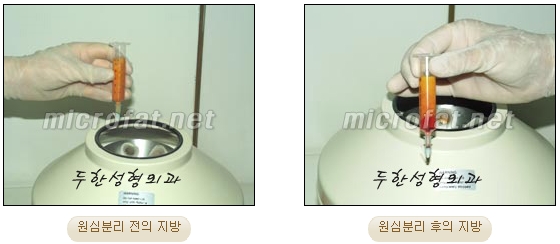
- The harvested fat is placed in a centrifuge to remove impurities (local anesthetic, serum, red blood cells, etc.).
The purpose of centrifugation is to remove impurities contained in the fat, increase its concentration, and improve the fat survival rate.
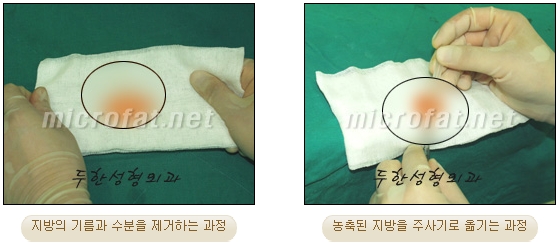
- After centrifugation, water and oil are removed through a second concentration process.
By removing water and oil, fat that is nearly 100% concentrated is obtained.
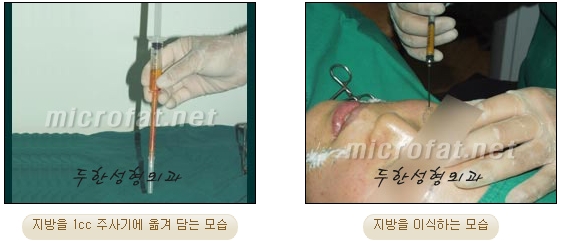
- The purified fat is transferred into a thin 1 cc syringe and grafted into the desired area.
The fat is again transferred into a thin 1 cc syringe and grafted into the desired area.
We use a micro needle (micro grafting cannula) developed in-house.
The micro needle is a special grafting cannula used only at our clinic, enabling ultra-precise grafting.
For grafting, subcutaneous tunneling should be done in advance before grafting so that the fat can be placed accurately in the wrinkle area and the wrinkles can be corrected effectively.
- After fat grafting, normal daily activities are possible immediately, and face washing and makeup are possible from the next day.
Examples of Indian fold fat grafting procedures
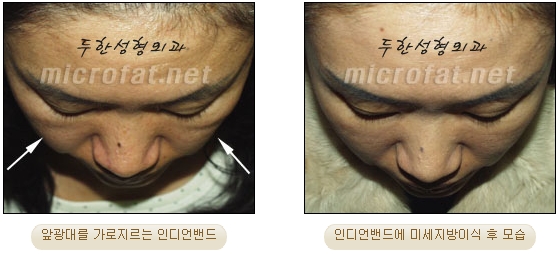
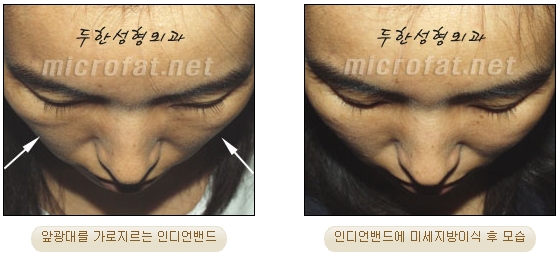
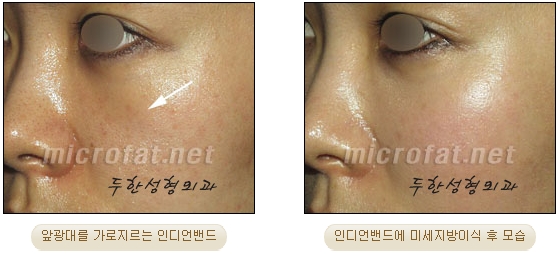
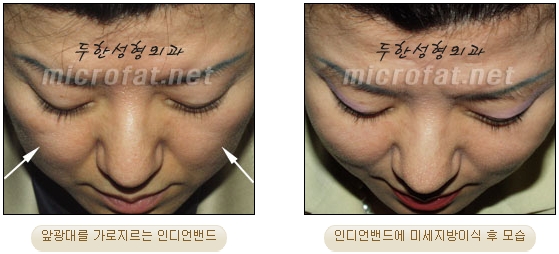
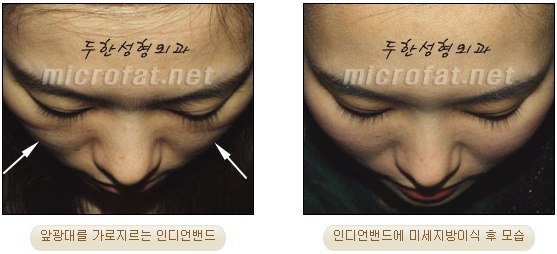
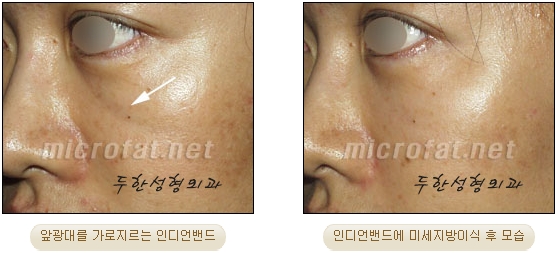
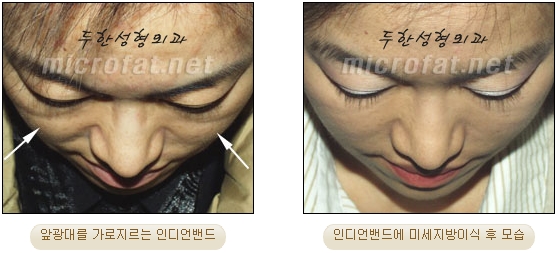
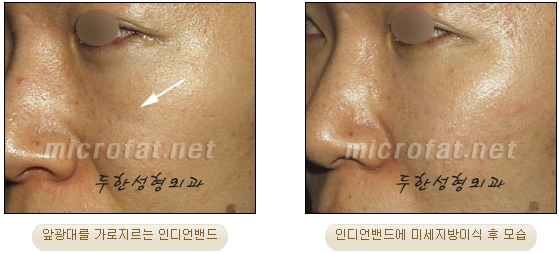
Advantages of Indian fold fat grafting
① The procedure is simple.
② Because it uses autologous tissue, the shape looks natural.
③ There is almost no swelling or bruising.
④ You can return to daily life immediately after the procedure.
⑤ If the fat tissue takes hold, the effect can be maintained for a long time.
Number of procedures and intervals for Indian fold fat grafting
Most fat grafting procedures can produce satisfactory results after an average of 1 to 2 sessions.
The interval between procedures should be at least 3 months, and for repeat procedures, the fat that had been collected at the time of the first grafting can be thawed and used.
Duration of effect for Indian fold fat grafting
Some people say fat grafting has no effect because much of it is absorbed, but this applies when the procedure is performed at a clinic with somewhat insufficient experience.
In principle, if fat grafting is performed correctly, satisfactory results can be achieved, and once the grafted fat takes hold, it is no longer absorbed and remains your own fat tissue for life, making it one of the safest and most effective methods.
On average, after 1 to 2 fat grafting sessions, a permanent and satisfactory facial contour correction effect can be achieved.
Side effects of fat grafting
Of course, good results are important, but depending on the surgeon’s skill and technique, sometimes unavoidable problems may occur.
Poor results due to low survival rate, unnatural shape, asymmetry, severe swelling, inflammation, fat necrosis, calcification, irregularity, sagging, and hyperpigmentation may occur.
| Inflammation | Occurs when bacteria enter during the procedure, or when the fat does not take hold and melts during the process of taking hold |
|---|
| Necrosis | A state in which fat that did not receive proper blood supply during the process of taking hold rots and melts, leaving residual material behind |
| Calcification | A phenomenon in which fat does not receive proper blood supply during the process of taking hold and hardens as calcium is deposited, forming a firm lump |
| Irregularity | A phenomenon in which the shape becomes uneven when the fat is not grafted uniformly or is concentrated in only one area |
| Sagging | If too much fat is grafted or grafted in the wrong place, sagging of the face may occur. |
| Hyperpigmentation | When bruising or swelling is severe, iron components left in the bruise may deposit in the skin and oxidize into a brown color depending on the person’s constitution; this can sometimes occur after under-eye procedures. |
| Asymmetry | Occurs when left and right survival rates differ or the amount is not properly adjusted during the first procedure, causing left-right imbalance |
| High absorption rate | A phenomenon in which the fat does not take hold sufficiently to create the desired contour and much of it is absorbed, so the shape before and after the procedure does not change much |
| Unnatural shape | A phenomenon in which the fat takes hold excessively or is grafted into the wrong area, disrupting the overall balance of the face |
Problems related to side effects of fat grafting
Because fat grafting uses your own fat, unlike commercial fillers, there are almost no side effects.
Except for some swelling and bruising after the procedure, it can be said to have no side effects.
Therefore, it can be considered safer than any other plastic surgery.
However, this is based on the premise that the fat grafting is done properly, and if the procedure is performed against the principles, side effects may occasionally occur, such as an uneven shape, fat necrosis and hardening, inflammation, or an unnatural shape due to excessive injection.
These are issues determined by the practitioner’s experience and technique, and are absolutely not a general problem with fat grafting itself.
Therefore, if the procedure is performed according to the principles, these side effects almost never occur.
How to perform fat grafting without side effects
Perform the procedure in a sterile state
As with all surgeries, fat grafting must also be performed with completely sterilized instruments and materials.
After the procedure, the inside of the suction cannula should be thoroughly cleaned with a brush and sterilized with a high-pressure steam sterilizer so that no fat residue remains in the suction or grafting cannulas. Anesthetic agents and saline must also be carefully managed so they are not contaminated.
Thorough sterilization and management of materials can prevent bacterial infection and inflammation.
Multiple stages of fat purification
Fat purification must remove impurities completely through several stages to maximize the effect.
The harvested fat usually contains about 80% impurities, and the actually usable portion is only around 20%.
If the remaining impurities (blood, serum, anesthetic, oil, water, etc.) are not removed, the results will be poor no matter how well the grafting is done.
Pre-treatment before fat grafting
A high survival rate should make it possible to achieve satisfactory results with a single procedure whenever possible.
The fine fat should be planted evenly in multiple layers, and before that, space should be secured at the grafting site so that the previously grafted fat is not compressed by the surrounding tissue. This allows the fat to avoid pressure and take hold well.
Precise and even grafting into multiple tissue layers
Soft and natural contour expression is the core of fat grafting.
For a soft contour, it is better to graft in a three-dimensional manner by distributing the fat evenly across multiple layers.
The grafting locations include the subcutaneous layer, muscle layer, and fascia layer. The fat should be spread through the tissue as if sowing seeds evenly to achieve a soft contour without irregularities.
Misconceptions about fat grafting
Question) The theory that fat harvested from the thighs takes hold better
Answer) The harvesting site for fat is not fixed.
Strictly speaking, the thighs are not a preferred harvesting site.
The issue is that the fat contains a lot of oil.
Oil is an impurity and does not help with survival.
After the procedure, there is more bruising and swelling, and until the bruising subsides, you should not walk more than necessary, which can make daily life inconvenient. If too much is harvested, problems such as changes in the shape of the thighs or hyperpigmentation may occur.
The harvesting site is not determined solely by survival rate.
You must consider whether there is enough fat, the convenience of harvesting, post-procedure swelling and pain, the degree of bruising, ease of returning to daily life after harvesting, and the survival rate of the harvested fat. You must also take into account the shape of the harvesting site and any future aftereffects.
For fat grafting, fat must first be harvested from an appropriate area.
The harvesting site is determined by considering the amount of fat that needs to be suctioned, and when only a small amount is being grafted, such as under the eyes, the nose, or nasolabial folds, the lower abdomen is usually used.
The reason the lower abdomen is good is that it is easy to harvest from, post-procedure swelling and pain are mild, and it is comfortable for daily life.
If a large amount must be grafted, such as in the cheeks or forehead, you need to check whether enough fat can be harvested from the donor area.
If the lower abdomen has a lot of excess fat, harvesting is done there. If there is no fat in the lower abdomen, or if the abdominal skin has lost much of its elasticity due to aging or childbirth, then harvesting cannot be done there even if there is fat.
That is because the belly may sag after fat harvesting.
In such cases, harvesting is done from the thighs, and the thigh is divided into the inner, outer, and back areas when deciding the harvesting site. The area with the most excess fat is selected for harvesting.
Fat is harvested with precise suction so that no deformity or indentation occurs in the harvesting site.
In some cases, if the person receiving the procedure has a particularly preferred area, harvesting may be done from that area whenever possible.
Because each person has a different distribution of excess fat and a different constitution, the most suitable fat harvesting site must be chosen according to the body’s characteristics and constitution.
The site from which fat is harvested does not determine the survival rate.
To achieve good results from fat grafting, you need precise harvesting, a proper purification process such as oil removal, pre-treatment of the procedure site, and grafting an appropriate amount of fat evenly into the area while ensuring the grafted area looks natural.
In other words, good results can be achieved only when the series of procedural steps from start to finish are carried out properly.
Question) The misconception that grafted fat flows downward or moves
Answer) Fat is the transplantation of solid cells.
Either it takes hold and remains as your own cells, or it melts away and disappears.
A solid cell does not move or flow downward. That never happens.
In unauthorized procedures, industrial silicone or paraffin is sometimes injected into the face carelessly. Because these are liquid substances, they often flow downward in the direction of gravity.
Liquids can move by seeping between cells.
Some people see or hear about side effects from unauthorized procedures and develop a prejudice that fat grafting may also cause problems, but solid fat cells remain in the place where they were grafted and cannot move to another area.
Sometimes at other clinics, fat is grafted excessively or into the wrong area, making the shape unnatural or saggy. Seeing this, one may think the fat moved, but it is not that the fat flowed or moved; rather, the grafting itself was done incorrectly, or too much was grafted, making it look saggy due to the weight of the fat.
Question) The theory that exposure to air must be blocked during the fat purification process
Answer) No step in fat grafting can be neglected, and the purification process is no exception.
Fat purification is intended to remove all unnecessary impurities other than fat cells.
The impurities removed in the centrifugation stage are water, anesthetic, serum, red blood cells, and so on.
What cannot be purified away at the centrifugation stage is the oil component inside the fat cells themselves.
Oil is one of the impurities that must be removed from fat cells and accounts for a significant proportion.
It is distributed both inside and outside the fat cells, and the fat cells can be thought of as entangled with oil.
The only way to remove the oil is to wrap the centrifuged fat in sterilized gauze and remove it by natural absorption. At this point, the fat is exposed to the outside.
Some claim that exposing fat to air increases the risk of infection or damages it through oxidation, but in reality such effects are almost nonexistent.
Under a microscope, fat cells are surrounded on both the inside and outside by a thick oil layer, so the fat cells themselves cannot directly contact the air.
Also, because diluted antibiotic solution is applied to the fat during the gauze purification process, bacterial infection can actually be prevented more effectively.
Question) Misunderstandings and truths about the lasting effect of fat grafting
Answer) Although there are many clinics that perform fat grafting, only a small number can produce proper results.
If fat grafting is not performed properly, the result may be worse than not doing it at all.
In principle, fat grafting can produce good results only when performed accurately.
The procedure method differs from clinic to clinic and can vary greatly depending on experience.
The survival period of fat is about 3 months.
Fat that survives beyond that point will permanently remain as your own fat cells.
It is often misunderstood that grafted fat disappears after 1 to 2 years and returns to the original state, but fat that has taken hold does not disappear for no reason.
Also, the reason the second procedure is done after 3 months is to let the fat from the first procedure fully take hold and settle, then perform the next procedure after checking the shape.
Up to about 3 months, some of the fat may be absorbed, but fat that has taken hold and is not absorbed after 3 months will no longer be absorbed and will remain as your tissue permanently.
However, the shape of the grafted area does not last forever.
As people age, the skin sags, wrinkles form, and the skeleton changes, so the area that received fat grafting is not exempt from aging.
For that reason, the effect of fat grafting is sometimes described as semi-permanent and sometimes as permanent.
There is a difference in wording, but it can be said to last until aging has progressed significantly with age.

Features and advantages of the Duhan Plastic Surgery fat grafting clinic
① All anesthesia is performed with local anesthesia (sedation anesthesia).
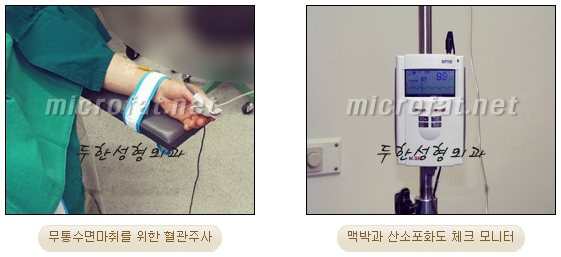
All fat grafting procedures are performed under local anesthesia, regardless of the area.
Local anesthesia is performed together with sedation anesthesia, and the procedure can be done without any pain during or after anesthesia.
Depending on the area, hyaluronidase, a swelling-prevention agent, is mixed into the local anesthetic and administered.
Hyaluronidase is a high-cost swelling-prevention agent with a tissue-fluid diffusion effect that helps prevent almost any swelling from occurring immediately after the procedure.
② We have a systematic and advanced fat grafting system.
The success of fat grafting depends on the survival rate.
To maximize the survival rate, the following are necessary.
○ Live fat cells must be harvested.
○ To improve the purity of the fat, the purity is maximized through centrifugation purification and removal of unnecessary oil.
○ Before fat grafting, subcutaneous tunneling at the grafting site secures space for the fat to be placed.
○ Using a micro fat grafting cannula, precise and detailed fat grafting is performed for each area.
○ By grafting thinly across multiple layers in a three-dimensional manner, the survival rate is increased and a soft contour is created.
④ We select and harvest from appropriate and various fat harvesting sites.
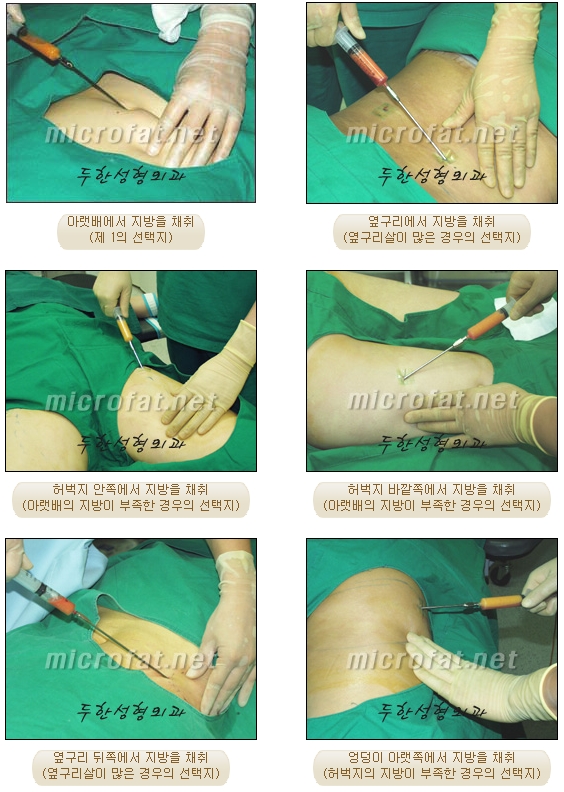
The most commonly used area for fat harvesting is the lower abdomen. Since the lower abdomen causes less pain after the procedure, less swelling and bruising, and is comfortable for daily life, it is the first choice for fat harvesting.
If the lower abdomen does not have enough fat or if the person undergoing the procedure prefers another area, fat is harvested from other sites as well. The next most commonly selected area is the inner thigh, followed by the outer thigh.
There is no fixed rule about which area is best for fat survival.
Results are similar regardless of the site, and while the area of the body with the most excess fat is the ideal harvesting site, it is best to choose the site by considering the amount of fat to be harvested and daily activities after the procedure.
⑤ The two-stage purification process of harvested fat maximizes the survival rate of the fat.
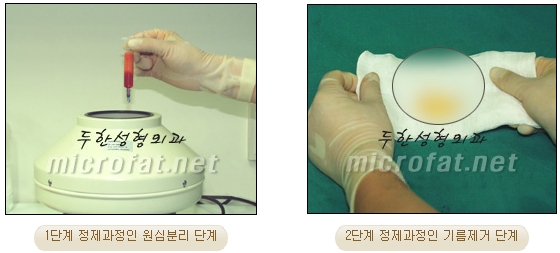
The harvested fat goes through a two-stage purification process to remove impurities other than fat cells.
The impurity present in the highest proportion in harvested fat is local anesthetic, followed by oil.
Other impurities such as serum and red blood cells are also included.
In the first stage, it undergoes about 3 to 4 minutes of centrifugation, and in the second stage it goes through an oil-removal process.
The centrifugation purifies away local anesthetic, red blood cells, serum, and so on.
Oil is removed manually using a natural absorption method.
Through the two-stage purification process, nearly 100% concentrated fat is obtained, maximizing the effect of fat grafting and the survival rate of the fat.
⑥ We secure space for fat grafting through subcutaneous tunneling.
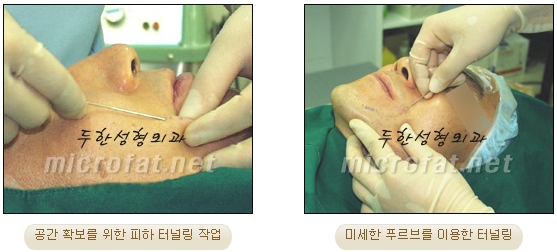
Subcutaneous tunneling is the process of creating space in advance at the area where the fat will be grafted. It is essential for a high survival rate and even grafting.
Using a thin probe, the area under the skin is moved repeatedly in a fan-like pattern to create space for the fat to be grafted.
The effect of subcutaneous tunneling is to increase the survival rate of the fat and prevent it from clumping, creating a uniform and soft contour.
⑦ Three-dimensional micro fat grafting can produce a soft and uniform facial contour.
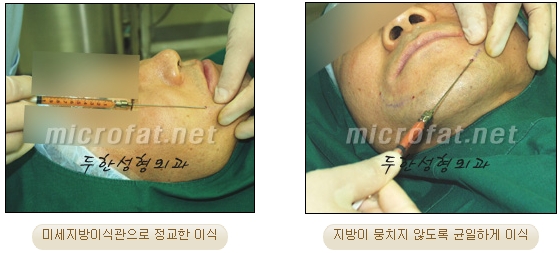
Although there are exceptions depending on the area, the basic fat grafting method is a three-dimensional approach.
By dividing the fat across multiple layers and grafting small amounts evenly in each area, the survival rate is increased and the take is made more uniform, helping to create a soft contour.
⑧ Micro fat grafting cannulas are used for precise fat grafting.
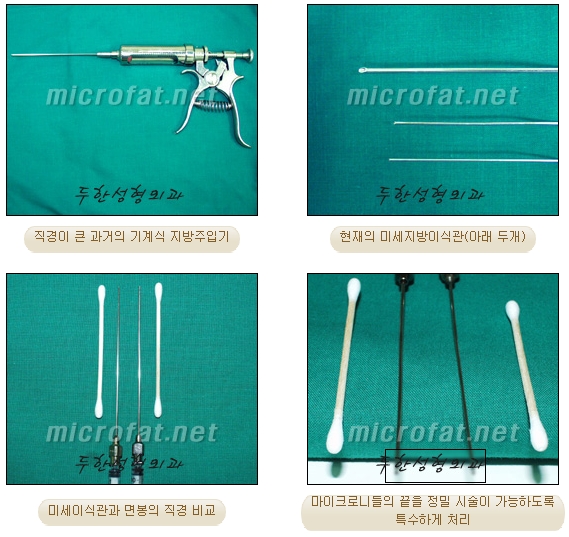
In the past, the method using a fat injection machine pushed fat under the skin with high pressure, which caused various problems.
The absorption rate of fat was high, the take was not uniform, the contour became uneven, and grafting into delicate areas such as under the eyes was difficult.
To solve these problems, the fat is transferred again into a thin 1 cc syringe and grafted into the desired area.
At our clinic, we use a micro needle (micro grafting cannula) developed in-house.
The micro needle is a special grafting cannula used only at our clinic, enabling ultra-precise grafting.
Fat grafting can be performed on the upper eyelids, lower eyelids, forehead wrinkles, glabellar wrinkles, nasolabial folds, and the bridge of the nose, making fat grafting possible in almost all cases except very fine wrinkles.
⑨ Molding immediately after fat grafting helps create a uniform and soft facial contour.
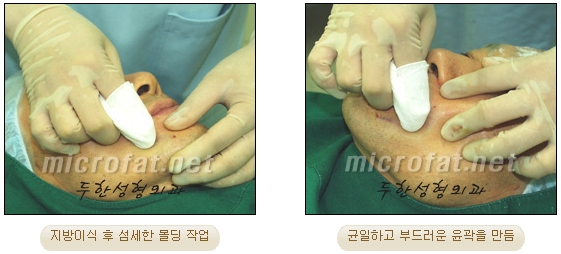
Immediately after fat grafting, delicate molding is performed to spread the grafted fat evenly and create a soft shape.
Molding is the final step in fat grafting and one of the most important steps.
⑩ Rapid freezing and sterile storage of remaining fat simplifies the second procedure.
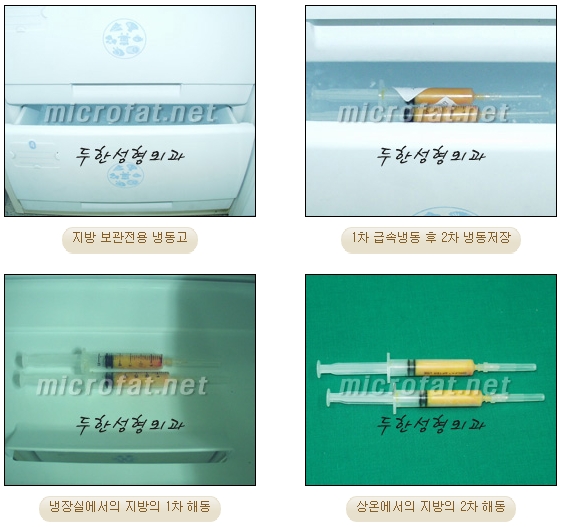
When a second procedure is performed 3 months after fat grafting, the remaining fat from the first procedure is used rather than harvesting fat again.
The fat remaining after the first procedure is rapidly frozen, sterilized, and stored.
For the second procedure, the stored fat is thawed, making the procedure more convenient.
The storage period for fat is up to 1 year, and if you visit within 1 year, the stored fat will be used for the procedure.
⑪ Thorough aftercare system
After fat grafting, we provide careful follow-up until the fat has fully taken hold by thoroughly managing aftercare.
During follow-up, if needed, we try to minimize customer dissatisfaction through swelling-reduction injections, shape correction, and molding.
http://www.duhans.com
http://www.microfat.net
Pre- and post-procedure process for fat grafting and post-procedure care instructions
This is the pre- and post-procedure process for undergoing fat grafting surgery.
-
Make a consultation appointment by phone or online.
-
Visit at the scheduled consultation time for the consultation.
-
If you want the procedure, make a surgery appointment immediately after the consultation and leave.
You can also make a surgery appointment later by phone or online.
-
Arrive 30 minutes before the scheduled surgery time, receive an explanation of the fat grafting procedure, and undergo design planning.
-
After the design is completed, change clothes and receive an intravenous injection for painless sedation anesthesia.
-
The procedure time for fat grafting varies by area, and if multiple areas are done at the same time, it may take longer.
On average, it takes from 30 minutes to as long as 2 hours.
-
After the procedure, you will receive antibiotic and anti-inflammatory injections and rest in the recovery room for about 30 minutes.
-
You will receive post-procedure precautions and schedule your next visit.
-
Visit 2 days after the procedure to check the progress of the fat-grafted area and disinfect the fat-harvesting site.
Showering is possible from 2 days after the procedure.
Visit on the 7th day after the procedure to check the progress and remove the stitches at the fat-harvesting site (navel).
If the hospital is too far away to visit, you do not have to come in.
- If a second procedure is needed, you will visit and receive it between 3 and 10 months later.
http://ww.duhans.com