#CrookedNose #CrookedNoseCorrection #BentNose #NoseThatLooksBent #CrookedNoseSurgery #CrookedNoseSurgeryMethod #NoseFatGrafting #RhinoplastyMethod #TypesOfRhinoplasty #Rhinoplasty #RhinoplastyProcedure
#BestPlaceForCrookedNoseSurgery #NoseSurgery #BestPlaceForCrookedNoseRhinoplasty #RevisionRhinoplasty #PlasticSurgeryClinic #BestPlaceForCrookedNoseCorrection #HumpNoseSurgery #CrookedNoseBoneSurgery #Duhan
#NoseDeviation #NoseDeviationSurgery #MenCrookedNose #NoseDeviation #RhinoplastyProcedure #BentNoseSurgery #BentNose #CrookedNoseCorrection #CrookedNoseBone #CrookedNoseSurgery #NasalBoneDeviation
#CrookedNose #NasalBoneDeviationSurgery #NasalBoneBentSurgery #MenCrookedNoseSurgery #RevisionCrookedNoseSurgery #HumpNoseSurgery #HumpNose #Hump #HumpNose #HumpNoseSurgery #HumpNoseCorrection #HumpNoseWithoutImplants #RevisionRhinoplastyTiming #HumpNoseRhinoplasty #BridgeOnlySurgery #NaturalNose #FemaleRhinoplasty #FemaleHumpNose
#PetitNoseSurgery #HumpNoseWithoutImplants #HumpNosePlasticSurgeryClinic #PlasticSurgeryClinic #GangnamPlasticSurgeryClinic #Duhan #DuhanPlasticSurgery #DuhanRhinoplasty #PrettyNose
#NasalAsymmetry #BestRhinoplastyClinic #GangnamNoseSurgery #NoseSurgeryWithoutImplants #BestPlaceForNoseSurgery #BestPlaceForGangnamNoseSurgery #BestPlaceForApgujeongNoseSurgery
#BetweenTheEyebrowsAndBridge #RevisionRhinoplastyRecommendation #LowNose #StraightNose #SaddleNose #NasalImplant #MicroFatGraftingForNose #AutologousFatGraftingForNose #NasalCorrection #BestPlaceForGangnamNoseSurgery
#BeautifulNose #ColumellaSurgery #ClinicKnownForRhinoplasty #NaturalRhinoplasty #TypesOfNoseSurgery #NoseLine #NoseSurgery #BestRhinoplastyClinic #FamousRhinoplastyClinic
#NoseSurgeryRecoveryPeriod #RhinoplastyRecommendation #BestClinicForNoseSurgery #BestPlasticSurgeryClinicForNose #GangnamPlasticSurgeryClinic #ApgujeongPlasticSurgeryClinic #RhinoplastyImplants
#DrShinDuhan #BestPlaceForGangnamRhinoplasty #BestPlaceForApgujeongRhinoplasty #BestPlaceForSinsaRhinoplasty #SeoulRhinoplasty #BestClinicForSeoulRhinoplasty
Crooked Nose Correction Using Fat Grafting
It can be corrected with fat grafting.
The biggest advantage of fat grafting is
that the procedure is simple
and has almost no side effects.
There is no burden of surgery using implants,
and you can return to daily life immediately after the procedure.
Dr. Shin Duhan
Fat Grafting for Rhinoplasty
Nasal fat grafting is applied when the goal is to naturally augment the bridge of the nose.
It is used when there is resistance to foreign materials such as silicone, when social life must resume immediately after the procedure, or when only a slight increase in height is desired.
Sometimes it can also be applied to correct a bent nasal bridge.
Indications for Fat Grafting Rhinoplasty
○ When the nasal tip is fine but only the bridge is low
○ When the area between the eyebrows (between the eyes) is low
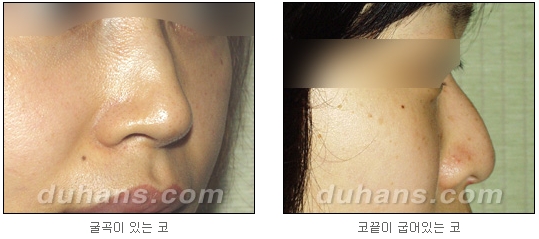
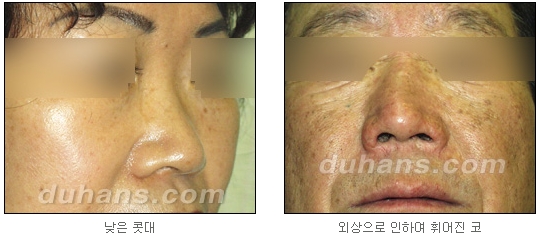
○ When the nose appears crooked
○ When there is a depressed scar on the nasal bridge
○ When there is depression on the nasal bridge (saddle nose) or a curved bridge
○ When a boundary line is visible after inserting an implant such as silicone and needs to be softened
Understanding Fat Grafting Rhinoplasty
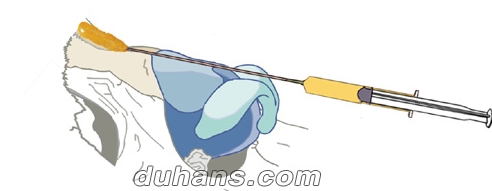
There are various ways to raise the nose, such as silicone or Gore-Tex, but when the nose is raised with autologous fat grafting, the advantages include being able to return to daily life immediately, having little swelling and bruising, and using one’s own tissue, which results in fewer side effects and less resistance. For these reasons, preference for fat grafting is increasing.
When raising the nose with fat, it should be applied only after carefully selecting suitable indications and only when a good result can be expected.
In addition, procedures using fillers (Artecoll, Restylane, Aquamid, etc.) are sometimes performed, but fillers are not products that should be used for raising the nose.
Fillers should only be used to correct fine wrinkles around the eyes, forehead wrinkles, or small depressed scars.
Injecting fillers into the nose is completely inappropriate for that purpose, and because of concerns about side effects such as skin necrosis or inflammation, the procedure must be approached cautiously.
For natural augmentation, fat grafting can be considered one of the good methods.
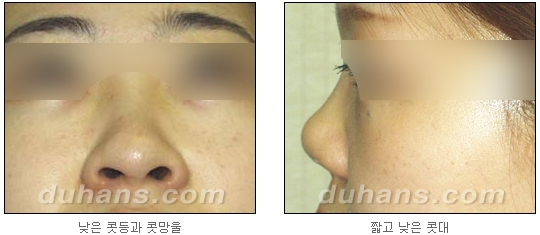
Fat Grafting Procedure for Rhinoplasty
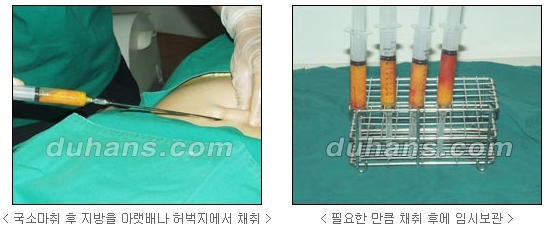
Fat is usually harvested from the lower abdomen. The reason the lower abdomen is a good harvest site is that fat collection is easy, the fat cells are robust, there is a lot of fibrous tissue, and there is less swelling and bruising, allowing for a quicker return to daily life and recovery.
If there is not enough fat in the lower abdomen, the thighs are sometimes used.
Usually, about 40 to 60 cc of fat is harvested in preparation for a second procedure.
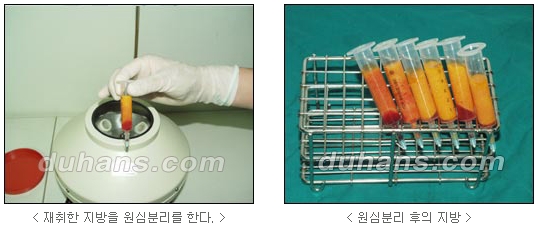
Unprocessed fat collected immediately after harvesting usually consists of about 80% impurities.
The largest component of the impurities is the local anesthetic, followed by the oily component mixed into the fat cells.
In addition, serum and a small amount of blood are mixed in, so all impurities except the fat cells must be removed.
Removing impurities cannot be done by centrifugation alone; in addition to centrifugation, an additional step to remove the oil is required.
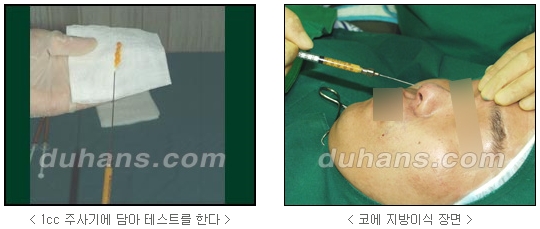
Once purification is complete, the fat is transferred into a 1 cc syringe and fitted with a micro fat grafting cannula before the procedure begins.
We use the microneedle (micro cannula) developed in-house at our clinic.
The microneedle is a special cannula used only at our clinic that enables ultra-precise grafting.
The procedure is performed by inserting the needle from the tip of the nose, and usually about 1 to 2 cc of fat is grafted.
Examples of Fat Grafting for Rhinoplasty
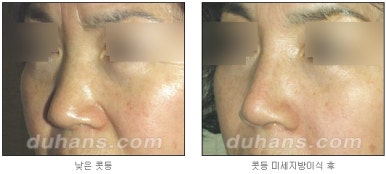
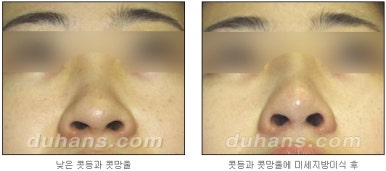
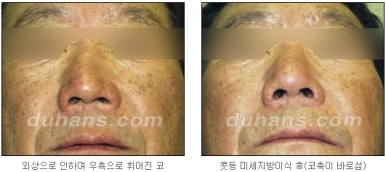
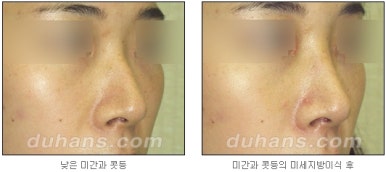
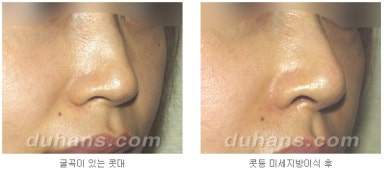
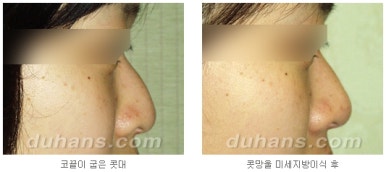
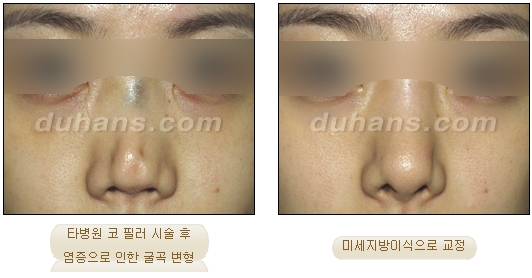
When Nasal Fat Grafting Is Appropriate
Nasal fat grafting is not a procedure that can be applied to everyone.
First, the patient’s skin must be of a certain thickness, and the nasal skin must also have a certain degree of flexibility for the fat to take hold.
When using nasal fat grafting to raise the bridge, the usual amount is about 3 mm, and the procedure should be planned with a second session in mind.
Conversely, if the skin is thin, firm, and lacks flexibility, even if the procedure is performed, all of the fat may be absorbed and there may be little to no effect.
Whether the procedure will be effective can be determined through an in-person examination.
When Nasal Fat Grafting Is Difficult
① When additional augmentation is desired while silicone or another implant is already in place
Fat cannot take hold on top of silicone.
However, fat grafting can be performed to soften the boundary line at the edge of the silicone.
② Within 3 months after removal of silicone or another implant
If the capsule surrounding the silicone does not dissolve, all of the grafted fat will be absorbed.
Therefore, after implant removal, at least 3 to 6 months must pass before grafting can be performed.
③ When the skin over the nasal bridge is thin and firm
For fat to take hold, blood circulation must be good and the pressure from the skin must be low.
Thin, firm skin has poor blood circulation and exerts strong pressure, causing the fat to be crushed and melted away.
What Are the Advantages of Rhinoplasty (Augmentation) Using Fat Grafting?
| 1. The procedure is simple. |
|---|
| 2. Because no foreign material such as silicone is used, there is little concern about side effects. |
| 3. Because the procedure is performed without cutting the skin, there is less burden than surgery. |
| 4. Unlike surgery, there is no need to fix the area with tape for several days immediately after the procedure. |
| 5. There is almost no swelling or bruising. |
| 6. You can resume daily life immediately after the procedure. |
| 7. Because your own tissue is used, natural augmentation is possible. |
The Effect of Fat Grafting for Correcting a Low Nose
Nasal fat grafting is a procedure intended to naturally augment only the bridge of the nose.
It is often insufficient for lifting the nasal tip as well.
When raising the bridge with nasal fat grafting, the usual amount is about 3 mm, which varies depending on the individual’s skin thickness and flexibility.
The survival rate of nasal fat is on average 30–50%, and in many cases a second procedure is performed after about 3 months.
The reason the survival rate is lower than in other areas is that the nasal skin continuously presses down on the fat, causing it to be crushed.
Nasal fat grafting is mainly applied when only a subtle, natural augmentation is desired or when the area between the eyes appears low.
The nose may become crooked when the nasal bone collapses due to severe trauma or when a nasal bone fracture was not properly treated.
The Effect and Progress Immediately After Rhinoplasty with Fat Grafting
Immediately after the procedure, the bridge of the nose may rise more than expected and then gradually settle over time.
In most cases, there is little swelling or bruising, so most people can return to daily life right away.
As it continues to settle over 3 to 6 months and fully takes hold with no further changes, a second procedure is performed to raise it further.
Precautions When Performing Rhinoplasty with Fat Grafting
① After fat grafting, the amount of fat may be insufficient with a single procedure, so in such cases a repeat procedure should be performed after 2 to 3 months.
② The nasal tip has thick skin, making it difficult to shape with fat grafting.
③ If the bridge of the nose is severely low, there are limits to how much it can be raised with fat grafting.
Number of Nasal Fat Grafting Sessions
On average, nasal fat grafting can produce satisfactory results after two sessions.
In some cases, satisfactory results are obtained with a single procedure, and this depends on differences in the individual’s constitution and the survival rate of the graft.
The interval between procedures should be at least 3 months, and if the patient returns within 10 months, repeat grafting is performed using the fat that was stored from the initial procedure.
The Long-Term Effect of Nasal Fat Grafting
Some people say that fat grafting is ineffective because much of the fat is absorbed, but this applies to cases performed at clinics with somewhat limited experience in fat grafting.
If fat grafting is performed correctly and according to principles, satisfactory results can be obtained, and once the grafted fat takes hold, it is no longer absorbed and remains as the patient’s own fat tissue for life, making it one of the safest and most effective methods.
On average, 1 to 2 fat grafting sessions can produce a permanent, satisfying augmentation effect.
A Comparison of Fat Grafting and Other Augmentation Procedures~
| Fat Grafting | Silicone Rhinoplasty | Nasal Filler |
|---|
| Suitable Candidates | When the goal is to naturally augment the nasal bridge | When the goal is to augment both the bridge and the nasal tip at the same time | Intended for correcting fine wrinkles and should not be used to raise the nose. |
| Advantages | * Less swelling and bruising. * Immediate return to daily life. * Almost no side effects. * Because it uses your own tissue, there is less resistance. | * A definite augmentation effect can be achieved. * Few side effects. * Can be easily removed if not desired. | * There are no advantages for nasal augmentation. |
| Disadvantages | Because of the survival rate, more than two sessions are often needed. | * Because it is a foreign material, there is concern about side effects. * There may be resistance to foreign material. * Swelling and bruising make immediate return to daily life difficult. | * Inflammatory reactions may occur due to foreign body response. * Side effects such as skin discoloration or necrosis due to vascular occlusion of the nasal skin may occur. * If side effects occur, removal is almost difficult. |
http://www.duhans.com
Features and Pride of Duhan Plastic Surgery Autologous Fat Grafting Clinic
Dr. Shin Duhan, a leader in fat grafting and a pioneer of a new paradigm in the field, personally performs both consultations and surgery.
① All anesthesia is performed as local anesthesia (sedation anesthesia).
Local anesthesia is combined with sedation anesthesia, and the procedure is performed without pain during anesthesia and even after the anesthesia is finished.
② We have a systematic and advanced fat grafting system.
We harvest living fat cells and maximize purity through centrifugation, purification, and removal of unnecessary oil.
Before grafting, we create subcutaneous tunneling in the graft site to secure space for the graft.
We use micro fat grafting cannulas for precise grafting.
We graft in a three-dimensional manner, evenly across multiple layers, to maximize survival rate and create a soft contour.
③ We select appropriate and various donor sites for fat harvesting.
The most commonly used site is the lower abdomen, which is often the first choice because post-procedure pain is minimal, swelling and bruising are reduced, and daily life is convenient.
The next preferred site after the lower abdomen is the inner thigh, followed by the outer thigh.
If there is not enough fat to harvest from the thighs, the lower buttocks or the sides of the waist may also be used.
There is no fixed rule for which area provides the best survival rate.
The results are similar, and although the area with the most excess fat is ideal, it is best to decide the donor site by considering the amount of fat needed and the patient’s activity after grafting.
④ We maximize survival rate through a two-step purification process of the harvested fat.
Among the impurities in harvested fat, the largest proportion is local anesthetic, followed by oil.
Other impurities include serum and red blood cells.
The first step is centrifugation for about 3 to 4 minutes, followed by the second step of oil removal.
Oil is removed manually using a natural absorption method.
Through this two-step purification process, highly concentrated fat that is close to 100% is obtained, maximizing the effect of fat grafting and increasing fat survival as much as possible.
⑤ We secure space for fat grafting through subcutaneous tunneling.
Subcutaneous tunneling refers to creating space in advance at the area where the fat will be grafted, and it is an essential process for high graft survival and even grafting.
Using a thin probe, the area under the skin is moved repeatedly in a fan-like pattern to create space for the fat to be grafted.
The effect of subcutaneous tunneling is to increase fat survival and prevent fat from clumping, thereby creating an even and soft contour.
⑥ Through three-dimensional micro fat grafting, a soft and even facial contour can be achieved.
Although there are exceptions depending on the area, the basic method of fat grafting is three-dimensional.
Fat is divided into multiple layers and grafted in small amounts evenly across each area.
⑦ We use micro fat grafting cannulas for precise grafting.
In the past, methods using fat injection machines caused various problems because fat was pushed under the skin at high pressure.
The absorption rate of fat was high, take-up was uneven, the contour became irregular, and it was difficult to graft into delicate areas such as under the eyes.
To solve these problems, the fat is transferred again into a 1 cc syringe during grafting and placed into the desired area.
At our clinic, we use the microneedle (micro cannula) developed in-house.
The microneedle is a special cannula used only at our clinic that enables ultra-precise grafting.
Fat grafting can also be performed on the upper eyelids, lower eyelids, forehead wrinkles, glabellar wrinkles, nasolabial folds, and the nasal bridge, making fat grafting possible for almost all cases except fine wrinkles.
⑧ Immediately after fat grafting, molding is performed so that an even and soft facial contour is created.
Right after fat grafting, delicate molding is performed so that the grafted fat spreads evenly and a soft shape is created.
Molding is the final step of fat grafting and one of the most important steps.
⑨ Rapid-freezing and sterile storage of remaining fat simplifies the second procedure.
When a second procedure is performed 3 months after fat grafting, fat does not need to be harvested again; instead, the fat left over after the first procedure is used.
The fat remaining after the first procedure is rapidly frozen, sterilized, and stored.
For the second procedure, the stored fat is thawed and the procedure can be done more easily.
The storage period for fat is 10 months, and if the patient returns within 10 months, the stored fat will be used for the procedure.
⑩ Based on over 20 years of extensive clinical experience and know-how, we perform multilayer fat grafting (layer-by-layer under the skin).
The key to fat grafting is ensuring that the fat cells remain living so they can achieve a high survival rate.
To increase survival rate, a large amount is not injected into one area; instead, the fat is evenly and uniformly grafted across multiple layers.
Between the skin and bone there are several tissues such as the fat layer and muscle layer, so the fat must be injected in a multilayer structure without overlapping, such as between the periosteum above the bone and between the layers above and below the muscle.
Multilayer fat grafting lasts 3 to 4 times longer than conventional methods, and fat survival is also higher.
The fat grafting performed at Duhan Plastic Surgery’s autologous fat grafting clinic also includes a process called “tunneling,” which allows the grafted fat to stay in close contact with abundant surrounding blood vessels so it can continuously receive nutrients.
Tunneling means creating a place for the fat under the skin using a micro needle; in other words, a space is prepared like making a tunnel, and then the fat is injected, so even after all the fat has been placed, it does not sag downward with gravity or become uneven.
In addition, a delicate injection method allows for customized design.
Through thorough post-procedure care after fat grafting, we carefully monitor the progress until the fat has fully taken hold.
During follow-up, if needed, we try to minimize dissatisfaction through swelling-reduction injections, contour correction, and molding.

http://www.duhans.com