#Sunken eyelids #Sunken eye fat grafting #Eyelid fat grafting #Upper eyelid fat grafting #Under-eye fat grafting #Sunken eyes #Upper eyelid filler #Middle-aged eye surgery #Youthful look #Youthful plastic surgery
#Eye fat grafting #Sunken eyelids #Sunken upper eyelids #Upper eyelid fat repositioning #Sunken eyes #Sunken eye fat grafting surgery #Sunken eye filler #Multiple double eyelids #Multiple-fold double eyelids #Sunken eye fat grafting #Eyelids
#Upper eyelids #Eyelid wrinkles #Eyelid filler #Upper eyelid fat removal #Deep-set eyes #Sleepy eyes #Facial fat grafting #Sunken eye surgery #Multiple double eyelids #Sunken eye plastic surgery #Sunken upper eyelids
#Sunken eyes #Fat grafting #Hollow eyes #Facial autologous fat grafting #Sunken eye surgery #Multiple-fold double eyelid surgery #Thick double eyelids #Sunken eye surgery #Sunken eyes #Sunken eye fat grafting #Sunken eyes #Lower blepharoplasty
#Double eyelid injection #People with small eyes #Eyelid sunken filler #Upper eyelid filler #Plastic surgery eyes #Autologous fat #Eyelid liposuction #Sagging eyelids #Eye skin removal #Types of double eyelid surgery #Eyelid surgery
#Out fold #Eyelid #Eye plastic surgery in your 40s #Eye plastic surgery in your 50s #Filial piety plastic surgery #Plastic surgery that makes you look younger #Plastic surgery to look younger #Drooping eyelids #Surgery for drooping eyes #Uneven eye correction surgery #Upper eyelid fat #Eye shape
#Sunken upper eyelids #Women’s eye plastic surgery #Apgujeong double eyelid surgery #Sinsa double eyelid surgery #Duhan #Duhan Plastic Surgery #Duhan autologous fat grafting #Duhan facial fat grafting #Duhan facial autologous fat grafting
#Eye opening correction procedure #Ptosis treatment #Middle-aged double eyelid surgery #Middle-aged re-do double eyelid surgery #Clear eye shape #Sunken upper eyelid filler #Drooping eyelids #Micro fat grafting #Fat injection #Upper eyelid fat removal surgery #Eyelid
#Drooping eye surgery #Upper eyelids #Micro autologous fat grafting #Eyelid fat removal injection #Second fat grafting #Fat grafting revision surgery #Eyelid fat insertion #Fat insertion #Middle-aged ptosis #Uneven eyes
#Middle-aged lower blepharoplasty #How to reduce eye fat #Sagging eye skin #Blepharoplasty #Upper eyelid fat #Torn eyes #Best upper blepharoplasty clinic #Eye asymmetry #Double eyelid asymmetry #Double eyelid surgery methods #Eye plastic surgery #Eye surgery
#Best place for fat grafting #Monolid surgery #Fat grafting area #Double eyelid surgery in your 50s #Double eyelid surgery in your 40s #Half-moon eyes #Double eyelid surgery hospital #Puffy-looking eyes #Upper eyelid swelling #Under-eye filler
#Eyelid fat #Upper eyelid fat removal #Eyelid swelling #Eye liposuction #Middle-aged eye surgery #Bulging eyes #Out-line double eyelid surgery #Middle-aged plastic surgery #Eyelid fat removal #Eye double eyelids #Upper eyelids
#Eye asymmetry correction #Uneven eye correction #Elderly double eyelids #Eye elasticity #Double eyelid surgery #Double eyelid procedure #One-day eye opening correction #Middle-aged double eyelid surgery #Middle-aged drooping eye surgery #Middle-aged drooping eyes
#One-side double eyelid revision surgery #Recommended double eyelid surgery hospital #Double eyelid surgery for ptosis #Autologous fat grafting #Male facial fat grafting #Eye opening correction surgery method #Apgujeong double eyelids #Double eyelid surgery types #Eye plastic surgery
#Gangnam Station fat grafting #Age-related ptosis #Double eyelid surgery for drooping eyes #How to remove double eyelids #Gangnam Station double eyelid surgery #Advantages of fat grafting #Recommended plastic surgery clinic for fat grafting #Plastic surgery clinic specializing in eye revision surgery
#Out-line double eyelids #Facial fat repositioning #Hidden double eyelid surgery #Famous place for fat grafting #Famous hospital for fat grafting #Best clinic for facial fat grafting #Famous hospital for facial fat grafting #Incision on the eyes

What is sunken upper eyelids?!
Soft and beautiful facial contours
Become more beautiful with micro fat grafting~
What is sunken eye fat grafting?
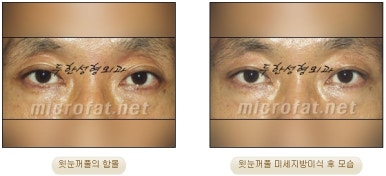
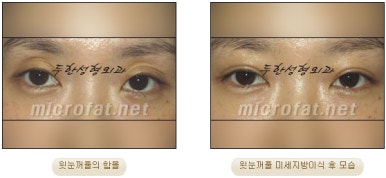
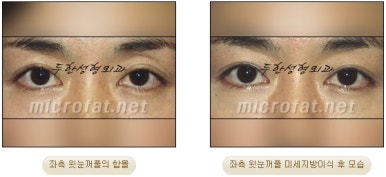
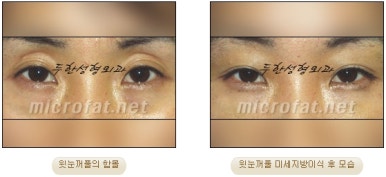
Micro fat grafting for the upper eyelids is a procedure used when the eyelids are sunken, making you look tired or older.
In addition to restoring sunken eyelids aesthetically, this procedure also helps make it easier to open the eyes functionally.
What are the indications for sunken eye fat grafting?
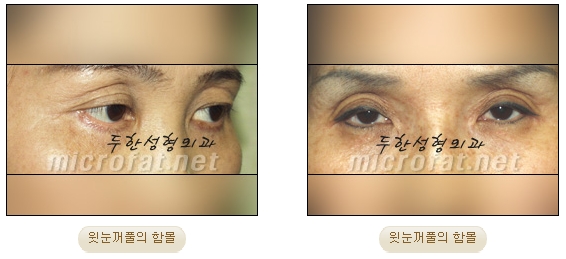
♥ Restoring sunken eyes to a fuller, more voluminous appearance
♥ When the cheekbones appear relatively prominent
♥ Improving discomfort or fatigue when opening the eyes
♥ In cases of bulging eyes, an effect that helps relieve symptoms of eye protrusion

What is the role of orbital fat?
♠ It gives the eyelid contour a fuller, softer look.
♠ It protects the eyeball from external impact.
♠ It acts as a lubricant so the levator palpebrae superioris muscle (the muscle that lifts the eyelid) can move smoothly.
What are the effects of sunken eye fat grafting?
| 01. Aesthetic aspect - Correction of the sunken area to restore a softer, younger-looking eye shape |
|---|
| 02. Functional aspect - Softens the movement of the levator palpebrae superioris that opens the eyes, reducing eyelid fatigue. |
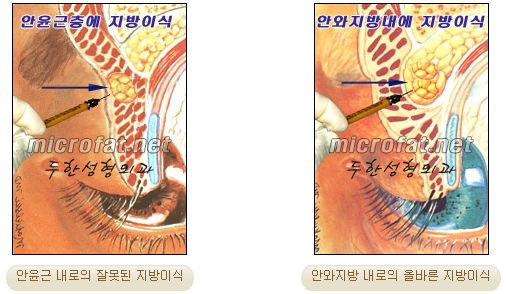
Where is sunken eye fat grafting performed?
The goal of upper eyelid fat grafting is to satisfy both aesthetic and functional purposes.
For this, it is very important to graft the right amount of fat into the correct location.
This is the area where orbital fat is located, and the newly grafted fat must blend with the existing fat in this area to achieve good results.
However, if it is grafted incorrectly into the orbicularis muscle layer, the eyelid may become uneven and, conversely, heavier, making it harder to open the eyes.
Therefore, upper eyelid fat grafting requires delicate grafting based on precise anatomical knowledge to achieve the desired result.
How is sunken eye fat grafting performed?
① Fat is harvested from areas where fat is abundant, such as the lower abdomen, waist, or thighs.
Since the amount of fat needed for eyelid fat grafting is not very large, it is usually best to harvest from the lower abdomen.
-
Because local anesthesia (pain-free sleep anesthesia) is used, there is no pain at all.
-
A thin liposuction cannula is used to collect the fat into a syringe.
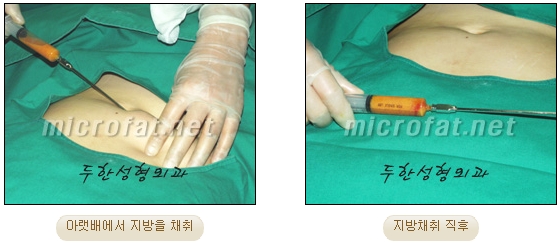
② The harvested fat is placed in a centrifuge to remove impurities (anesthetic solution, oil, blood).
③ The oil is removed through a two-step refining process. Only when almost all of the oil is removed can it be called true concentrated fat.
④ The refined fat is placed into a thin 1cc syringe.
Usually, the fat for one eyelid is transferred into a thin 1cc syringe and grafted into the desired area.
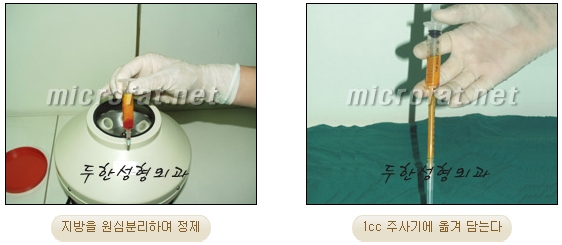
⑤ The micro fat grafting cannula is inserted along the planned line of the eyelid to perform the grafting.
At our clinic, we use a self-developed micro needle (micro grafting cannula).
The micro needle is a special grafting cannula used only at our clinic that enables ultra-precise grafting.
The graft must be placed into the orbital fat layer to create a soft contour and a high survival rate.
⑥ After the fat grafting, normal daily life is possible immediately, and washing the face and wearing makeup are possible starting the next day.
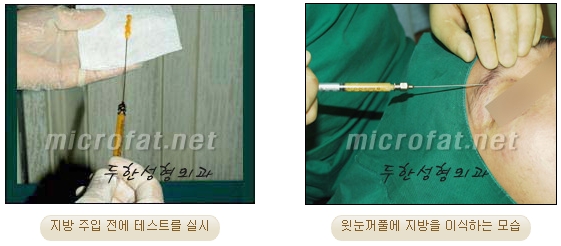
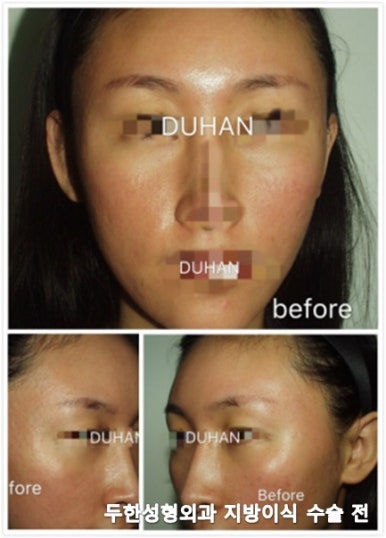
Examples of applying sunken eye fat grafting
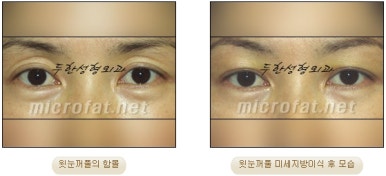
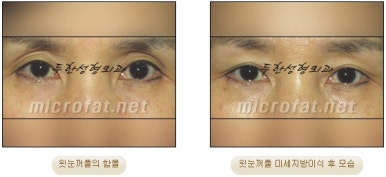
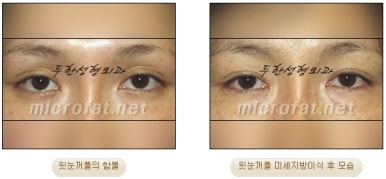
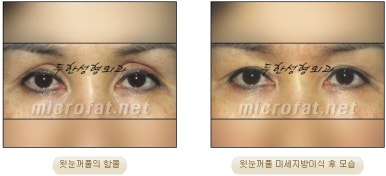
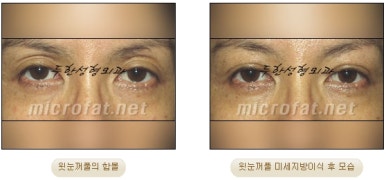
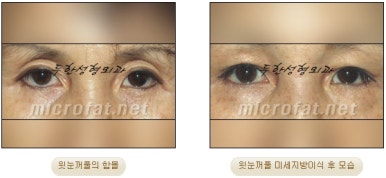
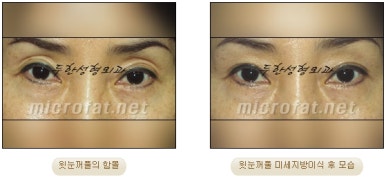
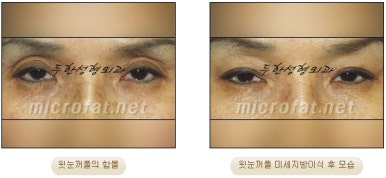
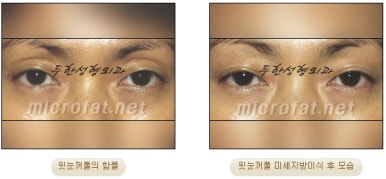
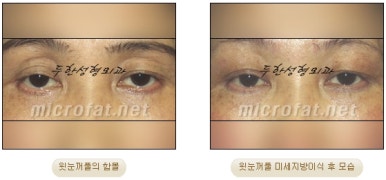
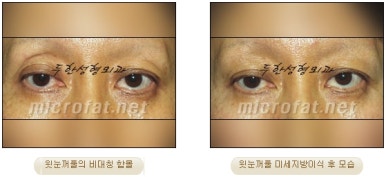
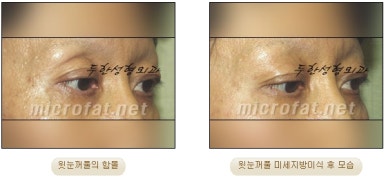
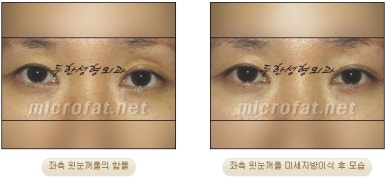
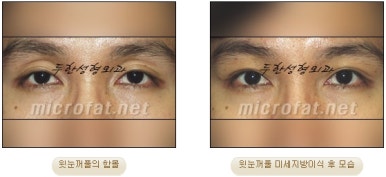
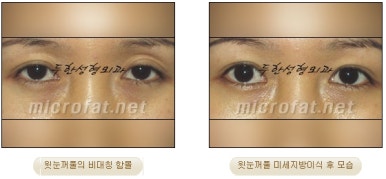
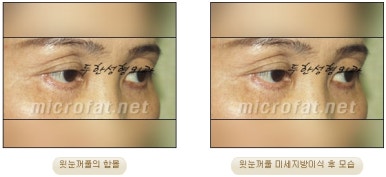
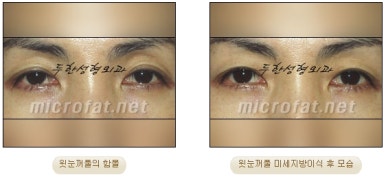
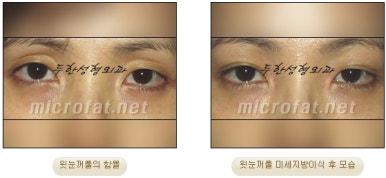
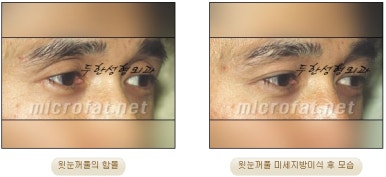
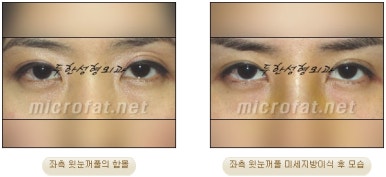
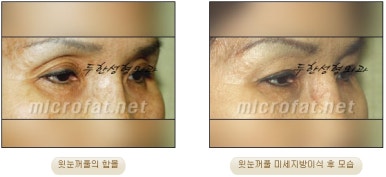
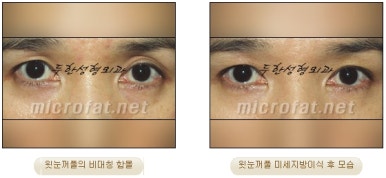
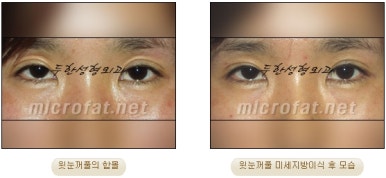
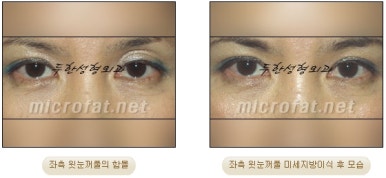
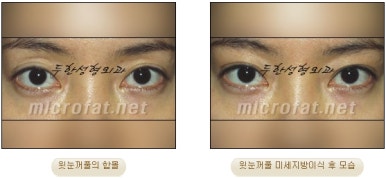
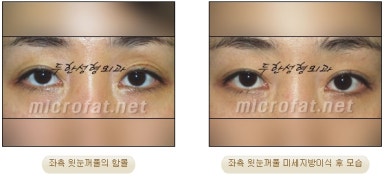
What is our clinic’s fat grafting tunneling technique?
Tunneling means using a micro needle just beneath the skin to create space for the fat to go in. Because space is created like making a tunnel and then the fat is injected, the fat does not sag in the direction of gravity or become uneven after it is all placed.
With the tunneling technique, instead of injecting a large amount into one area, we perform three-dimensional micro fat grafting using 100% concentrated fat distributed evenly across multiple layers.
Using a delicate and careful injection method, a customized design is possible.
Fat grafting also includes a process called “tunneling,” in which the graft is placed so it can contact the surrounding abundant blood vessels as much as possible and continuously receive nutrients.
What is two-dimensional plane fat grafting for sunken eyelids?
Fat grafting for the upper eyelids must be done as two-dimensional plane fat grafting.
If fat is grafted under the skin into the orbicularis muscle layer, problems such as heavier eyelids and uneven skin can occur.
To avoid these side effects, fat must be accurately grafted between the orbicularis muscle and the levator palpebrae superioris, and this requires precise anatomical knowledge and a lot of experience.
Only when grafted two-dimensionally into the orbital fat layer does upper eyelid fat grafting become complete both functionally and aesthetically.
What is the recovery period after sunken eye fat grafting?
Usually, normal activities are possible right away.
There may be some swelling and bruising, but it is usually mild enough to be covered with makeup, so it does not significantly interfere with social life.
However, swelling and bruising vary from person to person, so not every case is the same. On average, severe swelling and bruising do not occur, and it is generally the case that things look much more natural after about a week.
How many times is sunken eye fat grafting performed?
The survival rate of eyelid fat grafting is relatively high compared to other areas.
Depending on the case, one session or at most two sessions can produce satisfactory results.
Depending on the case, one session or at most two sessions can produce satisfactory results.
The interval between procedures is 3 to 10 months, and when repeating the procedure, the fat that was collected at the time of the first grafting is thawed and used.
However, in many cases, if the result is satisfactory after one procedure, a second procedure is not necessary.
Because the survival rate of fat varies from person to person, whether a second procedure is needed should be decided at least 3 months later.
What about fat survival and the survival rate?
The survival rate of fat cells differs depending on the area of the face.
The higher the survival rate, the fewer procedures are needed and the greater the effect.
For example, a survival rate of 80% means that 80% of the total grafted fat survives and 20% is absorbed and disappears.
Therefore, the higher the survival rate, the better the result.
Areas with a low survival rate include the lips, while the area with the highest survival rate is around the eyes.
The average survival rate after fat grafting is 50%.
In other words, after grafting 100 units of fat, only 50% will remain after a few months.
The better the blood circulation in an area, the higher the fat survival rate. Since the area around the eyes has the best blood circulation on the face, the survival rate is higher than in other areas.
Therefore, around the eyes, a lasting effect can be achieved with just one procedure.
However, in some cases a repeat procedure is performed, so it is better to think of fat grafting as something that is usually done about twice.
What about the second procedure and fat harvesting?
When fat is harvested from the lower abdomen or thighs, enough fat is collected for grafting, and the remaining fat is not discarded but stored aseptically in a freezer.
The fat stored this way can be kept for about 10 months, so if you visit within 10 months, you can receive an additional procedure on the desired area without harvesting more fat.
Whether the fat is stored and then used, or harvested immediately and used, the result is the same.
What is the lasting effect of sunken eye fat grafting?
After fat grafting, from 3 months up to as long as 6 months, some of the fat is absorbed and the volume gradually decreases.
After that, once the fat has fully survived and no further absorption occurs, the remaining fat stays permanently.
The fat that survives does not dissolve and disappear on its own.
If overall body weight decreases in the future, the grafted area may also be affected, but if body weight remains the same, the volume of the grafted area also changes very little.
Therefore, the fat that survives remains part of your own tissue for life.
That does not mean the shape itself lasts forever, of course.
As you age, the skeleton changes due to aging, wrinkles form in the eyelids, the skin sags, and weight loss can occur, so the shape of the fat-grafted area does not remain exactly the same.
Until aging progresses significantly, the effect lasts.
That is why the term “semi-permanent” is used.
What are the side effects of sunken eye fat grafting?
Just a little swelling and bruising.
Beyond that, there are essentially no side effects.
Because the procedure uses autologous fat rather than a foreign substance, there is no immune rejection or inflammation.
Also, once the fat survives, it is no longer absorbed and becomes your own tissue.
Occasionally, there are people who experience side effects after procedures done at clinics with somewhat limited fat grafting experience, but this is a matter of the provider’s technique.
There can be various problems, such as grafting into the orbicularis muscle layer instead of the orbital fat layer, which makes the eyelid heavier and the shape uneven; over-injecting fat, which causes eyelid swelling and interferes with daily life; ptosis caused by too much fat grafting that makes the eyes difficult to open; or results that are unsatisfactory because too much of the fat is absorbed.
Because results differ from clinic to clinic, the rule is not to undergo the procedure with a non-specialist plastic surgeon who lacks sufficient experience in fat grafting.
What other procedure methods are there besides fat grafting?
So far, there is no other method for correcting upper eyelid hollowing other than fat grafting.
In some cases, the upper eyelid is incised like double eyelid surgery and a lump of fat is grafted, but this comes with the burden of needing an incision, and grafting a large lump of fat can cause the eyelid to become heavy.
In addition, although various fillers used in plastic surgery (Restylane, Artecoll, Juvederm) are widely commercialized and used, placing commercial fillers in the upper eyelid can make the eyelid stiff and cause discomfort when opening the eyes, and it may also trigger inflammation.
Therefore, micro autologous fat grafting is a safe and effective method.
Frequently asked Q&A about eyelid fat grafting:
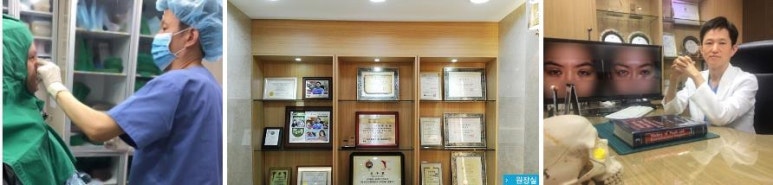
Q. I was told that eyelid fat grafting has many side effects, so it should not be done at another clinic. Is that true?
A. It does not mean that all other clinics are like that.
The area that requires the highest level of experience and skill in fat grafting is fat grafting for the upper eyelid and the under-eye dark circles.
This is an area that cannot be treated carelessly without accumulated experience and skill.
We always say this in the consultation room: fat grafting is absolutely not a procedure just anyone can do.
As with all surgeries, the results differ depending on the surgeon’s experience and know-how.
There are many clinics that perform fat grafting, but the number that do it properly can be counted on one hand.
Fat grafting is easy to perform, but difficult to produce proper results.
In principle, fat grafting can only produce good results when performed accurately.
Each clinic has a different method, and the results vary greatly depending on experience.
You may have a negative preconception from experiencing or hearing about poor fat grafting, but when fat grafting is done properly, satisfactory results can be achieved with just one procedure.
In particular, the upper eyelid area (sunken eyelids, hollow eyelids) requires extensive experience, technique, detail, and precision, so it cannot be performed by just anyone.
Q. I had eyelid fat grafting done at another clinic, but it has almost completely sunken again and there is little left. Can it be done again in this case?
A. Even after a procedure at another clinic and poor survival leading to near-complete regression, repeat treatment is possible.
However, it must be performed at least 3 months later.
Since the fat grafting survival period takes at least 3 months, you can undergo the procedure again once 3 months have passed since the last treatment.
Even when we perform a repeat procedure at our clinic, the result is almost no different from the first procedure.
Q. I had eyelid fat grafting done at another clinic, but it feels uneven and opening my eyes is uncomfortable. Is this a side effect?
A. The goal of eyelid fat grafting is to restore sunken eyelids and, functionally, improve the ability to open the eyes so that eye fatigue is reduced.
To achieve this goal, the procedure must be accurate and precise.
With fat grafting that lacks sufficient experience, fat may be placed in the orbicularis muscle layer instead of the orbital fat layer, causing irregularities, or grafted near the deep levator palpebrae superioris layer, resulting in more discomfort when opening the eyes than before the procedure.
If these side effects occur, the fat must be removed again, which is quite difficult.
To prevent side effects, it is best not to undergo treatment with someone who lacks experience or is not a board-certified plastic surgeon.

Q. What if filler is injected into the eyelids instead of fat grafting?
A. The eyelids are structures that move constantly, so procedures that interfere with eyelid movement should not be done.
When fat is grafted, it acts as a cushion and lubricant that helps the eyelids move more smoothly, but if a foreign substance such as filler is injected, it may seriously impair the function of opening the eyes, regardless of the eyelid’s shape. In severe cases, swelling may not go down or the eye shape may become distorted.
Inflammation can even occur, so fillers should absolutely never be injected into the eyelids.
Q. Since eyelid fat grafting is close to the eyeball, isn’t it dangerous?
A. Not at all.
The risk is higher when the procedure is done by a doctor with somewhat limited experience or by a non-specialist plastic surgeon. If an experienced specialist performs the procedure accurately, there is no need to worry.
Eyelid fat grafting should be performed based on precise anatomical knowledge and know-how gained through extensive double eyelid surgery experience, and if done according to the proper principles, it is one of the safe procedures.
Q. I developed a bulging side effect after eyelid fat grafting at another clinic. Can it be corrected?
A. Occasionally, there are cases where eyelids become heavy and bulge due to excessive fat injection at another clinic, and patients come to our clinic for correction.
Depending on the condition, the fat must be removed by suction. If the fat can be felt as a mass when held by hand, it can be corrected by inserting a fine cannula and suctioning it out.
However, 100% removal is impossible, and usually about 50–80% can be removed and corrected.

http://www.duhans.com