#Double eyelids #eye correction #double eyelid surgery #revision surgery #uneven eye correction #uneven eyes #uneven double eyelids #uneven double eyelids #double eyelid surgery #eye plastic surgery #famous eye surgery hospital #eye correction double eyelid surgery #how to make eyes look bigger
#uneven double eyelid surgery #double eyelid revision surgery #eye revision surgery hospital #uneven eyes #uneven eye surgery #uneven eye revision surgery #double eyelid revision surgery hospital #double eyelid revision surgery #Gangnam eye plastic surgery #double eyelid revision #buried suture revision surgery
#famous double eyelid surgery hospital #best place for double eyelid revision surgery #double eyelid revision #out-line double eyelids #in-out line #eye surgery #incisional revision double eyelid surgery #best place for eye revision surgery #eye plastic surgery
#best place for eye revision surgery in Gangnam #best place for eye revision surgery in Apgujeong #best place for eye revision surgery in Sinsa #eye revision surgery in Gangnam #buried suture double eyelid surgery #famous eye plastic surgery hospital #recommended eye plastic surgery hospital #double eyelids
#best place for eye plastic surgery #best place for eye plastic surgery in Gangnam #best place for eye plastic surgery in Apgujeong #best place for eye plastic surgery in Sinsa #buried suture method #eye plastic surgery hospital #eye plastic surgery hospital in Gangnam #eye plastic surgery hospital in Apgujeong #pretty eyes
#eye plastic surgery hospital in Sinsa #double eyelid surgery #famous hospital for eye revision surgery #incisional double eyelid surgery #incisional double eyelid revision #incisional double eyelid revision #partial incision double eyelid surgery #partial incision double eyelid revision #partial incision double eyelid revision #eye plastic surgery
#incisional double eyelid surgery #revision incisional surgery #uneven eyes #uneven double eyelids #uneven double eyelids #uneven double eyelids #uneven double eyelids #best place for double eyelid surgery #best place for double eyelid surgery in Gangnam #small eyes
#out-line double eyelid surgery #hospital famous for eye plastic surgery #best hospital for eye plastic surgery in Gangnam #best place for double eyelid surgery in Apgujeong #best place for double eyelid surgery in Sinsa #best hospital for eye plastic surgery in Apgujeong
#best hospital for eye plastic surgery in Sinsa #best place for double eyelid surgery #best place for double eyelid surgery in Gangnam #best place for double eyelid surgery in Apgujeong #best place for double eyelid surgery in Sinsa #drooping eyes #small eye surgery #double eyelid surgery #double eyelid line
#best hospital for double eyelid revision surgery #best hospital for double eyelid revision surgery in Gangnam #best hospital for double eyelid revision surgery in Apgujeong #best hospital for double eyelid revision surgery in Sinsa #Duhan #Duhan Plastic Surgery #pretty eyes
#Director Shin Duhan #Duhan double eyelid surgery #Duhan revision double eyelid surgery #double eyelid line #best place for eye correction #one-sided double eyelid #double eyelid on only one side #uneven eyes #buried suture double eyelid surgery #double eyelid surgery in Gangnam #revision surgery in Gangnam
#double eyelids in Gangnam #double eyelids #out-line double eyelids #double eyelid surgery popular among celebrities #releasing double eyelids #out-line double eyelids #double eyelid surgery in Gangnam #eye correction in Gangnam #buried suture eye surgery #buried suture double eyelid surgery #incisional method
#uneven double eyelids #uneven double eyelids #uneven double eyelids #uneven double eyelids #out-line double eyelid surgery #surgery to make eyes look bigger #incisional double eyelids #recommended eye plastic surgery hospital #eye enlargement #recommended double eyelid surgery
#double eyelid surgery hospital #double eyelid surgery hospital in Gangnam #double eyelid surgery hospital in Apgujeong #recommended double eyelid surgery #double eyelid surgery hospital #double eyelid eye correction #double eyelid #double eyelid surgery #uneven eye plastic surgery #recommended double eyelid surgery hospital
#eye plastic surgery in Seoul #best place for double eyelid revision surgery #double eyelids near Gangnam Station #one-sided double eyelid surgery #beautiful eyes #double eyelid surgery in Apgujeong #buried suture double eyelid surgery #drooping eye plastic surgery #partial incision eye correction #princess eyes
#natural-looking double eyelid surgery #natural-looking revision double eyelid surgery #double eyelids popular among celebrities #double eyelid revision surgery hospital #non-incisional double eyelids #ptosis surgery in Gangnam #eye correction method #double eyelid surgery in Seoul #double eyelid revision surgery in Seoul
#incisional double eyelid revision surgery #non-incisional double eyelid revision #plastic surgery eye #recommended double eyelid surgery #releasing buried suture method #one-sided double eyelid #place good at double eyelid surgery #best place for double eyelid surgery #best place for double eyelid surgery
#double eyelid surgery near Gangnam Station #best place for double eyelid surgery in Gangnam #best place for double eyelid surgery in Seoul #best place for revision surgery in Seoul #make eyes bigger #double eyelid surgery near Sinsa Station #eye plastic surgery near Gangnam Station #double eyelid surgery in Apgujeong #double eyelid surgery in Apgujeong #women's eyes

20 years of know-how
What if the double eyelid line is asymmetrical?!
A slight asymmetry in double eyelids is something everyone has to some extent.
However, double eyelids with a noticeably large difference need correction.
Director Shin Duhan
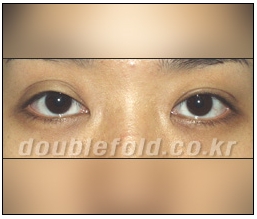
Example of uneven double eyelids
Causes of uneven double eyelids include:
An incorrect design, loosening of the double eyelid line, adhesion from double eyelid scarring,
and ptosis on one side.
The correction method for uneven double eyelids is:
The double eyelid surgery needs to be done again to match the desired side.
However, if only one side is done, complete symmetry may not be achieved,
and the shape of the double eyelids may not look the same right away.
So even after a proper surgery, it may be necessary to live with uneven eyelids for about the first 1 to 2 months.
If only one side is corrected, the decision must be made more carefully.
How is an uneven double eyelid line corrected?
There are various causes of asymmetrical lines, and there are also several methods of correction.
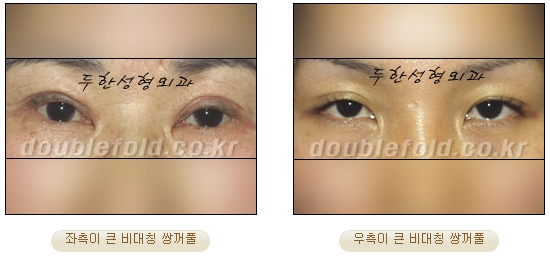
What are the causes of uneven double eyelid lines?
-
When the height of the double eyelid crease is different
-
When one eye has ptosis
-
When one double eyelid line has loosened
-
When the skin on one side has sagged
-
When the eyelid appears sunken due to a lack of orbital fat, causing the double eyelid line to be pulled upward
-
When the line is pulled upward due to adhesion from double eyelid scarring
How is an uneven double eyelid line corrected?
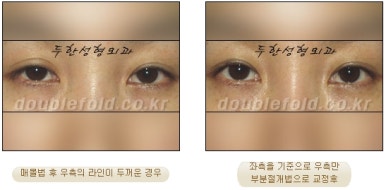
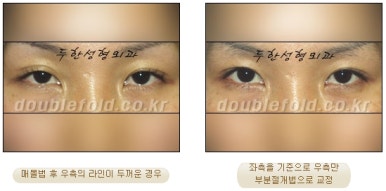
- When the height of the double eyelid crease is different after buried suture surgery?
If the surgery was done with the buried suture method, there is a high chance of loosening even if it is done again with the buried suture method.
A partial incision method is used to create a new line at the desired position.
The existing double eyelid line naturally smooths out and disappears as the new line is formed.
However, if the existing line is too distinct, partial incision correction may not be enough, and full incisional surgery may be necessary.
- When the height of the double eyelid crease is different after full incisional surgery?
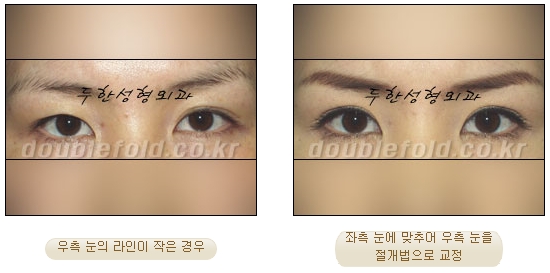
◈ When enlarging a small double eyelid line to match a larger one
If one side’s double eyelid line is lower and a smaller line needs to be made larger, a new double eyelid line is created above the existing one.
This is usually corrected with the partial incision method, and if the existing scar line is very dark, correction is done with the full incisional method.
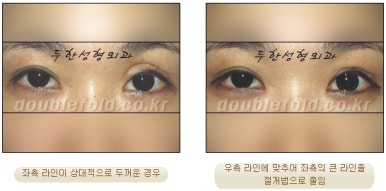
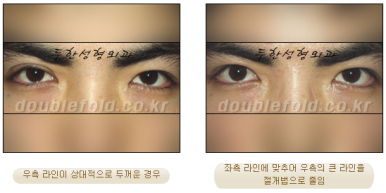
◈ When reducing a large double eyelid line to match a smaller one
To reduce a large double eyelid line created by full incisional surgery, full incisional surgery is performed again.
The existing scar line is excised and removed, and a new double eyelid is created to match the other side.
To reduce a large double eyelid line, the tissue is dissected and completely repositioned.
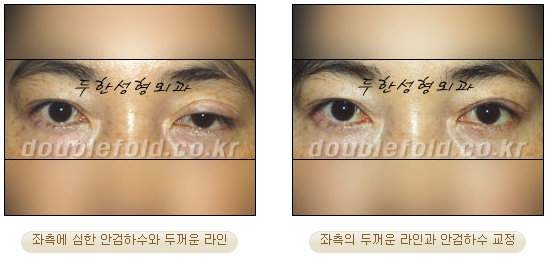
- What is the correction method when one side has ptosis?
A surgery is performed to help the ptotic eye open wider.
With the full incisional method, the levator palpebrae superioris muscle (the eyelid-lifting muscle) is pulled and attached to the tarsal plate in a levator shortening procedure.
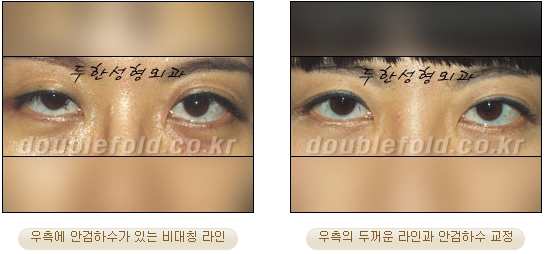
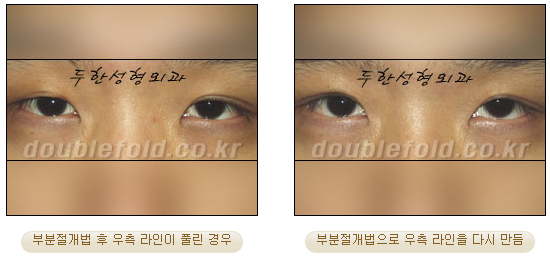
- When one double eyelid line has loosened?
If one side’s double eyelid line has loosened, the loosened side is corrected using either the partial incision method or the full incisional method.
If the skin is very thick or the scarring is not severe, the general rule is to correct it first with the partial incision method.
If it still loosens again, it is corrected with the full incisional method.
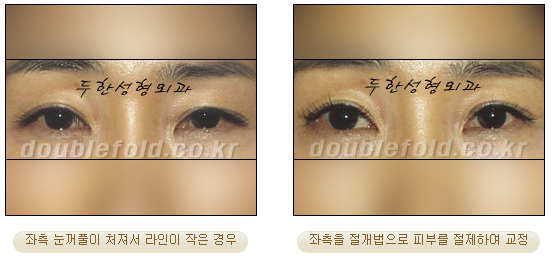
- When the skin on one side has sagged?
If the double eyelid line heights are the same but asymmetry occurs because of sagging skin, the drooping side is corrected by removing the sagging skin with the full incisional method.
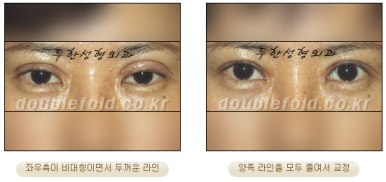
- When both sides are asymmetrical and both double eyelid lines look awkward?
If the left and right sides are asymmetrical and both double eyelid lines are unattractive and awkward, both sides need revision surgery.
The lines are designed at the same height, the existing double eyelid scar lines are removed, and a new double eyelid line is created with complete repositioning.

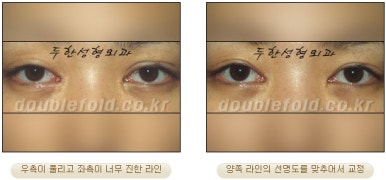
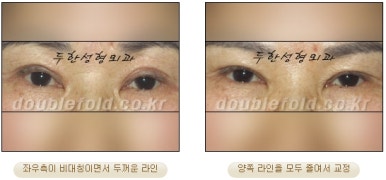
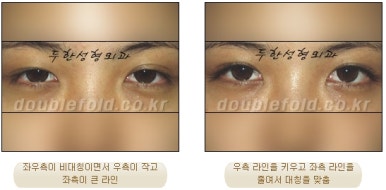
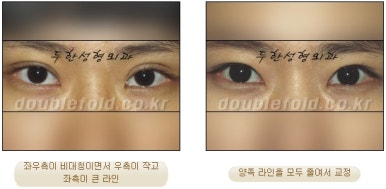
- When one eyelid has become sunken and the double eyelid line has been pulled upward, causing asymmetry?
When the eye socket fat is insufficient and the eyelid sinks in, the double eyelid line gets pulled upward and becomes larger.
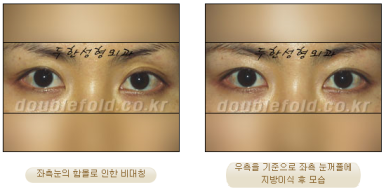
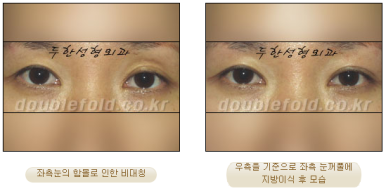
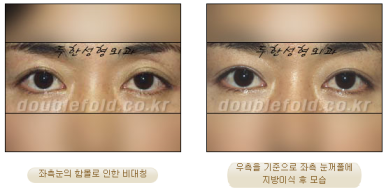
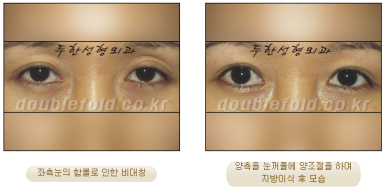
In such cases, it can be corrected simply with microfat grafting without revision surgery.
Microfat grafting is a simple procedure that injects fat with a syringe.
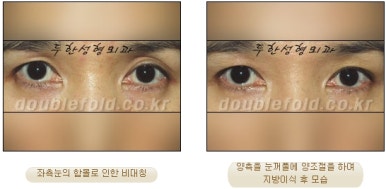
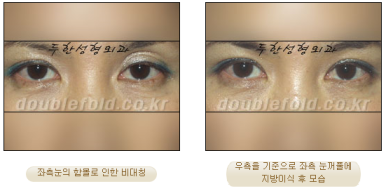
What is the revision surgery method for uneven double eyelid lines?
- Full incisional method
The process of full incisional revision surgery is very difficult and requires extensive experience, advanced skill, and know-how.
It usually takes about 2 to 3 hours and proceeds through a total of 10 major steps.
If even one step is omitted, the result may fall short of expectations.
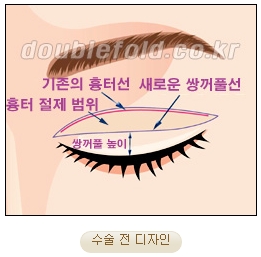
▶ The planned incision line is designed to include the existing scar tissue from the incision.
A preoperative design is made to create a new double eyelid line below the scar line and determine the width of skin excision up to the scar line.
The excision width is measured from the new double eyelid line, so it extends to the existing scar line.
For example, if the existing scar line is 10 mm above the eyelashes and the new double eyelid line is set at 7 mm, the skin excision width would be 3 mm.
The standard is determined based on the center width.
The new double eyelid line is determined by considering how much the line should be reduced and how much skin reserve is available.
The average height of the double eyelid line in revision surgery is 5 to 7 mm.
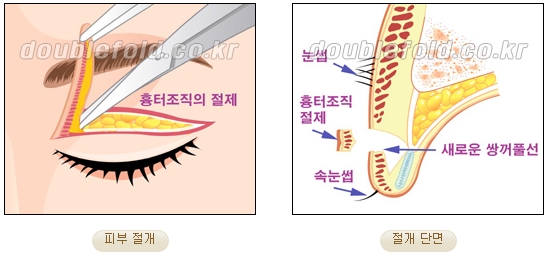
▶ The skin and scar tissue are cut away.
The scar tissue is excised along the design line.
The incision is made precisely with a scalpel, and then the tissue is excised with surgical scissors.
The lower excision line becomes the new double eyelid line, and the upper line must be dissected and naturally pulled downward for closure after tissue release.
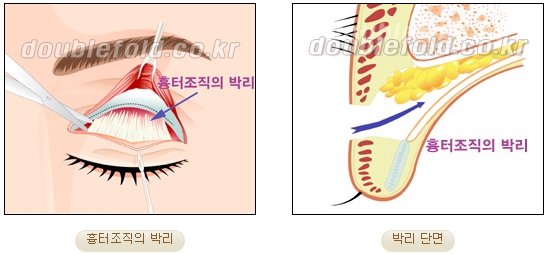
▶ The orbicularis oculi muscle, orbital fat, and skin adhered to the levator palpebrae superioris are dissected.
Because the skin above the incision line must be pulled downward, the hard scar tissue that is stuck together must be released.
Scar tissue dissection proceeds by separating the orbital fat layer from the levator palpebrae superioris, and in some cases the dissection is also done between the muscle and fat to allow forward repositioning of the fat.
Through this dissection process, the tissue can be advanced and repositioned downward, and it is an important preparatory step for achieving a natural double eyelid line.
▶ If there is contraction of the orbicularis oculi muscle, the muscle is incised or excised to remove the contraction.
If the adhesion of scar tissue is too severe, in rare cases a vertical 1 to 2 mm incision is made in the orbicularis oculi muscle to release the contraction.
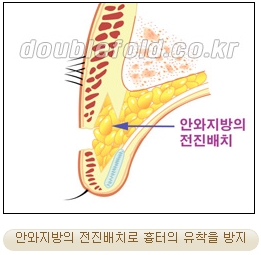
▶ To prevent re-adhesion, orbital fat is repositioned to the incision line.
Forward repositioning of orbital fat is a process to prevent tissue from re-adhering.
If the fat is not repositioned, the tissue will stick together again, which can lead to ptosis and make the eyes look sleepy and half-closed.
In some cases, a triple double eyelid may form, damaging the eyelid line.
Another effect of repositioning orbital fat is that if the eyelid is sunken, the sunken appearance can be corrected to some degree. So even if fat grafting might be needed later, the surgery itself may improve the condition enough that fat grafting becomes unnecessary.
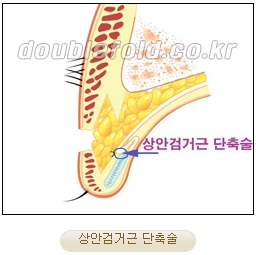
▶ The levator palpebrae superioris is shortened to strengthen its function.
Levator shortening is one method of correcting ptosis.
It is simple and effective, with the advantage of correcting the condition with almost no tissue damage.
The levator palpebrae superioris is not cut out; instead, it is simply advanced and tied to the tarsal plate.
In double eyelid revision surgery, the effects of levator shortening are twofold: it helps the eyes open wider so they can be corrected to look more refreshed, and by opening the eyes more widely, it also makes the double eyelid line smaller.
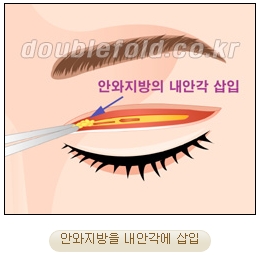
▶ After incising the orbicularis oculi muscle at the inner canthus, orbital fat is inserted between the muscles to prevent re-adhesion.
In addition to forward repositioning of fat, fat is inserted into the inner corner of the eye to prevent adhesion of the orbicularis oculi muscle.
The inner part of the eye is the area where scar adhesion occurs most easily, and adhesion in this area makes the eyes look sleepy and harder to open, causing discomfort when opening the eyes.
To prevent this, orbital fat, which can act as a lubricant, is placed between the orbicularis oculi muscle and the tarsal plate and fixed with sutures.
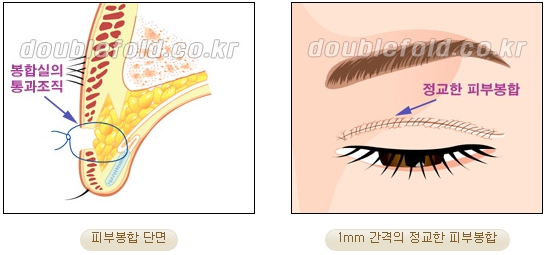
▶ During suturing, layered sutures are used so that the repositioned structures do not shift.
The suturing method in double eyelid revision surgery is not simple.
The purpose of suturing is to close the open wound and create the double eyelid line.
Therefore, in order to obtain the double eyelid line as initially designed, the skin below the incision line must not be pulled upward.
To do that, the skin below the incision line must be firmly fixed to the tarsal plate, and the repositioned fat must also be secured with sutures so it does not get pulled upward.
In addition, the orbicularis oculi muscle and skin above the incision line must both be passed through by the suture and firmly closed in layers in order to achieve the desired double eyelid line.
▶ To prevent hematoma and inflammation, a small amount of anti-swelling agent (hyaluronidase) is administered to the surgical area.
Hyaluronidase, an anti-swelling agent, is a medication that has the effect of dispersing fluid and quickly reducing swelling as soon as it is administered.
However, using too much can instead cause more bruising, so it is used selectively only to reduce swelling.
▶ Suture removal is kept relatively late, from 7 to 14 days depending on the patient’s condition.
Sutures are removed in two stages, on day 4 and day 7.
The reason for removing sutures late is that in double eyelid revision surgery, there is usually not enough skin reserve, and because the surgery involves advancing and repositioning all tissues, a lot of tension is placed on the suture line.
Therefore, if the sutures are removed on day 3 or 4, the tense suture line may open, or the scar line may widen, causing a larger scar and making the tissue gradually pull upward, which can also enlarge the double eyelid line.
So, until the tissue stabilizes, the sutures need to hold it in place, which is why it is better to leave them in longer.
In many hospitals, sutures are removed early out of concern that stitch marks may remain, but that applies only to the initial double eyelid surgery.
It does not apply to double eyelid revision surgery.
To minimize stitch marks, most of the sutures are removed on day 4, leaving only about 3 or 4 sutures, and those are removed on day 7. This helps minimize stitch marks and prevent the scar from widening, while also minimizing changes to the double eyelid line.
To quickly reduce early inflammation and swelling, steroid medication is administered for about 2 days.
After surgery, artificial tears are used for about 1 month to prevent dry eyes.
If all of the above principles are followed with skilled technique, a satisfactory result can be achieved.
What is the revision surgery method for uneven double eyelid lines?
- Partial incision method
This is a surgical method mainly used to restore a line that has become smaller, loosened, or blurry back to its original distinct double eyelid line.
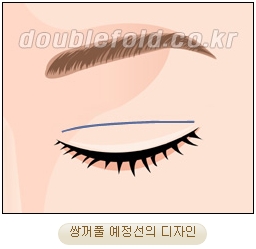
▶ The desired double eyelid line is designed.
In many cases, the design is made along the existing scar line.
Sometimes it is designed according to the height and shape the patient wants, or the surgeon identifies the most suitable double eyelid line and designs it accordingly.
Also, the direction of the design line changes depending on whether it will be an out-fold or an in-fold.
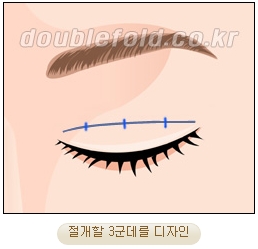
▶ Three small markings are made with design ink to indicate the incision points.
The locations are lightly marked on the inner, middle, and outer parts.
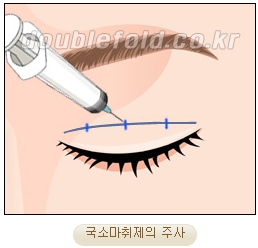
▶ Under sedation anesthesia, local anesthetic is administered to the three marked points after about 5 minutes of sleep.
The local anesthetic is given in the smallest possible amount to avoid swelling as much as possible.
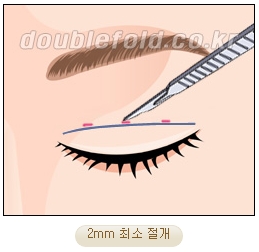
▶ Very small incisions of about 2 mm are made at the three marked points.
If the incision is too large, more scarring remains, so the surgery is performed with minimal incisions to leave almost no scar.
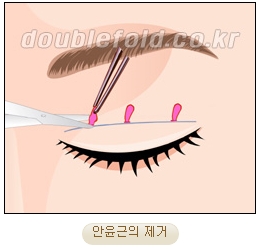
▶ Through the incisions, the orbicularis oculi muscle is first pulled out and removed with scissors.
The orbicularis oculi muscle is the muscle layer covering the eyelid, and since it interferes with double eyelid formation, it must be removed to prevent the line from loosening again.
Along with removal of the orbicularis oculi muscle, the pre-tarsal fat beneath the muscle layer is also removed.
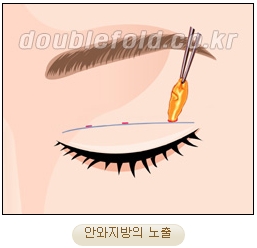
▶ When there is a lot of orbital fat, it is pulled out through the outer incision.
Fat removal is mainly done from the outer side.
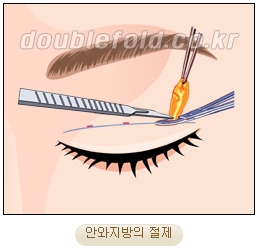
▶ The fat is held with hemostatic forceps, and the base of the fat that has come out is cut with a scalpel.
Removing too much fat can cause the eyelid to become sunken, so it is better to remove only as much as has protruded.
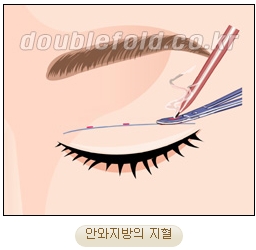
▶ After removing the fat, bleeding is controlled with electrocautery to prevent bleeding.
If hemostasis is not done properly, orbital hemorrhage can occur, making bruising and swelling severe, so careful hemostasis is important.
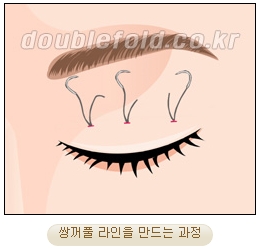
▶ Through the three incision sites, a very fine dissolvable thread is used to connect the levator palpebrae superioris and the skin to create the double eyelid line.
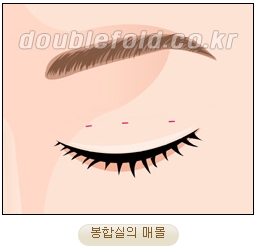
▶ After burying the thread and applying eye ointment, the surgery is finished.
Washing the face and wearing makeup are possible starting the next day.
Use the cool pack provided by the hospital for cold compresses for 3 days.
If cold compresses are done for more than 3 days, the swelling may not go down as well, so it is best to do them only for exactly 3 days.
What is the revision surgery method for uneven double eyelid lines?
- Microfat grafting
If the eyelid has become sunken and the line has been pulled upward and loosened, microfat grafting can correct the sunken eyelid along with the loosened line.
However, this applies only when the cause of loosening is solely due to eyelid hollowing. The main purpose of the procedure is to correct the sunken eyelid, and correcting the double eyelid line is a secondary goal.
If the line does not naturally recover even after the eyelid is restored, double eyelid revision surgery must be performed.
■ When fat grafting and double eyelid revision surgery are performed at the same time for sunken eyelids
Some hospitals perform both at the same time when the eyelid is sunken and revision surgery is needed, but that should not be done.
Fat grafting should be done first, and double eyelid revision surgery is possible after 3 to 6 months.
During double eyelid revision surgery, tissue must be dissected, and fat cannot be grafted into the dissected area. If fat grafting and double eyelid revision surgery are performed at the same time, it is like scattering fat into an empty dissected space, so the fat does not properly take and only damages the double eyelid line.
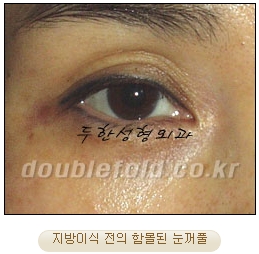
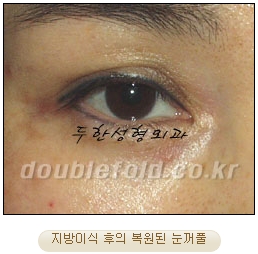
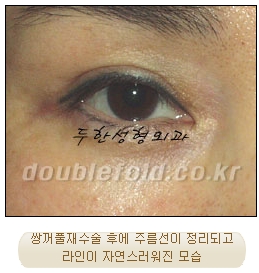
■ What is the process of fat grafting for uneven double eyelid lines?
This is applied only when the upper eyelid is sunken.
Microfat grafting requires very advanced skill and know-how.
The anatomical structure of the eyelid must be understood precisely.
Eyelid fat grafting can only be done properly by someone with extensive double eyelid surgery experience.
It is a very high-level procedure that must be performed while also considering correction of the awkward double eyelid line along with the sunken eyelid.
If the provider lacks experience or is not a board-certified plastic surgeon, it is better not to undergo the procedure.
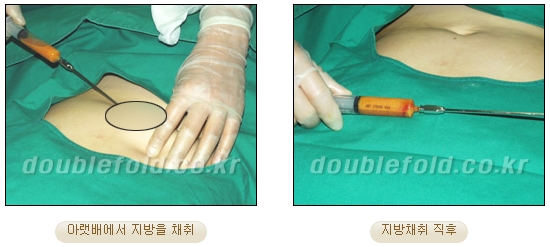
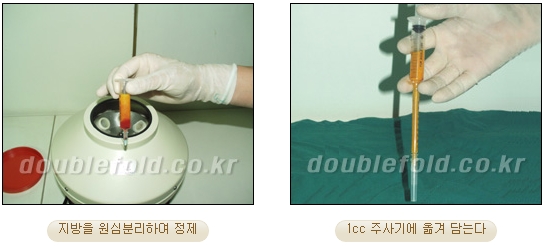
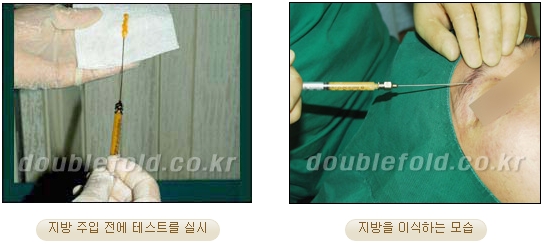
① Sedation anesthesia and local anesthesia are performed.
② Fat is finely harvested from the abdomen with a syringe.
③ The harvested fat is centrifuged and purified.
④ The purified fat is then processed again to remove oil.
⑤ Tunneling is performed at the treatment area to secure space for grafting.
⑥ Precise grafting is done into the orbital fat layer of the sunken eyelid.
⑦ The procedure is completed by molding and retracing the tunnels to adjust the contour of the eyelid and the height of the double eyelid line.

■ What are the frequently asked questions and answers about correcting the double eyelid line with fat grafting?
Question) I heard that eyelid fat grafting has many side effects, so it should not be done at other hospitals. Is that true?
Answer) It is not true that all other hospitals are the same.
This is an area that cannot be handled carelessly without accumulated experience and skill.
We always say this during consultations: fat grafting is absolutely not a procedure that just anyone can do.
As with all surgeries, the result differs depending on the surgeon’s experience and know-how.
There may be many hospitals that perform fat grafting, but the ones that do it properly can be counted on one hand.
Fat grafting is easy to do, but difficult to achieve proper results with.
In principle, good results from fat grafting are possible only when it is performed accurately.
The technique differs by hospital, and results vary greatly depending on experience.
You may have a poor impression after seeing or hearing about incorrect fat grafting, but if it is done properly, a satisfying result can be achieved in a single procedure.
In particular, the upper eyelid area (sunken eyelids, hollow eyelids) requires extensive experience, technical skill, delicacy, and precision, so it cannot be done by just anyone.
Question) I had eyelid fat grafting done at another hospital, but almost all of it has sunken and there is almost nothing left. Can it be done again in this case?
Answer) Even after a procedure at another hospital and low engraftment results that leave the area almost sunken again, repeat treatment is possible.
However, it must be done at least 3 months later.
Fat grafting requires a minimum of 3 months for engraftment, so once 3 months have passed since the last procedure, it can be done again.
Even if repeat treatment is done here, the result is almost no different from the first procedure.
Question) I had eyelid fat grafting done at another hospital, but it is uneven and uncomfortable to open my eyes. Is that a side effect?
Answer) The goal of eyelid fat grafting is to restore sunken eyelids and functionally improve the ability to open the eyes, thereby reducing eye fatigue.
To achieve this goal, the procedure must be precise and refined.
With fat grafting done by someone with somewhat limited experience, the fat may be grafted into the orbicularis oculi muscle layer rather than the orbital fat layer, causing uneven contours, or it may be grafted near the deep levator palpebrae superioris layer, making it even more uncomfortable to open the eyes than before the procedure.
If such side effects occur, the fat must be removed again, which is a very difficult problem.
To prevent side effects, it is better not to undergo the procedure with an inexperienced provider or a non-board-certified plastic surgeon.
Question) What if filler is injected instead of fat grafting in the eyelid?
Answer) The eyelid is a structure that moves constantly, so procedures that interfere with eyelid movement should not be done.
Fat grafting can act as cushioning and lubrication, making eyelid movement smoother, but injecting a foreign substance like filler can seriously impair the function of opening the eyes, regardless of the eyelid shape, and in severe cases the swelling may not go down or the eye shape may become distorted.
Inflammation can even occur, so fillers should absolutely not be injected into the eyelid.
Question) Isn’t eyelid fat grafting dangerous because it is so close to the eyeball?
Answer) Not at all.
The risk is high only when the procedure is performed by a doctor with limited experience or by a non-board-certified plastic surgeon. If you receive accurate treatment from an experienced specialist, there is no need to worry.
Eyelid fat grafting must be performed by someone who has precise anatomical knowledge and know-how gained through extensive double eyelid surgery experience, and if it is done according to proper principles, it is one of the safe procedures.
Question) After eyelid fat grafting at another hospital, my eyelids became puffy. Can it be corrected?
Answer) In some cases, after excessive fat injection at another hospital, the eyelids become heavy and puffy, and patients come here for correction.
Depending on the condition, the fat needs to be removed by liposuction. If the fat can be felt as a mass when grasped by hand, it can be corrected by inserting a microcannula and aspirating it.
However, 100% removal is not possible, and usually about 50% to 80% can be aspirated for correction.

There are many cases in which double eyelid revision surgery is impossible or difficult.
These include cases where there is not enough skin reserve, where the scar line is too strong to release the adhesion, where the skin and muscle are excessively thick, where the tissue has become hard and thick after multiple eye revision surgeries, where there is severe sausage-like swelling but the condition may recur because it is pushed down again even after surgery, and where there is severe ptosis.
Double eyelid revision surgery is very complicated and difficult, and in such cases patients themselves must understand its limitations, but there are people who do not want to accept those limits.
If surgery is done with vague hope alone, the patient is essentially throwing themselves into a deep pit.
Uneven double eyelids are usually caused by a different design, excessive skin removal on one side, partial loosening on one side, adhesion of scar tissue on one side, or ptosis on one side.
Ptosis can be corrected through double eyelid revision surgery, and uneven eyes can also be improved.
During consultation, the surgery is planned only when various examinations and tests predict the postoperative result and there is a sufficient chance of improvement after surgery.
The most important factors in double eyelid revision surgery are the amount of skin reserve, and the position and darkness of the scar line.
The purpose of double eyelid revision surgery is broadly twofold.
To restore a larger, more refreshing eye shape and to restore a natural double eyelid line.
After double eyelid revision surgery, the double eyelid line is made thinner and more natural.
The surgery must erase the existing scar line and create a new line below it.
http://www.duhans.com