lower eyelid aegyo-sal # lower eyelid aegyo-sal # lower eyelid aegyo-sal surgery # aegyo-sal fat graft # lower eyelid aegyo filler # dark circles # aegyo-sal # aegyo surgery # dark circle surgery # aegyo filler # lower eyelid aegyo surgery # lower eyelid
under-eye dark circles # aegyo-sal surgery # dark circle laser # removing dark circles # aegyo-sal effect # eye aegyo filler # aegyo-sal plastic surgery # under-eye autologous fat graft # under-eye fat-dissolving injection # under-eye fat
aegyo fat graft # lower eyelid aegyo-sal filler # under-eye hollowing # under-eye depression # under-eye fat removal # aegyo-sal filler # under-eye radiofrequency # surgery under the eyes # under-eye wrinkle improvement # aegyosal # a place good at aegyo filler
Gangnam aegyo-sal # Gangnam dark circles # dark surgery # dark circle management # under-eye fat repositioning # under-eye wrinkles # under-eye wrinkle lines # under-eye wrinkle line removal # aegyo-sal surgery # aegyo filler # surgery under the eyes
under-eye wrinkle improvement # under-eye correction # under-eye fat removal # eye aegyo-sal # aegyo-sal fat graft # under-eye aegyo-sal fat graft # men's aegyo-sal filler # eye aegyo filler # natural-looking aegyo filler # Duhan
men's aegyo-sal # micro fat grafting under the eyes # dark-circle plastic surgery # wrinkles # under-eye plastic surgery # lower eyelid plastic surgery # dark circle surgery # Gangnam aegyo filler # under-eye dark circle surgery # periocular dark
periocular dark circles # under-eye dark circles # under-eye protrusion # under-eye fine wrinkles # under-eye wrinkle fat graft # under-eye wrinkle removal # under-eye wrinkle removal procedure # under-eye wrinkle removal surgery # Duhan Plastic Surgery
Dr. Shin Duhan # Duhan lower eyelid surgery # revision lower eyelid surgery # brown dark circles # black dark circles # dark circle fat graft effect # fat graft take rate # number of fat graft sessions # flat-looking eyes # eye shape
attractive eye shape # flat under-eye area # micro fat graft for aegyo-sal # facial autologous fat graft # facial micro fat graft # micro fat grafting # autologous fat graft # fat graft # fat injection # fat plastic surgery
a place good at fat grafting # a hospital good at fat grafting # plastic surgery clinic specializing in fat grafting # recommended fat grafting # recommended hospital for fat grafting # a famous place for fat grafting # a famous hospital for fat grafting # after aegyo filler
under-eye aegyo filler removal # aegyo filler removal # aegyo-sal filler removal # a place good at lower eyelid surgery # a hospital good at lower eyelid surgery # COL-FAT fat graft # COL-FAT fat graft # colfat fat graft # COL-FAT graft
fat graft advantages # fat graft effect # fat graft area # mini fat graft # facial fat graft # a place good at facial autologous fat graft # fat graft specialist # board-certified plastic surgeon # aegyo-sal creation

20 years of clinical experience and know-how, countless successful cases
Aegyo-sal procedures under the eyes using filler products (Restylane, Juvederm, Aquamid, Artecoll)
There are many different types of commercially available filler products.
They are generally developed to improve fine wrinkles, so if used for their intended purpose, there is usually no major problem.
However, they are not suitable for use in large amounts.
In addition, some products can easily cause inflammation, which may lead to serious side effects.
Because almost all filler products are colorless and transparent, when aegyo-sal is created with them,
The under-eye area can become bulging and look transparent, almost like a blister, which often contrasts awkwardly with the surrounding skin tone.
Because of concerns about side effects and the unnatural appearance caused by the color, this is not a recommended method for creating under-eye contours.
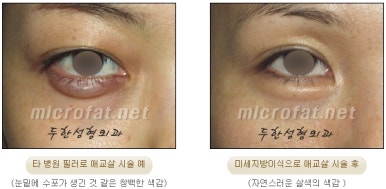
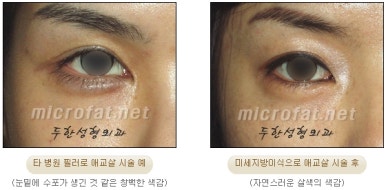
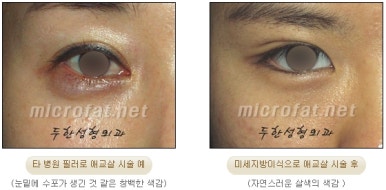
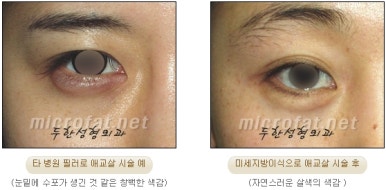
What is micro fat grafting for under-eye aegyo-sal?!
When the under-eye area is hollow or has depression lines,
and dark circles make the eye shape look less attractive,
this procedure is performed by harvesting fat from the lower abdomen or thighs with a thin suction cannula,
then grafting it under the eyes using a micro fat grafting cannula,
to correct under-eye hollows and wrinkle lines and brighten the skin tone.
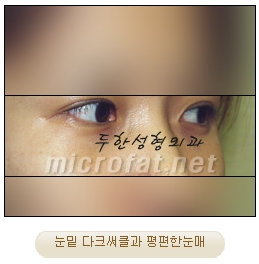
20 years of experience in fat graft surgery
COL-FAT fat grafting is Duhan Plastic Surgery’s proprietary intellectual property.

What is COL-FAT fat grafting?
It is a trademark developed from Dr. Shin Duhan’s 20 years of fat graft surgery know-how, leading a new paradigm in fat grafting.
COL-FAT fat grafting, developed by Dr. Shin Duhan of Duhan Plastic Surgery, is a new technique that strengthens collagen self-regeneration factors through a tunneling method and can address under-eye wrinkles in one procedure.
It also uses highly concentrated autologous fat to increase the take rate, offering high skin elasticity and durability.
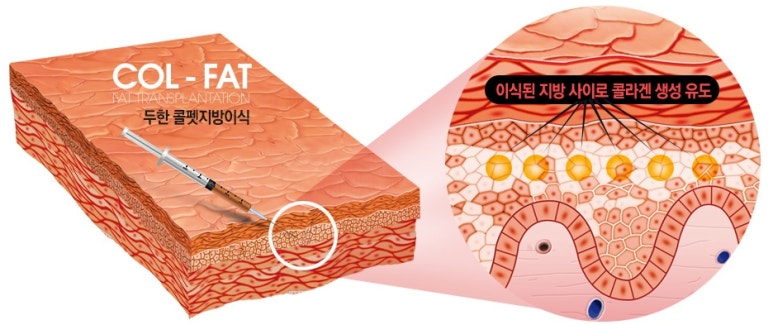
Concept diagram of COL-FAT fat grafting
Micro fat grafting survives by becoming vascularized in the surrounding tissue after the fat is grafted.
The take process takes at least three months, and during that time, some of the fat may be lost because it is not vascularized, or may be compressed and disappear due to pressure from surrounding tissue.
Therefore, because volume increase alone may not be sufficient in some cases, COL-FAT fat grafting enhances fat take by promoting collagen production, helping create younger, more elastic skin and contours.
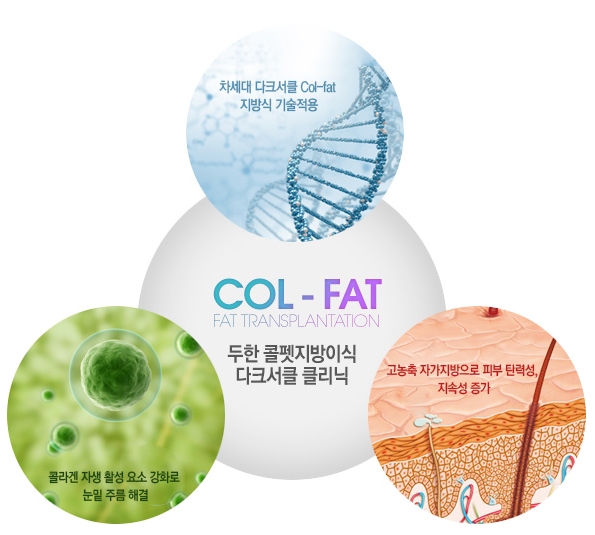
What are the features of COL-FAT fat grafting?
| Supplies serum, the nutrient source during the early stage of fat take. |
|---|
| Minimizes pressure from surrounding tissue, increasing the take rate. |
| Fat is grafted evenly, so it does not create uneven contours. |
| Collagen self-production enhances contour-correction effects. |
| Elasticity develops in the tissue and skin, helping improve wrinkles and create a more youthful appearance. |
We compared general fat grafting and COL-FAT fat grafting.
| General fat grafting | Comparison | COL-FAT fat grafting |
|---|
| Uneven contours may occur. | Contour | No uneven contours. |
| Take may occur unevenly. | Take pattern | Almost uniform take |
| Collagen is not produced. | Collagen production | High collagen production |
| Relatively lower. | Take rate | High take rate, effective facial contour correction is possible |
| Skin elasticity is barely affected. | Skin elasticity | Collagen production increases skin elasticity |
How is micro fat grafting for under-eye aegyo-sal performed to create attractive eye shape?
Fat grafting is performed through a step-by-step, systematic process.
The procedure involves several stages, including painless sedation anesthesia, fat harvesting, purification, tunneling, and grafting.
- Fat is harvested from areas where fat is well accumulated, such as the lower abdomen, waist, or thighs.
-
Because local anesthesia (painless sedation anesthesia) is used, there is no pain at all.
-
A thin liposuction cannula is used to collect fat into a syringe.
-
The harvested fat is centrifuged to remove impurities (anesthetic solution, oil, blood, etc.).
-
Oil is removed through a second purification process.
-
The purified fat is placed into a 1 cc syringe.
Usually, about half to one 1 cc syringe is grafted into one under-eye area.
- A micro fat grafting cannula is inserted along the planned design line under the eye to perform the grafting.
The graft is placed within or above the orbicularis oculi muscle layer, creating a smooth contour and a high take rate.
- After the graft, you can return to daily life immediately, and washing your face and applying makeup are possible starting the day after the procedure.
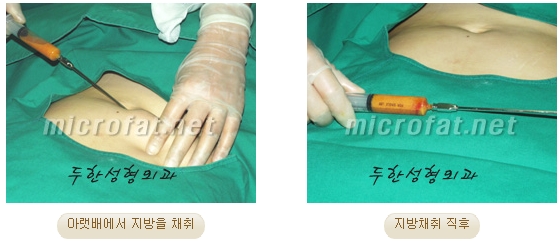
Fat is harvested from areas where it has accumulated well, such as the lower abdomen, waist, or thighs.
For the under-eye area, because a large amount of fat is not required, the lower abdomen is usually the most common harvest site.
Fat is carefully collected as living fat cells using a syringe and a thin suction cannula.
If a large cannula is used, the fat is suctioned too roughly, making precise grafting difficult, so it is better to use a thin cannula.
During suction, fat is collected from a wide area to avoid creating irregularities in the abdomen.
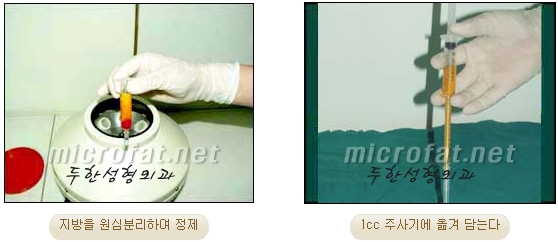
The harvested fat is placed in a centrifuge to remove impurities.
Impurities include blood, serum, anesthetic solution, oil, and moisture, while centrifugation removes blood, anesthetic solution, and some moisture.
Oil and other components are removed in a second step through natural absorption.
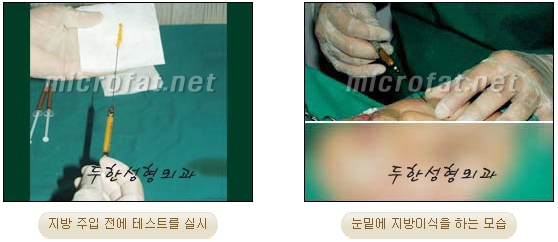
Fat with almost all oil removed is called concentrated fat. The concentrated fat is transferred into a 1 cc syringe and fitted with a micro grafting cannula.
We use the micro needle (micro grafting cannula) developed in-house.
The micro needle is a special grafting cannula used only at our clinic, enabling ultra-precise grafting.
The procedure is performed by injecting into the locally anesthetized under-eye area, and the injection is carefully distributed evenly across the designed area.
Distributing the appropriate amount of fat evenly without clumping is important for fat take and for expressing a smooth contour.
http://www.darkcare.com
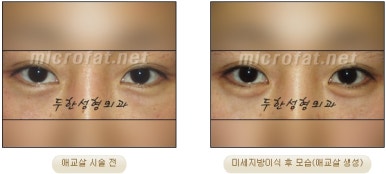
Examples of applying micro fat grafting for under-eye aegyo-sal
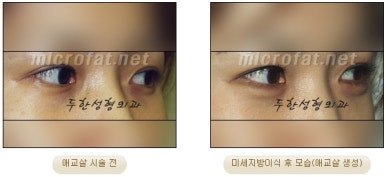
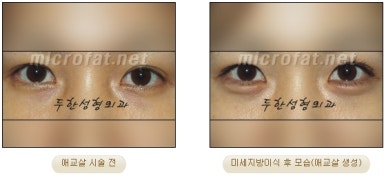
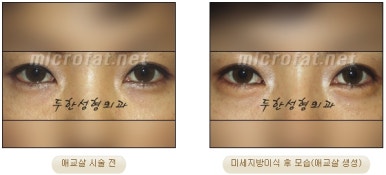
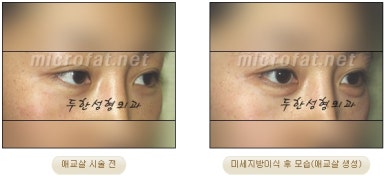
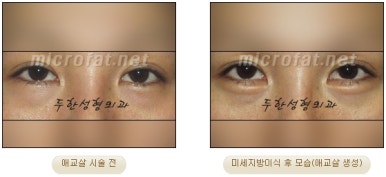
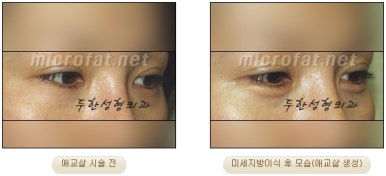
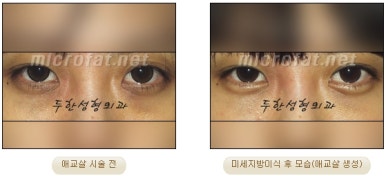
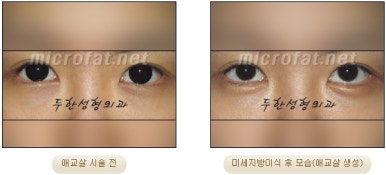
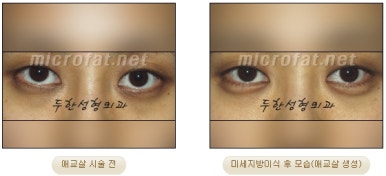
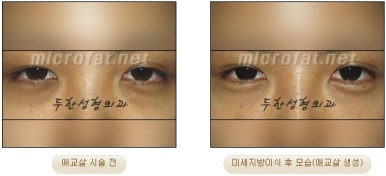
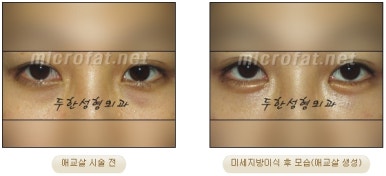
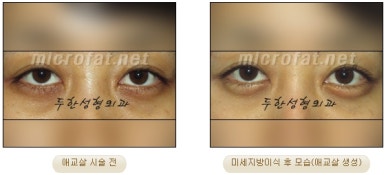
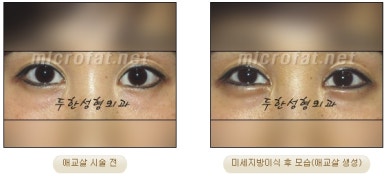
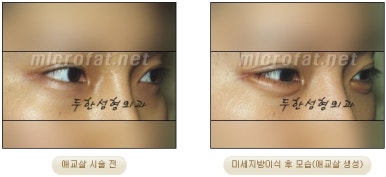
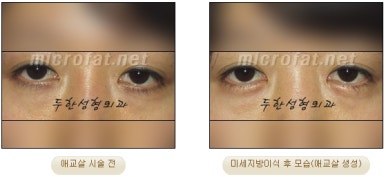
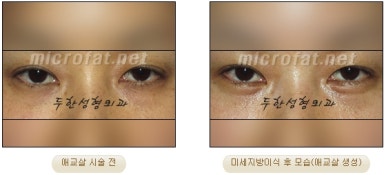
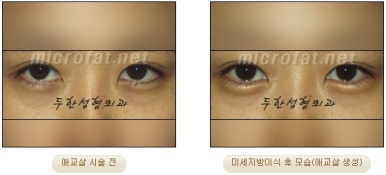
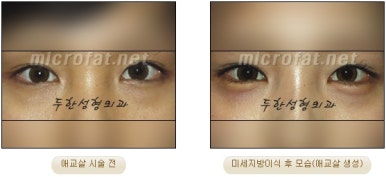
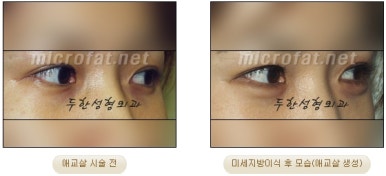
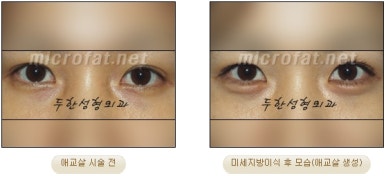
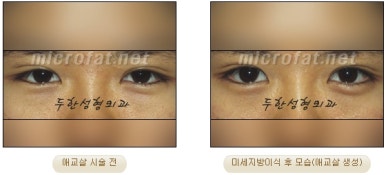
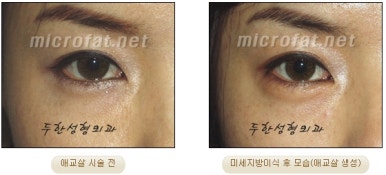
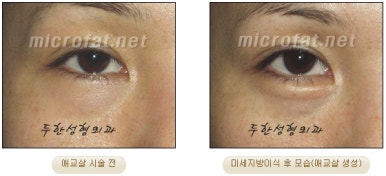
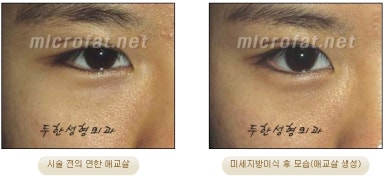
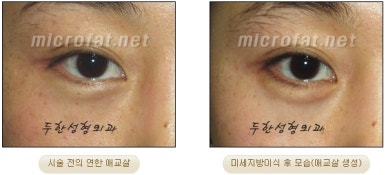
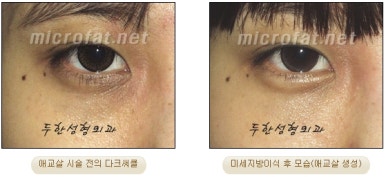
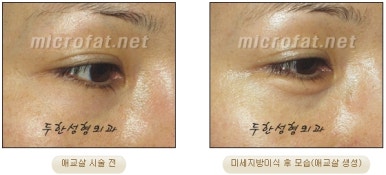
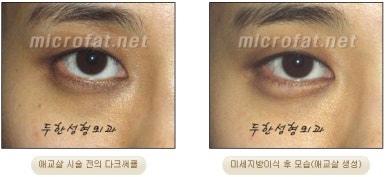
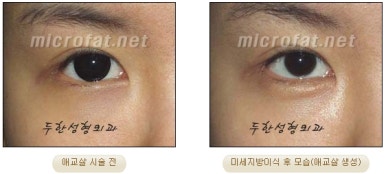
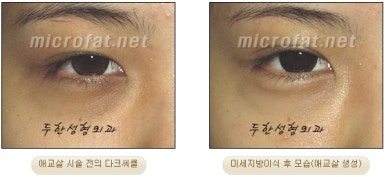
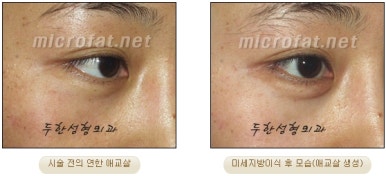
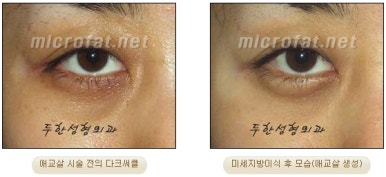
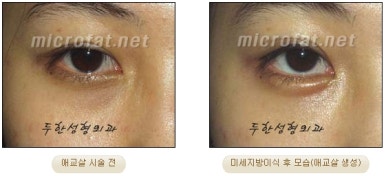
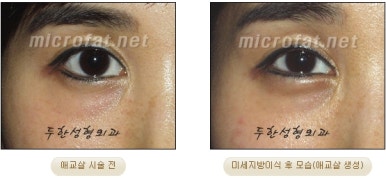
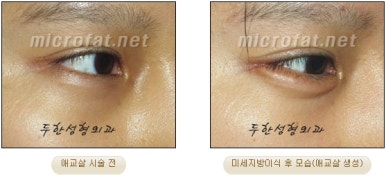
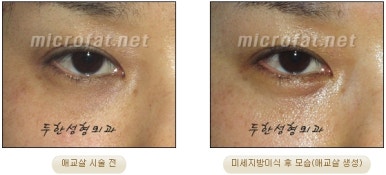
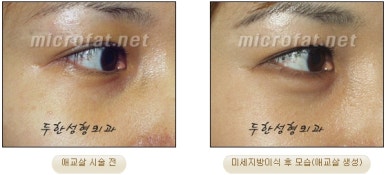
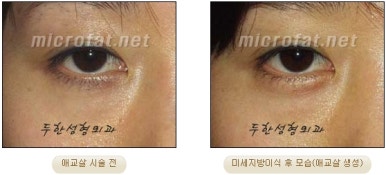
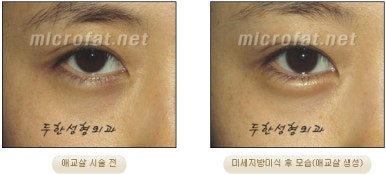
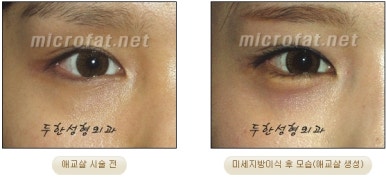
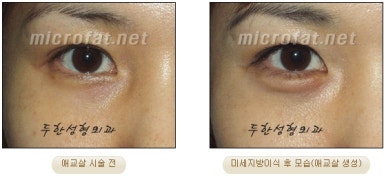
At our clinic, harvested fat is stored for up to 10 months, and if a second procedure or fat grafting to another area is desired before 10 months, the procedure is performed using the stored frozen fat.
However, many people feel uncomfortable with frozen fat and worry whether it affects the take rate.
You do not need to worry too much about this.
A simple example would be artificial insemination.
It is the same as freezing and storing male sperm in a sperm bank. Have you seen any cases where problems occurred when pregnancy happened and a child was born this way?
If fresh fat were much better, then children born through artificial insemination would have to be healthier than children born through natural conception.
In fact, frozen and stored fat is absolutely no different from fresh fat.
The take rate depends on how delicately the fat is harvested, how it is preserved so it does not necrose during storage, and how well it is injected during grafting.
How should you care for the area after under-eye aegyo-sal treatment?
Because aegyo-sal is an area where bruising easily occurs during under-eye fat grafting, careful bruising management is necessary.
▶ Starting the day after the procedure, cover the bruised area well with skin-colored cosmetics.
▶ Daily life is possible starting the day after the procedure, and if swelling does not go down well after about a week, it is helpful to receive an injection to reduce swelling.
▶ Four days after the procedure, it is fine to sweat in a sauna or jjimjilbang.
What are other methods for creating under-eye aegyo-sal?
▶ Using fat repositioning
Some clinics recommend aegyo-sal treatment using fat repositioning.
It is impossible to create satisfying aegyo-sal with fat repositioning.
Aegyo-sal should protrude smoothly just below the eyelashes, but orbital fat cannot be forced toward the lash line to create a natural aegyo-sal contour.
In most cases, the shape of the aegyo-sal is barely created, or the bulge appears below rather than directly under the eyelashes, resulting in an awkward shape.
Creating aegyo-sal through fat repositioning should be approached with caution.
▶ Using AlloDerm (an artificial dermis)
Some people create aegyo-sal using solid artificial dermis such as AlloDerm or SureDerm, but because it requires an incision, there is the burden of scarring, and the shape does not come out naturally, creating an artificial look, so it is not a recommended method.
In the case of liquid AlloDerm, the cost is high and the absorption rate is high, so the results are often unsatisfactory when sufficient projection is desired.
What about side effects from fat grafting?
Because fat grafting uses autologous fat, it has almost no side effects compared with commercial filler materials.
Except for slight swelling and bruising after the procedure, it can be said that there are essentially no side effects.
Therefore, it can be considered safer than any other cosmetic procedure.
However, this refers to cases where proper fat grafting is performed. If the procedure goes against the principles, side effects may sometimes occur, such as uneven lumps, fat necrosis and hardening, inflammation, or an awkward shape caused by excessive injection.
These issues depend on the practitioner’s experience and technique; they are not inherent problems with fat grafting overall.
Therefore, if the procedure follows proper principles, such side effects are rare.
Frequently asked questions and answers about under-eye aegyo-sal treatment
Question) If aegyo-sal was treated with filler, is correction with fat grafting possible later?
Answer) Many people who had filler treatment later want fat grafting again because of various problems.
However, once a person has been treated with filler, under-eye aegyo-sal fat grafting cannot be performed.
The reason is that the filler-treated area is not a suitable condition for fat to take.
Because blood circulation is not good, the fat may fail to take and side effects such as inflammation or fat necrosis may occur. Even if it does take, the take rate may be low or the shape may not be natural.
Some people ask, “What if the filler is completely dissolved with a dissolving injection and then fat grafting is done?” If the filler is a hyaluronic acid filler (Restylane, Juvederm, etc.), it can be dissolved with an enzyme injection called hyaluronidase.
However, unless the filler is almost completely dissolved, if some remains and the aegyo-sal shape is still present, fat grafting is not possible.
Even if the filler is dissolved with a dissolving injection, some residue remains, so there is still concern about inflammation after fat grafting. In principle, anyone who has ever used filler cannot undergo fat grafting.
Question) I had lower blepharoplasty because of under-eye wrinkles. Is aegyo-sal fat grafting possible?
Answer) Lower blepharoplasty is a method that removes and tightens the skin to smooth wrinkles caused by under-eye wrinkles or sagging.
After lower blepharoplasty, the skin is pulled tight, so there is no extra skin and scar tissue forms directly below the eyelashes.
In this condition, creating aegyo-sal is difficult.
For aegyo-sal to look natural, there needs to be some skin looseness so it can expand, but lower blepharoplasty removes skin, leaving almost no room for expansion.
Also, the scar tissue at the incision site makes it difficult to create the desired shape properly.
Therefore, it is difficult to create aegyo-sal after lower blepharoplasty.
As an exception, if the scar line is faint and it has been a long time since the lower blepharoplasty so that there is at least some slight skin laxity, a small amount of aegyo-sal may be created.
Question) If aegyo-sal was treated with AlloDerm, is correction with fat grafting possible later?
Answer) Many people who had treatment with AlloDerm (artificial dermis) later want fat grafting again because they are dissatisfied with the shape.
Because AlloDerm is living tissue, if it is not protruding in a very awkward way, fat grafting can be used to shape it.
However, if the shape is awkward, the protrusion is severe, or the bulge is not directly under the eyelashes but appears below that area, correction with fat grafting is difficult.
Conversely, fat grafting is possible only when the AlloDerm has been placed in the correct position directly below the eyelashes and the shape is mild.
Question) Other clinics say that using fat grafting for aegyo-sal is not good because the shape is not pretty and it creates uneven contours. Is that true?
Answer) Some clinics use fillers indiscriminately for contour procedures.
We also use fillers, but we use them only for fine wrinkles or small depressed scars.
Fillers (Aquamid, Restylane, Artecoll, etc.) are not made for contour surgery.
Therefore, their use involves limitations and brings various problems such as side effects and reduced effectiveness.
The issue is that non-specialist plastic surgeons and some doctors with insufficient experience overuse fillers.
Special features of Duhan Plastic Surgery’s autologous fat grafting clinic~

◎ All anesthesia is performed as local anesthesia (sedation anesthesia).
Local anesthesia is performed together with sedation anesthesia, and the procedure is carried out with absolutely no pain during or after anesthesia.
◎ We have a systematic and advanced fat grafting system.
To collect living fat cells and increase purity, we maximize purity through centrifugation, refinement, and unnecessary oil removal.
Before grafting, subcutaneous tunneling is performed at the graft site to secure space for the grafted fat.
A micro fat grafting cannula is used for precise grafting.
By evenly grafting across multiple layers in a 3D method, we maximize the take rate and create a soft contour.
◎ Appropriate and diverse fat harvest sites are selected.
The most commonly used site is the lower abdomen. Because it has less pain after the procedure, less swelling and bruising, and is more convenient for daily life, it is often the first choice.
After the lower abdomen, the inner thighs are selected, followed by the outer thighs.
If there is not enough fat to harvest from the thighs, the lower buttocks or flanks may also be used.
There is no fixed rule for which area gives the best fat take rate.
The results are similar, and although the ideal harvest site is the area with the most excess fat, it is best to decide the site by considering the amount needed and the activities after grafting.
◎ The take rate is maximized through a two-step purification process of the harvested fat.
The highest proportion of impurities in harvested fat is local anesthetic, followed by oil.
Other impurities include serum and red blood cells.
In the first step, the fat undergoes centrifugation for about 3 to 4 minutes before entering the second oil-removal process.
Oil is removed manually through natural absorption.
Through the second purification step, concentrated fat approaching 100% is obtained, maximizing the effect of fat grafting and increasing the take rate as much as possible.
◎ Subcutaneous tunneling secures space for fat grafting.
Subcutaneous tunneling means creating space in advance for the fat to be grafted, and it is an essential and important process for high take rates and uniform grafting.
Using a thin probe, the area under the skin is moved repeatedly in a fan-like pattern to create space for the fat graft.
The effect of subcutaneous tunneling is to increase fat take and prevent fat clumping, creating a uniform and soft contour.
◎ 3D micro fat grafting creates a soft and uniform facial contour.
With some exceptions depending on the area, the basic fat grafting method is a 3D approach.
Fat is divided into multiple layers and small amounts are evenly grafted into each area.
◎ A micro fat grafting cannula is used for precise fat grafting.
In the past, methods using fat injection machines forced fat under the skin at high pressure, which caused various problems.
The absorption rate of the fat was high, take was inconsistent, contours became uneven, and it was difficult to graft in delicate areas such as under the eyes.
To solve these problems, during fat grafting the fat is transferred again into a thin 1 cc syringe and grafted into the desired area.
We use the micro needle (micro grafting cannula) developed in-house.
The micro needle is a special grafting cannula used only at our clinic, enabling ultra-precise grafting.
Fat grafting can also be performed on the upper eyelids, lower eyelids, forehead wrinkles, glabellar lines, nasolabial folds, and the bridge of the nose, making fat grafting possible in almost all cases except fine wrinkles.
◎ Immediately after fat grafting, molding is performed to create a uniform and soft facial contour.
Immediately after fat grafting, delicate molding is performed so that the grafted fat spreads evenly and creates a soft shape.
Molding is the final step of fat grafting and one of the most important steps.
◎ Rapid freezing and sterile storage of remaining fat simplifies second procedures.
If a second procedure is performed three months after fat grafting, fat is not harvested again; instead, the fat remaining after the first procedure is used.
The remaining fat after the first procedure is rapidly frozen and sterilized for storage.
During the second procedure, the stored fat is thawed and the treatment can be performed more conveniently.
The storage period for fat is up to 10 months, and if you visit within 10 months, the stored fat will be used for the procedure.

In some cases, fillers or AlloDerm are used instead of fat grafting for aegyo-sal procedures.
Because fillers such as Restylane are transparent, after the procedure the under-eye area can become pale as if a blister has formed, with no natural blood color, and the shape can look awkward. Also, because they are foreign materials, there is a possibility that the shape may change or sink downward.
AlloDerm grafting through incision is an overly invasive method that leaves scars, and the shape also does not come out naturally.
For this reason, many patients visit our clinic to dissolve fillers and undergo repeat treatment with fat grafting.
Therefore, based on experience, fat grafting seems to be the best method.
The advantages of fat grafting are that, because it uses the body’s own tissue, there are no side effects, the shape is natural, and daily life is possible immediately.
Aegyo-sal is performed selectively only when it suits the patient’s own eye shape, so there is no need to worry about whether it will suit you.
At Duhan Plastic Surgery’s autologous fat grafting clinic, based on more than 20 years of extensive clinical experience and know-how, we perform 3D micro fat grafting with 100% concentrated fat evenly across multiple layers through a tunneling technique rather than injecting a large amount into one place.
In addition, customized design is possible using a delicate injection method.
To minimize swelling and bruising during the procedure, we mix an anti-swelling agent with the anesthetic and administer painless sedation anesthesia under local anesthesia.
http://www.duhans.com