#Disaster Relief Fund Where to Use #Disaster Relief Fund Hospital #Disaster Relief Fund Hospital Use #Disaster Relief Fund Plastic Surgery #Plastic Surgery with Disaster Relief Fund #Disaster Relief Fund Usable Hospital
#Plastic Surgery Where Disaster Relief Fund Can Be Used #Disaster Relief Fund Plastic Surgery #Plastic Surgery Where Emergency Disaster Relief Fund Can Be Used #Plastic Surgery Where Disaster Relief Fund Can Be Used #Plastic Surgery Disaster Relief Fund Use #Plastic Surgery
#Emergency Disaster Relief Fund Can Be Used #Plastic Surgery Where Emergency Disaster Relief Fund Can Be Used #Can You Use the Emergency Disaster Relief Fund at a Plastic Surgery Clinic #Plastic Surgery Disaster Relief Fund #How to Use the Emergency Disaster Relief Fund
#Emergency Disaster Relief Fund Plastic Surgery #National Disaster Relief Fund Plastic Surgery #Government Emergency Disaster Relief Fund Plastic Surgery #At a Plastic Surgery Clinic with Emergency Disaster Relief Fund #Emergency Disaster Relief Fund Plastic Surgery #Disaster Relief Fund Plastic Surgery
#Disaster Relief Fund Use at Plastic Surgery Clinics #Emergency Disaster Relief Fund Use at Plastic Surgery Clinics #Blepharoplasty #Eyelid Surgery #Lower Blepharoplasty #Lower Eyelid Surgery #Lower Eyelid Blepharoplasty #Lower Eyelid Blepharoplasty Surgery
#Revision Lower Blepharoplasty #Revision Blepharoplasty #Eyelid #Under the Eyes #Eyelid Fat Removal #Under-Eye Fat Removal #Orbital Fat #Under-Eye Orbital Fat #Under-Eye Fat #Bulging Eye Shape #Bulging Upper Eyelids #Plastic Surgery
#Under-Eye Fat Removal Procedure #Under-Eye Fat Removal Surgery #Bulging Under-Eye Area #Easily Puffy Eyes #Bulging Under-Eye Wrinkle Line #Under-Eye Wrinkle Line #Under-Eye Dark Circles #Red Under-Eye Dark Circles #Upper Eyelid Surgery
#Upper Eyelid Fat Removal Surgery #Heavy Eyelids #Puffy Eyelids #Under-Eye Wrinkles #Under-Eye Wrinkle Correction #Under-Eye Wrinkle Removal #Under-Eye Wrinkle Removal Procedure #Under-Eye Wrinkle Removal Surgery #Youthful Eyes #Youth-Rejuvenating Plastic Surgery
#Youth-Rejuvenating Surgery #Youthful Appearance #Youthful Face #Creating a Youthful Face #Anti-Aging Plastic Surgery #Rejuvenation Plastic Surgery #Filial Piety Plastic Surgery #Middle-Age Plastic Surgery #Plastic Surgery in Your 50s #Upper Eyelid Orbital Fat #Upper Eyelid Fat Removal #Above the Eyes
#Above-the-Eye Fat #Above-the-Eye Fat Removal #Above-the-Eye Fat Removal Procedure #Above-the-Eye Fat Removal Procedure #Fat Removal Failure #Under-Eye Fat Removal Failure #Scar-Free Under-Eye Fat Removal #Under-Eye Plastic Surgery #Best Place for Under-Eye Surgery
#Excessive Fat Removal #Fine Under-Eye Wrinkles #Under-Eye Hollowness #Under-Eye Hollowing #Under-Eye Sunkenness #Fine Wrinkles Under the Eyes #Wrinkles Under the Eyes #Worsened Dark Circles #Worsened Dark Circles #Board-Certified Plastic Surgeon #Revision Surgery
#Board-Certified Plastic Surgeon #Gangnam Plastic Surgeon #Gangnam Plastic Surgery #Under-Eye Fat Repositioning #Benefits of Fat Repositioning #Benefits of Under-Eye Fat Repositioning #Best Place for Fat Repositioning #Fat Repositioning Clinic
#After Fat Removal #After Under-Eye Fat Removal #After Under-Eye Fat Repositioning #After Fat Repositioning #Laser Fat Removal #Laser Fat Removal #My Under-Eyes Look Hollow #Fat Removal Procedure #Fat Removal Surgery
#Fat Plastic Surgery #Fat Plastic Surgery Procedure #Upper Eye Surgery #Youthful Eyes #Puffy Eyes #Puffy-Looking Eyes #Eye Fat #Heavy Eyelids #My Eyelids Feel Heavy #Orbital Fat Removal #Upper Eye Fat Removal
#Lower Blepharoplasty Under the Eyes #Eyelid Fat #Upper Lid Fat Removal #Under-Eye Fat Repositioning Lower Blepharoplasty #Removing Under-Eye Fat #Upper Blepharoplasty #Upper Blepharoplasty #Upper Eyelid Blepharoplasty #Upper Eyelid Blepharoplasty Procedure #Eye Plastic Surgery
#Gangnam Upper Blepharoplasty #Apgujeong Upper Blepharoplasty #Sinsa Upper Blepharoplasty #Gangnam Lower Blepharoplasty #Apgujeong Lower Blepharoplasty #Sinsa Lower Blepharoplasty #Revision Plastic Surgery Clinic #Famous Plastic Surgery Clinic in Gangnam #Recommended Plastic Surgery Clinic in Gangnam #Middle-Aged Eyes
#Improving Under-Eye Wrinkles #Youthful Eye Plastic Surgery #Creating a Youthful Face #Under-Eye Sagging #Under-Eye Elasticity #Duration of Under-Eye Fat Removal Results #Double-Eyelid Under-Eye Fat Removal #Fat Repositioning Already Improves Appearance #Anti-Aging
#Complex Lower Blepharoplasty #Middle-Age Eye Plastic Surgery #Middle-Age Eye Surgery #Middle-Age Under-Eye Surgery #Improving Droopy Eyes #Repositioning Below the Eyes #Solving Droopy Under-Eyes #Creating Bright, Lively Eyes #Under-Eye Anti-Aging

What is eyelid fat removal?
The eyelids contain a structure called "orbital fat."
If there is a proper amount of orbital fat, it helps maintain the contour of the eyelids, protects the eyeball, and acts as a lubricant for eyelid movement. However, if there is too much, the lower or upper eyelids can protrude and appear swollen.
When the upper or lower eyelids are thick, it is often because there is too much orbital fat.
Eyelid fat removal is the procedure that removes more fat than needed.
What are the types of fat removal?
- Under-eye fat removal
The lower eyelid usually has three fat pads: one on the inner side of the eye, one in the middle, and one on the outer side.
Among these, the middle fat pad is the largest, so the middle fat is removed, and depending on the case, the middle and inner fat may also be removed.
How many areas of fat are removed and how much are removed varies by individual, so it is important to remove the appropriate amount for each person.
Too much fat removal can cause under-eye hollowing, so the proper amount of fat should be removed after an accurate examination.
▶ Indications for under-eye fat removal
| Under-eye protrusion caused by forward displacement of orbital fat |
|---|
| Eyes that swell easily in the morning |
| In cases where wrinkle lines are visible around the protruding under-eye area |
| In cases with red dark circles under the eyes |
- Upper eyelid fat removal
The upper eyelid usually has two fat pads: one on the inner side of the eye and one on the outer side.
The outer fat pad is about twice the volume of the inner one, so the usual fat removal method is to remove the outer fat.
▶ Indications for upper eyelid fat removal
| Eyes that look puffy around the eyelids |
|---|
| Eyes that swell easily in the morning |
| When the eyelids feel heavy |
| When you want to remove only fat without touching the double eyelid crease |
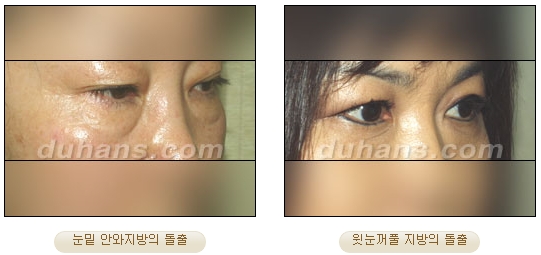
What are the effects of fat removal?
| It can correct eyelids that look swollen. |
|---|
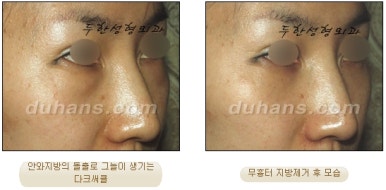
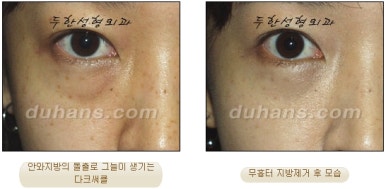
| In the case of under-eye fat removal, it restores a smoother eye shape and corrects under-eye hollow wrinkle lines. |
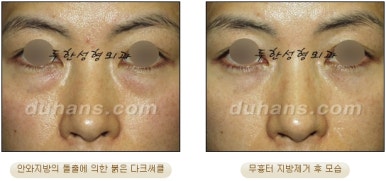
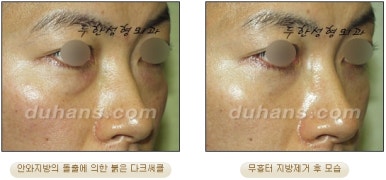
| It can improve red dark circles under the eyes. |
| It can restore a more youthful eye shape. |
Anatomy of upper eyelid orbital fat

What is the upper eyelid fat removal surgery process?
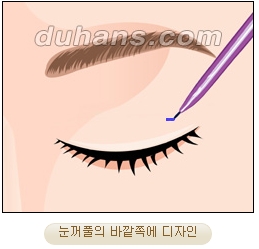
① Mark the outer side of the eyelid with a design pen.
If there is a double eyelid, the design is made along the double eyelid crease.
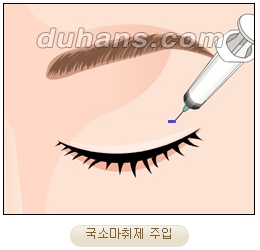
② Inject local anesthetic.
Even a small amount is enough to provide anesthesia, so there is little swelling from the anesthetic medication.
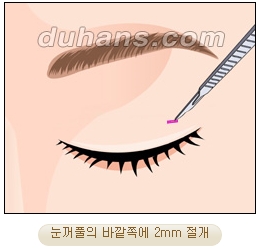
③ Make an incision along the design line with a scalpel.
The incision is only about 2 to 3 mm long, so there is almost no scar.
In the case of eyelids with a double eyelid, the incision line passes through the double eyelid crease, so the scar is hidden in the crease and is not visible.
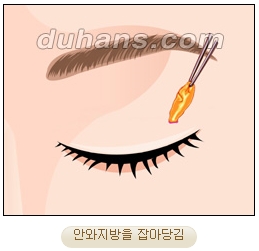
④ Pull out the orbital fat.
The fat is accumulated in the orbital septum, so the orbital septum must be removed first, and then the fat is pulled out so that enough fat comes out.
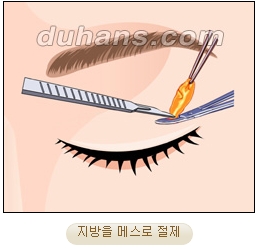
⑤ Hold the lower part of the protruding fat with a hemostatic forceps and excise it with a scalpel.
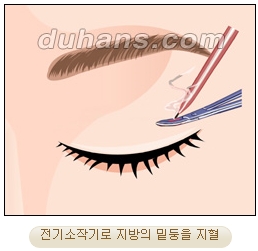
⑥ Cauterize the remaining fat tissue with an electric coagulator to prevent bleeding from the lower part of the remaining fat.
Proper hemostasis is necessary to prevent swelling and bruising.
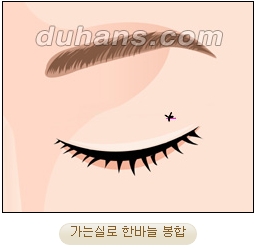
⑦ Suture with one stitch using a thread as thin as a strand of hair.
The stitch can be removed after 2 to 3 days.
You can return to daily life immediately after surgery, and swelling and bruising are usually minimal.
Examples of upper eyelid fat removal application
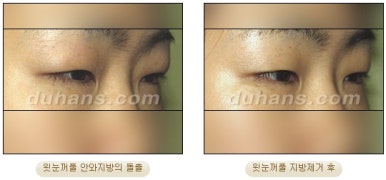
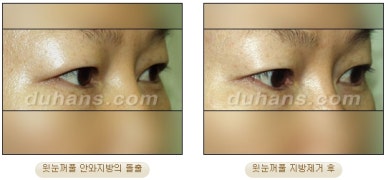
How should you care for yourself after upper eyelid fat removal?
-
After fat removal, use the cold compress pack provided by the hospital for about 3 days.
-
Remove the stitches on the second day after surgery.
-
Washing your face and wearing makeup are possible from the day after surgery.
-
Swelling and bruising are mild, so you can return to daily life right away.
What precautions should be taken after upper eyelid fat removal?
| ① If the skin or orbicularis oculi muscle is thick and makes the area look swollen, the effect of fat removal may be limited. |
|---|
| ② When fat is removed from eyes with a double eyelid, the double eyelid line may become slightly larger. |
| ③ Excessive fat removal can make the eyes look sunken, so do not remove too much fat. |
| ④ If the skin or orbicularis oculi muscle of the upper eyelid is thick and makes the area look swollen, the effect of fat removal may be limited. |
| ⑤ Upper eyelid fat removal is more difficult in eyes that have undergone double eyelid surgery. |

What is under-eye fat removal?
The lower eyelid usually has three fat pads: one on the inner side of the eye, one in the middle, and one on the outer side.
Among these, the middle fat pad is the largest, so the middle fat is removed, and depending on the case, the middle and inner fat may also be removed.
How many areas of fat are removed and how much are removed varies by individual, so it is important to remove the appropriate amount for each person.
Excessive fat removal can cause under-eye hollowing, so the proper amount of fat should be removed after an accurate examination.
Anatomy of under-eye fat
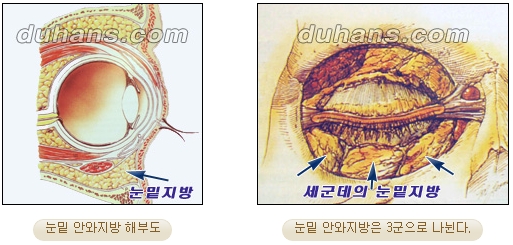
What is the surgery process for under-eye fat removal?

① Mark the location of the fat with design ink. Usually, the inner and middle areas are marked, and in some cases only the middle area is marked.
The area to remove is determined according to the distribution and amount of fat.
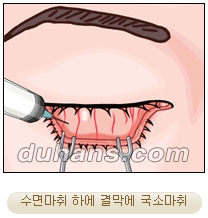
② Anesthesia is performed under sedation with local anesthesia, and since the anesthesia is done while the patient is asleep, it can be done without any pain.
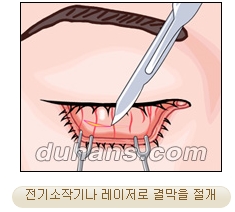
③ To protect the eyeball, a corneal shield is worn and an incision is made in the conjunctiva with an electric coagulator.
Laser is sometimes used, but because laser has weaker hemostatic effect and bleeding can be severe during surgery, an electric coagulator is generally used more often.
The electric coagulator reduces bleeding and minimizes swelling and bruising.
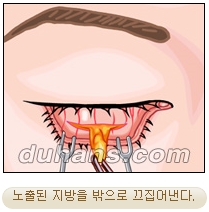
④ After the incision, when the fat is exposed, it is pulled outward with forceps so that only the amount to be excised comes out.
Excessive fat removal can cause under-eye hollowing and wrinkles, so it is appropriate to remove only the amount that comes out when pulled.
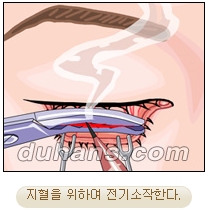
⑤ To ensure firm hemostasis, bleeding is controlled with a bloodless-surgery device, an electric coagulator.
If hemostasis is insufficient, bleeding can occur from the inside after surgery, causing significant swelling and bruising, so proper hemostasis is important.
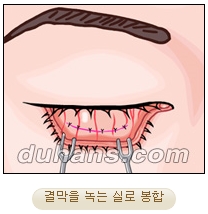
⑥ After all the fat has been removed, the conjunctiva is sutured with dissolvable thread.
Because the dissolvable thread dissolves within 7 to 15 days, there is no need to return to have stitches removed later.
You can also wear contact lenses from the day after surgery.
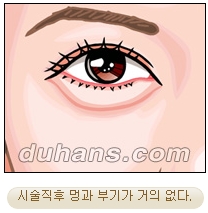
⑦ The surgery takes about 20 to 30 minutes, and if it ends quickly with good hemostasis and no bleeding, it is common to have little swelling or bruising.
Antibiotic and anti-inflammatory eye drops are used after surgery to prevent swelling and inflammation.
Examples of under-eye fat removal application
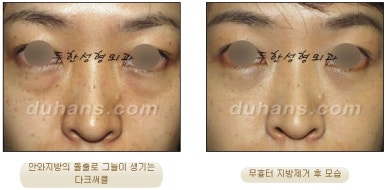
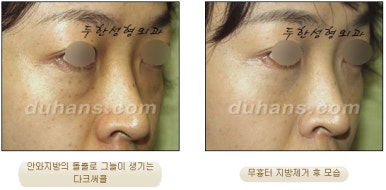
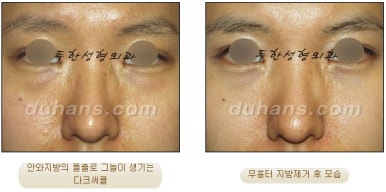
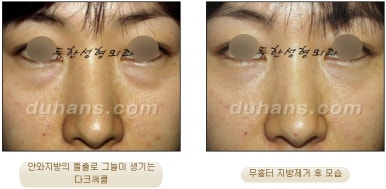
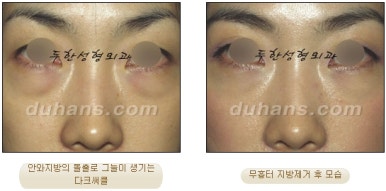
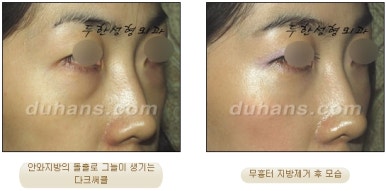
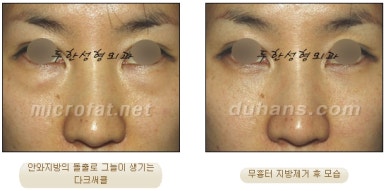
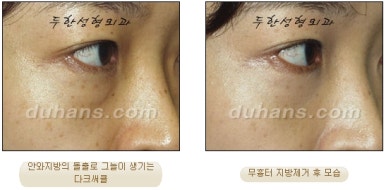
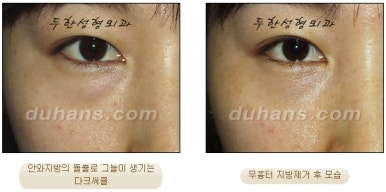
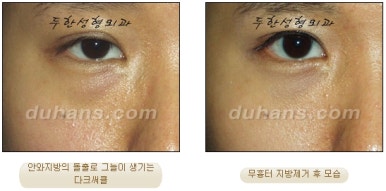
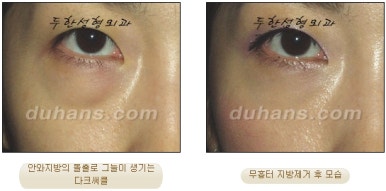
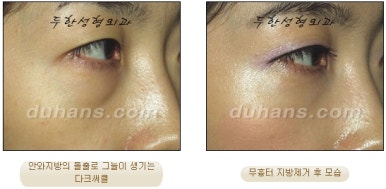
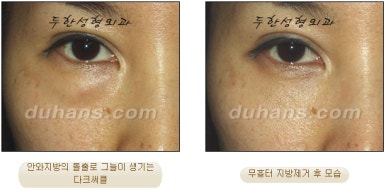
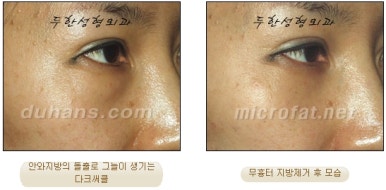
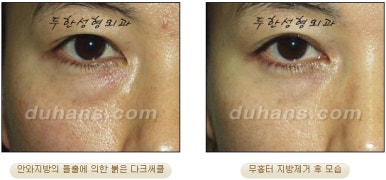
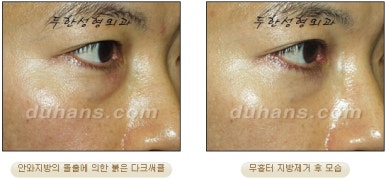
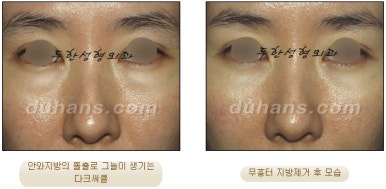
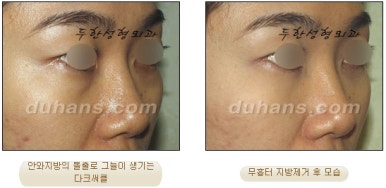
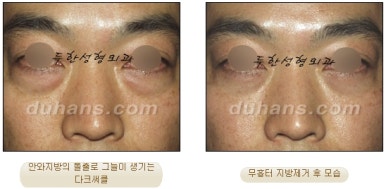
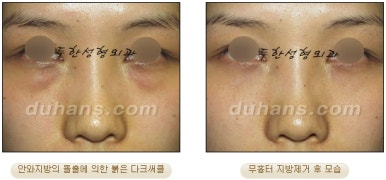
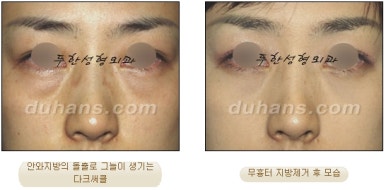
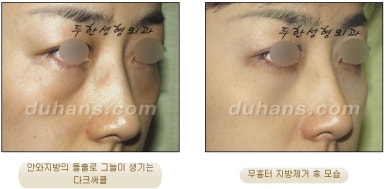
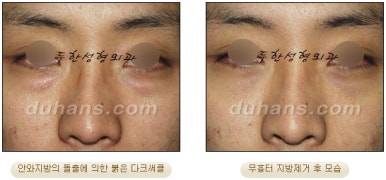
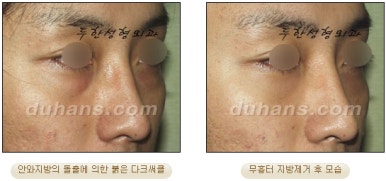
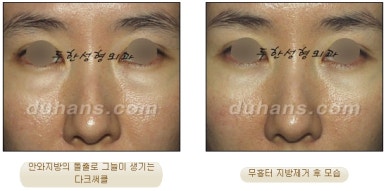
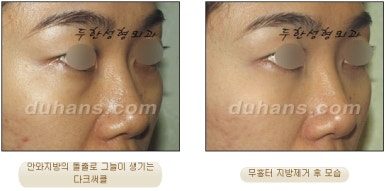
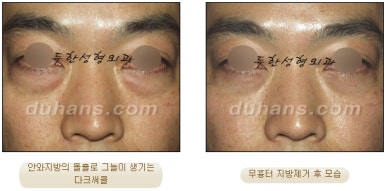
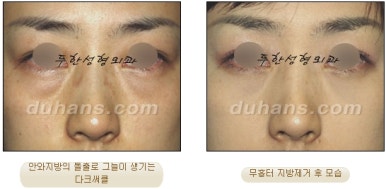
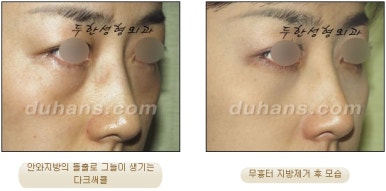
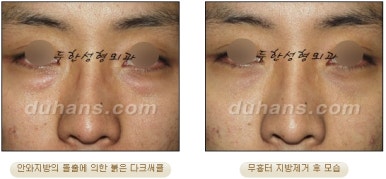
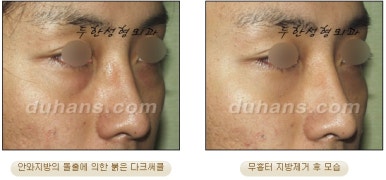
How should you care for yourself after under-eye fat removal?
-
After fat removal, use the cold compress pack provided by the hospital for about 3 days.
-
On the day of surgery, sleep with your head elevated about 30 degrees to reduce bruising and swelling.
-
To reduce swelling and bruising, try not to lie down on the day of surgery and stay seated as much as possible.
-
Washing your face and wearing makeup are possible from the next day.
-
Contact lenses can be worn from the day after surgery.
-
Use the eye drops prescribed by the hospital for about a week.
-
The conjunctiva is sutured with dissolvable thread, so there is no stitch removal.
-
Swelling and bruising are mild and usually subside after about a week.
What precautions should be taken for under-eye fat removal?
| ① Excessive fat removal can make the under-eye area sunken, so be careful not to remove too much fat. |
|---|
| ② If the skin is loose and under-eye fat removal is performed, the skin may sag and more wrinkles may appear. |
| ③ If you have had LASIK, wait at least 3 months before under-eye fat removal; if you have had LASEK, wait at least 1 month before under-eye fat removal. |
| ④ Under-eye fat removal can, in some cases, worsen dark circles, so if there is a risk of worsening dark circles, fat removal should not be performed. |
What are the side effects of under-eye fat removal?
The most common side effects are under-eye hollowing due to excessive fat removal caused by a surgeon’s lack of experience or incorrect measurement of the fat amount, an increase in fine wrinkles compared to before surgery, and the appearance or worsening of dark circles.
It is better not to have surgery at dermatology clinics or other departments where the doctor has relatively little experience or is not a board-certified plastic surgeon.
If under-eye hollowing occurs after excessive fat removal, it can be corrected and restored with micro fat grafting.
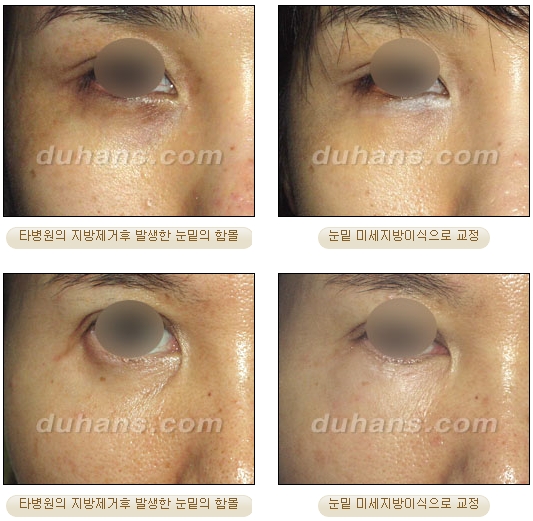
To avoid side effects, it is important to carefully identify the indications for fat removal through an accurate examination before surgery and remove only an appropriate amount of fat.
If there is no skin elasticity and there is a tendency toward fine wrinkles, or if dark circles may worsen or appear, fat removal should not be performed.
To avoid side effects, the rule is not to undergo surgery by someone who is not a specialist in plastic surgery.
Color changes in the under-eye area after fat removal
Depending on the skin type under the eyes, there are roughly three types of color change after fat removal.
They are cases where there is almost no color change, cases where the color becomes slightly darker, and cases where the color becomes lighter.
If there are dark circles under the eyes, the color often becomes darker after fat removal.
Conversely, if the color is red, the redness may decrease.
Depending on the skin type and the current color, the color change after fat removal should be predicted and managed in advance.
When fat removal is performed for the purpose of improving dark circles, it can actually worsen them, so the indications for the procedure must be carefully determined.
If fat is removed for the purpose of improving dark circles, additional fat grafting may later be needed under the area where the fat was removed.
Correction through under-eye fat repositioning
This refers to moving the under-eye orbital fat instead of removing it and spreading it over the lower protruding area.
This method aims to correct both protruding and sunken areas at the same time.
It was designed to compensate for the drawback of fat removal, which can address protrusion but cannot resolve hollowness.
What are the problems with under-eye fat repositioning?
The problem with under-eye fat repositioning is that it is difficult to achieve the desired result properly.
Because the surgery is performed through the conjunctiva, visibility is limited and the surgery may not be done properly, and there are not many people who are suitable candidates who can get good results from fat repositioning.
As a simple example, if there is land with a pit and a hill, and the goal is to level the whole area by digging soil from the hill to fill the pit, if the hill is not very large, even after removing all of the hill’s soil, there still may not be enough, and after filling the pit, the hill may instead become a pit.
This is the strange phenomenon in which, when repositioning is forced by pulling too hard when the amount of fat is not very large, the previously protruding area may instead become sunken.
In another case, the pit may be larger than the hill, so even after removing all the soil from the hill to fill the pit, the depth of the pit is only slightly reduced and it still remains a pit.
This refers to a case where a small amount of fat is pulled and repositioned, but the sunken area is not well corrected and remains sunken.
In yet another case, the hill is large, so even after filling the pit, the hill only becomes slightly smaller and still remains a hill.
This refers to a case where there is a lot of protruding fat, so even after repositioning, fat remains and the under-eye protrusion is still present.
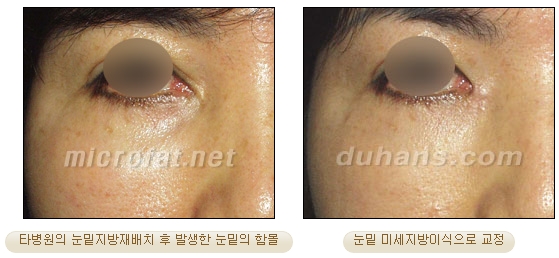
What are the four unsatisfactory outcomes of fat repositioning?
| ① When the amount of fat is insufficient, the protruding area where the fat used to be becomes sunken after fat repositioning |
|---|
| ② When there is a lot of fat, the original protruding area still looks protruded even after fat repositioning |
| ③ After fat repositioning, the original sunken area may instead protrude and look raised |
| ④ When the amount of fat is small, even after fat repositioning, the original sunken area is not properly filled and still looks sunken and shadowed |
Therefore, when performing fat repositioning, surgery should be done by carefully selecting the proper shape and indications so that satisfactory results can be obtained. If the case is not suitable for the procedure, fat repositioning can be an ambiguous surgery.
In addition, because the surgery requires more tissue dissection than fat removal, swelling and bruising are much more severe.
If the case is not suitable for repositioning, fat removal can provide a more definite result than fat repositioning, and if needed after fat removal, micro fat grafting can be performed to fill only the sunken area.
Things you should know right away about under-eye fat removal
◆ When fat removal is performed with a laser
Some hospitals perform fat removal with a laser, but there is something you should know.
Even if most hospitals have lasers, they do not use them for surgery.
Some people mistakenly think of lasers as a universal and best surgical method.
The problem with laser incision during under-eye fat removal is that there is a lot of bleeding after the incision.
The heat generated by the laser naturally stops bleeding in fine capillaries, but in the case of slightly larger blood vessels, bleeding does not stop, so if surgery is performed only with a laser, the operation cannot proceed at all because of bleeding.
To perform laser surgery, you must operate with an electric coagulator.
If there is bleeding, the laser must be stopped and the surgery must proceed while controlling bleeding with the electric coagulator.
Therefore, there is no reason to perform surgery in this way.
If the surgery is done from the beginning with an electric coagulator, hemostasis is properly achieved and the surgery can proceed faster.
Despite these disadvantages, some hospitals use lasers.
It is simply to gain promotional effect by using the word "laser."
By using a laser, they try to make the surgery seem better and encourage people to choose the procedure.
The laser used for fat removal is a carbon dioxide laser for incision.
Pigment lasers used to remove Ota nevus or tattoos can cost tens of millions of won, but the carbon dioxide laser is the least expensive type of laser and is usually used to remove moles, freckles, and seborrheic keratoses.
Just because a hospital has a carbon dioxide laser does not mean it has especially expensive equipment.
You can think of it as basic equipment that all plastic surgery and dermatology clinics have.
Our clinic also has a carbon dioxide laser, and we mainly use it only to remove moles and seborrheic keratoses.
It is not used for surgery.
◆ Performing plastic surgery for fat removal at a dermatology clinic
There are cases where plastic surgery is performed at a dermatology clinic rather than a plastic surgery clinic.
This is something to think carefully about.
A dermatology clinic is a department that treats skin diseases.
Dermatology is a field that has no direct relation to plastic surgery.
Sometimes people confuse dermatology with plastic surgery.
Dermatology is like internal medicine.
Internal medicine is the department that treats colds and internal diseases of the body with medication, and dermatology is also the department that treats skin diseases with medication.
A dermatologist performing plastic surgery with a scalpel is no different from an internal medicine doctor holding a scalpel.
There are frequent cases where patients come to our clinic for correction after excessive fat removal and side effects following fat removal at a dermatology clinic.
In such cases, we correct it again with micro fat grafting, but before that, these side effects should not be created in the first place.
As the saying goes, medicines are for pharmacists and treatment is for doctors, so plastic surgery should be entrusted to a plastic surgery specialist.
◆ Fat removal for improving dark circles
The main purpose of under-eye fat removal surgery is to correct the protruding contour under the eyes.
It is not a surgery that primarily targets skin color under the eyes.
In most cases, when fat is removed, the skin color changes due to skin contraction, and if too much fat is removed, the under-eye area becomes sunken and can look even darker.
The goal of fat removal is to remove an appropriate amount of fat and create a smoother eye shape.
Color changes after fat removal vary from person to person, but it is not common for the color to become brighter.
If the under-eye skin is thin and the red muscle layer underneath is visible, causing a red tone,
then after fat removal the redness may decrease.
However, in other cases, the color may become darker, so this must be kept in mind during surgery.
Before surgery, the color change after fat removal should be predicted in advance to prevent problems after surgery.
�0http://www.duhans.com�

�http://www.duhans.com�
�