The nose, which affects a person’s first impression,
is located at the center of the face, so it has a major influence on a person’s facial features, image,
and overall atmosphere. Therefore,
if you want a sophisticated image,
you will likely look into rhinoplasty with a high level of satisfaction.

In particular, I think many people will look into a solution that can
transform the nose, located at the center of the face,
into a line that harmonizes with the facial features and at the same time
improve the appearance so that it gives a better impression.
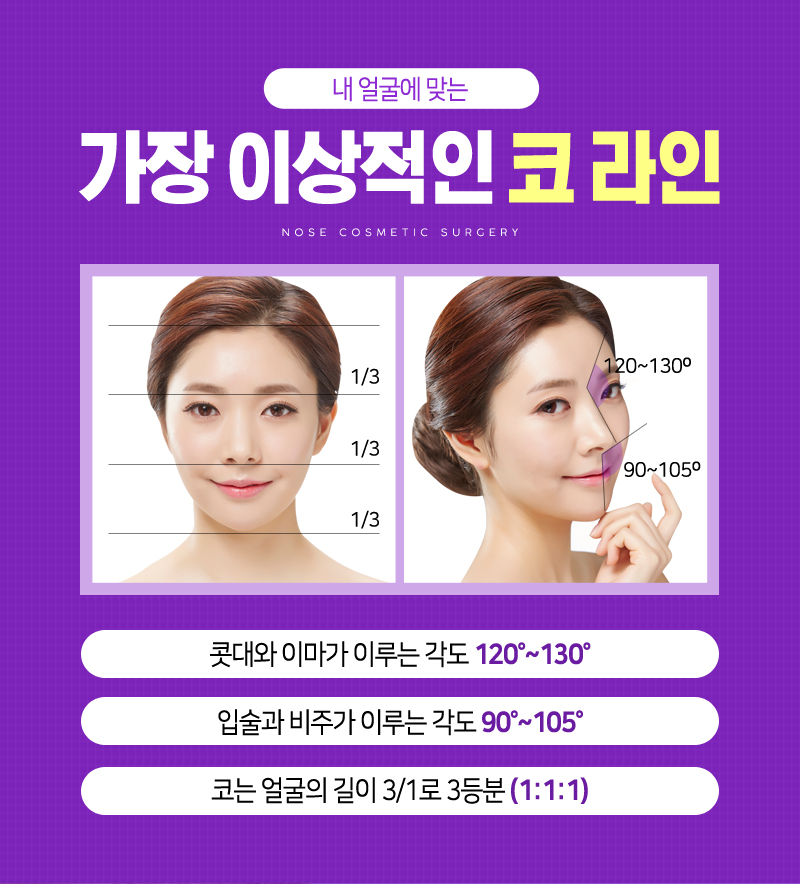
However, there are people who cannot bring themselves to decide easily and only worry because they do not have detailed information about a solution that can improve the nose into an ideal nose line divided into thirds, with the angle between the bridge of the nose and the forehead being 120 to 130 degrees, the angle between the lips and the columella being 90 to 105 degrees, and the nose being one-third of the length of the face.

So today, we would like to introduce autologous tissue rhinoplasty, which takes 2 to 5 hours under sedation anesthesia during surgery, improves the nose shape to suit facial proportions,
does not require hospitalization, and removes stitches after 5 to 7 days to help achieve satisfying results for a long time.
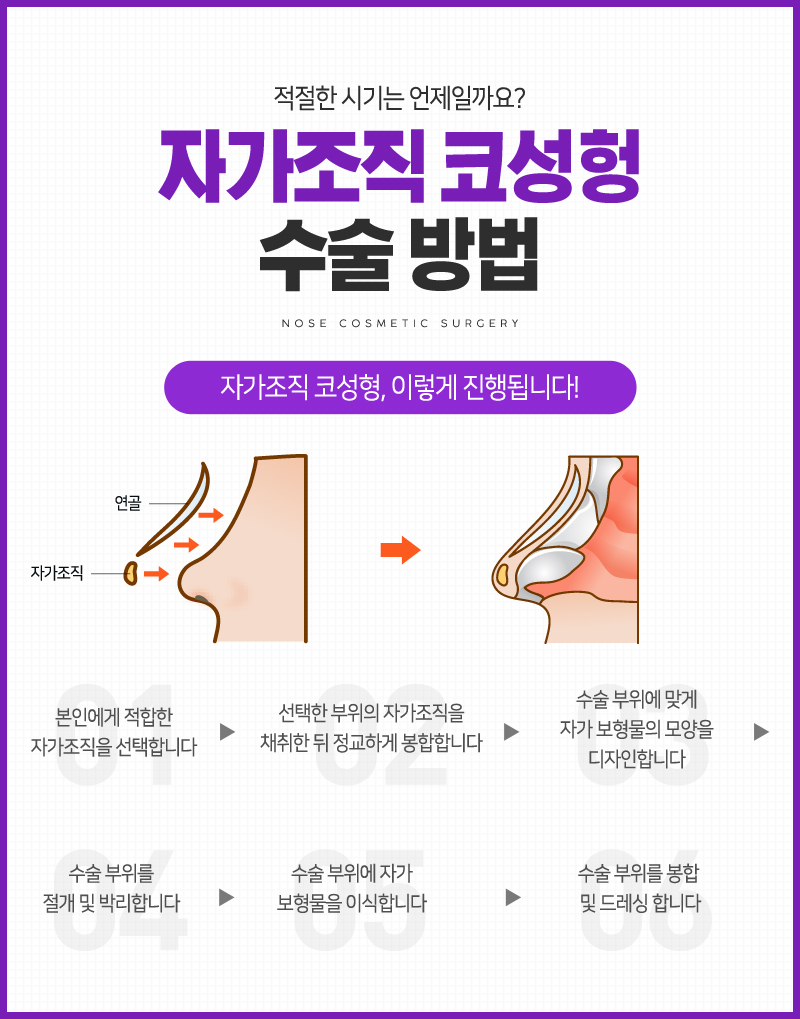
First, the autologous tissue rhinoplasty introduced today
selects the autologous tissue that is suitable for the patient and harvests autologous tissue from the selected area,
then performs precise suturing. After that, the shape of the autologous implant is
designed according to the surgical area, the surgical area is incised and dissected, and the autologous implant is inserted into the surgical site.
Finally, the surgical area is sutured and dressed, helping maintain a beautiful nose
shape for a long time without rejection.
This solution is especially used in a surgical method that many people seek among rhinoplasty procedures.
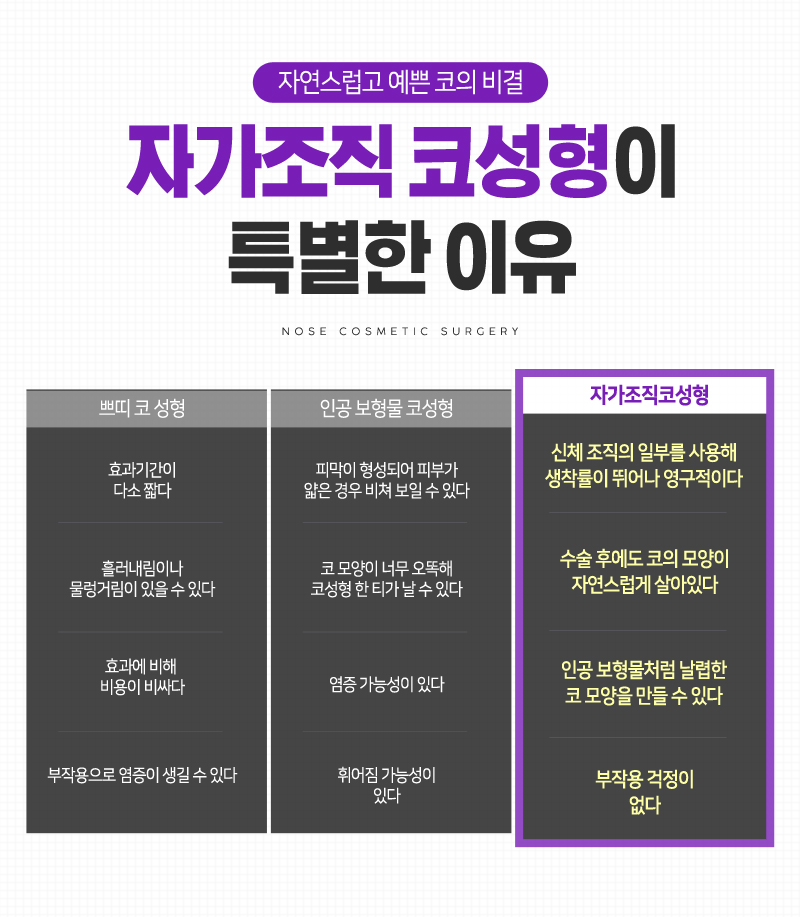
Compared to artificial implants, it uses part of the body’s own tissue, so the engraftment rate is excellent and it is permanent.
In addition, the nose shape remains naturally preserved after surgery, allowing for results that do not look artificial,
which is why the satisfaction level of rhinoplasty reviews is also high.

In addition, autologous tissue rhinoplasty completes a sophisticated nose line using only autologous tissue,
creates a natural shape with a soft feel and no foreign-body sensation,
and has the advantage of no risk of side effects such as inflammation or pain and no change in shape even from external impact.
Autologous tissue rhinoplasty, which attracts interest regardless of age or gender,
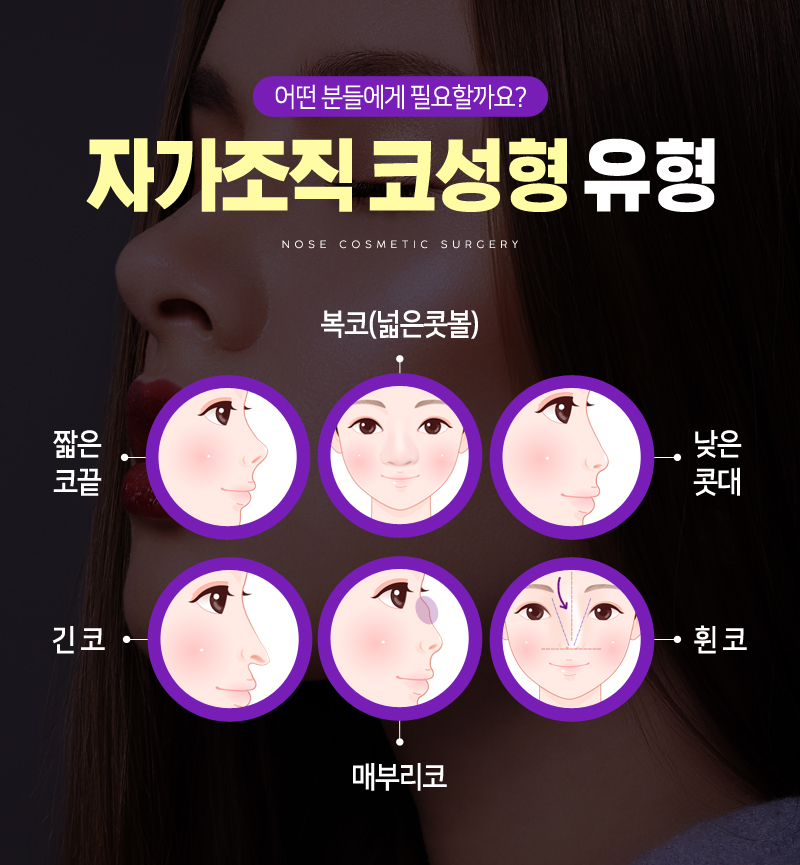
is recommended for people who feel stressed due to an unfavorable image, such as a round and blunt nasal tip, a wide nostril base and a flat, spread-out tip,
a thick nasal skin and fat layer, a nasal tip that is relatively wider than the width of the nose, wanting a more refined image,
a short nasal tip, or a hump nose.
If you proceed through a well-known rhinoplasty clinic,
you can reduce risks and obtain satisfying results.
This concern is experienced not only by women who are highly interested in cosmetic surgery,
but also by men. So if you want to change your nose shape to harmonize with your own facial features,
you may consider autologous tissue rhinoplasty.
For rhinoplasty using such autologous tissue, it is especially a good idea to check several points so that surgery is not performed by medical staff who lack experience and know-how,
which could lead to the unfortunate need for revision rhinoplasty.
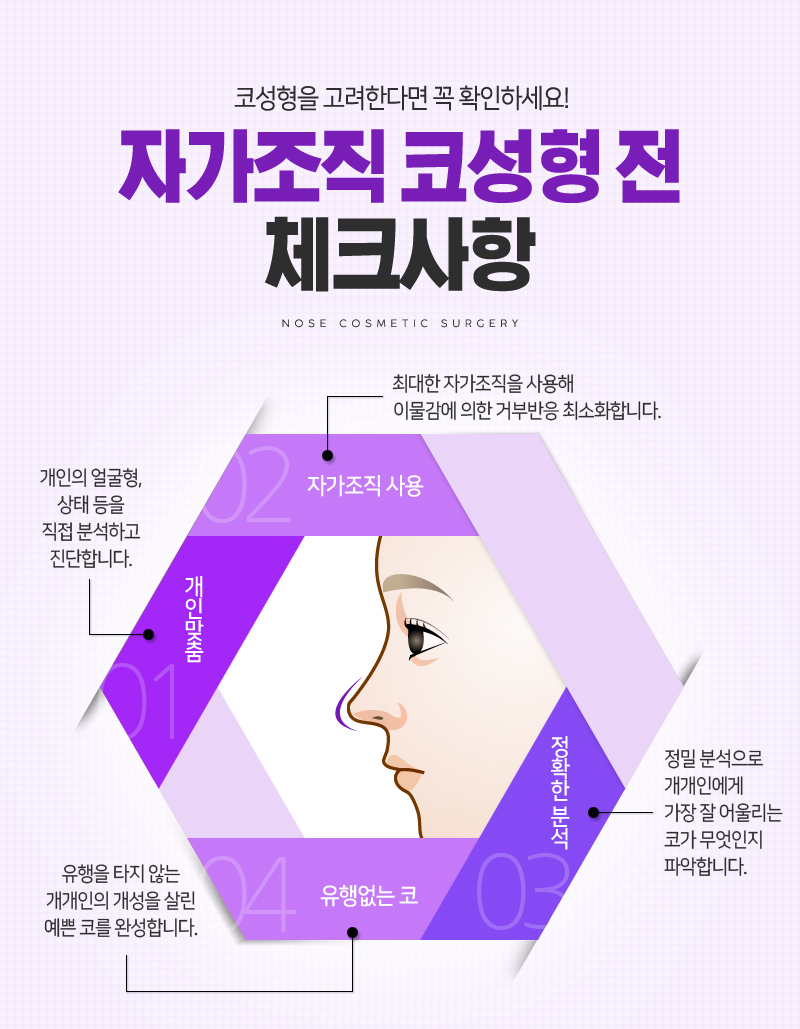
< Pre-rhinoplasty checklist >
| 01. Do they directly analyze and diagnose the individual’s face shape and condition? |
|---|
| 02. Do they use autologous tissue as much as possible so that rejection due to a foreign-body sensation occurs rarely, if at all? |
| 03. Do they complete a pretty nose that highlights each person’s individuality without following trends? |
| 04. Do they identify which nose best suits each individual through precise analysis? |
You should check the above points before proceeding with autologous tissue rhinoplasty.
In addition, among the various autologous tissue materials, you should identify the material needed for your nose
and visit a hospital known for good rhinoplasty results to undergo autologous tissue rhinoplasty.
The autologous tissue materials commonly used at well-known rhinoplasty clinics are:
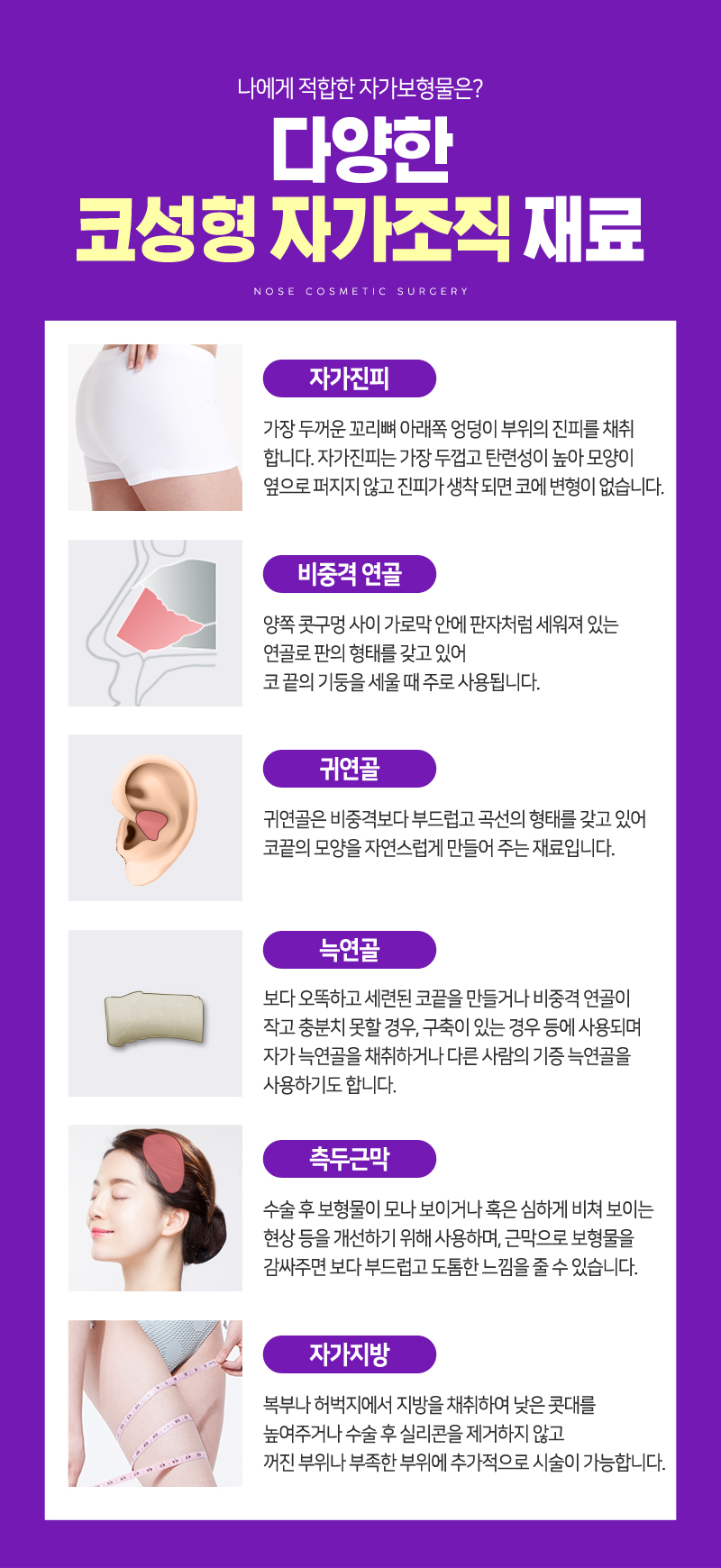
First, autologous dermis:
The dermis is harvested from the lower buttock area below the tailbone, which is the thickest area.
Autologous dermis is the thickest and highly elastic, so the shape does not spread sideways,
and once the dermis has engrafted, there is no deformation of the nose.
Second, septal cartilage:
This is cartilage located like a plank in the septum between the two nostrils.
Because it has a plate-like shape, it is mainly used as an autologous material when building the support structure of the nasal tip.
Third, ear cartilage:
This is softer than septal cartilage and has a curved shape,
making it a material that naturally shapes the nasal tip.
Fourth, rib cartilage:
It is used to create a more upright and refined nasal tip, or when the septal cartilage is small and insufficient,
or in cases of contracture. Autologous rib cartilage may be harvested,
or cadaveric rib cartilage may be used.
Fifth, temporalis fascia:
It is used to improve situations where the implant looks angular or is severely visible after surgery.
Wrapping the implant with fascia can create a softer and fuller appearance.
Sixth, autologous fat:
Fat is harvested from the abdomen or thighs to raise a low nasal bridge,
or after surgery, it can be additionally injected into sunken or insufficient areas without removing silicone.

For satisfying autologous tissue rhinoplasty results,
you should proceed at a plastic surgery clinic that has an integrated management system,
even among well-known rhinoplasty hospitals.
- Individual 1:1 management system
To achieve satisfying surgical results, they emphasize postoperative care and recovery,
providing consistent care and delivering results without regret.
- Sterilization and disinfection management system
All surgical instruments and equipment used in every surgery are thoroughly managed through a sterilization and disinfection system.
In addition, to ensure that this management is carried out thoroughly,
there is a dedicated manager for each area to follow the rules,
and a system is in place to maintain a hygienic surgical environment and fundamentally prevent infection.
- Reassuring anesthesia management system
The patient’s past medical history and surgical records
are reviewed in advance to minimize anxiety and pain,
and a structured safety anesthesia system is implemented for safer surgery.
- Surgical process monitoring system
The surgical process is broadcast live in real time,
and can be checked in real time from anywhere inside the hospital.
The reassurance monitoring system is carried out only for guardians who have previously consented,
so the surgery can proceed without added burden.
- Aftercare recovery management system
Because a private recovery room is operated for postoperative recovery,
it helps ensure rapid recovery and does not interfere with daily life,
while providing differentiated recovery care programs such as swelling management, bruise management, and pain management.
- Postoperative swelling management system
Since managing postoperative swelling of bone and skin tissue, recovery, circulation, and elasticity can improve surgical results,
it is better to receive systematic and professional aftercare after surgery.
To quickly reduce swelling after surgery,
we provide a customized swelling management system tailored to each individual.

If you want to live with a beautiful nose line for a long time,
it is a good idea to check the key points below and find a plastic surgery clinic for rhinoplasty before proceeding.
| 1. A place that performs only three cosmetic surgeries a day |
|---|
| 2. A place where personalized 1:1 rhinoplasty is possible through precise preoperative analysis |
| 3. A place where rapid recovery is possible with a systematic care system from before surgery to after surgery |
| 4. A place where a board-certified plastic surgeon personally handles consultation, surgery, and aftercare without a pay doctor or proxy surgery |
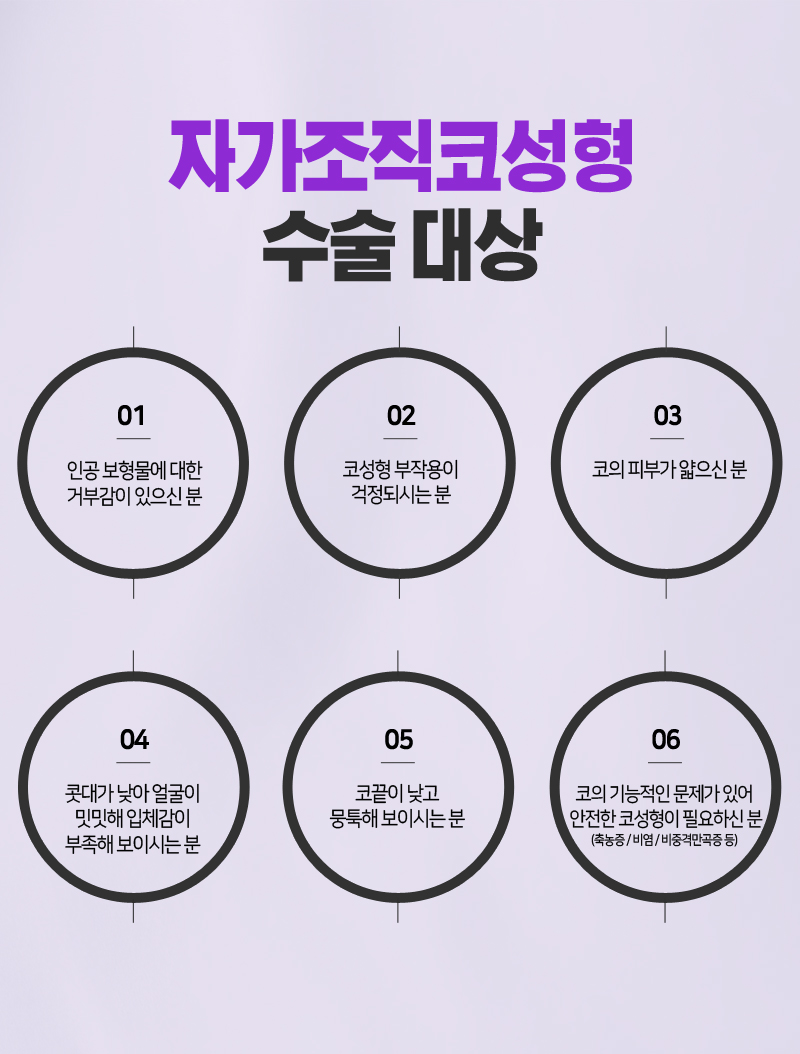
If you are reluctant about artificial implants, worried about rhinoplasty side effects, have thin nasal skin,
a low nasal bridge that makes your face look flat and lacking in dimension, a low and blunt nasal tip,
or functional problems with your nose and need safe rhinoplasty,
please refer to the key points above and meet a result you will not regret.

Lastly, I hope you visit a well-known rhinoplasty clinic where a board-certified plastic surgeon with extensive surgical experience and an excellent sense of aesthetics
personally performs the surgery so that you can achieve the result you want.