Acne Laser Treatment
Hello, this is Raon Dermatology Clinic.
As summer approaches, many people are seeking acne treatment. There are various treatment methods, from prescription medication to extraction and laser treatment. Among them, today we will take a detailed look at laser treatment, which is known as the most definitive treatment method. Today’s post was created based on Chief Director Baek Jong-heon’s skin column.

Acne Laser Treatment
Today's Topic
A method of treating acne using photothermal effects is commonly referred to as acne laser treatment. Photothermal effect means the phenomenon in which heat is generated within skin tissue by laser energy! Most acne lasers use this principle. It is also described as sebaceous gland destruction! Then how is the photothermal effect used to treat acne? Today, I will explain the related information in detail so it is easy to understand.
<Today's Topic>
-
Acne treatment using the photothermal effect
-
Irradiating laser to stimulate sebaceous glands
-
The most representative acne treatment method

Today's Topic
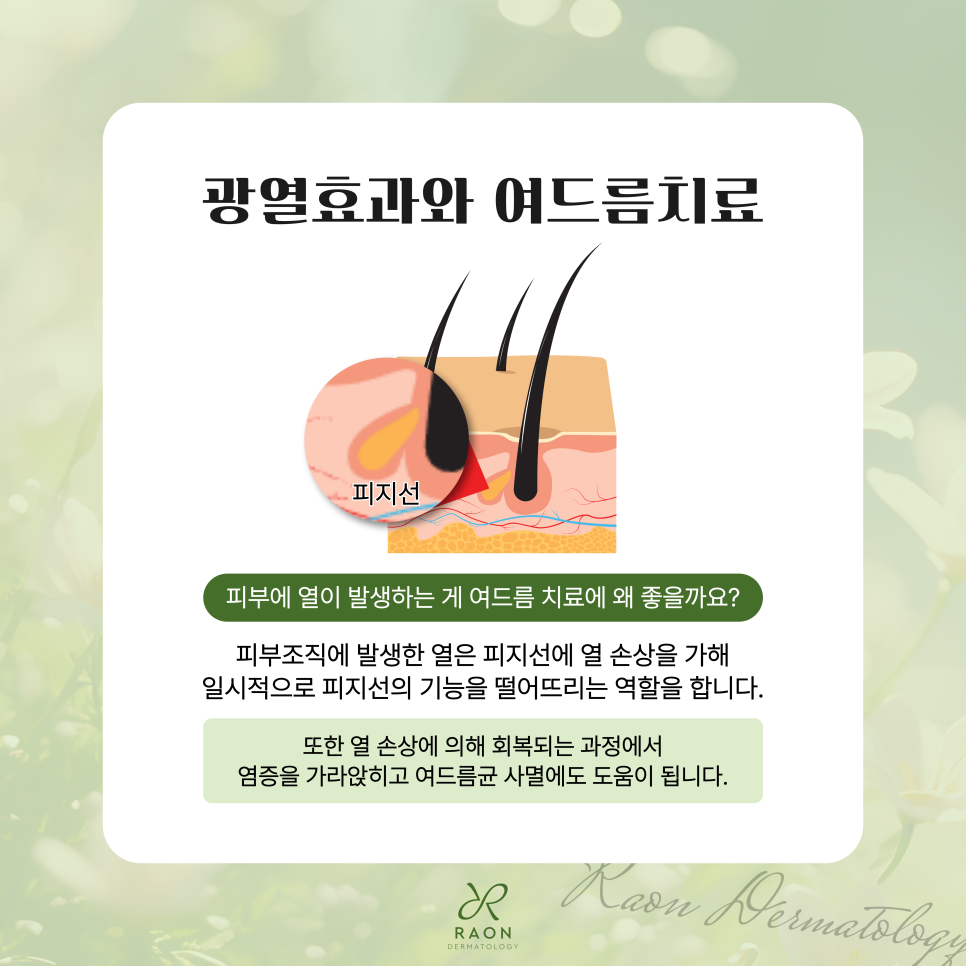
Photothermal effect?
As everyone knows, the most direct cause of acne is "excessive sebum secretion." Sebum is secreted by an organ called the sebaceous gland. If the sebaceous gland itself is destroyed, sebum is no longer secreted, and acne is naturally relieved.
The light energy of a laser is mainly used to stimulate the sebaceous glands and reduce their function. In other words, heat damage is applied to the sebaceous glands through light energy to normalize sebum secretion. In addition, the heat damage removes acne-causing bacteria inside pores, and the recovery process may also help reduce inflammation. Hearing this explanation so far, it may sound like a "perfect treatment method"! But is that really the case in practice?
Photothermal effect?
1,450nm diode laser
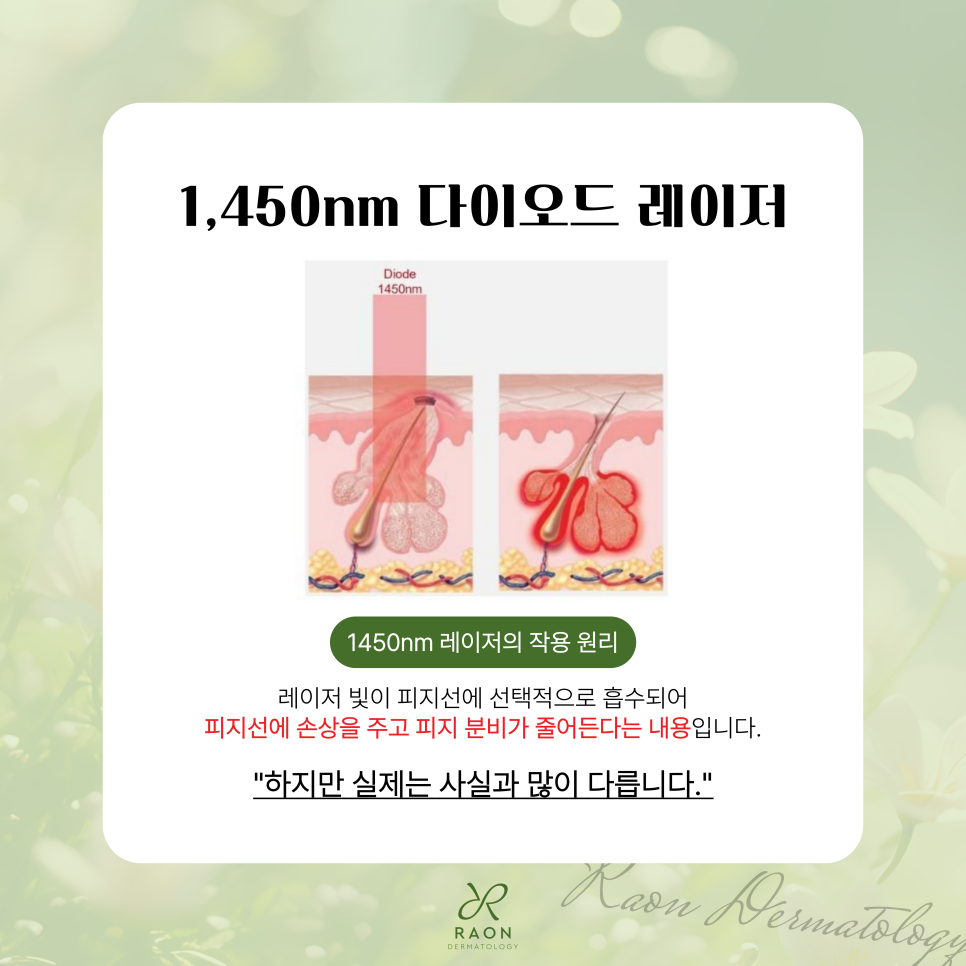
The most widely used device is the 1,450nm diode laser. The illustration below explains the treatment principle of the 1,450nm diode laser. It shows that laser energy is selectively absorbed by the sebaceous glands, and in the process, heat damage occurs to the sebaceous glands, reducing sebum secretion.
Of course, it would be ideal if heat could be delivered precisely only to the sebaceous glands. However, selectively delivering thermal energy only to a specific tissue is not actually easy.
1,450nm diode laser
Problem 01
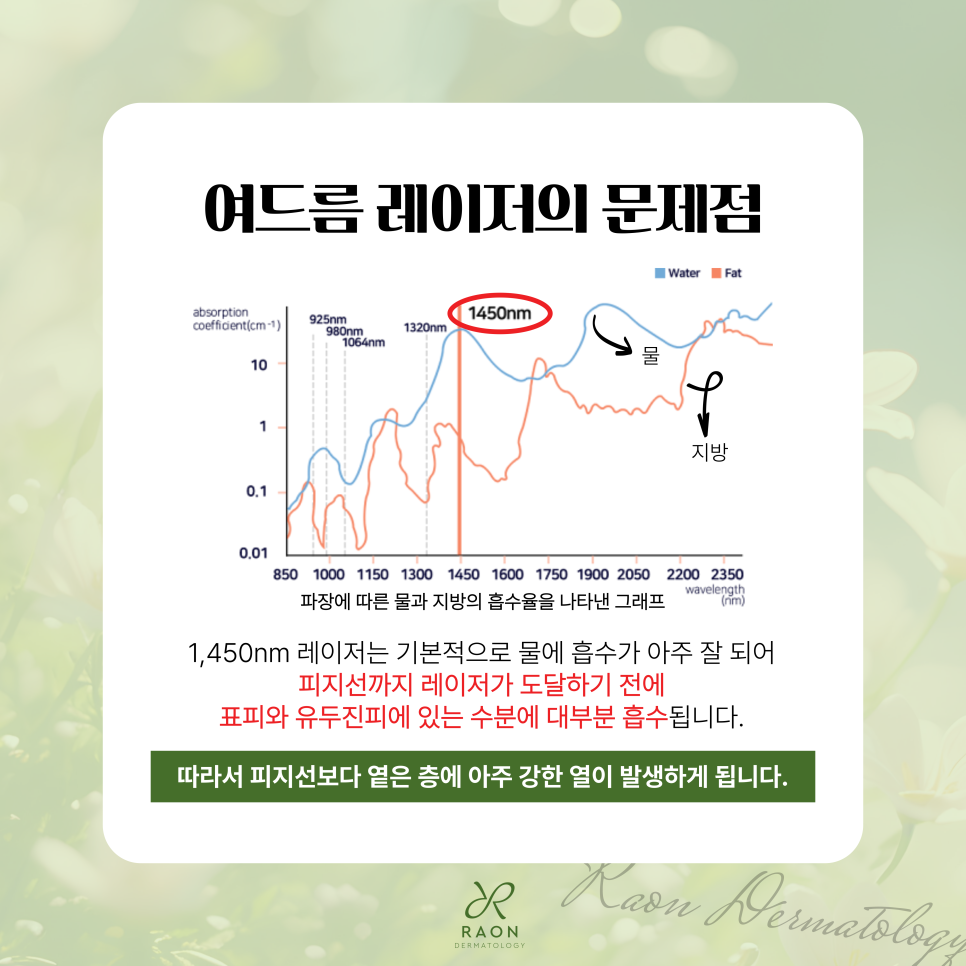
If you look at the materials below, you can see the absorption rate for water and fat depending on wavelength. What about the 1,450nm wavelength? It is more readily absorbed by water than by fat. Due to this characteristic, most of the laser energy is absorbed by the moisture in the epidermis and papillary dermis before it even reaches the sebaceous glands.
To summarize, very strong heat is generated in the shallower skin layers above the sebaceous glands, while relatively little heat is generated in the sebaceous glands. As a result, unlike in theory, the actual treatment effect can be quite limited.
"Can’t you just increase the laser intensity?"
You may ask this in response. Wouldn’t increasing the laser intensity solve the problem? Absolutely not. If the laser intensity is increased, stronger heat will form in the epidermis, right? Therefore, if the intensity is raised indiscriminately, serious side effects such as burns may occur instead.
<Problem 01>
-
1,450 wavelength with a high absorption rate for water
-
Mostly absorbed by moisture in the epidermis and papillary dermis
-
Energy cannot be fully delivered to the sebaceous glands
Problem 01
Problem 02
Then what if a laser equipped with a DCD cooling device is used? Even if the laser intensity is increased, the skin surface is cooled, so wouldn’t the energy be fully delivered to the sebaceous glands? That is difficult as well. When a DCD cooling device is used, sufficient heat is generated to a depth of about 0.4 to 0.5 mm. But beyond that depth, heat is not properly generated.
However, sebaceous glands are generally located at a depth of 0.2 to 1.0 mm. In addition, if acne is severe, there is a high possibility that the sebaceous glands have been pushed deeper into the skin by sebum or inflammation. Therefore, it is more accurate to consider the actual depth of the sebaceous glands to be 0.2 to 1 mm or more. In the end, even with a DCD cooling device, it is impossible to generate enough heat in the sebaceous glands.
And fundamentally, the maximum penetration depth of the 1,450nm wavelength is only 0.5 mm. Taking everything summarized above into account, no matter how hard we try, it is difficult for a 1,450nm laser to precisely target the sebaceous glands. So how on earth should this problem be solved? We will take a detailed look at the solution in the next post :)
<Problem 02>
-
1,450nm penetration depth within 0.5 mm
-
Sebaceous gland location: 0.2 to 1 mm or deeper
-
Laser penetration depth < sebaceous gland location

Problem 02
Limitations of acne treatment

Located right by the Wangsimni five-way intersection
- Wangsimni Station Exit 9 in Haengdang-dong, Seongdong-gu -
👉 Direct access to 4 subway lines
Line 2 (Sindang, Sangwangsimni, Seongsu)
Line 5 (Shingeumho, Haengdang, Majang, Dapsimni)
Gyeongui–Jungang Line (Oksu, Eungbong, Cheongnyangni)
Suin–Bundang Line (Seoul Forest )