Proper Sunscreen Use
Hello, this is Raon Dermatology at Wangsimni Station :)
As summer approaches, more and more people are heading out to buy sunscreen. In fact, even in seasons other than summer, sunscreen is essential before outdoor activities! If you haven’t been applying it regularly, please make sure to start this summer. Today, we’ll take a closer look at which sunscreen to choose and how to apply it properly :)
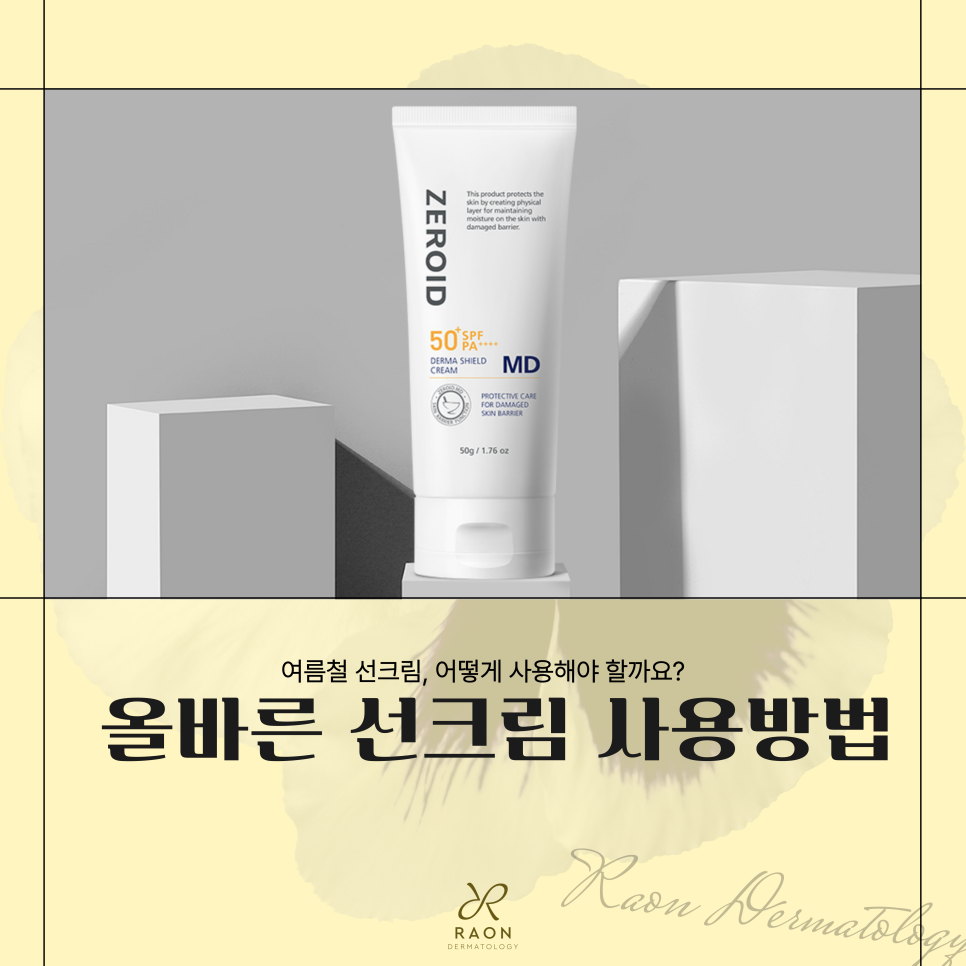
Proper Sunscreen Use
What types of sunscreen are there?
UV-blocking ingredients are broadly divided into physical blockers and chemical blockers. First, inorganic sunscreen, which falls under physical UV blockers, works by reflecting or scattering UV rays on the skin’s surface! It starts protecting the skin as soon as it is applied, and because it tends to cause less irritation, it is suitable for sensitive skin. It can be prone to leaving a white cast, but many people prefer this type because it provides excellent skin protection.
In contrast, organic sunscreen works by absorbing UV rays and converting them into heat to prevent them from penetrating the skin. Since it needs time to be absorbed, its protection begins after some time has passed since application, and it leaves almost no white cast, making it a good match for makeup. However, some ingredients may cause skin irritation, so caution is needed for sensitive or troubled skin.
"Isn’t there a way to combine the advantages of both types?"
As you keep reading the explanation, you may have thought this. Recently, "hybrid sunscreen" that combines the advantages of both types has also been gaining popularity! Because it offers both staying power and smooth application, choosing a hybrid product can be a good option if you are unsure which product to pick.
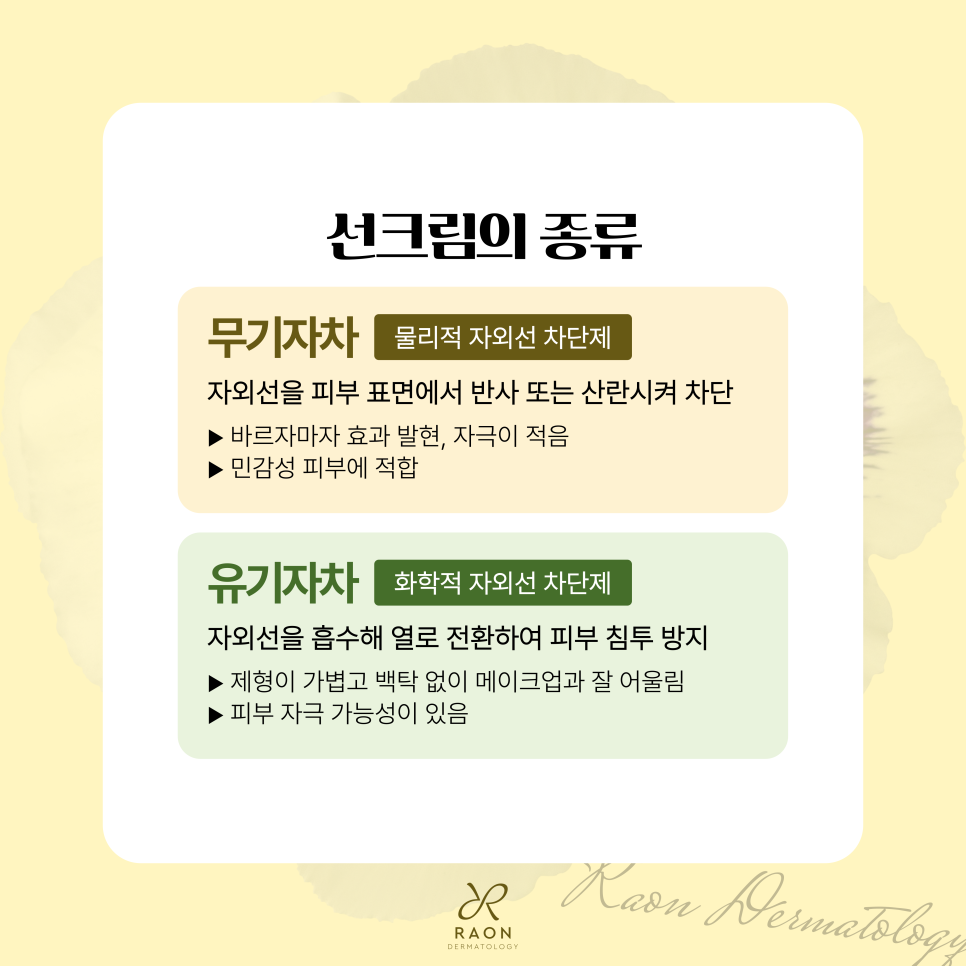
What types of sunscreen are there?
What is best for my skin?
So, which product should you choose specifically? Before choosing, you must consider your skin type. Oily skin, which produces a lot of sebum, is suited to a light and refreshing gel formula, and it is best to choose an inorganic sunscreen-based product with less oil and less irritation. It is also important to carefully check whether it contains ingredients that may trigger breakouts!
For dry skin, a cream-type sunscreen with moisturizing properties is effective. Hybrid sunscreen products that combine organic and inorganic filters are recommended because they can provide both sun protection and skin suppleness. Lastly, for sensitive skin, fragrance-free, colorant-free, low-irritation products based mainly on inorganic filters are the most suitable. If the product also contains ingredients that help protect the skin barrier, it can be used more stably, right~?
<Sunscreen selection by skin type>
-
Oily → Inorganic sunscreen with less oiliness
-
Dry → Hybrid sunscreen, moisture retention is also important
-
Sensitive → Skin barrier protection function, low irritation
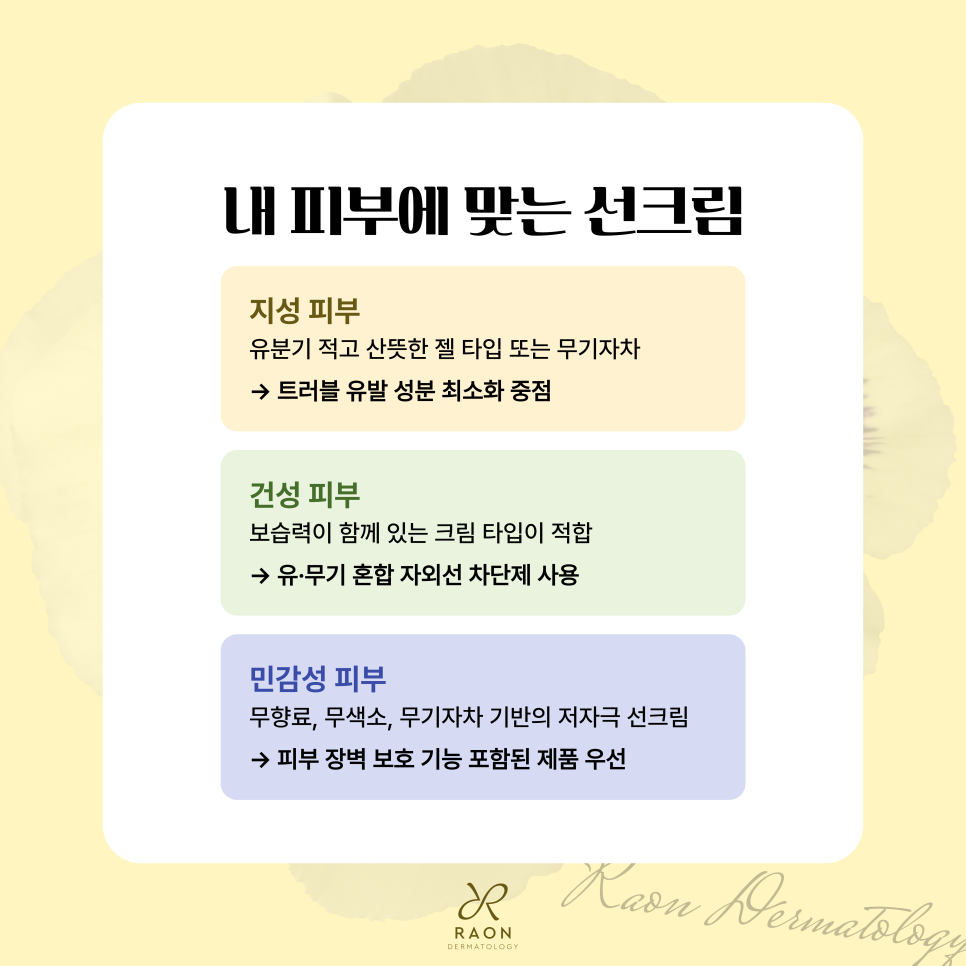
What is best for my skin?
Proper use
To use sunscreen effectively, the timing and method of application are also important. Applying it 20 to 30 minutes before going out allows it to absorb into the skin and provide sufficient protection. However, rather than applying a large amount at once, applying thin layers several times is more effective for improving adhesion and longevity.
Because UV protection gradually weakens over time, it is best to reapply every 2 to 3 hours! Even on cloudy days or indoors, UV rays can reach the skin through windows or lighting, so it is best to apply it every day whenever possible. SPF and PA ratings should be carefully chosen according to your environment and skin type, and products with SPF 30–50 / PA +++ or higher are generally recommended.
<How to use it properly>
-
Apply in advance, 20 to 30 minutes before going out
-
Apply small amounts in multiple layers
-
Reapply every 2 to 3 hours when outdoors
-
SPF 30–50 / PA +++ or higher is recommended
-
Use even on rainy days or when staying indoors
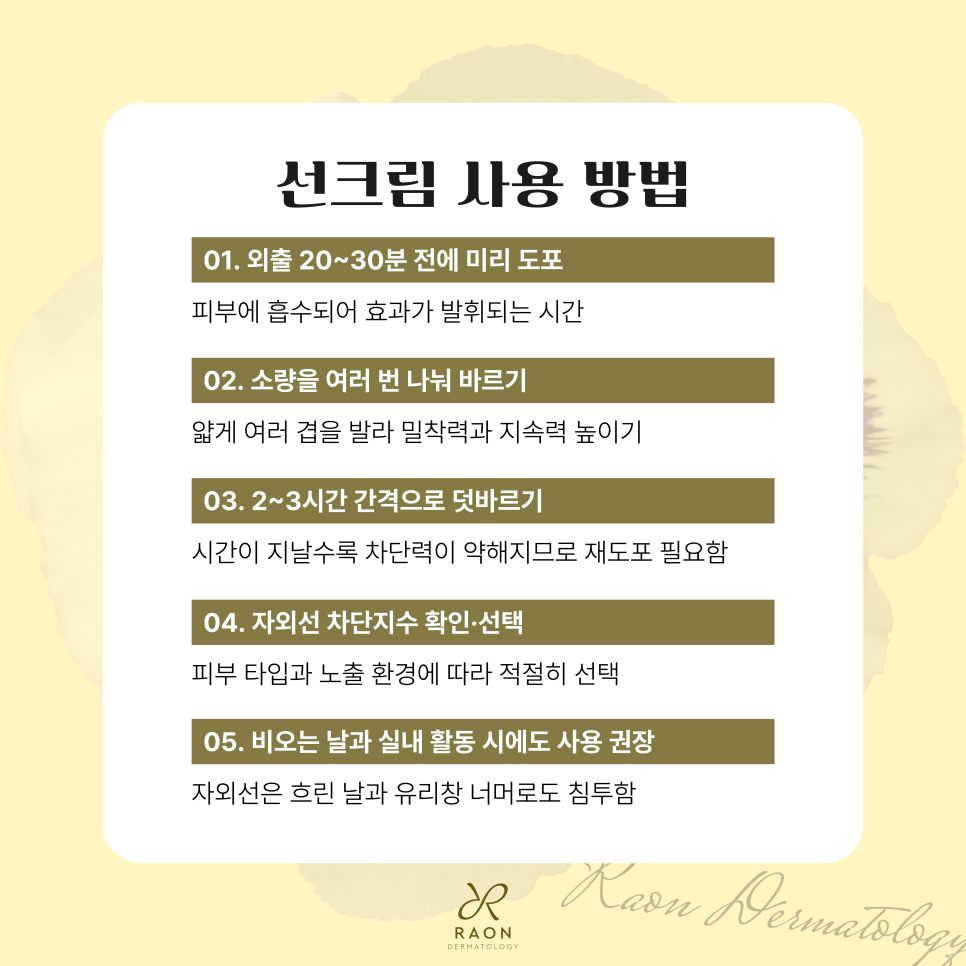
Proper use
Zeroid Dermashield Cream MD
*Covered by actual expense insurance
To help reduce your concerns, I’d like to introduce one sunscreen product. It is Zeroid Dermashield Cream MD, a product with high-level UV protection of SPF 50 / PA ++++. It is designed based on inorganic sunscreen filters, so it can be used with confidence not only by people with sensitive skin but also by those who frequently experience breakouts. In particular, it also has a skin barrier protection effect, so it can be said to be a product that considers skin health beyond simple sun protection!
Because it has a formula with little white cast or stickiness, it feels comfortable to use and blends well with makeup. Another advantage is that it is made with a low-irritation formula so it can be used even when the skin is sensitive, such as right after a procedure. If you are looking for a sunscreen that sensitive skin can apply with peace of mind all day long, Zeroid Dermashield Cream MD can be a good choice.
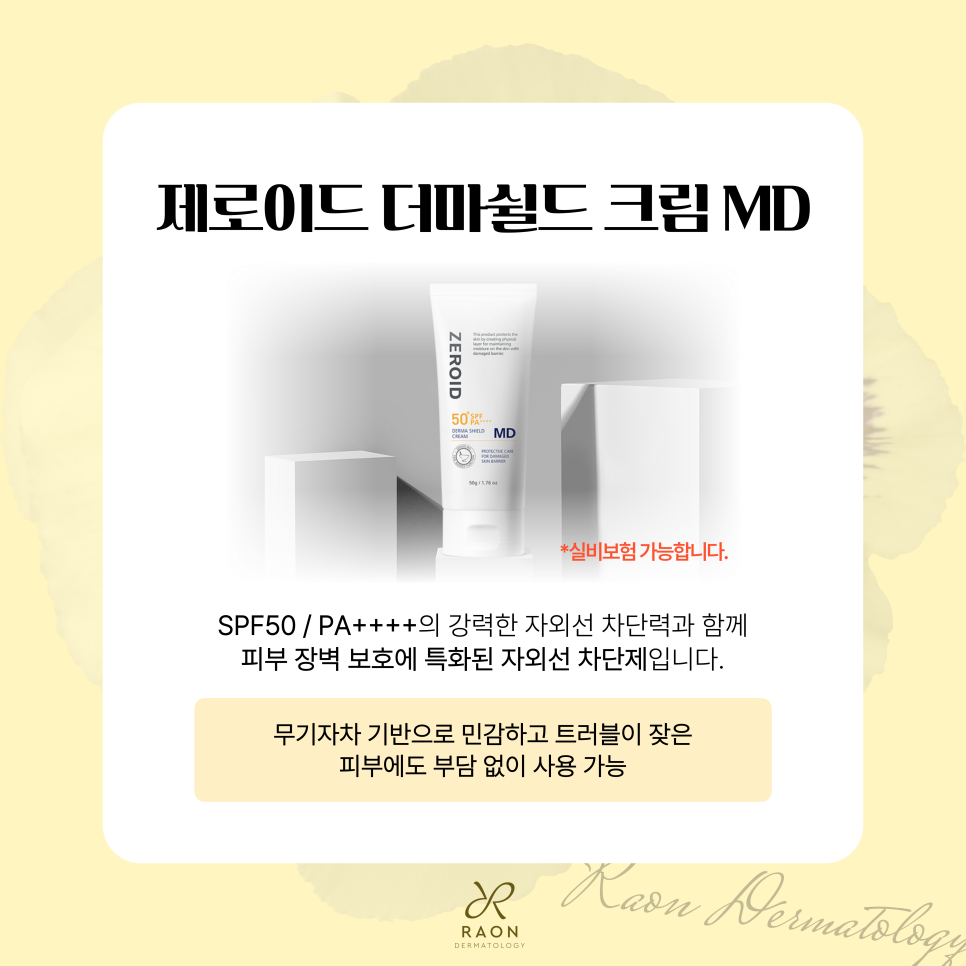
Zeroid Dermashield Cream MD
Features and Benefits
Below, I have summarized the advantages of Zeroid Dermashield Cream MD. As mentioned on the previous slide, it offers excellent staying power and spreadability, and it also has a skin barrier protection effect.
In particular, many women tend to choose sunscreens that are relatively less effective because of makeup! There’s no need to do that anymore, right~? Zeroid Dermashield Cream MD spreads lightly and leaves a fresh finish, so it is not burdensome to use before makeup. Please keep these points in mind and choose a sunscreen that suits your skin :)
<Features and Benefits>
-
Helps prevent skin barrier damage
-
Fresh finish, blends well with makeup
-
Safe product that has completed irritation testing
-
Blocks both UVA and UVB
-
Considers indoor UV exposure and the digital environment
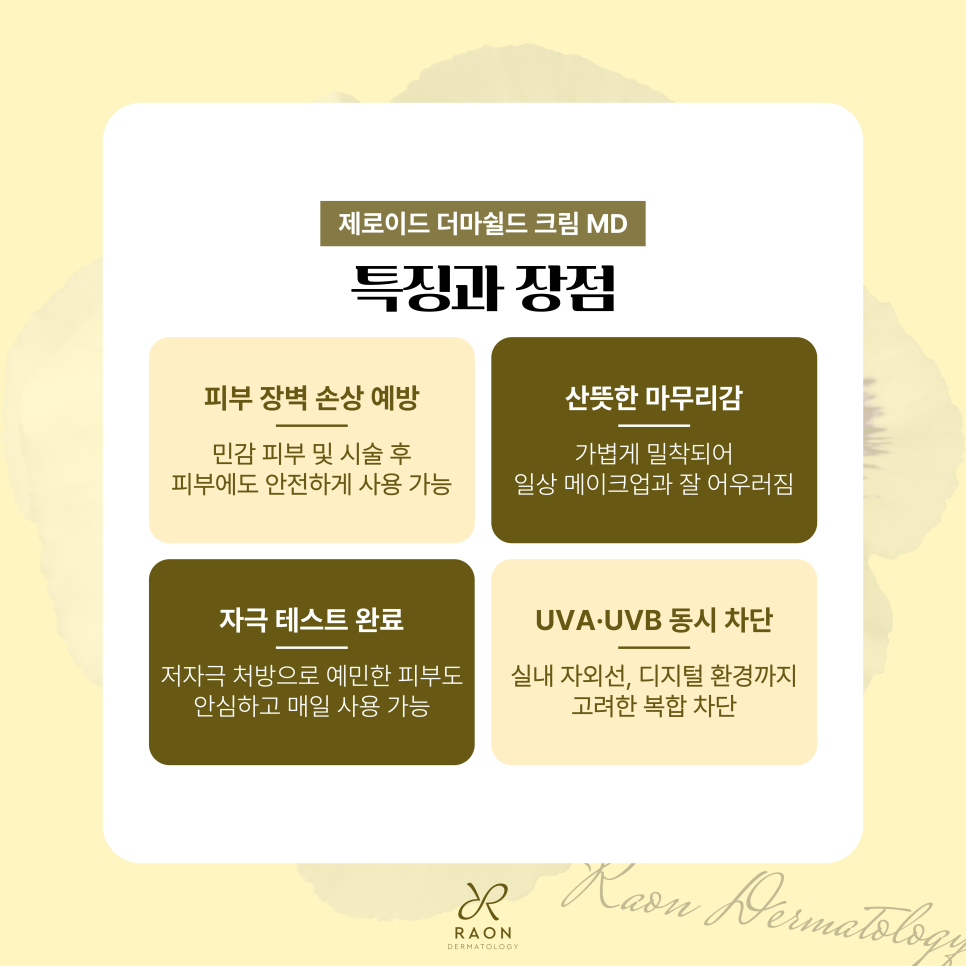
Features and Benefits
Dermatologist-recommended sunscreen

Located in a prime spot near Wangsimni Crossroads
- Wangsimni Station Exit 9 in Haengdang-dong, Seongdong-gu-
👉 Direct access to 4 subway lines
Line 2 (Sindang, Sangwangsimni, Seongsu)
Line 5 (Singeumho, Haengdang, Majang, Dapsimni)
Gyeongui–Jungang Line (Oksu, Eungbong, Cheongnyangni)
Suin–Bundang Line (Seoul Forest)