Reasons for Pigmentation Treatment Failure
Hello, this is Raon Dermatology near Haengdang Station!
Many people have had the experience of receiving laser treatment for blemishes, melasma, or freckles, only to feel disappointed when the improvement was not as noticeable as expected. Some people seem to improve right after the procedure, but the pigmentation returns over time, and in some cases it becomes even darker than before treatment! When the results are not as good as expected, it is highly likely that the issue is not simply the device’s performance, but a combination of factors including skin diagnosis, treatment method, and post-treatment care. That is why pigmentation treatment needs to be approached carefully from the very beginning of the planning stage in order to achieve good results :)

Reasons for Pigmentation Treatment Failure
Why Pigmentation Treatment Fails
The first reason pigmentation treatment fails is using only a single device. Pigmentation that appears on the skin comes in many different types, such as melasma, freckles, blemishes, and nevus of Ota, and their depth and distribution also vary, making them difficult to treat with just one device. For example, IPL is effective for superficial blemishes, but it has limitations for deeper melasma.
Another reason is treatment that does not take individual skin characteristics into account. Even with the same melasma, some people have thicker skin that can tolerate stronger stimulation well, while others have thin, sensitive skin and may see pigmentation worsen even with minor irritation. If a laser that is too strong is used, the melanin within the skin may be stimulated, causing the pigmentation to become darker. Lastly, it is easy to overlook the fact that inadequate sun protection or moisturizing care after the procedure can reduce the effectiveness of treatment.
<Reasons Why Pigmentation Treatment Fails>

Why Pigmentation Treatment Fails
Skin Diagnostic Device
For accurate treatment, the skin condition must first be examined in detail. If treatment is decided based only on the pigmentation visible on the surface, hidden pigmentation or other issues such as redness may be missed. That is why, in addition to a specialist’s visual examination, various diagnostic devices should be used to understand the condition beneath the skin as well.
A representative example is the 2D Mark-Vu, which can identify not only the surface but also pigmentation that is not visible to the eye through ultraviolet imaging. In fact, there are cases where pigmentation appears light on the surface but is heavily accumulated within the skin, and this must be identified accurately in order to determine the appropriate laser and intensity. Once information about the skin beneath the surface is obtained, the treatment plan becomes more specific, and unnecessary procedures or excessive irritation can be avoided. In that sense, the diagnostic stage can determine the success or failure of treatment :)
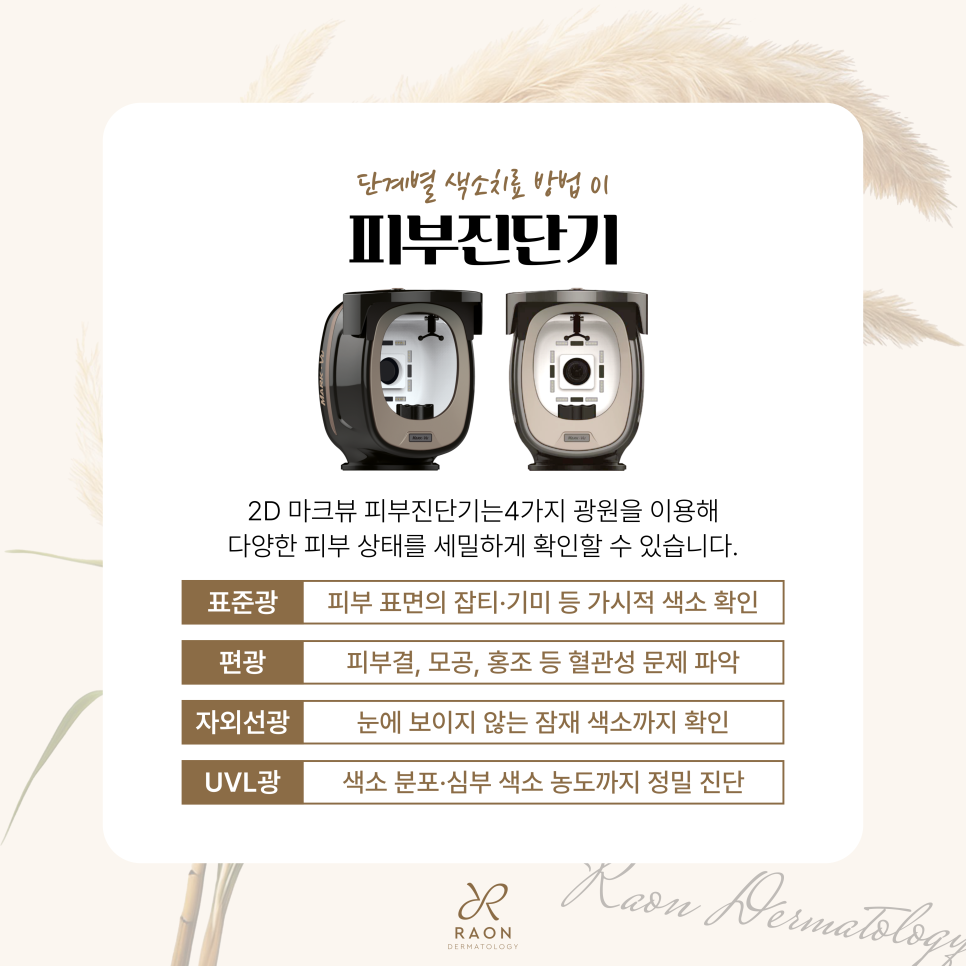
Skin Diagnostic Device
Pigmentation Treatment Devices
In the actual treatment stage, choosing devices suited to the characteristics of the pigmentation is key. The Lumenis M22 IPL uses a broad wavelength range to help alleviate surface pigmentation and vascular issues such as melasma, freckles, and redness at the same time. Meanwhile, the Helios 785 is a picosecond ultrashort-pulse laser that can precisely break down pigmentation even in the deeper dermal layer, and is used for refractory melasma and tattoo removal.
The N-Pulse CO2 laser is suitable for removing localized lesions such as moles or raised blemishes. Finally, the DDR laser is effective for reducing red marks and erythema, helping to create a more even overall skin tone! Because each device acts at different depths and wavelengths, finding the optimal combination for each patient is essential.
<Pigmentation Treatment Devices>
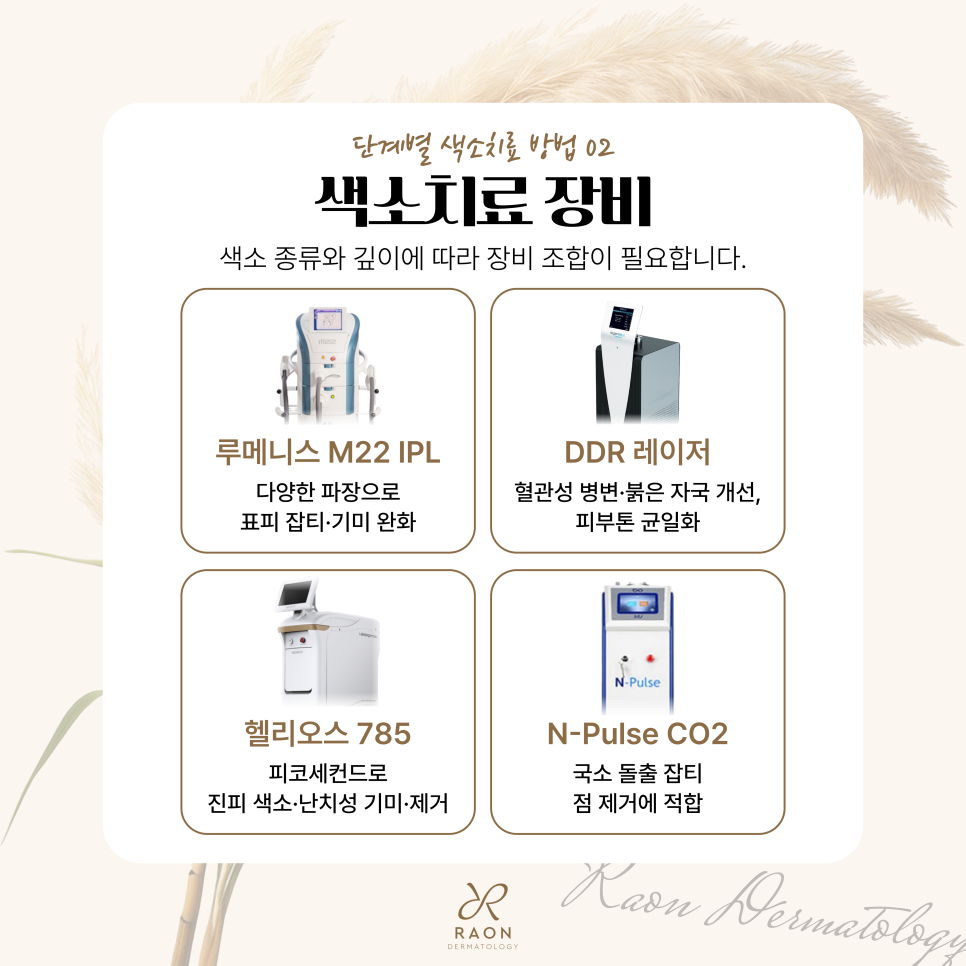
Pigmentation Treatment Devices
Why Combination Pigmentation Treatment Is Needed
In a similar context, pigmentation treatment absolutely requires combination therapy using at least 2 to 3 types of lasers! This is because it is common for one person to have multiple kinds of pigmentation. For example, when melasma, freckles, and blemishes are all present at the same time, IPL alone may not sufficiently improve melasma, and a pico laser alone may not effectively target freckles. Therefore, several devices need to be used appropriately in combination to achieve an overall even skin tone.
Combination treatment also has the advantage of distributing skin irritation. Instead of using one device too aggressively, using several devices more gently in stages can reduce the risk of side effects while maximizing treatment effect. In the end, rather than relying on a single device, a customized combination treatment that takes into account the skin’s characteristics and the types of pigmentation is needed to lower the chance of recurrence and achieve the desired results.
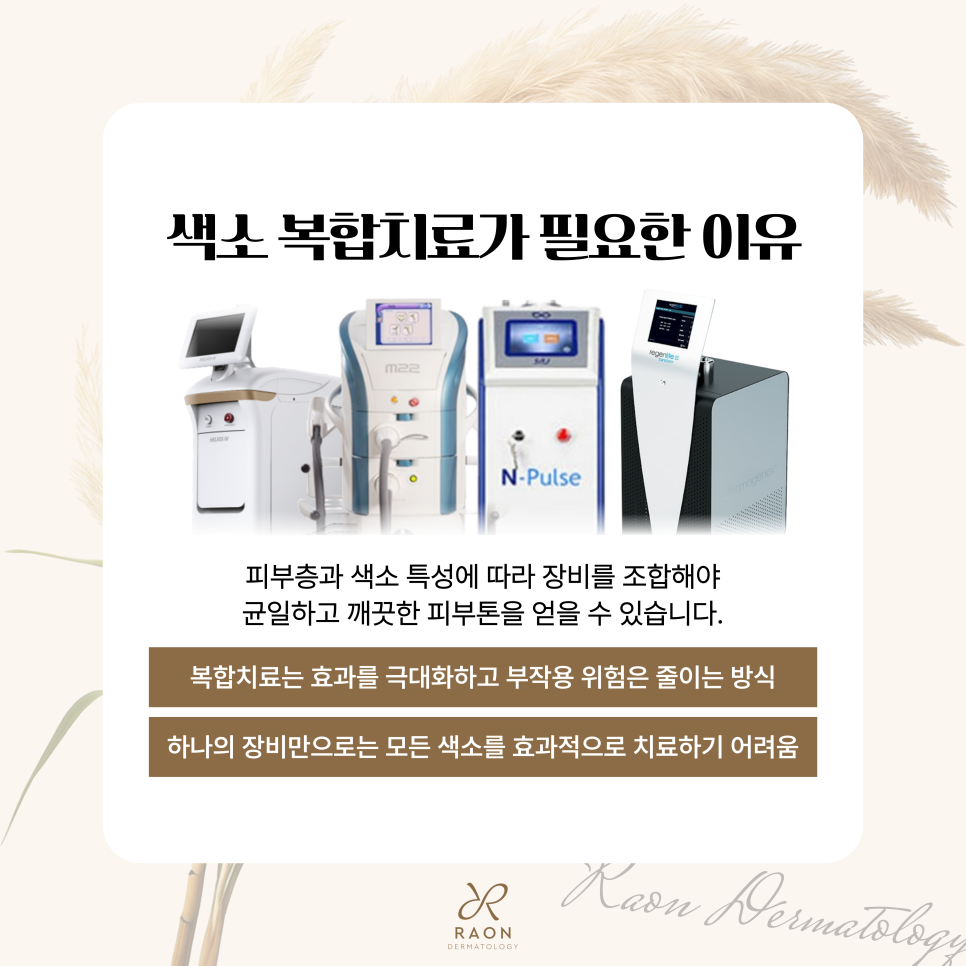
Why Combination Pigmentation Treatment Is Needed
How to Care for Your Skin After Pigmentation Treatment
Treatment does not end when the procedure is over. If you do not apply sunscreen consistently, pigmentation can easily return, and dry skin can increase inflammatory reactions and worsen pigmentation. Therefore, sufficient moisturizing and soothing care are essential.
Also, right after treatment, you should avoid irritating skincare products such as exfoliants and retinol, and if you combine this with a soothing care program that supports skin recovery, healing may be faster. Lifestyle management is also important: irregular sleep, drinking alcohol, and smoking promote melanin production, so caution is needed. Ultimately, treatment and post-treatment care must go hand in hand in order to prevent pigmentation from recurring and to maintain clear skin for a long time :)
<How to Care for Your Skin After Pigmentation Treatment>
-
Use sunscreen consistently / Moisturize properly
-
Avoid irritating skincare products / Combine with soothing care programs
-
Maintain a regular lifestyle

How to Care for Your Skin After Pigmentation Treatment
Pigmentation Treatment: From Identifying the Causes of Failure to Treatment and Prevention