The Truth About Lifting Pain
Hello, this is Raon Dermatology Clinic near Wangsimni Station.
�a0
You may be considering lifting for a firmer facial line, but the biggest reason many people hesitate to take the first step is probably a vague fear of pain. Stories about pain heard through social media or from people around you can make lifting seem like a process that comes with unbearable discomfort! But if you understand the clear reasons why pain occurs and the ways to systematically control it, wouldn’t it be much easier to address your skin concerns with a calmer mind?
The Truth About Lifting Pain
Why Lifting Pain Occurs
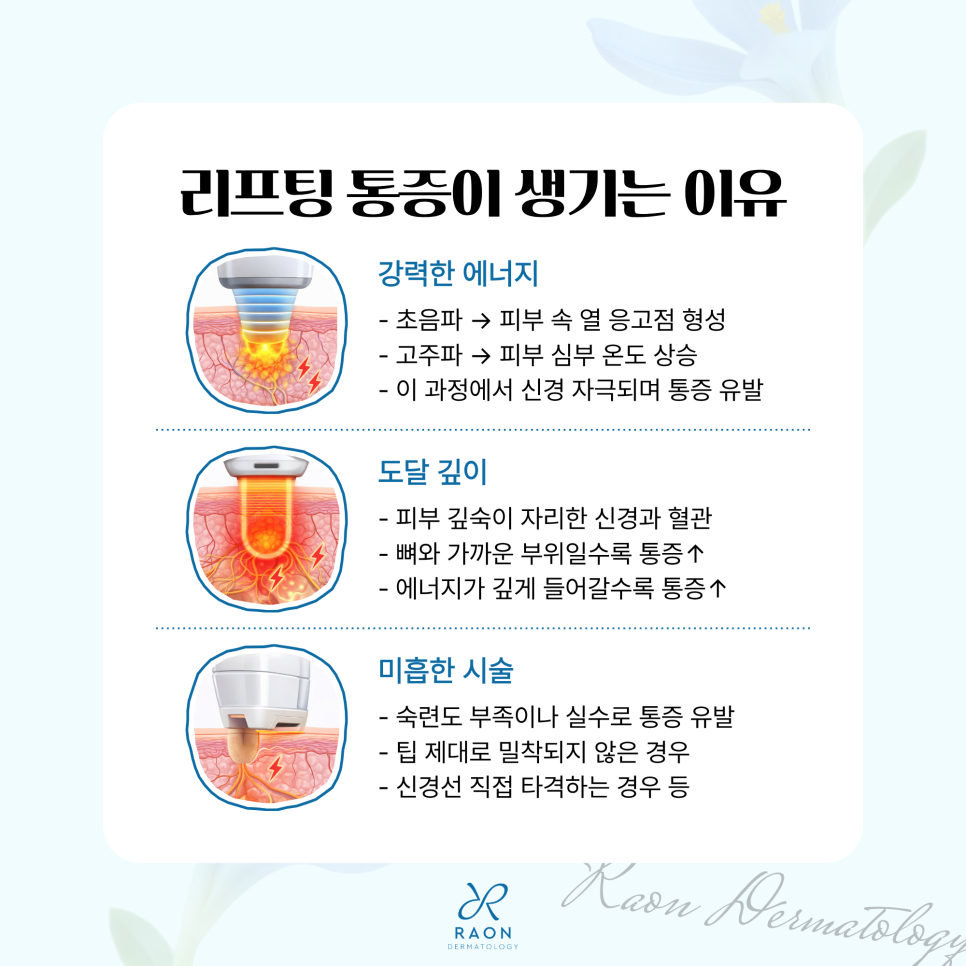
First, you need to understand why pain is felt during the lifting process. It is closely related to the mechanism by which energy is delivered! For example, high-intensity focused ultrasound creates thermal coagulation points at specific depths within the skin, while radiofrequency raises deep tissue temperature to induce collagen regeneration. The thermal energy generated in this process stimulates nerve tissue, inevitably causing pain. In particular, areas close to the jawbone or places where the skin is thin can feel the energy reaching a relatively deeper level, so nerve stimulation may be transmitted more strongly.
�a0
The skill level of the practitioner handling the device is also an important variable that determines the intensity of pain. If energy is delivered while the tip is not properly in contact with the skin surface, surface burns or sharp pain can occur! Also, if energy is applied directly without accurately identifying the path of the nerve lines, you may experience unexpectedly strong stimulation. Therefore, a uniform approach that does not take individual anatomical structure into account can be a major cause of unnecessary discomfort.
�a0
<Why lifting pain occurs>
Why Lifting Pain Occurs
How Can Lifting Pain Be Reduced?
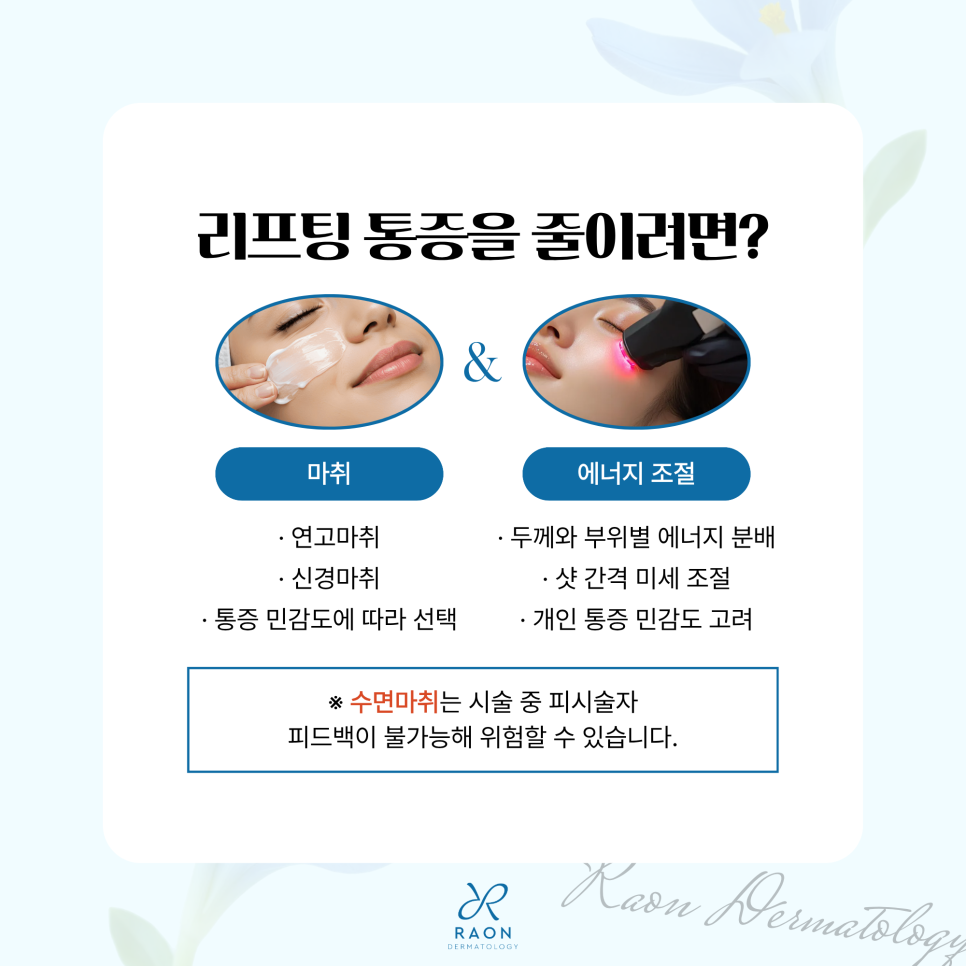
To control pain in a practical way, it is advisable not simply to endure it, but to use an appropriate anesthesia system. In addition to the commonly used topical anesthetic ointment, combining nerve anesthesia appropriately according to pain sensitivity can significantly reduce discomfort! However, with sedation anesthesia, you should note that it is difficult to check the patient’s immediate feedback during the procedure. Because it is difficult to detect abnormal reactions caused by excessive energy delivery in real time, it is recommended to proceed in a state where communication is possible whenever possible.
�a0
Beyond anesthesia, the pain burden can also be reduced by precisely adjusting the device’s own settings. By distributing energy according to the individual’s skin thickness and the distribution of the fat layer, and by fine-tuning the intervals between shots, it is possible to prevent heat from concentrating in one area. In addition, lifting methods equipped with powerful cooling systems are now widely used, allowing the skin surface to stay cool while energy is effectively delivered to deeper layers, which helps ease concerns about pain.
�a0
<How to reduce lifting pain>
-
Topical anesthesia / nerve anesthesia / choose according to pain sensitivity
-
Energy distribution by thickness and area / fine adjustment of shot intervals
-
Consider individual pain sensitivity
How Can Lifting Pain Be Reduced?
Solution 01. Anesthesia
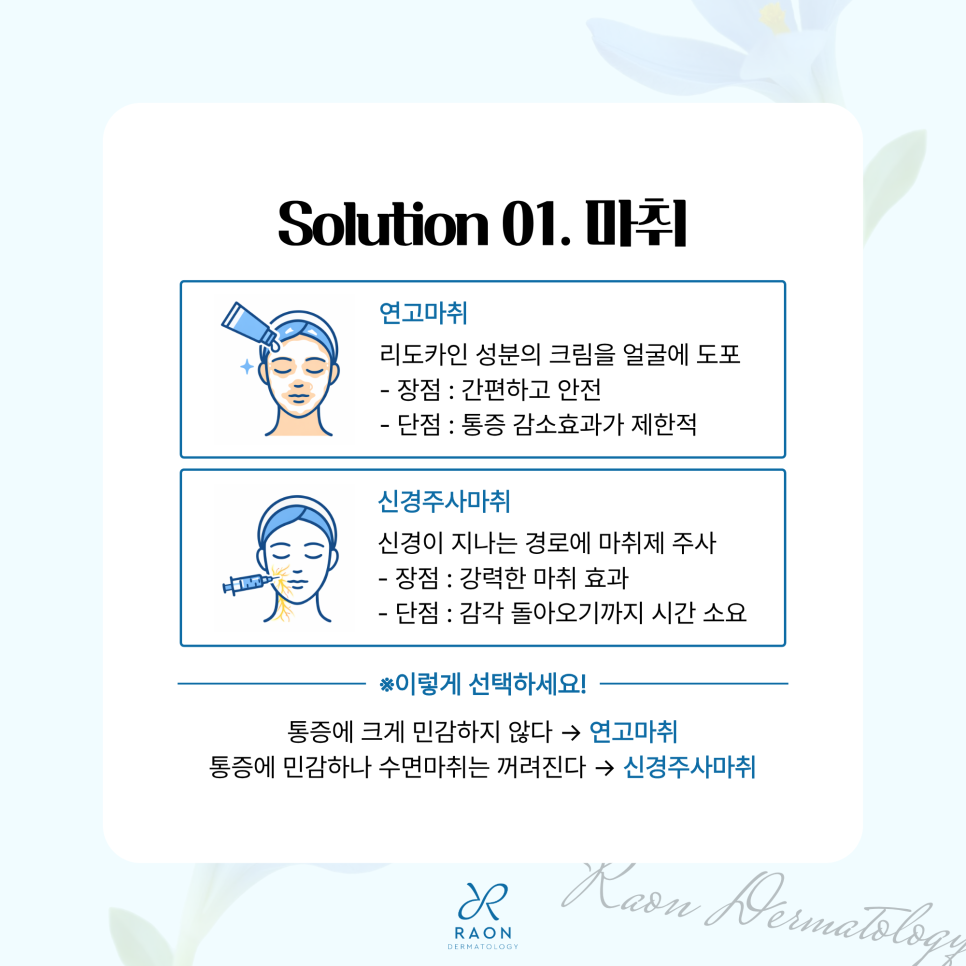
The most common method, topical anesthesia, involves applying a lidocaine cream over the entire face to temporarily dull the skin’s sensation. It is widely used because the process is simple and safe, but there is a limit to how deeply the anesthetic can penetrate, so pain may still be felt in treatments that use strong energy. If you are particularly sensitive to pain in everyday life, nerve block anesthesia, which injects anesthetic directly along the nerve pathway, can be a helpful alternative.
�a0
Nerve block anesthesia has a powerful effect by blocking nerve transmission in a specific area so that pain is barely felt. Although it takes some time for sensation to fully return, its advantage is that it dramatically reduces fear and discomfort during treatment! If you are not especially sensitive to pain, topical anesthesia alone may be sufficient, but if pain has made you avoid lifting itself, choosing nerve anesthesia can also be a wise decision for a more reassuring procedure.
Solution 01. Anesthesia
Solution 02. Energy Adjustment
You need to move away from the fixed idea that treatment is only effective when performed with strong energy. Precise parameter settings tailored to the skin condition are the key to balancing pain and results! For thin areas such as around the eyes and the forehead, energy should be lowered, while custom settings are needed to adjust the depth of energy delivery more deeply for areas with thicker fat layers, such as the cheeks and jawline. By carefully setting different energy levels for each area, unnecessary stimulation can be avoided and energy can be delivered accurately only to the target tissue.
�a0
The device’s cooling system and the practitioner’s delicate technique also play a major role in pain control. If the epidermal temperature is lowered using cooling gas or a cooling function, discomfort caused by heat can be reduced! If you adjust the shot interval to prevent overlapping energy and overheating, or use techniques that disperse heat, you can reduce pain while still fully enjoying the skin-firming effect. When energy is properly adjusted like this, only then can comfortable and satisfying results be expected :)
�a0
<Energy adjustment>
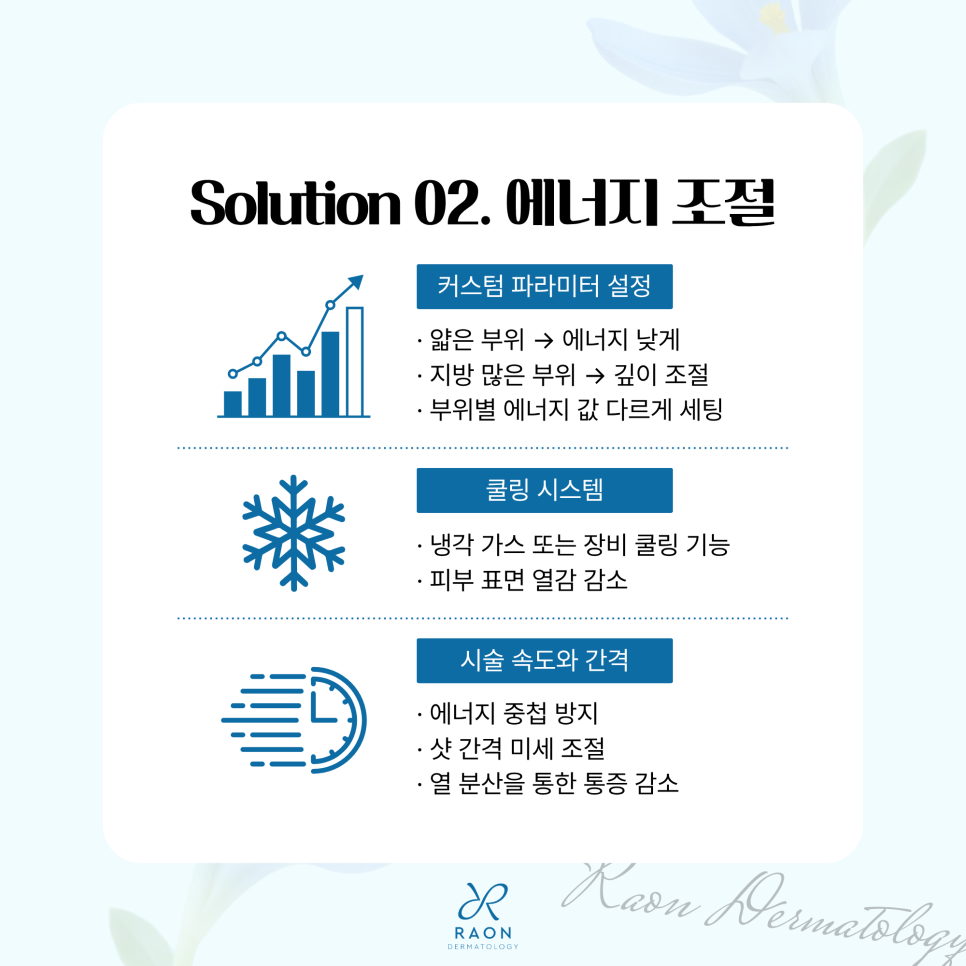
Solution 02. Energy Adjustment
Representative Lifting Treatments: Ultrasound and Radiofrequency
Lastly, let’s look at representative lifting devices that use ultrasound and radiofrequency. First, Ulthera works by delivering ultrasound energy to the deep fascia layer of the skin, lifting the skin in the opposite direction of gravity. Because it delivers energy while directly checking the internal skin structure through a real-time imaging system, it is a major feature that treatment can be performed safely while avoiding nerve lines! It plays an important role in refining sagging facial lines caused by aging and providing direct firmness.
�a0
Meanwhile, Density High uses radiofrequency energy to strongly induce collagen regeneration within the skin. Because it delivers energy while measuring the skin’s resistance value in real time, efficient improvement in firmness is possible, and thanks to its powerful cooling system, it is considered to reduce the burden of pain relatively well! Since ultrasound and radiofrequency act on different layers and operate on different principles, please remember that it is important to choose the method that suits your skin condition :)

Representative Lifting Treatments: Ultrasound and Radiofrequency
Why Does Lifting Hurt?