Contour-Focused Solution
Hello, this is Raon Dermatology in Seongdong-gu:)
When you place a photo from several years ago next to a current one, there are cases where the facial features look the same but the overall impression seems different. The difference is especially noticeable from the side rather than from the front. Even without any particular weight gain, the face may look larger and the side profile may feel less defined. These changes can occur as the internal structures of the face shift, rather than because of weight gain! I will explain, in order, why facial contours become less defined and how to determine whether lifting or adding volume should come first.

Contour-Focused Solution
Why Do Facial Contours Become Less Defined?
Facial contours are formed by multiple overlapping layers. At the deepest level, the volume of the bones gradually decreases, weakening their supporting force. When the area around the eye socket widens and the angle of the jawbone becomes gentler, all the tissues resting above it become unstable! In terms of a building, it is like the foundation becoming narrower. Although it cannot be seen, the facial bones of people in their 20s and 50s differ in shape.
Changes then continue in the fat layer. When the retaining ligaments that hold the fat in separate compartments loosen, the fat compartments move downward! The upper areas become hollow, while volume accumulates in the lower areas, causing the boundary of the jawline to disappear. When collagen in the skin also decreases, it becomes unable to accommodate the expanded surface area. These three changes overlap to create a less defined impression!
<Why Facial Contours Become Less Defined>
-
Combined changes in fat, bone, and skin
-
Reduced bony support
-
Loosening of the retaining ligaments
-
A combination of factors, including fat redistribution

Why Do Facial Contours Become Less Defined?
Types and Their Differences
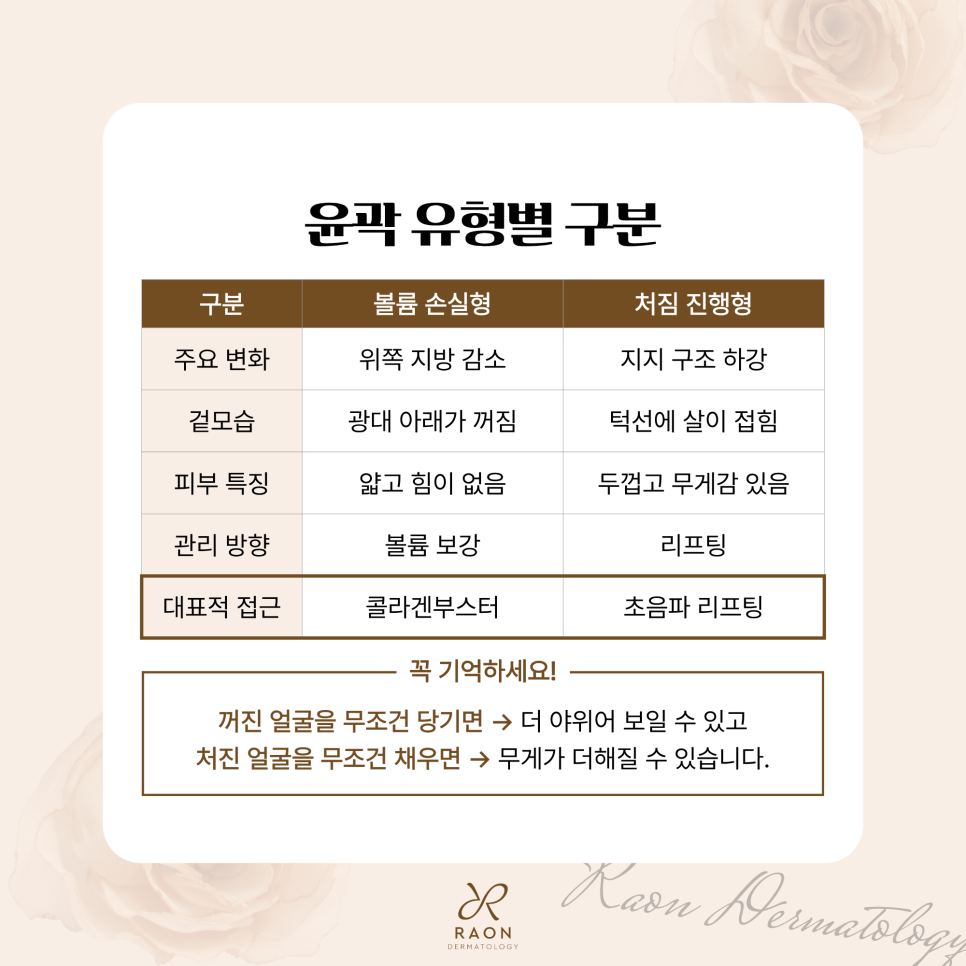
It is necessary to distinguish between different types. When the upper facial fat decreases and a shadow forms beneath the cheekbone, the condition is closer to a volume-loss type. The skin tends to be thin and lack firmness, so reinforcing volume is needed! If strong lifting is repeated in this type, the gaunt appearance may become more pronounced.
On the other hand, when the skin folds along the jawline and weight is concentrated there, it corresponds to a sagging type. In this form, the skin is relatively thick and volume has accumulated in the lower area. In this case, lifting upward should come before adding volume! Lifting a hollow area can make it look even gaunter, while adding volume to a sagging area increases the weight and may accelerate sagging. Determining which layer the change began in should come first. It is also not uncommon for the two types to overlap.
Types and Their Differences
Ultherapy
Ultherapy is used to lift tissue that has moved downward. It uses ultrasound imaging to identify the position of the fascial layer while creating thermal coagulation points at a depth of 4.5 mm. When the coagulated tissue contracts, the supporting layer that had sagged downward moves upward! Rather than pulling on the skin, this method changes the position of the supporting layer.
Depending on the situation, the dermal layer can also be reinforced in stages using 3.0 mm and 1.5 mm tips. The position is organized in the deeper layer first, followed by density reinforcement in the more superficial layer! When the boundary between the neck and jaw becomes visible again, you may feel as though the size of the face itself has changed. However, if there is little facial fat, the treatment range and depth should be set conservatively. It is safer to avoid the center of the cheeks and focus on a narrower area around the jawline:)
<Ultherapy>
-
Focused targeting of the fascial layer
-
Tissue contracts and pulls the skin upward
-
Defines the facial contours and jawline

Ultherapy
Radiesse
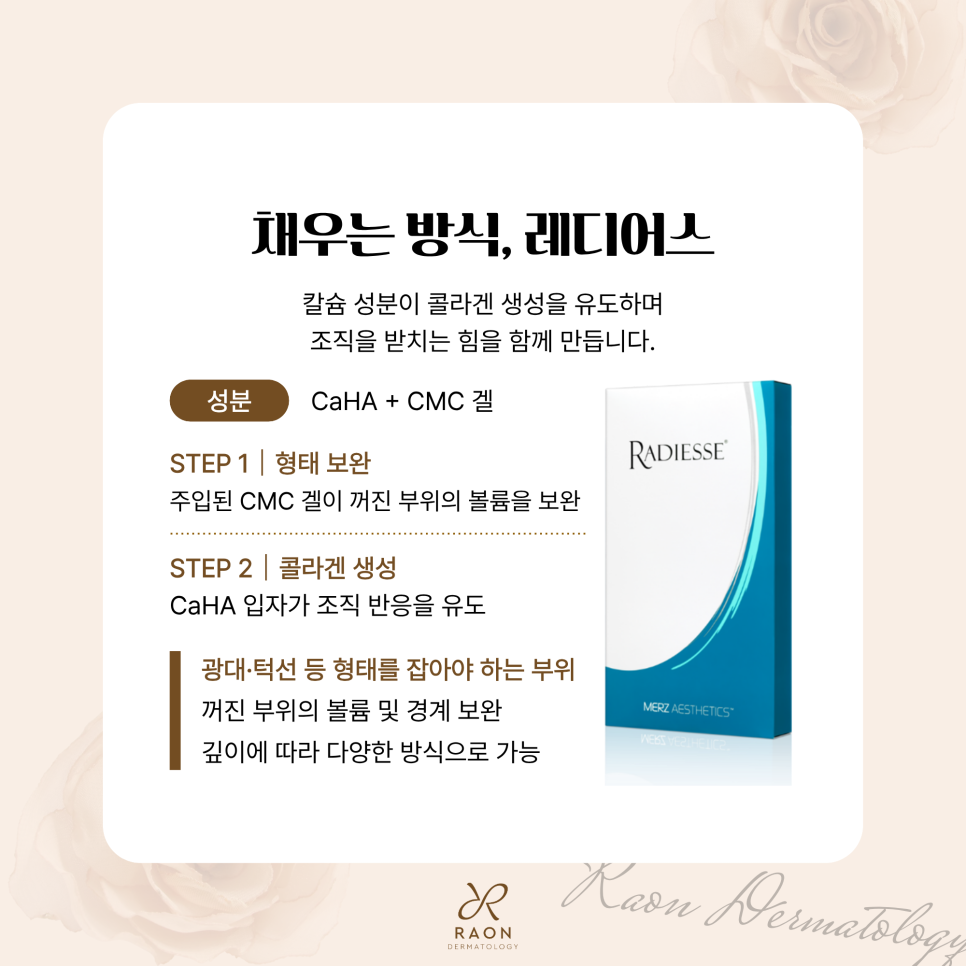
Radiesse is an option for addressing hollow areas. It contains calcium hydroxylapatite (CaHA) and a carboxymethylcellulose (CMC) gel, allowing it to work in two stages. Immediately after injection, the gel fills the hollow area and helps shape it. Over time, the remaining calcium particles stimulate fibroblasts to produce the body’s own collagen! In other words, immediate changes are followed by changes that take time to develop.
The reason Radiesse is often mentioned in contour management is its supporting strength. Compared with other collagen boosters, it tends to provide stronger support for the tissue, making it useful in areas such as the cheekbones and jawline where shape needs to be maintained:) It can be injected superficially down to the lower dermis, making it useful for refining boundary lines as well. In this way, it can be used both to add volume more deeply and to refine the contours superficially!
<Radiesse>
-
CaHA + CMC gel
-
Volume reinforcement immediately after injection
-
CaHA collagen and elastin regeneration
-
Firm support, useful for improving contours
Radiesse
Ultherapy X Radiesse
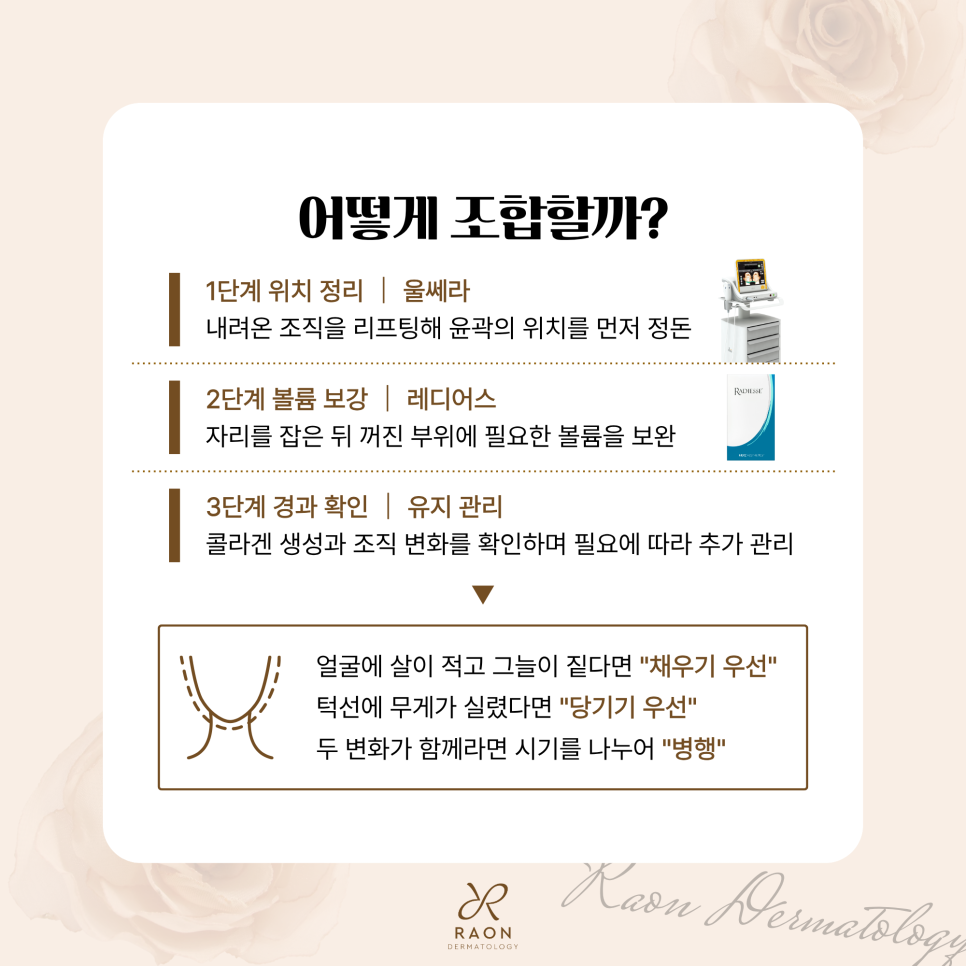
In practice, these two approaches are often used together. First, Ultherapy is used to reposition tissue that has moved downward. Once the position has settled, Radiesse is used to reinforce volume in hollow areas. This is because adding volume before repositioning the tissue can result in an unbalanced shape! Simply changing the order can change the outcome.
Because collagen production takes time, the progress is monitored and adjusted over two to three months:) Ultherapy is generally performed approximately once a year, while the interval for Radiesse is determined according to the individual condition. If there is little facial fat and the shadows are pronounced, it may be better to begin with adding volume; if weight is concentrated along the jawline, it may be better to begin with lifting! Please remember that identifying which layer is currently undergoing change is the starting point of contour management.
Ultherapy X Radiesse
Synergistic Effects of Ultherapy X Radiesse