Facial Volume Management
Hello, this is Wangsimni Raon Dermatology!
The moment a face begins to look older is often first noticeable in its volume rather than its wrinkles. When the front cheeks look flat and the under-eye area becomes hollow, the face can appear tired even without making an expression! Because facial fat decreases at different rates in different compartments, the strategy for restoring volume should also vary depending on which area has lost volume. Once you understand which products are suited to which areas, choosing becomes much easier. Today, we will organize four options for improving areas that are prone to volume loss.

Facial Volume Management
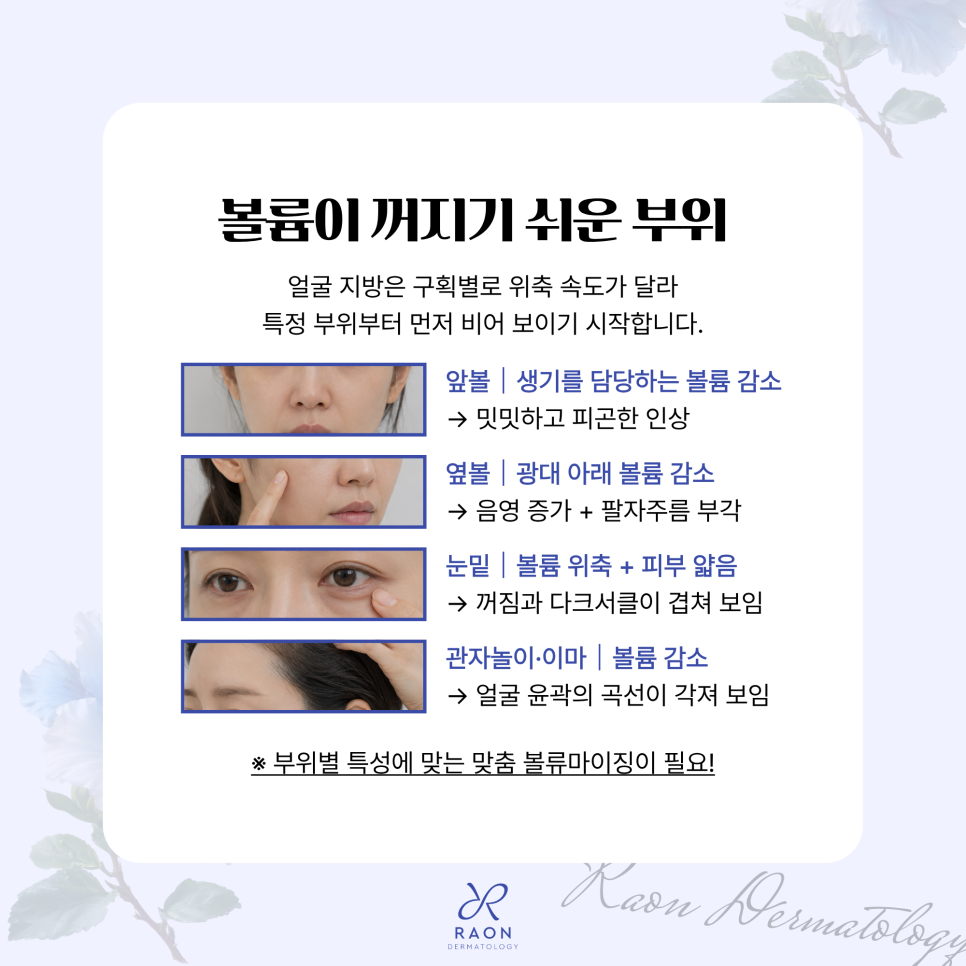
Areas Prone to Volume Loss
The main areas where volume loss is especially noticeable are the front cheeks, side cheeks, and under-eye area. When the front-cheek volume decreases, the face loses vitality. When the side cheeks below the cheekbones become hollow, shadows form and the nasolabial folds may appear deeper. The under-eye area is particularly likely to create a tired appearance because fat atrophy and dark circles overlap there. The front cheeks and under-eye area attract attention through facial expressions and eye contact, so even a small hollow can be highly noticeable. When the temples or forehead become hollow, the curves of the facial contours may also begin to look more angular.
As shadows increase, the overall complexion can appear darker, and skin that has lost its support folds more easily, making wrinkles look deeper. For this reason, the results of facial volume management depend on matching the right product to the right area. Let us now look at the options for each area one by one.
Areas Prone to Volume Loss
Juvelook Volume
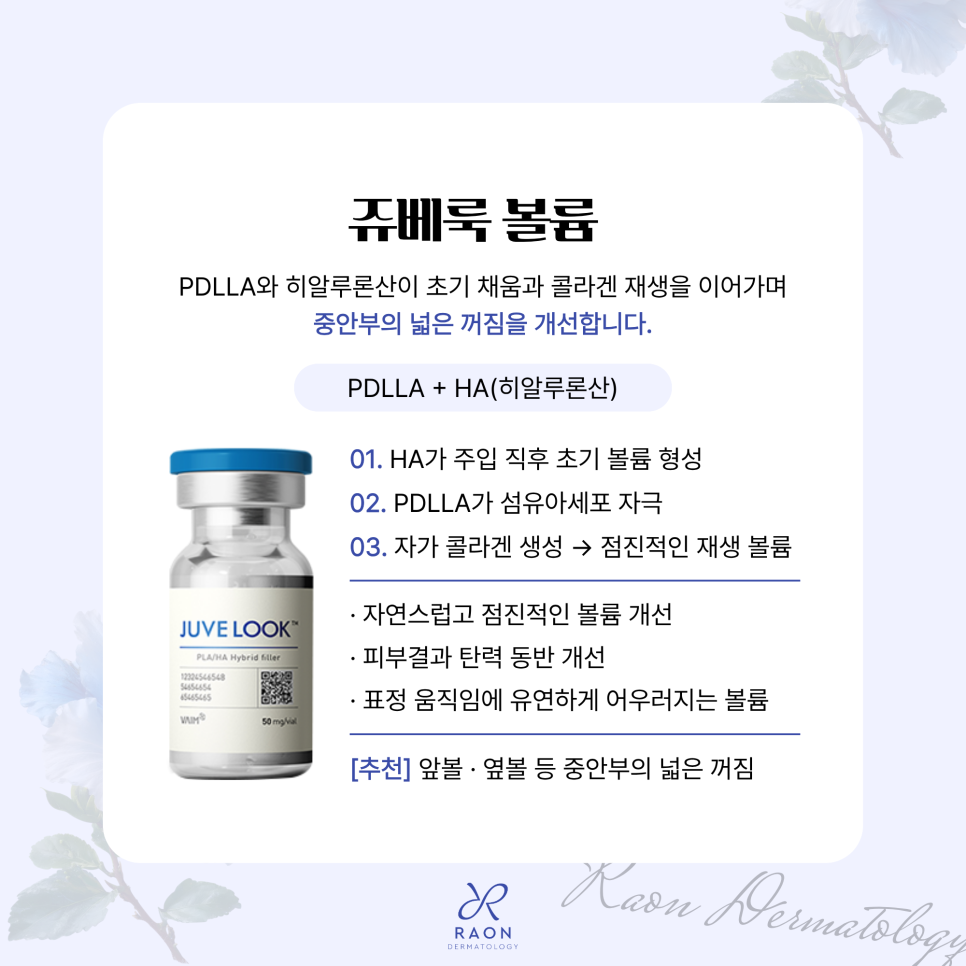
The first option is Juvelook Volume. It is a collagen booster that combines PDLLA and hyaluronic acid. Immediately after injection, the hyaluronic acid provides initial volume, while the PDLLA later stimulates fibroblasts to produce the patient’s own collagen. Over time, the initial volume is naturally replaced by regenerated volume. It is generally administered several times at intervals of a few weeks, building gradual changes over time.
Because the volume is created by the patient’s own collagen, the changes are subtle and natural. Its soft formulation also blends flexibly with facial movements. Another advantage is that skin texture and elasticity may improve at the same time. It is particularly suitable when a broad area of the midface, such as the front or side cheeks, has lost volume:)
<Juvelook Volume>
-
Natural, gradual improvement in volume
-
Simultaneous improvement in skin texture and elasticity
-
Volume that blends flexibly with facial movements
Juvelook Volume
Radiesse
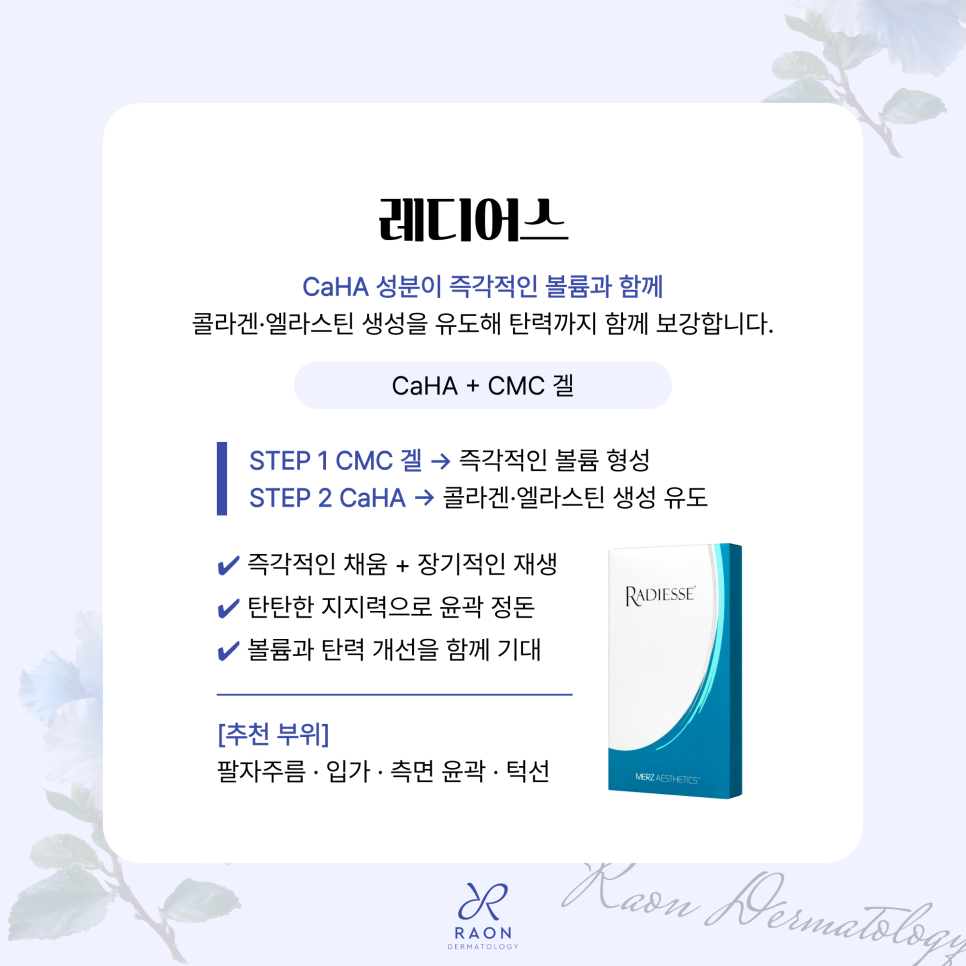
The second option is Radiesse. It is a calcium collagen booster composed of calcium hydroxylapatite (CaHA) and a carboxymethylcellulose (CMC) gel. Immediately after injection, the gel fills the volume, while the CaHA continues to support collagen and elastin production as the gel is absorbed. In other words, it combines immediate filling with long-term regenerative effects. Even after the gel is fully absorbed, the regenerated tissue takes over in maintaining the volume.
Radiesse’s strength is its firm support. It can support indented areas such as the nasolabial folds and around the mouth, and it is also highly useful for refining the side contours of the face and the lines around the jaw. Because it promotes elastin production in addition to collagen production, it is suitable for people who want to address both volume and elasticity. You can think of it as a product with a balanced combination of immediate and regenerative effects:)
<Radiesse>
-
Immediate filling + long-term regeneration
-
Contour refinement through firm support
-
Volume and elasticity improvement together
Radiesse
Hyaluronic Acid Filler
The third option is the best-known hyaluronic acid filler. A gel-form hyaluronic acid product is injected into the desired area and at the desired depth, where it functions as volume itself. The change is immediate enough to be seen in the mirror right after injection, and its clearly defined shape offers excellent contouring capability.
For this reason, fillers are particularly effective in areas that require clearly defined volume, such as the chin tip or forehead. If the result is unsatisfactory, it also offers the option of correction by dissolving it with hyaluronidase. Using a filler is a reasonable choice for areas that require immediacy and precise contouring. The duration generally ranges from approximately six months to one year, depending on the product and treatment area.
<Hyaluronic Acid Filler>
-
Volume that can be seen quickly
-
Precise contour shaping is possible
-
Correction is possible using hyaluronidase

Hyaluronic Acid Filler
Retigen
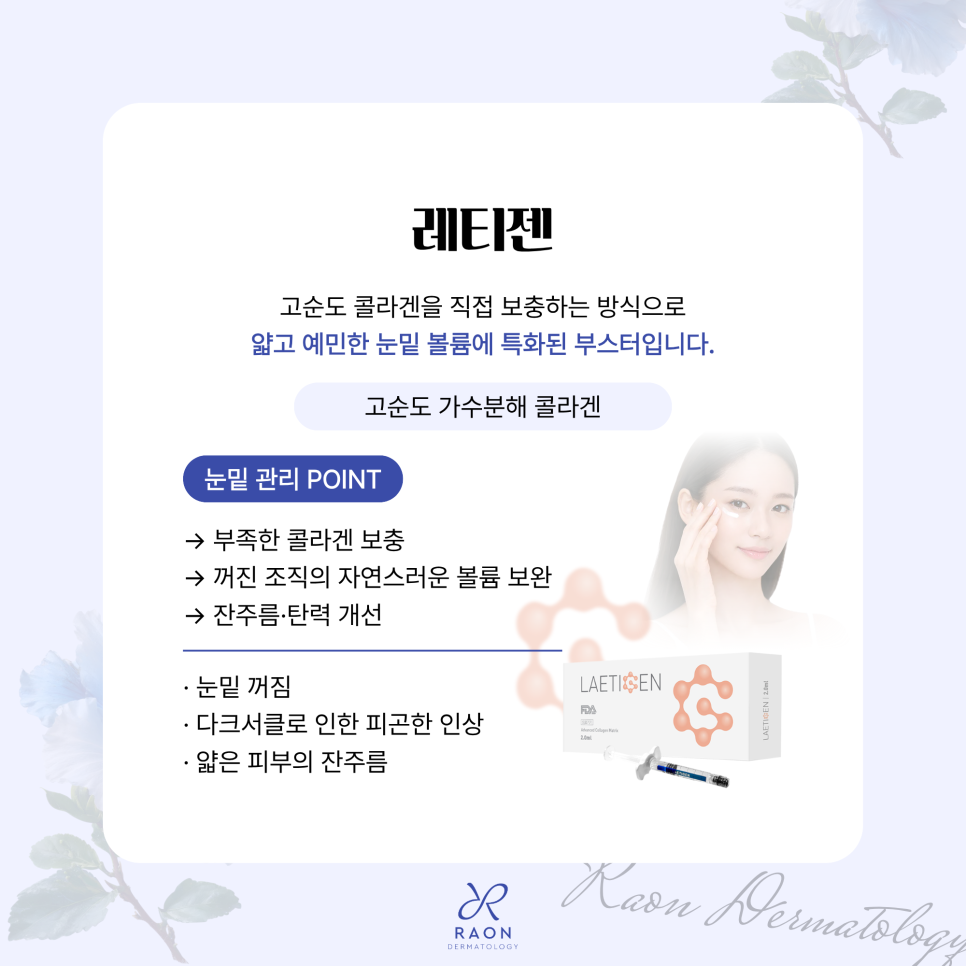
The final option is Retigen, which is specifically intended for the under-eye area. Because the skin under the eyes is extremely thin, conventional fillers can easily cause visibility or lumpiness, making it a challenging area to treat. Retigen directly supplements high-purity collagen with a structure similar to that of the dermis. This allows it to naturally fill hollow tissue with less burden on thin skin. It may help create a brighter appearance in an area that looked dark due to dark circles and may also soften fine lines. Retigen is also used to improve areas with fine, delicate wrinkles.
In summary, Juvelook Volume is used for broad hollowness in the midface, Radiesse for the nasolabial folds and facial contours, fillers for clearly defined shaping, and Retigen for the under-eye area. When the characteristics of each area match the properties of the product, the result looks most natural. It is also possible to use two or three products together, dividing them according to the treatment area. We recommend starting your volume management by having a professional assess which areas of your face have lost volume:)
Retigen
Facial Volume Management