Hello.
Making each person’s unique charm stand out even more,
as if they had always been beautiful,
I am Yoo Young-gi,
representative director of Roy Plastic Surgery.
Have you heard of lower blepharoplasty,
and do you know what under-eye fat repositioning is,
but are unsure which surgery is right for you
and are 고민 중이신가요?
Then you’ve come to the right place.
:)
Please know the most important criteria!
When you inquire about under-eye fat repositioning,
the first thing we ask to help with the consultation
is the patient’s age.
The reason is
you can’t fight age.........
Not everyone, but
for almost all people,
after around 45 to 50 years of age,
skin that has loosened and sagged
over time becomes noticeable.
As that happens, the sagging skin
creates more wrinkles,
and the more wrinkles there are, naturally,
they can become a negative factor
that makes a person look older.
However, age is not an absolute standard;
it is a relative one that can be used to roughly filter cases at a broader level.
The most important criterion,
I think,
is whether wrinkles are present.
Recently, I saw an unusual patient
who was 52 years old but had almost no wrinkles under the eyes.
This person underwent only under-eye fat repositioning as a standalone procedure.
Satisfaction after surgery was also high.
But this is a very rare case.
In this way, you can decide which surgery to have
based on whether wrinkles are present.
Surprisingly, many people do not even realize
whether they have wrinkles or not.
Especially when the under-eye fat protrudes too much,
when looking at that person’s face,
your eyes naturally focus on the bulging fat.
The bulging fat acts as the scene stealer,
so you may not notice it well.
If you look closely in the mirror,
you can tell.
Just look at how many wrinkles there are above the protruding fat.
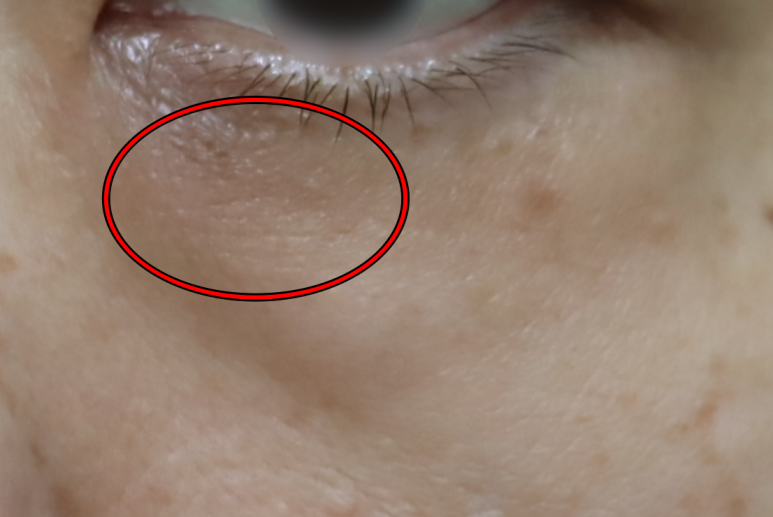
For reference,
it is a bit like a wrinkled balloon
that smooths out somewhat when air is blown into it.
If wrinkles already exist in the skin under the eyes,
then because of the outward pressure from the fat pushing from inside,
it is usually slightly smoothed out compared to the original wrinkles.
If the pushing force alone disappears and
the bulging area becomes flat,
the result is not that new wrinkles appear,
but that the wrinkles that were already there become more noticeable.
When performing lower blepharoplasty,
because the sagging and excess skin is removed,
some areas will have the wrinkle area cut out directly,
and when the skin is pulled and sutured,
there are also areas where the skin wrinkles are stretched and become smoother.
If you decide without ever considering wrinkles,
simply because you think a simpler surgery is better,
there are more cases than you might think
where you later regret it.
No matter which surgery you choose,
you will experience discomfort early after surgery because of swelling,
so it is usually more advantageous in many ways
to finish it in one go.
So, to summarize,
If you think wrinkles will not be much of a concern after surgery
-> under-eye fat repositioning
If you think wrinkles will still be visible even after the area becomes flat
-> lower blepharoplasty
Choosing like this
reduces the chance of regret.
^^
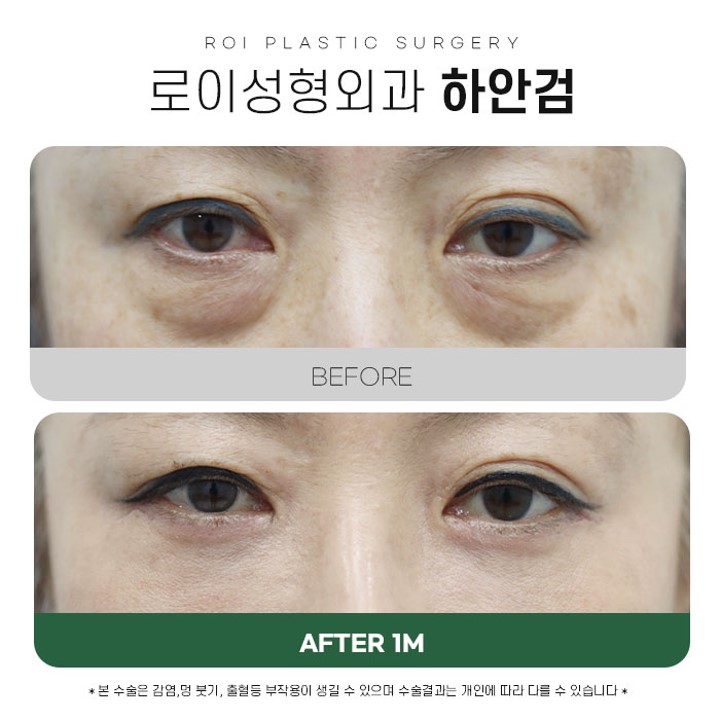
But for those who have only just started taking an interest in surgery
and are hearing about these procedures for the first time,
there are also many people who do not really know
what lower blepharoplasty is
and what under-eye fat repositioning is,
or what the difference is.
If you come for a consultation for under-eye fat repositioning
without really knowing much about it,
and after hearing a detailed explanation,
you change your plan and decide you want lower blepharoplasty,
that happens more often than you might think.
If I put the difference simply,
lower blepharoplasty is a broader concept
than under-eye fat repositioning.
Lower blepharoplasty basically includes the process of under-eye fat repositioning,
and also removes sagging skin,
and sometimes refines the muscles around the eyes
to support the lower eyelid fat,
and if the degree of looseness in the eyelid tissue is pathologically severe,
procedures such as lateral canthopexy may be performed together,
so it may be easier to understand if you think of it as involving a larger scope of work.
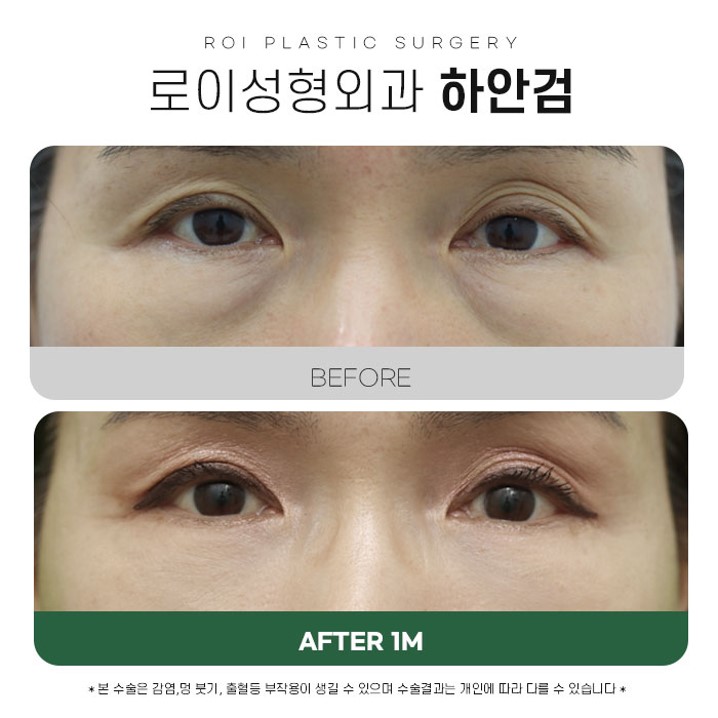
However, for reference,
not every clinic performing lower blepharoplasty
necessarily performs under-eye fat “repositioning.”
Some clinics perform under-eye fat removal.
From my perspective, the problem with under-eye fat removal is this:
as people age, the protruding under-eye fat becomes a problem,
but that is not all.
Some parts of the facial bones are gradually resorbed over time,
so certain areas become especially sunken,
and relatively speaking, other areas may look more protruded,
so age-related changes are not limited to the protruding fat alone.
In that case, it becomes important to replenish the space in the sunken areas with fat.
If you simply remove the under-eye fat without much thought
just because it is protruding,
it may not make that area flat;
instead, the formerly bulging area may look severely hollow,
which can make the person look ill,
so you need to be careful.
Please refer to the links below for posts about
scarring after lower blepharoplasty
and
under-eye fat removal.
#1. If you are curious about scars after lower blepharoplasty,
the following post may be helpful.
https://blog.naver.com/youngkeeyoumd/223378540111
#2. If you are curious about hollowness that appears after under-eye fat removal,
please read the following post.
https://blog.naver.com/youngkeeyoumd/223384925618
▼ Plus Friend chat inquiry ▼


Roy Plastic Surgery complies with the Medical Service Act.
The photos in this post were taken under the same conditions,
and are images captured with the patient’s prior consent.
Also, because side effects such as bleeding, infection, and inflammation may occur depending on the individual after plastic surgery or procedures, caution is required.