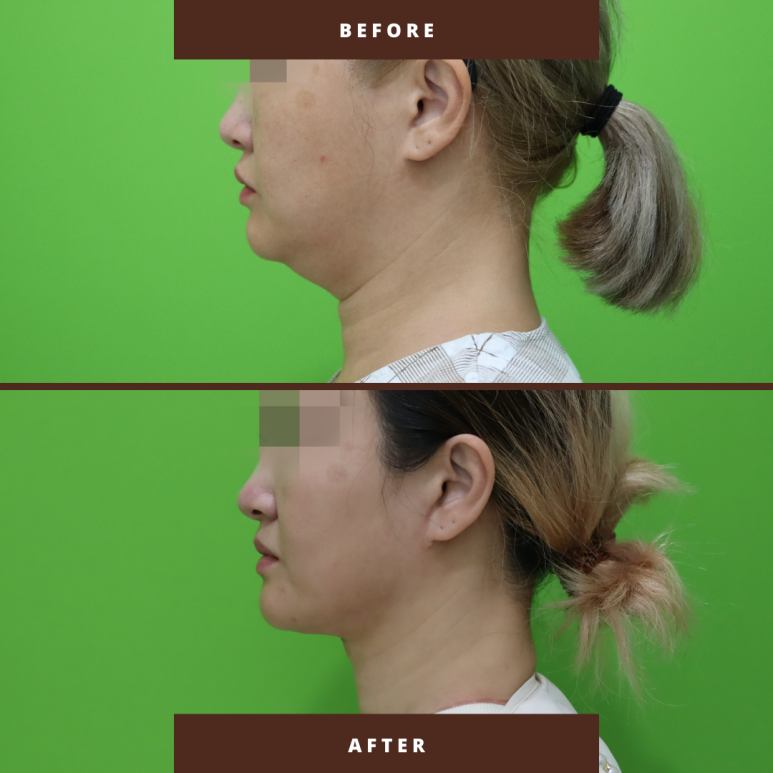
A slim body, but only the face looks puffy? The story of a woman in her early 40s who changed dramatically with double chin fat removal
Hello,
I’m Yoo Young-ki, head doctor at ROY Plastic Surgery Clinic.
Today, I’d like to introduce a special surgical case for people whose bodies are slim but whose faces look fuller,
or who worry that no matter how much weight they lose, the double chin fat just won’t go away.
This case involves a woman in her early 40s.
Although she was actually slim, her face looked round, and because of her double chin, she was often asked, “Have you gained weight?”
Even though she was confident that she was slim, every time she looked in the mirror,
the area under her jawline looked uneven, causing her daily stress.
When she came in for a consultation,
it was truly a case where her body was very slim, but only the double chin area had a lot of fat.
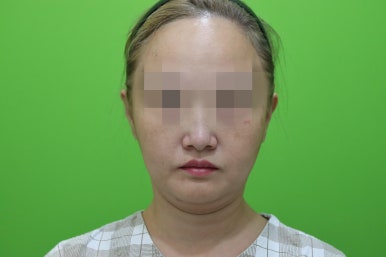
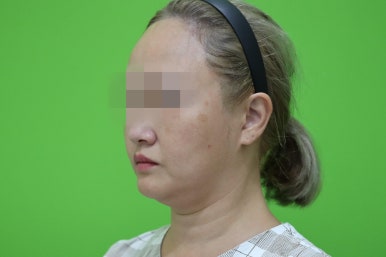
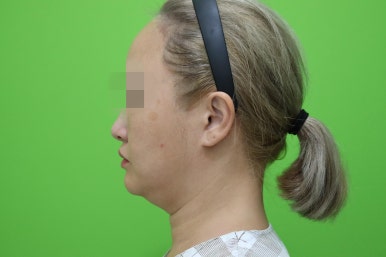
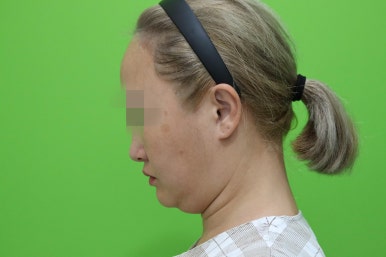
The method she chose was the double chin contouring procedure,
combined with the so-called “three-part set” partial resection surgery.
And now, 1 year and 5 months after surgery,
she is maintaining the defined jawline she wanted for a long time.
In this post, I’ll explain in detail how the surgery is performed
and why the results can be maintained for such a long period.
- Why doesn’t double chin fat disappear even on a slim body?
We often think, “If I lose weight, my double chin will disappear too,”
but in reality, that is often not the case.
This patient had also tried dieting several times,
but the fat on her face, especially under her chin, did not go away at all, so it had been a constant concern.
The cause is not simply subcutaneous fat,
but rather several complex factors under the chin that interfere with double chin fat removal.
• Salivary glands enlargement:
When the salivary glands become enlarged, they can create a bulging appearance between the neck and the jaw,
making the face look fuller and the jawline less defined.
• Grapelike fat:
There is a uniquely clustered layer of fat under the chin,
which does not easily disappear even after weight loss.
• Digastric muscle enlargement:
This is one of the muscles connected to the neck.
When this area is developed or sagging,
the double chin can appear more prominent.
In other words, to properly remove double chin fat,
the three-part set that creates the double chin—enlarged salivary glands, grapelike fat, and the digastric muscle—must all be corrected together
to achieve long-lasting results.
ROY’s signature “double chin contouring procedure”
is not simply an incision under the chin
One of the most common questions during preoperative consultation is,
“Can’t you just make a small incision in the center under the chin?”
Of course, if you only do simple liposuction or partial muscle fixation,
some correction can be achieved with just a central under-chin incision.
But if you want a clear double chin fat removal effect that lasts for more than 10 years,
you need to consider not only the center under the chin but also an incision under the ears.
Why is an incision under the ears necessary?
• The platysma is a thin, delicate muscle that broadly covers the neck and jaw area.
• If only the central area is tied,
first, it is not easy to firmly tie such a delicate muscle,
and second, there is a tough region on the outer side of this muscle that connects with fascia,
allowing it to be tied much more tightly than the center.
If only the center is loosely tied, the surrounding muscles may sag again later,
increasing the risk of recurrence.
• Therefore, through an incision under the ears, both sides of the platysma should also be tied together
so that the jawline is clearly defined and maintained for a long time.
This patient also initially worried that “an additional incision line would be burdensome,”
but in the end, as the scar faded during recovery after surgery,
it settled to a level that was barely noticeable.
Rather than accepting the risk of recurrence with a partial procedure,
she often said that shaping the jawline through a contouring procedure was much more satisfying.
- Partial resection of the three-part set (salivary glands, grapelike fat, digastric muscle) is key
Simply tying the muscle alone (muscle tying) can limit the effect of double chin fat removal.
That is because if enlarged salivary glands, fat, or the digastric muscle remain,
over time, gravity continues to press on the platysma,
making it highly likely that the jawline will eventually collapse again.
-
Salivary glands enlargement: If the salivary glands become excessively large, the area below the neck can look uneven,
making it appear as though there is extra fat.
-
Grapelike fat: Unlike ordinary fat, it is clustered,
so it is difficult to remove with regular dieting or laser procedures alone.
-
Digastric muscle enlargement: If the muscle that extends from the center of the neck to under the jaw becomes enlarged,
it becomes a major cause of a collapsed jawline.
This muscle lies in a deeper layer than the platysma,
and because it does not originally have a major function, most people do not feel any discomfort even after partial resection.
The process of partially removing or reducing this three-part set
is the key factor that determines the quality and longevity of double chin fat removal.
During surgery, the tissue must be removed delicately while minimizing damage.
At this point, using a standard electrocautery device can cause significant heat damage to surrounding tissue,
and can also leave too much burned tissue behind, which may later lead to severe scarring within the tissue.
To prevent this, we introduced Ligasure, an ultra-expensive, university-hospital-level device,
and use it in double chin contouring procedures.
Especially when removing the salivary glands, bleeding can occur easily and hemostasis may be difficult,
but with this device, complete hemostasis and a clean finish without burned tissue are possible within 2–3 seconds.
Thanks to this, surgery became very safe and quick.
Postoperative photos after 1 year and 5 months
The patient returned for a follow-up visit about 1.5 years later, specifically 17 months after surgery.
The left side is before surgery, and the right side is after surgery.
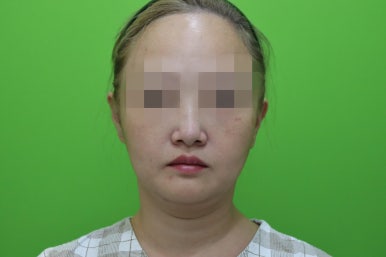
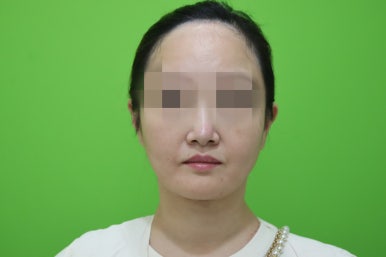
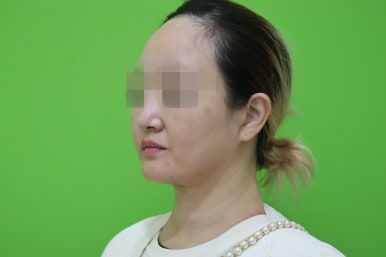
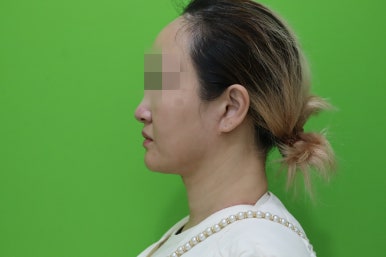
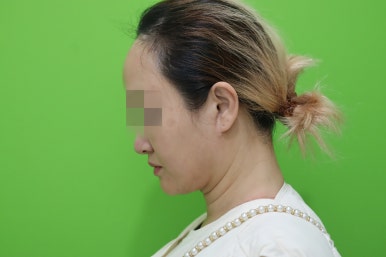
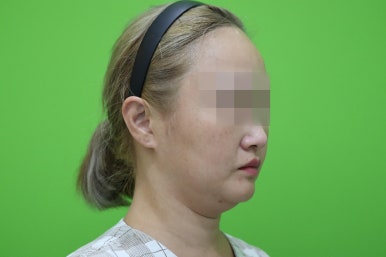
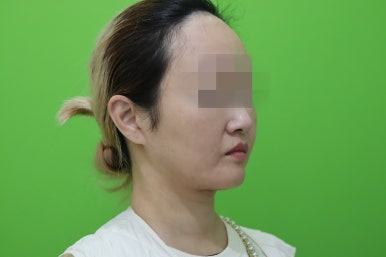
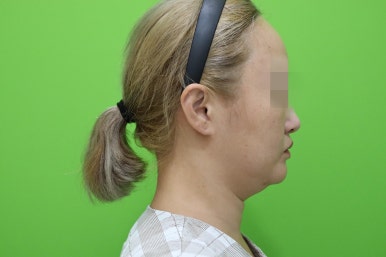
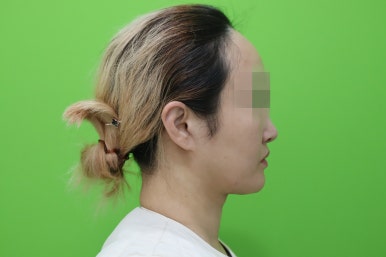
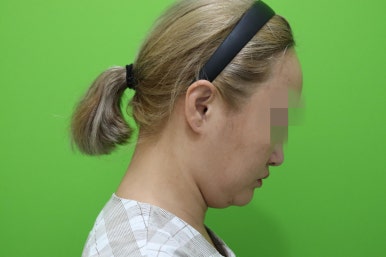
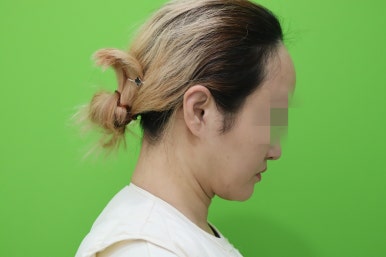
• Before surgery: Even with weight loss, the area under the chin remained, making her look heavier than she actually was.
From the side, it gave the impression that there was no jawline.
• 1 year and 5 months after surgery: Even from the front, the jawline is clear, and the boundary between the neck and jaw is distinctly defined.
Even as time passed, it has maintained a firm state with no signs of recurrence.
At first, the patient said she was half skeptical,
wondering, “Can it really last for 10 years?”
But even after 1 year and 5 months, with no sign of loosening,
she looked at her defined jawline and laughed, saying she was glad she chose the contouring procedure :)
“Can I also get double chin fat removal?” - Things to keep in mind
- Constitutional factors:
There are many causes of a double chin.
To create the right surgical plan, it is necessary to determine accurately whether the issue is fat-related, muscle-related, or due to salivary gland enlargement.
- Scar concerns:
If an incision under the ears is necessary, the scar may be visible immediately after surgery,
but it gradually becomes more natural over time.
- Recovery period:
In general, there is not much pain, but swelling and bruising may last for about 1–2 weeks.
If you work in an office, it is good to schedule surgery with at least one week to ten days of leeway.
- Aftercare:
After surgery, you should avoid keeping your head lowered for long periods or engaging in strenuous exercise,
and you must follow the aftercare instructions provided by the clinic, such as wearing compression gauze and refraining from smoking and drinking.
If you have tried dieting countless times because your double chin fat would not go away and failed,
it may be time to consider double chin fat removal surgery, that is, the “double chin contouring procedure.”
With the double chin contouring procedure, if enlarged salivary glands, grapelike fat, and digastric muscle are partially resected,
and the platysma is firmly tied on both sides,
you can expect a beautiful jawline that minimizes recurrence and lasts for more than 10 years.
In this way, even people who take good care of themselves can feel discouraged when facing the “double chin” problem.
If the exact cause is diagnosed and the timing of surgery is chosen well,
you may get a much cleaner and longer-lasting result than expected.
One decision can bring confidence for more than 10 years :)
Based on our abundant clinical experience, ROY Plastic Surgery Clinic carefully checks each patient’s condition and concerns,
and suggests a customized surgical method, so please feel free to contact us anytime.
So far, we have looked at a case of double chin fat removal through the double chin contouring procedure.
I hope this was helpful to those who are considering it.
If you are curious about another review from someone whose body was slim but only the double chin fat was the problem,
please click the post below :)
https://blog.naver.com/youngkeeyoumd/223715325142
Click the image below for Plus Friend chat inquiries

ROY Plastic Surgery Clinic (Sinsa Station, Line 3)
Main phone: 02-516-5525
Weekdays 10:00 ~ 19:00
Saturday 10:00 ~ 16:00
ROY Plastic Surgery Clinic complies with medical laws.
The photos in this post were taken under the same conditions,
and are images taken with the patient’s prior consent.
In addition, after plastic surgery or procedures, side effects such as bleeding, infection, and inflammation may occur depending on the individual, so caution is required.