After lower blepharoplasty, how much scarring is there really?
Hello,
I’m Yoo Young-gi, the chief director of Roy Plastic Surgery.
Today, I’d like to talk about one of the questions people most often ask when considering lower blepharoplasty:
lower blepharoplasty scars.
In fact, many people hesitate before deciding on lower blepharoplasty because they worry, “What if the scar becomes noticeable?”
However, as with any surgery, if the proper method and know-how are applied, lower blepharoplasty scars can be left so small that they are barely noticeable.
The case I’m introducing today is a woman in her late 40s.
She had bulging under-eye fat and hollowing below it,
which caused her stress for many years.
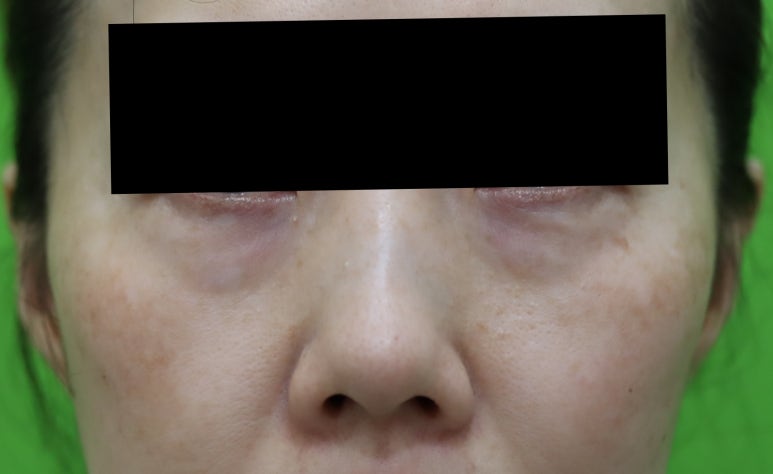
So along with lower blepharoplasty, fat repositioning
and fat grafting to fill the deficient areas were performed at the same time.
The biggest concern before and after surgery was,
“Will the surgical scar be noticeable?”
So what do things look like on day 1 after surgery and on day 7, when the stitches are removed?
Immediately after surgery (day 1) – swelling, bruising, and the scar
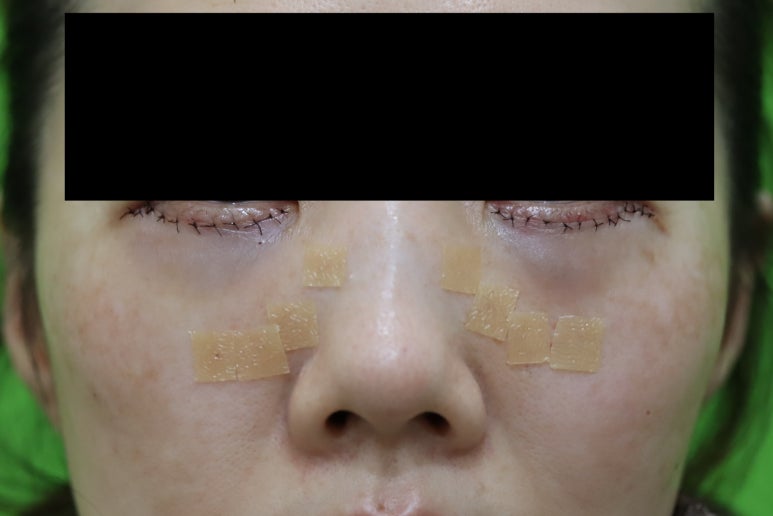
Lower blepharoplasty is usually performed through an incision below the lower lash line.
If the incision is designed appropriately,
if the amount of skin excision is appropriate,
and if the suturing is done delicately,
it is common for the lower blepharoplasty scar to become barely visible later on.
However, on the day of surgery and the following day (day 1), swelling and bruising appear together,
so when you look in the mirror, the incision line may appear more pronounced.
This is a natural part of the recovery process.
Swelling and bruising:
Although it varies from person to person, on day 1 the area may be swollen to a somewhat exaggerated degree.
Incision line:
It has been sutured as a thin line,
but as the surrounding tissue swells, it may look somewhat uneven on day 1.
At this stage, the most important thing is not to try to hide the lower blepharoplasty scar with thick makeup,
but to follow the cold compress and wound care instructions given by the clinic.
The timing for using scar ointment or scar patches is usually recommended after stitch removal,
so in the early stage, care should be taken not to directly irritate the wound.
At stitch removal (day 7)
– Will the scar really not be visible?
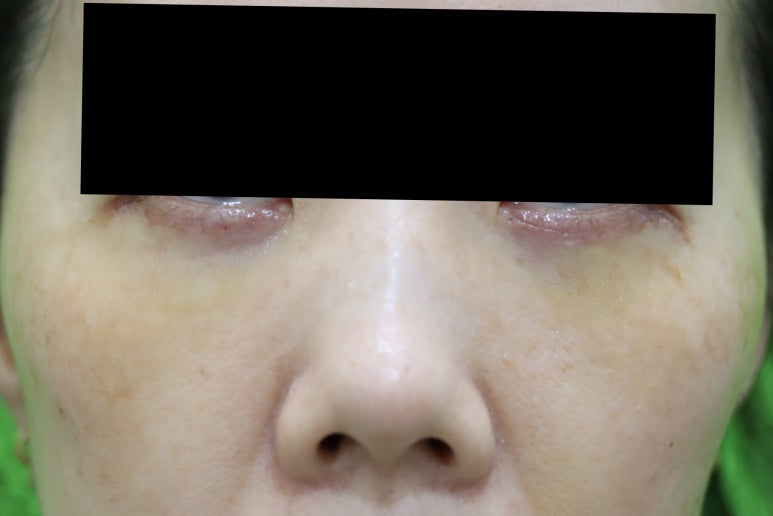
By day 7 after surgery, the sutures are removed.
By then, swelling and bruising have decreased significantly,
and the incision area has healed almost completely.
This patient was reportedly so surprised that she said, “Has the scar already faded this much?”
The lower blepharoplasty scar was barely noticeable.
Reduction in swelling:
After one week, most of the acute swelling subsides,
and the lines around the eyes gradually begin to settle into place.
Suture removal:
If the suturing was thorough and delicate, the stitches come out smoothly at the time of removal without much pain or discomfort.
Scar status:
The scar is not completely gone yet,
but it had faded to the point where there was no major mark even when looked at up close.
Of course, this can vary somewhat depending on the patient’s skin condition and constitution,
as well as the surgeon’s technique and suturing skill.
To minimize lower blepharoplasty scars, not only the surgeon’s delicate suturing but also the surgical method is important.
Points for minimizing scars
A common mistake in lower blepharoplasty is the wrong belief that removing more skin will make the area look tighter.
However, if too much skin is excised, the skin tension becomes extremely high even after suturing,
creating a stronger force that tries to pull the incision apart. As a result, the lower blepharoplasty scar is more likely to stand out.
In addition, this increases the risk of ectropion.
- When fixing the outer canthus, pull and secure part of the orbicularis oculi muscle
How the outer canthus is handled during lower blepharoplasty also affects the scar outcome.
If part of the orbicularis oculi muscle is pulled and fixed, the eye area shape is stabilized,
which helps reduce postoperative skin tension and the likelihood of lower blepharoplasty scarring.
- Surgical method + suturing skill
No matter how good the surgical plan is, if the suturing is poor, it is difficult to avoid lower blepharoplasty scars.
The skin around the eyes is thin and delicate, so it must be sutured carefully to leave less scarring.
The choice of needle and thread, the thickness of the suture material, and adjusting the tension of the suture line
must all work together to achieve a good result.
- Appropriate fat repositioning & fat grafting
In cases like this patient, where under-eye fat is excessively bulging while hollow areas are also present,
fat repositioning alone may not be enough.
In such cases, fat grafting should be done together so the postoperative contour settles smoothly.
The less unevenness there is, the more smoothly the re-suturing process proceeds,
and as a result, the lower blepharoplasty scar becomes less noticeable.
Postoperative precautions
Cold compress & rest:
On day 1, because the swelling is severe,
it helps to apply cold compresses for about 10–15 minutes at a time, without overdoing it.
Avoid excessive eye makeup:
Until the stitches are removed, keep the wound area clean,
and even after removal, it is better to apply makeup lightly.
Exercise, sauna, and alcohol:
It is safest to avoid these for about 4 weeks if possible.
Activities that cause blood vessels to expand or lead to heavy sweating in the early stage interfere with scar recovery.
Scar care products:
After stitch removal, using silicone gel or scar patches made specifically for scars
may provide additional help.
However, it is best to start using scar ointment only if recommended by the surgeon.
Comparison photos before surgery and one week after surgery.
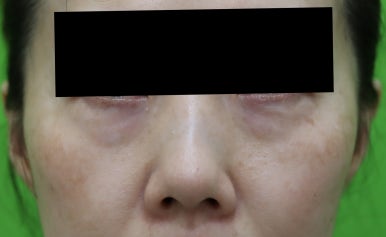
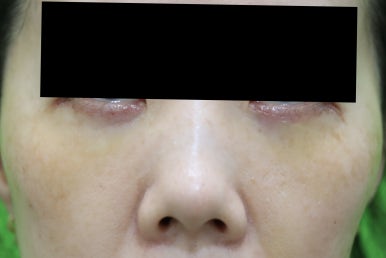
As shown here, many people hesitate while considering lower blepharoplasty because they are too worried about lower blepharoplasty scars,
but depending on the surgical technique and suturing skill of an experienced surgeon, much of that concern can be reduced.
This woman in her late 40s also had swelling and bruising on day 1, of course,
but by the time the sutures were removed at one week, the scar was already clean and hardly visible.
In conclusion, to minimize lower blepharoplasty scars,
appropriate incision placement,
precise surgical planning that avoids excessive skin excision,
orbicularis oculi fixation when securing the outer canthus,
and delicate suturing techniques are essential.
If you are still worried about under-eye fat and wrinkles,
but hesitate because you are afraid of scars,
you may also find it helpful to get a consultation without 부담.
At Roy Plastic Surgery, we suggest the safest and most satisfactory surgical method tailored to each patient’s condition.
We hope you can manage under-eye fat, wrinkles, and lower blepharoplasty scars neatly with a single surgery.
Thank you.
Are you still not sure whether to undergo under-eye fat repositioning surgery
or lower blepharoplasty?
Please refer to the post below :)
https://blog.naver.com/youngkeeyoumd/223553351644
Click the image below for Plus Friend chat inquiries
Roy Plastic Surgery Clinic (Sinsa Station, Line 3)
Main phone number: 02-516-5525
Weekdays 10:00 ~ 19:00
Saturday 10:00 ~ 16:00
Roy Plastic Surgery complies with the Medical Service Act.
The photos in this post were taken under the same conditions,
and are images taken with the patient’s prior consent.
Also, after plastic surgery or procedures, side effects such as bleeding, infection, and inflammation may occur depending on the individual, so caution is required.