Hello,
I am Yoo Young-gi, the chief doctor of Roy Plastic Surgery.
Today, I’d like to introduce the case of a woman in her early 40s.
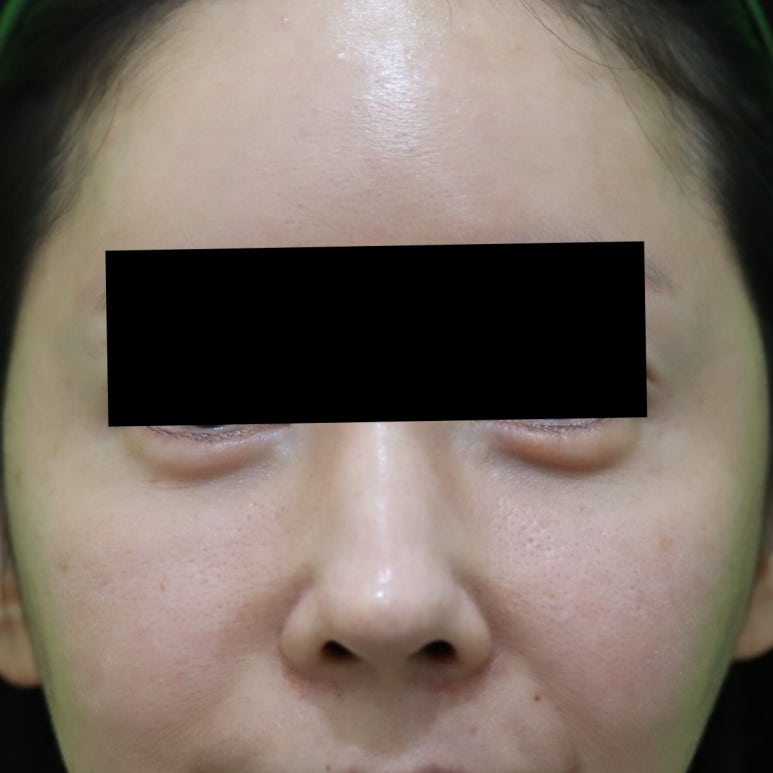
She had been under a great deal of stress for a long time because of under-eye fat grafting she received 10 years ago.
She had consulted several clinics, but she was told only that “removal is difficult” or “it would be better to leave it alone.”
In the end, even when she had a neutral expression, the under-eye area looked excessively protruded,
and apparently even people around her reacted by saying it looked “strange,” so the emotional burden must have been considerable.
This patient did not know exactly what the problem was,
or where and how the under-eye fat grafting had been done.
Since the clinics also did not give a clear answer,
she ended up giving up and living with it over time.
Then, after a consultation with me, we came to the conclusion that we should at least proceed with surgery and check the internal condition.
At first, I also assumed that the past surgery may have caused a problem with the orbicularis oculi muscle,
or that the fat may have taken root across multiple layers,
so I explained the various possibilities to the patient.
When I actually began the incision,
the fat tissue that had taken root from the previous under-eye fat grafting
was immediately visible in the area where the orbicularis oculi muscle should have been seen.
Rather than being tangled in multiple complex layers,
fortunately it had been injected as a single mass into the space between the orbicularis oculi muscle and the skin.
Even during removal, I had to be extremely careful not to disturb the area around the orbicularis oculi muscle.
If the dissection that cleanly separates the fat from the orbicularis oculi muscle is not done properly during removal,
the muscle can be damaged, causing a lot of bleeding during surgery,
and if hemostasis is forced, scar tissue may form in the muscle layer during recovery,
increasing tension and even the risk of ectropion.
In the end, I carefully removed the remaining fat mass from the under-eye fat grafting,
and repeatedly checked the area where the fat had been placed to make sure there were no further issues.
This is the amount of fat removed and the amount of excess skin trimmed.
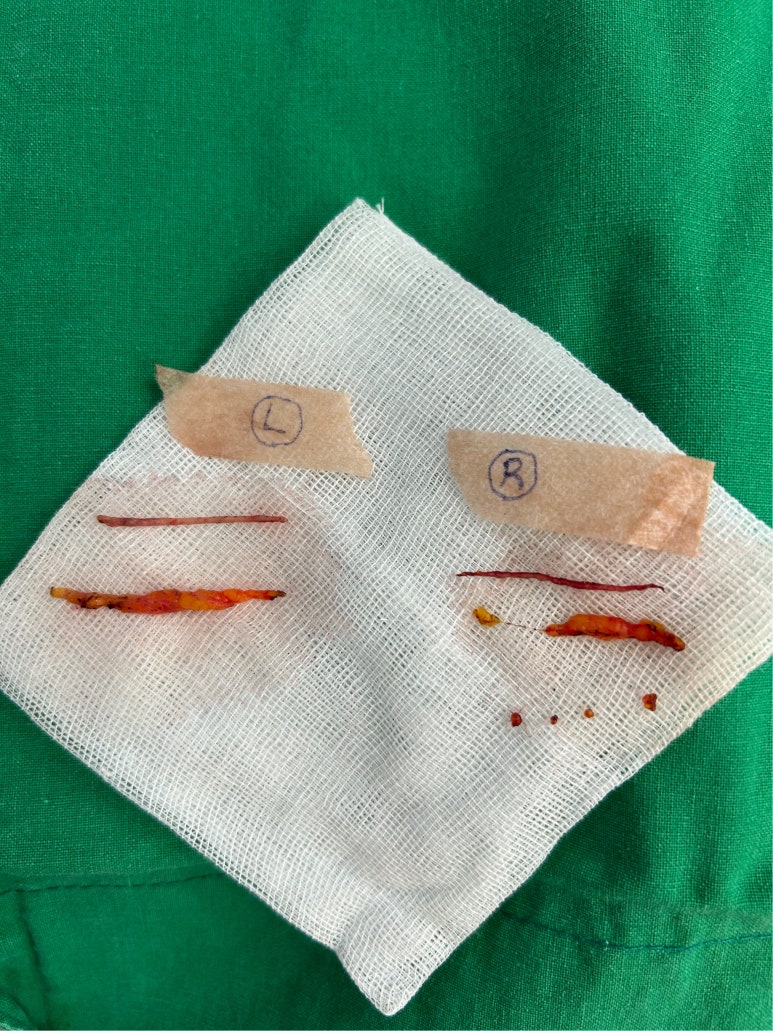
Because the skin had been slightly stretched by the fat that had taken root,
I removed a small amount of the remaining excess skin.
Through this process, unlike the consultation result that said removal itself was impossible,
we confirmed that a sufficiently clean solution was possible.
Next is when she came back to have the stitches removed at the 1-week mark.
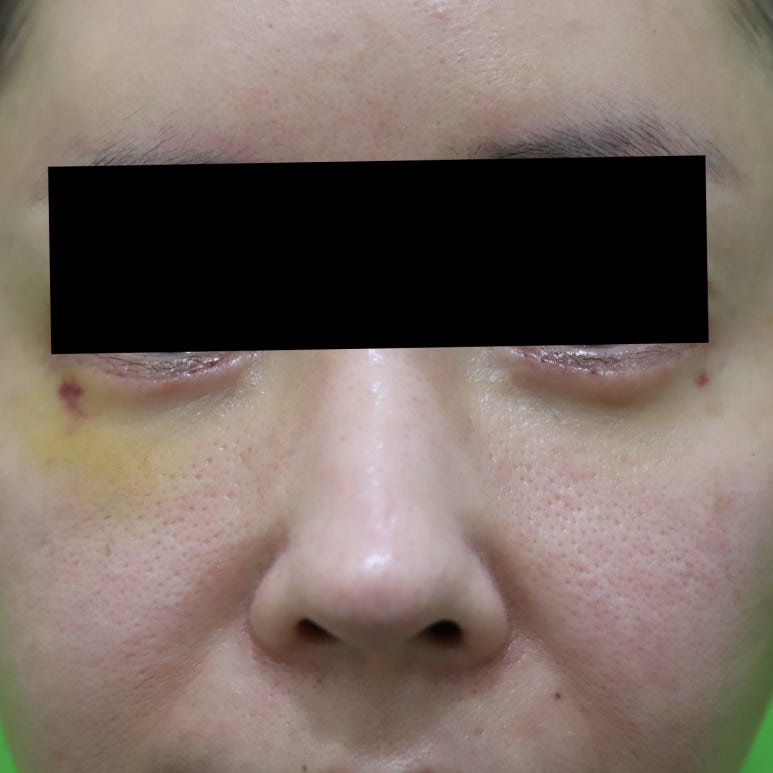
Only one week had passed since the surgery,
so there was still quite a bit of bruising and swelling,
but the patient said, “I don’t know why I didn’t do this sooner.”
Even people around her were saying, “That bothersome under-eye area is finally taken care of?”
so the difference was already significant.
In particular, since the unevenness caused by the under-eye fat grafting disappeared,
she was happy that the eye area looked natural both when smiling and when keeping a neutral expression.
As the swelling goes down, an even prettier line will settle in,
so the patient is greatly looking forward to it.
“Then why did other clinics say removal was difficult?”
I think many people may be wondering that.
In fact, if under-eye fat grafting has become complicated by being placed across multiple layers,
or intertwined with the muscle layer,
removal may not be easy.
However, not every case is the same.
If, like this case, it is located in a relatively single space,
then with careful attention, it can be removed unexpectedly without much difficulty.
In the end, there is an aspect that must be confirmed directly through surgery,
and the surgeon’s know-how and approach are also important.
If you have already had under-eye fat grafting,
but it has settled too excessively and you are worried,
or you were told that removal would not be easy and want it taken out,
then it may be worth getting a second consultation.
Of course, I cannot promise that every case can be resolved as easily as this one.
But there may certainly be room to try again with a different approach or surgical technique.
Through this case, I wanted to say that even if you are stressed because of an old under-eye fat grafting procedure,
there is not necessarily no solution at all.
The most important things are,
thorough preoperative diagnosis tailored to each patient’s condition,
and a cautious approach during surgery.
Then there can be hope of returning to something similar to the previous state,
or to an even more natural result.
Case of resolving a hollow under the eyes that appeared after lower eyelid fat removal
If you are curious, please refer to the link below :)
https://blog.naver.com/youngkeeyoumd/223384925618
Click the image below for Plus Friend chat inquiries
Roy Plastic Surgery Clinic (Sinsa Station, Line 3)
Main phone: 02-516-5525
Weekdays 10:00 ~ 19:00
Saturday 10:00 ~ 16:00
Roy Plastic Surgery complies with the Medical Service Act.
The photos in this post were taken under the same conditions,
and are images taken with the patient’s prior consent.
In addition, after plastic surgery or procedures, side effects such as bleeding, infection, and inflammation may occur depending on the individual, so caution is required.