“Isn’t an implant only worth it if you can use it for a long time?”
Many patients say this.
“Doctor, this cost me several million won...
How long does it last?” or
“I paid so much for it, so I’d like it to last for life if possible.”

Hello.
I’m Lim Jong-woo, chief director of
Gwanghwamun The Square Dental Clinic.
Today, I’d like to talk about something many people are curious about:
“how to make implants last longer.”
Based on the cases we actually see in the clinic and the questions patients ask, I’ll explain in simple terms the factors that affect implant lifespan and how to manage them.
Implants are consumable items.
There is no fixed lifespan for an implant.
An implant is called an “artificial tooth,”
but in fact, it is a medical device that is fixed directly into the bone.
It can be used much like a natural tooth,
but that also means it is a structure sensitive to impact, hygiene, and habits.
In theory, it can be used for 10 or even 20 years or more,
but due to poor care habits or lifestyle choices,
problems can sometimes occur within just 1–2 years.
Three representative habits that shorten lifespan
- Poor oral hygiene
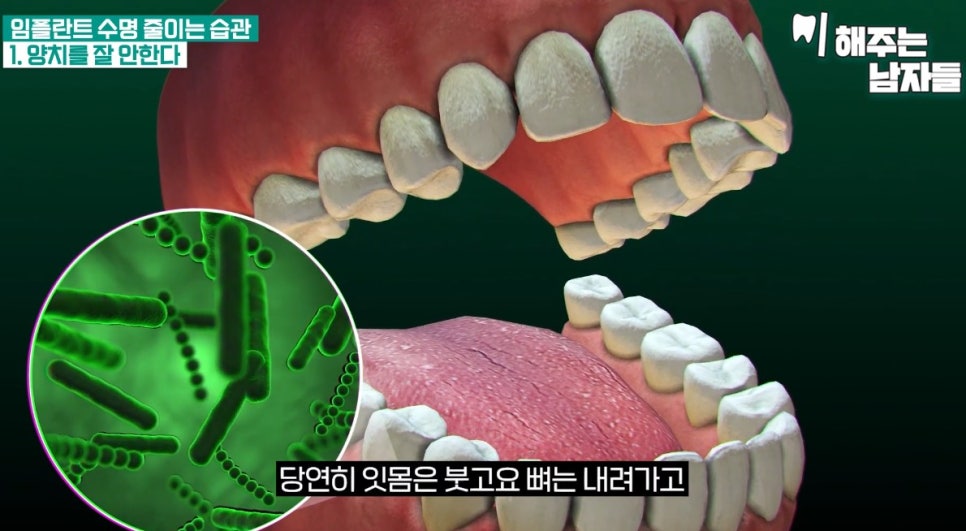
If you neglect brushing,
peri-implantitis can develop.
If inflammation occurs in the gums around the implant,
the bone can gradually be lost, and eventually the implant may become loose or fall out.
In particular, unlike natural teeth, implants have no periodontal ligament,
so once bacteria invade, they can affect the bone right away.
- Smoking and frequent drinking

Smoking constricts blood vessels,
reducing blood flow to the gums and bone,
and lowering healing ability and immunity.
As a result, recovery becomes difficult when inflammation occurs,
and tissue damage around the implant progresses faster.
- Eating hard and chewy foods + teeth grinding

Because implants do not have a periodontal ligament,
they are vulnerable to lateral force.
If you often chew dried squid, hard dried squid, ice, or have a habit of clenching your teeth during sleep,
the implant structure may break
or the bone may be damaged.
So, how should you care for them?
- Thorough oral care using the Bass brushing method
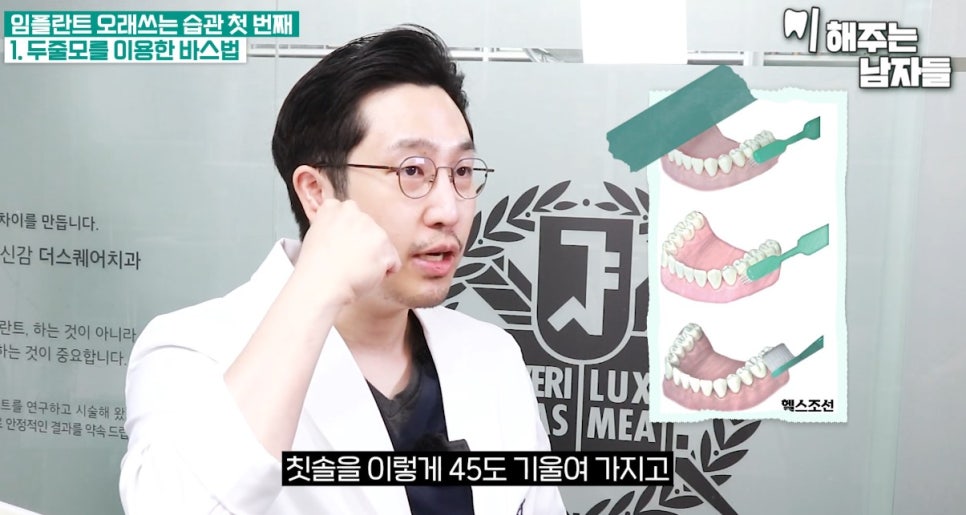
Place the toothbrush at a 45-degree angle against the boundary between the gums and the teeth (the gingival sulcus)
and brush one or two teeth at a time with small vibrating motions.
Using a fine-bristled toothbrush makes the Bass method even more effective.
Floss and interdental brushes should also be used together.
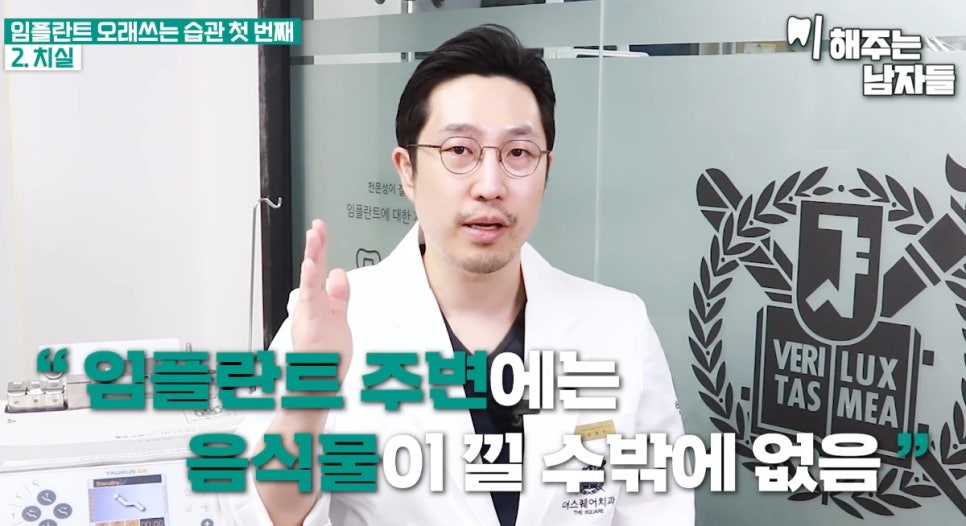
The area around an implant is structurally vulnerable because food can get stuck there more easily.
- Quit smoking and drink less

If possible, you should definitely quit smoking,
and it is better to reduce alcohol consumption.
Smoking goes beyond a simple dental issue
and affects systemic immunity as well.
- Improve habits that reduce excessive force

Limit hard foods
and chewy foods.
If you grind your teeth or clench your jaw,
consider making a night guard (splint).
If chewing force is excessive,
not only the implant
but also the surrounding natural teeth may be at risk.
An implant is also
a tooth that requires careful management.
The lifespan of an implant does not depend simply
on whether the surgery was successful.
Rather, what matters much more is how the patient manages it after surgery.
Most importantly,
regular checkups are essential.
If problems can be checked before they arise,
and even small abnormalities can be found early
and handled conservatively,
you can extend the life of the implant by several more years.

“Like natural teeth,
implants last longer when you care for them carefully every day.”
Implants are certainly a good treatment option,
but they are not a case of “once placed, that’s it.”
Care after placement is where the real work begins.
Just as you invested and went through the trouble once,
I hope you can use them for a long time with thorough brushing and good habits.
As always, I sincerely support your oral health.
Thank you.
—
Gwanghwamun The Square Dental Clinic
Lim Jong-woo, Chief Director