“Doctor, are clear aligners better?
Or would wire-based bracket braces be better?”
Questions like this are among the most common ones asked by patients considering orthodontic treatment in the clinic.
Orthodontic treatment usually lasts for more than a year,
and in many cases for 2 to 3 years or longer,
so the choice of appliance has a big impact on convenience during treatment
and overall satisfaction.
Hello.
I am Lim Jong-woo,
Chief Director of Gwanghwamun The Square Dental Clinic.
Today, I’ll explain the differences between clear aligners and bracket braces
in a way that relates to everyday situations,
which is what many patients are most curious about.

Clear aligners,
these are a good fit for:
Clear aligners are, as the name suggests,
a method of moving teeth by wearing a device that is not very noticeable.
Since they are removable,
meals and brushing are more convenient,
and because they offer a strong aesthetic advantage,
they are often preferred by people with active social lives.
● Office workers, people who do a lot of public-facing activities
→ When showing orthodontic appliances is a concern
● People who care a lot about hygiene
→ You can remove the appliance after meals and brush your teeth
● When only simple alignment improvement is needed
→ Effective for relatively simple tooth movement
One thing to keep in mind is that
they must be worn for at least 20 hours a day for the effects to appear.
If you do not wear them consistently,
it is difficult to achieve the desired results.
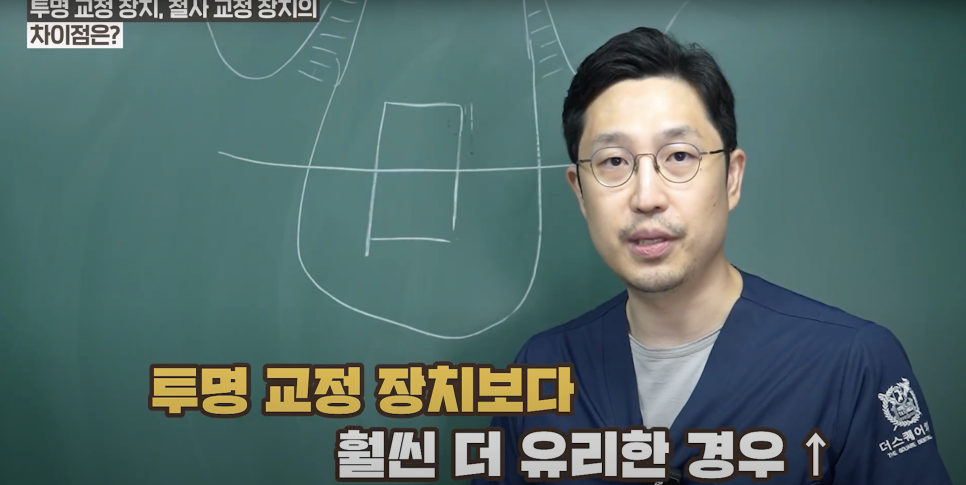
Bracket braces,
these are more suitable in the following cases:
Bracket braces are a traditional method
with a long history.
Brackets are attached to the teeth,
and wires are used to move the teeth
in the desired direction.
● When complex tooth movement is needed
→ Advantageous for precise pulling, pushing, and rotation
● When you feel that managing the appliance would be difficult
→ Because the appliance is fixed, force is applied consistently
● When cost is an important factor
→ Relatively less expensive than clear aligners
The drawbacks are that they are easily visible
and more difficult to manage.
However, in recent years,
there have also been alternatives that improve aesthetics,
such as ceramic braces and lingual braces.

We have looked at the advantages and disadvantages
of clear aligners and bracket braces respectively.
So, which appliance is right for me?
Let’s summarize it briefly by lifestyle pattern.
Guide by lifestyle pattern
● If you are highly active socially and aesthetics matter
→ Clear aligners
● If you only need simple alignment improvement
→ Clear aligners
● If complex orthodontic treatment is needed
→ Bracket braces
● If managing the appliance is difficult or you may forget to wear it out of habit
→ Bracket braces

The success of orthodontic treatment comes not from the appliance,
but from “diagnosis and consistency.”
When starting orthodontic treatment, the part patients worry about most
is the type of appliance.
However, the success or failure of orthodontic treatment is determined not by the appliance,
but by an accurate diagnosis and the patient’s consistent effort.
Whether you choose clear aligners or bracket braces,
what matters is selecting an appliance that fits your lifestyle pattern
and proceeding consistently according to the plan
through regular visits and management.
I encourage patients
not to stop at worrying only about “choosing an appliance,”
but to focus on an accurate diagnosis and managing daily habits.
That choice determines the outcome of orthodontic treatment.
I hope your orthodontic treatment becomes a process that protects not only a beautiful smile,
but also healthy teeth and gums.
Thank you.
_
Gwanghwamun The Square Dental Clinic
From Lim Jong-woo, Chief Director