One of the questions I hear most often from patients who come in for dental treatment is:
“Don’t you have to get a root canal before getting a crown?”
Many people believe this, but in fact, that is not always true.
Root canal treatment is needed selectively, depending on the condition inside the tooth, the extent of inflammation,
and how long the tooth is likely to remain usable.
Even so, due to incorrect information or past experiences,
root canal treatment is often misunderstood as some kind of required step.
Hello.
I’m Im Jong-woo, Chief Director of Gwanghwamun The Square Dental Clinic.
Today, I will explain in an easy-to-understand way what root canal treatment actually is,
when it is absolutely necessary, and when it can be avoided.

What is root canal treatment?
Because of the term “root canal treatment,” many people think
that the tooth’s “nerve” is completely removed.
In reality, the goal is not to eliminate the nerve itself,
but to remove the diseased tissue when the nerve has become infected or inflamed,
then disinfect and seal the inside of the tooth so that bacteria can no longer grow.
How the need for root canal treatment differs by cavity stage
Whether root canal treatment is needed depends greatly on how much the tooth has been damaged.
 ● Stage 1 cavity (cavity limited to the enamel)
If only the outer surface of the tooth is slightly damaged,
it can be managed by monitoring it through regular checkups.
At this stage, it has nothing to do with root canal treatment at all.

● Stage 2 cavity (cavity that has progressed into the dentin)
Pain may occur intermittently, and choosing the right treatment becomes important.
Even if the cavity is deep, if it has not reached the nerve,
it may be treated with conservative treatment such as resin or an inlay.
However, if the pain continues or the cavity has spread close to the nerve,
root canal treatment may be necessary.
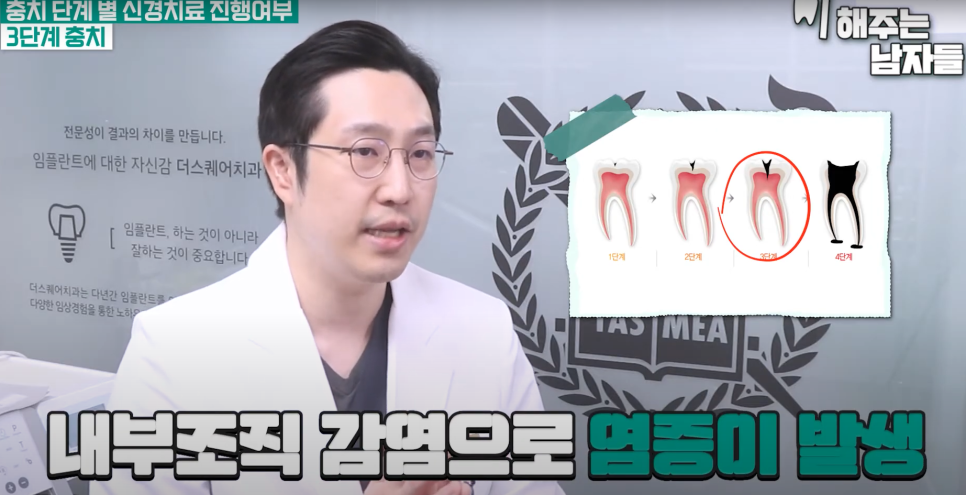
● Stage 3 cavity or beyond (pulpitis, apical periodontitis)
If the nerve tissue has been irreversibly damaged,
that is, if the nerve has reached a stage where it cannot recover on its own, root canal treatment is absolutely necessary.
In particular, if the pain is severe or the inflammation has spread to the bone,
root canal treatment becomes the only solution to avoid extraction.

There are also cases where root canal treatment can be avoided
Recently, as dental materials and techniques have advanced,
root canal treatment is not necessary in every case.
For example, there is a method called pulp capping.
This treatment is used when only part of the nerve is inflamed rather than the entire nerve being damaged,
and it involves covering the affected area with a special material (such as MTA) to preserve the nerve.
It can be attempted in younger patients or when the problem is found at an early stage,
and it helps preserve the tooth in as natural a state as possible.
However, pulp capping cannot be applied in every case,
and it can only be chosen after accurately evaluating the extent of inflammation and the condition of the patient’s tooth.

Root canal treatment is a common procedure in dentistry,
but it is neither a treatment that must always be done,
nor one that must always be avoided.
In summary, it is best to avoid root canal treatment if it can be avoided,
but when it is absolutely necessary, you should not hesitate to receive it.
That is how you can protect your tooth for as long as possible.
Rather than worrying on your own, get an accurate diagnosis at the dental clinic,
and choose the treatment method that fits your situation.
If you receive enough explanation and understand the process,
your fear of treatment will also be greatly reduced.
We will always be here to think together and help you on the path to protecting your dental health.
_
Gwanghwamun The Square Dental Clinic
From Im Jong-woo, Chief Director