In the dental treatment room,
one of the most common things I hear is,
“Do you think it’s okay if a little blood comes out when I brush my teeth?”
Many people brush off bleeding gums or
swelling as nothing serious,
but in fact, these can be important
warning signs sent by your gums.

Dental health depends not only on the teeth themselves,
but also on the gums and bone that support them.
That is why ignoring small signs can lead
to irreversible loss.
Hello,
I’m Lim Jong-woo, the chief director of
The Square Dental Clinic in Gwanghwamun.
Today,
I’d like to talk about what the gum signs
patients often experience in daily life mean,
and how to deal with them.
Three representative warning signs from your gums

- If your gums bleed every time you brush
A little bleeding for a day or two may simply be due to irritation,
but if the same area keeps bleeding repeatedly,
it is a typical sign of gum inflammation.
This happens because plaque or tartar builds up,
causing the gums to swell and the blood vessels there
to become easily damaged.
If you ignore it, the inflammation can gradually deepen
and progress to periodontal disease.
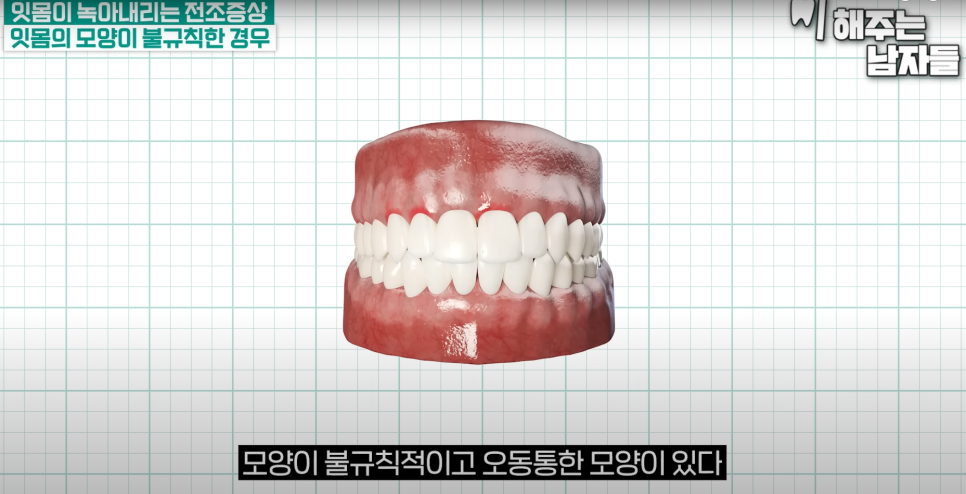
- If your gums are swollen or change shape
You should also be careful if, when you look in the mirror,
your gums are puffy
or have changed into an uneven shape.
This may be more than simple swelling;
it can be a sign that inflammation inside the gums is spreading.
In particular, if the gum color changes from bright pink
to red or purplish,
there is a strong possibility that the inflammation has already progressed.

- If your teeth feel loose
If your teeth feel loose even though you don’t have cavities,
this is one of the late-stage signs that can appear when periodontal disease
has progressed significantly,
and it may no longer be recoverable with simple scaling alone.
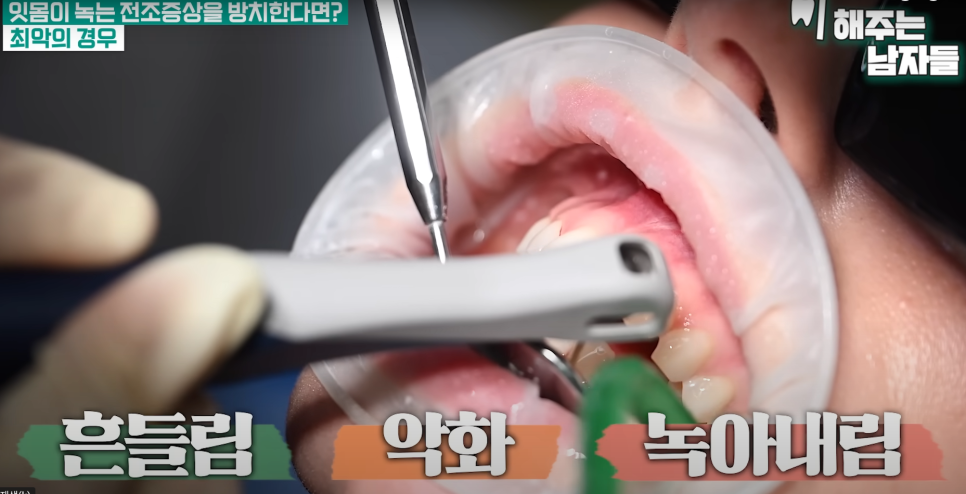
What happens if you leave these signs untreated?
In actual practice, there have been cases where a patient who had only a little bleeding
did not visit the dentist for years,
and eventually the teeth became so loose that extraction could not be avoided.
Gum disease is easier to ignore because it is not usually very painful.
But just because there is no pain
does not mean there is no disease.
In fact, periodontal disease often progresses quietly,
and by the time it is discovered,
bone loss is already significant in many cases.

What should you do when you notice these gum signs?
● Regular checkups and scaling
If you notice signs sent by your gums,
the first thing you need is a dental examination.
Scaling means more than just removing tartar.
It is the first step in removing the causes of inflammation hidden in the gums.
● Professional examination
By checking the condition of the gum bone through an X-ray examination,
you can tell whether it is simply gum inflammation
or a state in which bone loss is progressing.
It is essential to examine areas that cannot be seen with the naked eye.
● Improving daily habits
Proper brushing, using interdental brushes and dental floss,
quitting smoking, and managing stress are daily habits that
directly affect gum health.

It is most important to respond early to warning signs
sent by your gums.
Small signs from your gums are never something to take lightly.
What starts with a little bleeding or swollen gums can
eventually lead to tooth loss.
If you detect and manage it early through regular checkups and scaling,
you can keep your teeth for a long time.
Please remember this: “Healthy gums help teeth last longer.”
I sincerely wish you good gum health,
and I will always be with you through safe and reliable treatment.
_
The Square Dental Clinic in Gwanghwamun
From Lim Jong-woo, Chief Director