Hello,
I’m Lim Jong-woo, the chief director of Gwanghwamun The Square Dental Clinic.
There is a question patients often ask in the treatment room.
"If I’ve lost a few molars,
would partial dentures be better,
or would it be better to get implants?"

On the surface, it may seem like a simple choice,
but in reality, it is a matter that must take into account
not only the condition of the gums and bone,
but also the health of the neighboring teeth
and the patient’s lifestyle.
Today, I’ll explain in detail the two representative options
for when teeth are partially missing: partial dentures
and multiple implants.
Partial dentures: are they really more cost-effective?
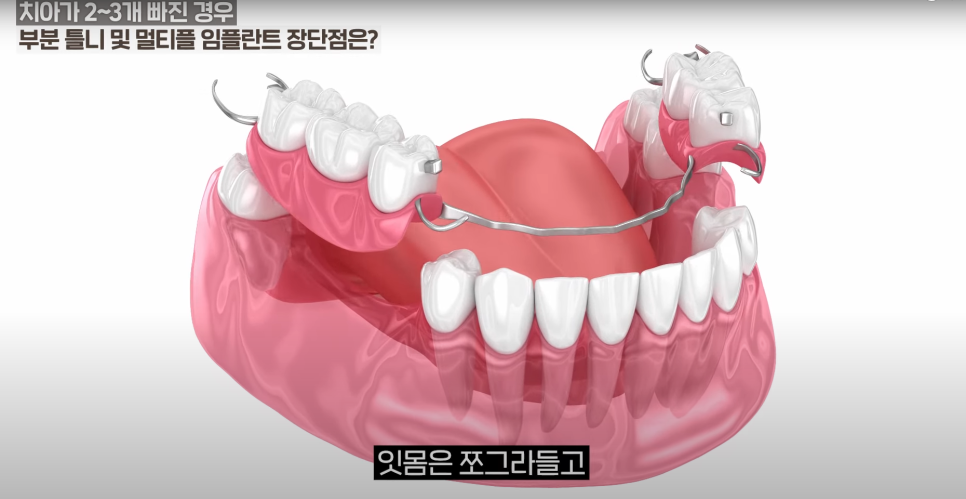
Partial dentures are used by hooking metal clasps
onto the teeth on both sides of the missing tooth.
Many people initially think this way:
"Wouldn’t this cost less than implants?"
But when we actually consult with patients,
that is not always the case.
● Advantages
○ Faster to make and relatively low initial cost
○ Can replace several teeth at once
● Disadvantages
○ Forces are transmitted to neighboring teeth, accelerating gum and bone resorption
○ Can place strain on the supporting teeth, which may shorten their lifespan
○ Uncomfortable to wear, and food can get stuck easily, making hygiene management difficult

It may seem inexpensive at first,
but in many cases the supporting teeth also need crowns.
In addition, over the long term,
neighboring teeth can weaken as well,
leading to the need for additional treatment.
Therefore, it is not accurate to say that "dentures are always cheaper."
Multiple implants: an easy way to understand them
Patients often ask in the treatment room,
"What are multiple implants?
Do you place an implant for every missing tooth?"
Multiple implants do not mean placing an implant
for every single missing tooth.
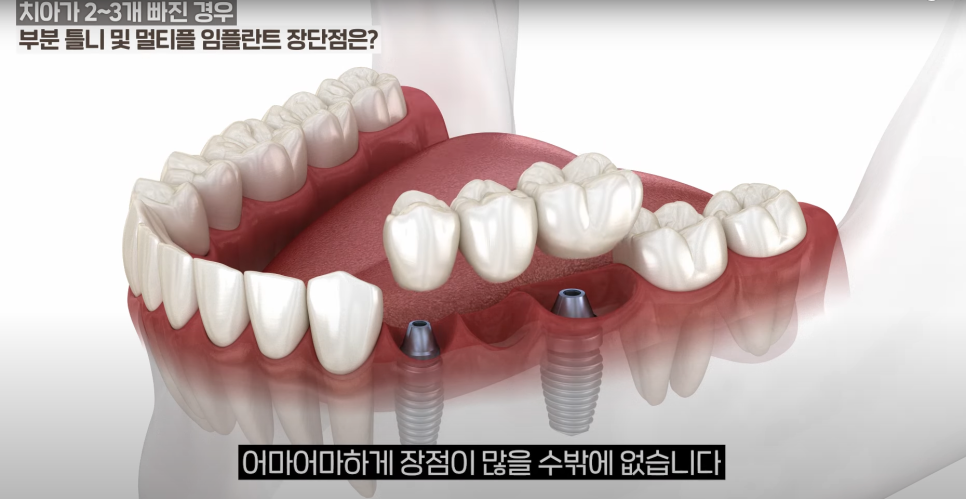
Instead, implants are placed only where needed,
like pillars, and several artificial teeth are connected above them
with prosthetics to restore the missing area.
For example, if seven teeth are missing,
we do not necessarily place seven implants.
We select only the positions where implants are truly needed
to serve as tooth roots, place three to four implants,
and connect artificial teeth on top.
To make it easier to understand,
you can think of it as an upgraded version of bridge treatment.
Multiple implant procedure
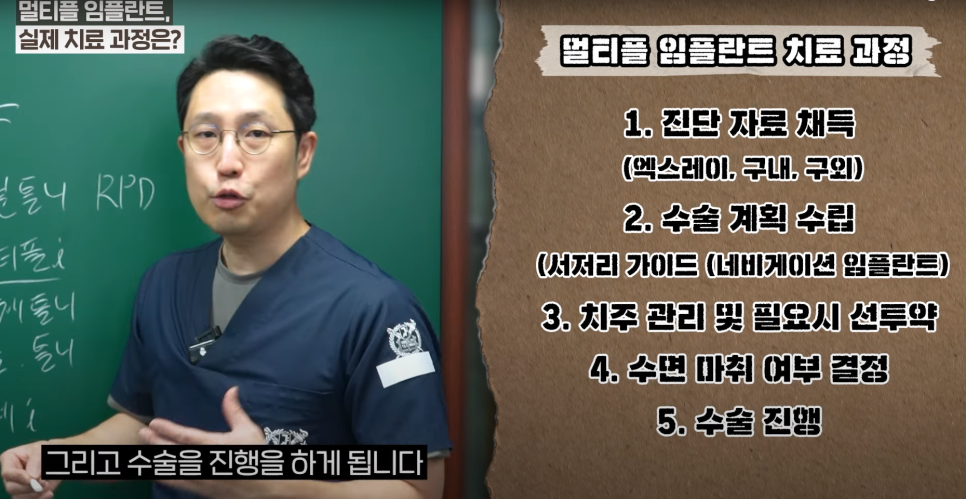
- Precise diagnosis
First, we take a CT scan and an oral scan
to carefully check the condition of the bone and gums.
This is the process of determining whether implants can be placed
by examining the thickness and density of the bone.
- Treatment plan
We simulate how many implants to place
and where to position them.
In simple terms, you can think of this as the process of first designing
where to set the pillars when building a bridge.
- Implant surgery
After local anesthesia, a small hole is made in the bone
and the implant is placed.
- Healing period
Time is needed for the implant to bond with the bone.
If bone grafting was performed, it may take longer.
- Prosthetic connection
Once the implant is firmly stabilized
and the gums have recovered,
the artificial tooth (crown) is attached.
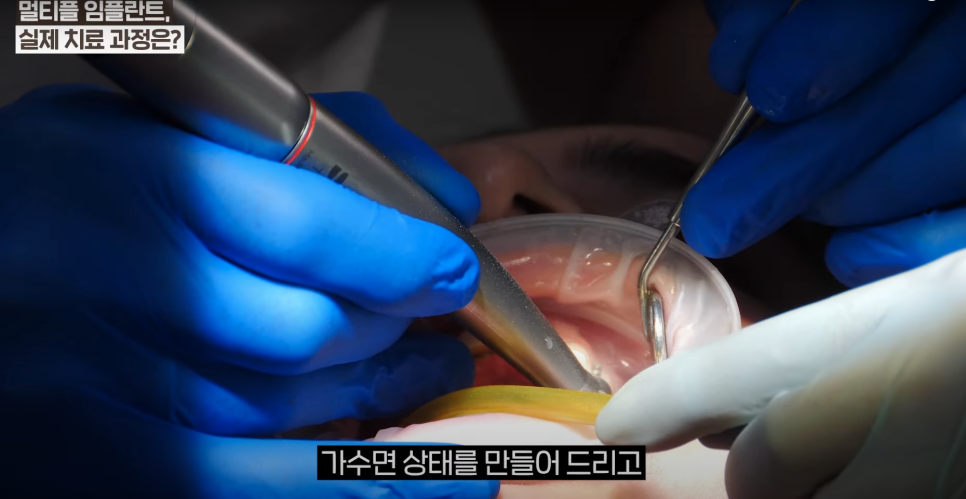
"Doesn’t it hurt during the surgery?"
Because of the anesthesia, there is almost no pain,
and there may be discomfort for a few days afterward,
but it can be controlled with medication.
If you are very afraid of pain,
it is also a good idea to have the procedure done at a clinic
that offers conscious sedation.
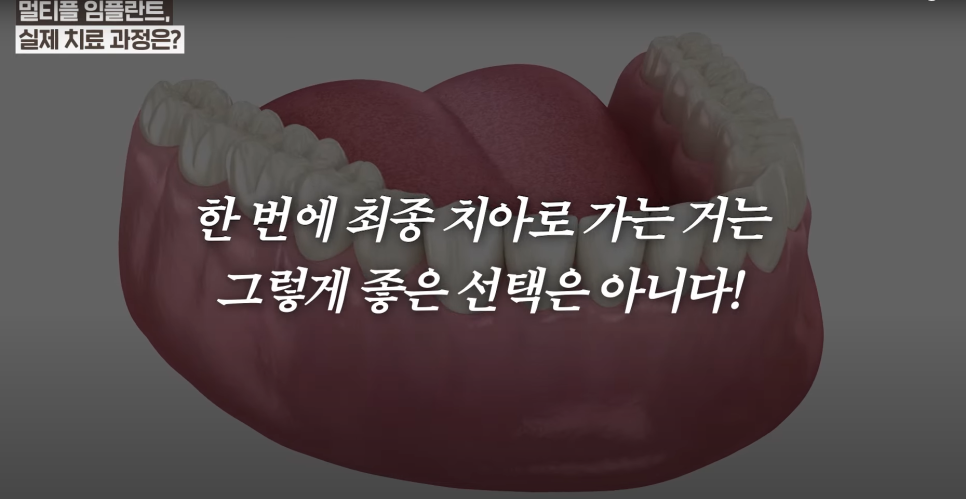
"Can I chew right away?"
Temporary prosthetics are used first,
and the final prosthetics are connected after the healing period.
Until the implant is firmly fixed in the jawbone,
you need to be careful.
"How long does it take?"
It varies depending on the location and the condition of the bone.
If the bone condition is good and it is a lower tooth, 2 to 3 months.
For upper teeth, 3 to 6 months.
If bone grafting is needed, it takes a little longer.
| Category | Partial Denture | Multiple Implants |
|---|
| Maintenance | Must be removed and cleaned daily; hygiene is inconvenient | Managed with brushing and scaling like natural teeth |
| Effect on neighboring teeth | Clasps place force on the teeth, weakening them | Does not affect neighboring teeth |
| Lifespan | May be shortened depending on the condition of the supporting teeth | Can be used for more than 10 years with proper care |
| Convenience | Feels like a foreign object; discomfort with speech and chewing | Similar to natural teeth |
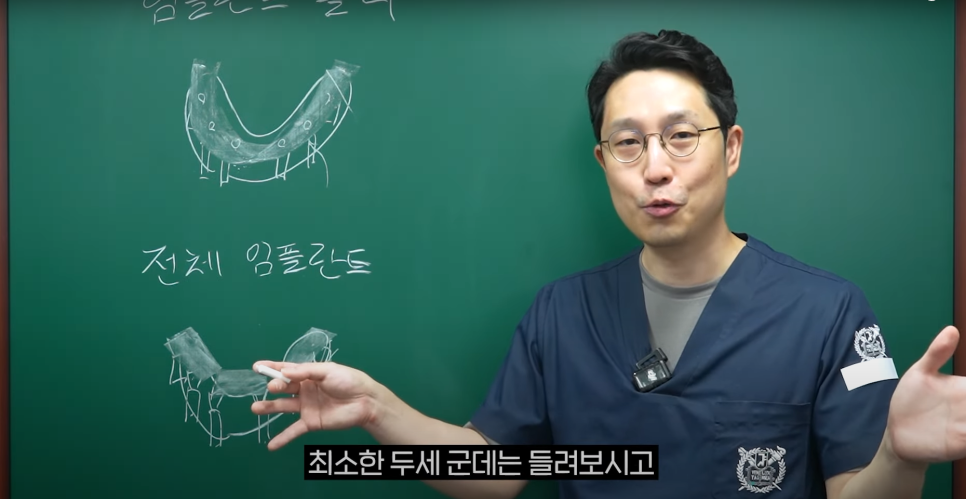 There is no single right answer for every patient
Partial dentures have advantages in terms of
initial cost and fabrication speed,
but over the long term they can place strain on neighboring teeth
and the gums.
Multiple implants provide function and aesthetics similar to natural teeth,
but they involve surgery and cost burden.
There is no single correct answer.
It is important to choose the best treatment
by considering the patient’s bone condition, gum health,
and lifestyle habits.
If possible, I recommend visiting more than one dental clinic,
getting consultations, and comparing options before deciding.
_
Gwanghwamun The Square Dental Clinic
Chief Director Lim Jong-woo