When patients come to the dentist for treatment,
one of their biggest concerns is often
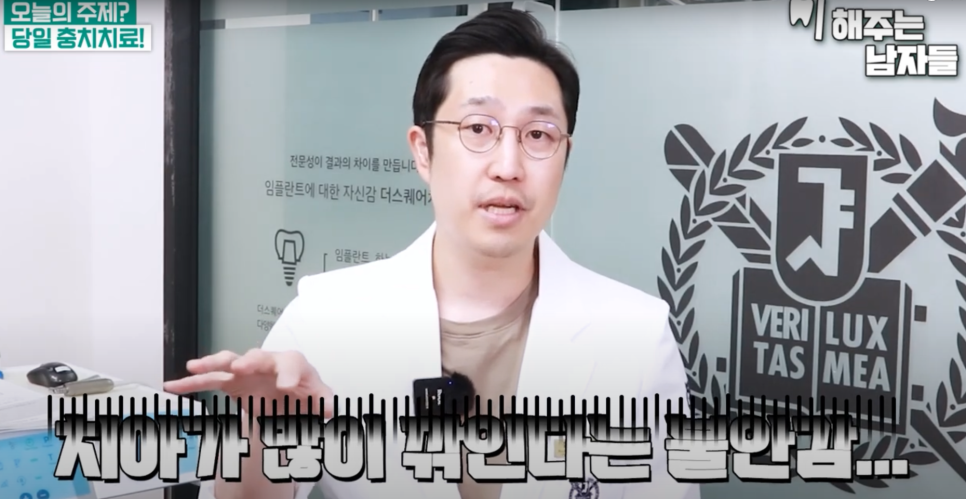
“Will a lot of tooth need to be shaved down?”
When people hear they need cavity treatment,
they often worry that
there will be extensive tooth reduction,
that they will need multiple visits,
and that their natural teeth will gradually become weaker.
Hello,
I’m Lim Jong-woo,
Chief Director of The Square Dental Clinic in Gwanghwamun.
Today, I’d like to talk about a treatment method
that can ease these concerns,
resin build-up cavity treatment,
which can be completed in a single day
while preserving as much natural tooth structure as possible.

Why does cavity treatment often involve removing so much tooth?
When a cavity becomes deep,
a restoration is needed to rebuild the tooth.
Treatments such as inlays or crowns are used,
and in these cases, it is not enough to simply remove the decay.
Healthy tooth structure must also be removed to make space for the restoration.
This process can result in far more tooth tissue being damaged
than is actually necessary to remove the cavity.
In the end, the more treatment is repeated,
the more of your own tooth is lost,
and over time this can create a cycle
of moving on to a crown or an even larger restoration.
What is resin build-up?
The “resin filling” that many people know
is commonly used to fill small cavities.
But resin build-up
is a different concept from simple filling.

As the word “build-up” suggests,
this method restores the tooth’s original shape
by layering resin one layer at a time.
Because the dentist directly recreates
the tooth’s anatomical form by hand,
this treatment goes beyond simply filling a hole
and can restore both function and aesthetics.
The biggest difference is that
tooth reduction can be minimized.
By removing only the decayed area
and preserving the remaining healthy tooth structure,
the tooth can last longer.
How is it different from conventional treatment?
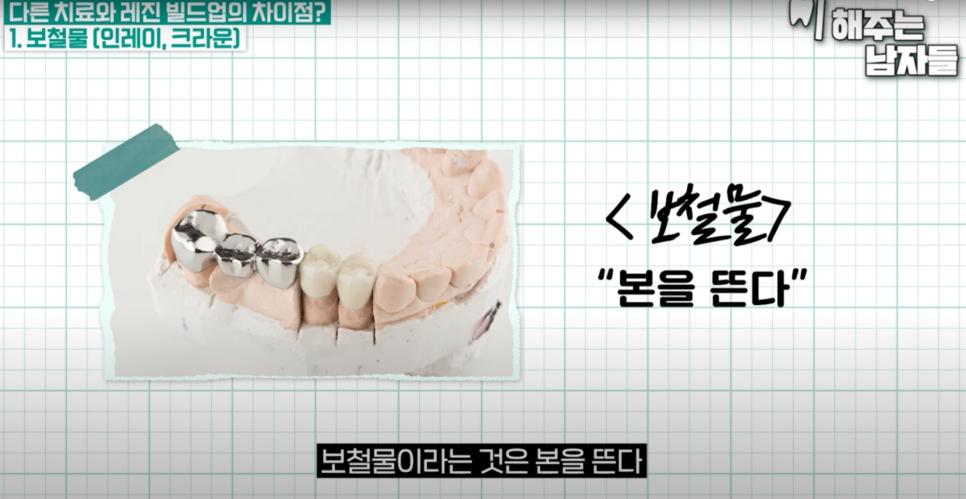
● Inlay and crown treatment
○ An impression is taken and the restoration is fabricated in a dental lab.
○ Because of the fabrication process, it usually takes more than one week.
Multiple visits are required.
○ A large amount of tooth structure is removed to fit the restoration.
● Resin build-up treatment
○ No impression is taken,
and the dentist directly restores the shape.
○ Treatment can be completed on the same day (usually about 1 hour).
○ Only the decayed area is minimally removed, maximizing preservation of natural tooth structure.
Cases seen in actual clinical practice
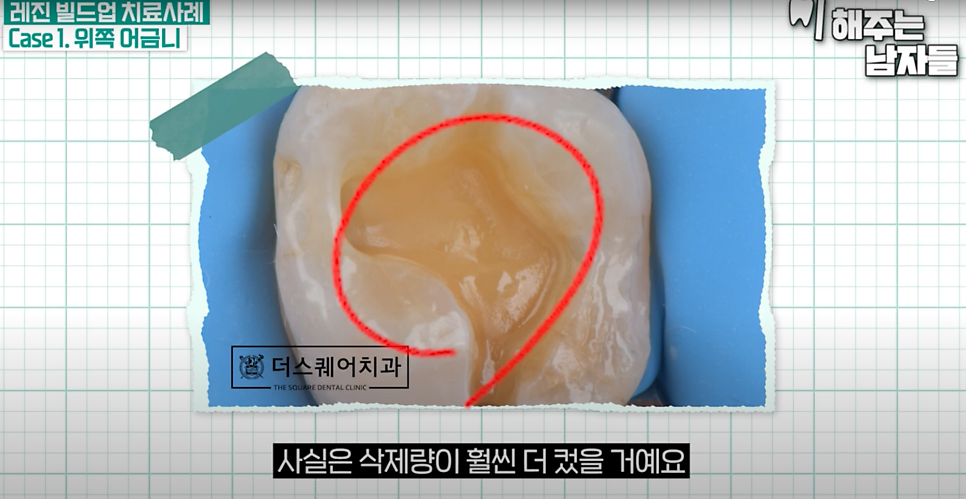
The first patient had a small cavity,
but if treated with an inlay,
the amount of tooth reduction would have been greater.
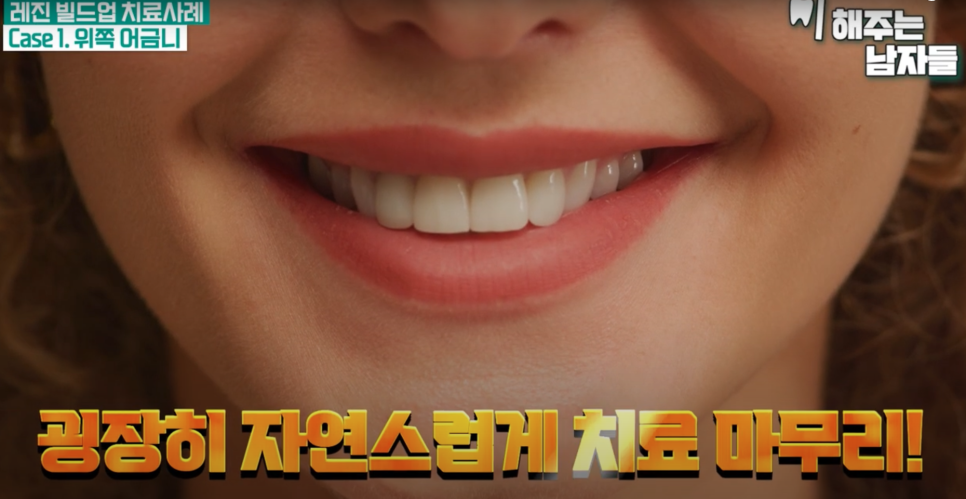
In this case, treatment was performed with resin build-up,
and the tooth’s shape was preserved
while the treatment was completed within a day.
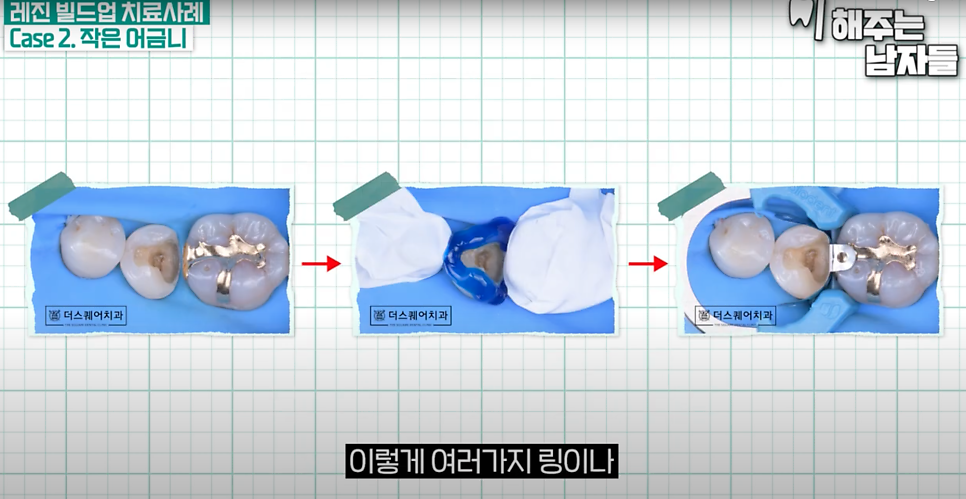
The second patient had a cavity on the side of a molar,
making shape restoration a difficult case.
However, by using various instruments and techniques
to build a wall and layer resin step by step,
the original shape and function were restored.
As such, resin build-up has the advantage of being able to carefully restore even complex areas
that are difficult to treat with a simple filling.
Frequently asked questions from patients
● Isn’t resin weak and likely to come off quickly?
→ Older resin materials did have limitations,
but with recent advances in materials and bonding techniques,
strength and durability have improved greatly.
When applied properly,
they can be used stably for a long time.
● Is resin build-up possible for all cavities?
→ No, it is not.
If tooth damage has spread extensively in all directions
or if root canal treatment is already needed,
a crown may be more appropriate.
Therefore, an accurate diagnosis and selection are necessary.
● Is the treatment very uncomfortable afterward?
→ There may be a slight foreign-body sensation immediately after treatment,
but in most cases,
after about a week,
the tooth adapts naturally, just like your original tooth.
The most important principle for protecting teeth
The most important thing in cavity treatment is
“how much natural tooth can be preserved?”

Resin build-up is not a universal treatment
that can be applied in every case,
but there is no doubt that it is a useful method
that minimizes tooth reduction
and can complete treatment in a single day.
Once a tooth is removed,
it does not come back.
Therefore, it is most important to detect problems early
and treat them as conservatively as possible.
We recommend that you discover cavities early
through regular dental checkups
and choose the appropriate treatment method
depending on the situation.
The Square Dental Clinic in Gwanghwamun
From Lim Jong-woo, Chief Director