Hello,
I am Jong-woo Lim,
Chief Dentist at
Gwanghwamun The Square Dental Clinic.
Sometimes your gums bleed when you brush your teeth,
or you may feel that the spaces between your teeth
have become wider than before.
You may dismiss it by thinking,
“It must be because I’m getting older,”
but various causes may be hidden behind these changes.
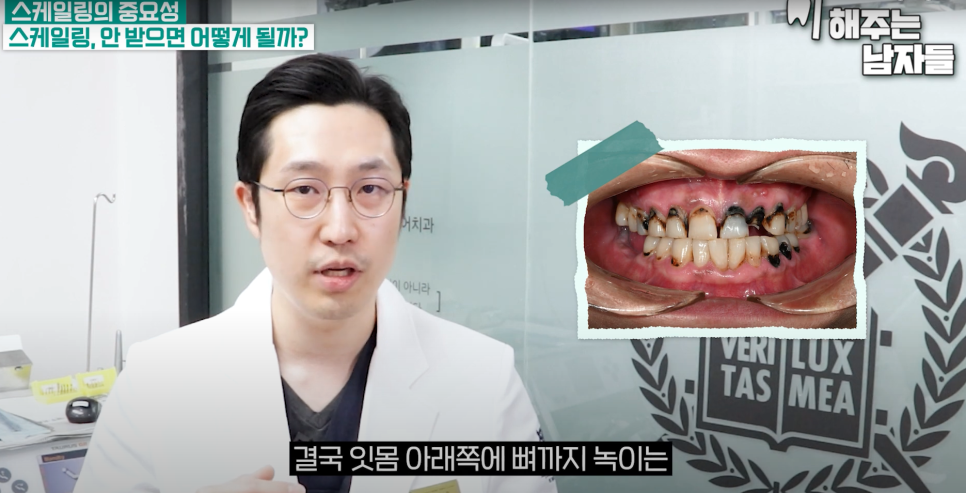
There Is More Than One Reason Gums Become Weaker
The causes of shrinking jawbone may include
aging,
or systemic conditions such as diabetes
and osteoporosis may also have an effect.
However, in many cases,
long-standing tartar buildup
and inflammation are behind it.
The problem is that this inflammation
progresses very slowly without causing pain.
As a result, most patients
do not notice any discomfort
and only visit the dentist after their teeth become loose
or their gums recede.

Traces of Bacteria That Cannot Be Seen
Every time we eat,
a bacterial film called dental plaque forms on the surface of our teeth.
If this plaque is not completely removed,
it combines with minerals in saliva
and hardens into tartar.
Although tartar appears hard,
it contains many tiny pores,
allowing bacteria to survive inside it.
These bacteria irritate the gums,
cause inflammation,
and eventually gradually destroy the bone that holds the teeth in place
(the alveolar bone).
The disease that develops in this way
is periodontitis.
Because damaged jawbone does not naturally grow back,
early management is especially important.

Scaling Is Treatment, Not Just Cleaning
Scaling is not simply a procedure
that cleans the teeth.
It is a treatment process that removes
hard, firmly attached masses of bacteria,
helping the gums breathe again.
Ultrasonic instruments
are not tools that shave down the teeth.
They are devices that separate tartar
using tiny vibrations.
The surface of the teeth is made of enamel,
the hardest substance in the human body,
so scaling does not damage it.
If your teeth feel sensitive after scaling,
or your gums seem to have receded,
this is only a temporary reaction
that occurs as previously swollen gums settle down.
It usually stabilizes after a few days.

Don’t Put It Off—Think of It as Maintenance
The rate at which tartar forms varies from person to person.
Because it depends on the amount of saliva,
brushing habits,
and tooth alignment,
the interval between regular scaling appointments
should be tailored to each individual.
The National Health Insurance coverage for scaling once a year
does not mean,
“Have it done only then.”
It means,
“At the very least, be sure to have your teeth checked once during that time.”
Teeth are hard,
but the gums and bone that hold them in place
are delicate and sensitive.
The fact that they gradually deteriorate without causing pain
is the most significant characteristic of this disease.
Scaling is not a treatment that repairs
a problem that has already developed.
It is a preventive process that helps keep
the gums from getting worse.
With regular care and attention,
you can use your teeth for much longer
and with much greater comfort.
Regular care and small acts of attention
are the surest way to keep your teeth for a long time.
Gwanghwamun The Square Dental Clinic
Chief Dentist Jong-woo Lim